The third lever
Monetary, fiscal, migration. How the US recession was averted, 2022-2023.
27 Nov 2023
5 minutes
Watch Philip and Sahil share their thoughts on the outlook for 2024 and where investors should position for the next cycle.
Initial US dollar weakness reversed as the resilience of the US economy became clear. Continued strong consumer demand and looser fiscal policy more than offset manufacturing sector weakness. As a consequence, corporate earnings held up and equities rebounded, led by the so-called magnificent seven1. At one point, commentators were making the case for a new bull market. At the time of writing, bond markets are on track to record a third year of negative returns, adding up to one of the most severe bear markets on record.
Geopolitics remained fraught. The Ukraine conflict showed no signs of ending. China continued to flex its muscles over Taiwan and in the South China Sea, and America tightened restrictions on trade in key technologies. In a tragic turn of events, hopes for a more stable Middle East were dashed.
The key macro debate revolves around the degree to which the dramatic reset in borrowing costs will impact the US, Europe and associated economies. The consensus appears to be for benign growth and inflation outcomes, rapid earnings growth and mild-to-no credit issues, leading to a modest US interest-rate cutting cycle. We agree inflation will continue to slow in the near term. But we think the price to be paid for the shift into a new interest-rate regime is higher, particularly in terms of growth, and that the macroeconomic risks are to the downside.
In the coming year, inflation could fall quite quickly, close to central-bank targets. In some cases, as in Europe, it may even undershoot. Consequently, interest rates are probably at or near their cyclical peaks. However, barring an event of some kind, official rates are likely to remain elevated until economic stress becomes more evident.
Monetary tightening typically works with a lag of 12-18 months, which means the impact of the July 2023 rate hike will still be playing out in July 2024. The economic strength seen thus far has been the result of excess savings built up during the pandemic and the subsequent resilient income growth and fiscal expansion that have elongated this process. Policy tightening will continue to push against this. Europe has probably already overtightened. We therefore think the probability of a soft landing is overstated.
The other major macro issue concerns China. Deliberate policy tightening to address the imbalances of China’s growth model of the past three decades, and its residential property sector in particular, have had a material impact on the economy.
China remains in a multi-year transition to a more domestically driven, higher value-add economy. The leadership is highly incentivised to ensure this transition proceeds apace, which requires adequate nominal growth. Recent supportive measures to achieve this include fiscal and monetary loosening, as well as steps to improve business confidence. On balance, we think domestic consumption growth will stabilise, in turn supporting global growth. The result could tail previous recoveries. In a way, that is the point – a transition to a new, more stable, lower equilibrium level of growth.
A stronger China would support developing economies. They are already benefitting from having tightened policy to counter inflation before their developed-world counterparts. Their central banks have emerged with more credibility from the last few years, and in many cases their macroeconomic fundamentals are in the best shape in years. Brazil is a good example. Its trade account is extremely healthy and inflation is falling, providing ample scope for real interest rates to decline from the current high levels.
Chinese commodity import volumes for oil, iron ore and copper ore, rebased to 100

Source: Ninety One, Bloomberg, as at 31 October 2023.
Chinese exports to the Global South vs. to the US, Europe and Japan

Source: Ninety One, Bloomberg. Please note that this chart has been redrawn by Ninety One.
1. Alphabet, Amazon, Apple, Meta, Microsoft, Nvidia and Tesla.
Financial markets often confound the consensus view and 2023 was no exception. The much-anticipated recession failed to arrive, at least in the US. Expectations for a powerful Chinese post-COVID recovery foundered. Meanwhile, confronted with stubborn inflation, developed-world central banks continued to raise interest rates aggressively.
Initial US dollar weakness reversed as the resilience of the US economy became clear. Continued strong consumer demand and looser fiscal policy more than offset manufacturing sector weakness. As a consequence, corporate earnings held up and equities rebounded, led by the so-called magnificent seven1. At one point, commentators were making the case for a new bull market. At the time of writing, bond markets are on track to record a third year of negative returns, adding up to one of the most severe bear markets on record.
Geopolitics remained fraught. The Ukraine conflict showed no signs of ending. China continued to flex its muscles over Taiwan and in the South China Sea, and America tightened restrictions on trade in key technologies. In a tragic turn of events, hopes for a more stable Middle East were dashed.
The key macro debate revolves around the degree to which the dramatic reset in borrowing costs will impact the US, Europe and associated economies. The consensus appears to be for benign growth and inflation outcomes, rapid earnings growth and mild-to-no credit issues, leading to a modest US interest-rate cutting cycle. We agree inflation will continue to slow in the near term. But we think the price to be paid for the shift into a new interest-rate regime is higher, particularly in terms of growth, and that the macroeconomic risks are to the downside.
In the coming year, inflation could fall quite quickly, close to central-bank targets. In some cases, as in Europe, it may even undershoot. Consequently, interest rates are probably at or near their cyclical peaks. However, barring an event of some kind, official rates are likely to remain elevated until economic stress becomes more evident.
Monetary tightening typically works with a lag of 12-18 months, which means the impact of the July 2023 rate hike will still be playing out in July 2024. The economic strength seen thus far has been the result of excess savings built up during the pandemic and the subsequent resilient income growth and fiscal expansion that have elongated this process. Policy tightening will continue to push against this. Europe has probably already overtightened. We therefore think the probability of a soft landing is overstated.
The other major macro issue concerns China. Deliberate policy tightening to address the imbalances of China’s growth model of the past three decades, and its residential property sector in particular, have had a material impact on the economy.
China remains in a multi-year transition to a more domestically driven, higher value-add economy. The leadership is highly incentivised to ensure this transition proceeds apace, which requires adequate nominal growth. Recent supportive measures to achieve this include fiscal and monetary loosening, as well as steps to improve business confidence. On balance, we think domestic consumption growth will stabilise, in turn supporting global growth. The result could tail previous recoveries. In a way, that is the point – a transition to a new, more stable, lower equilibrium level of growth.
A stronger China would support developing economies. They are already benefitting from having tightened policy to counter inflation before their developed-world counterparts. Their central banks have emerged with more credibility from the last few years, and in many cases their macroeconomic fundamentals are in the best shape in years. Brazil is a good example. Its trade account is extremely healthy and inflation is falling, providing ample scope for real interest rates to decline from the current high levels.
Chinese commodity import volumes for oil, iron ore and copper ore, rebased to 100
Source: Ninety One, Bloomberg, as at 31 October 2023.
Chinese exports to the Global South vs. to the US, Europe and Japan
Source: Ninety One, Bloomberg. Please note that this chart has been redrawn by Ninety One.
1. Alphabet, Amazon, Apple, Meta, Microsoft, Nvidia and Tesla.
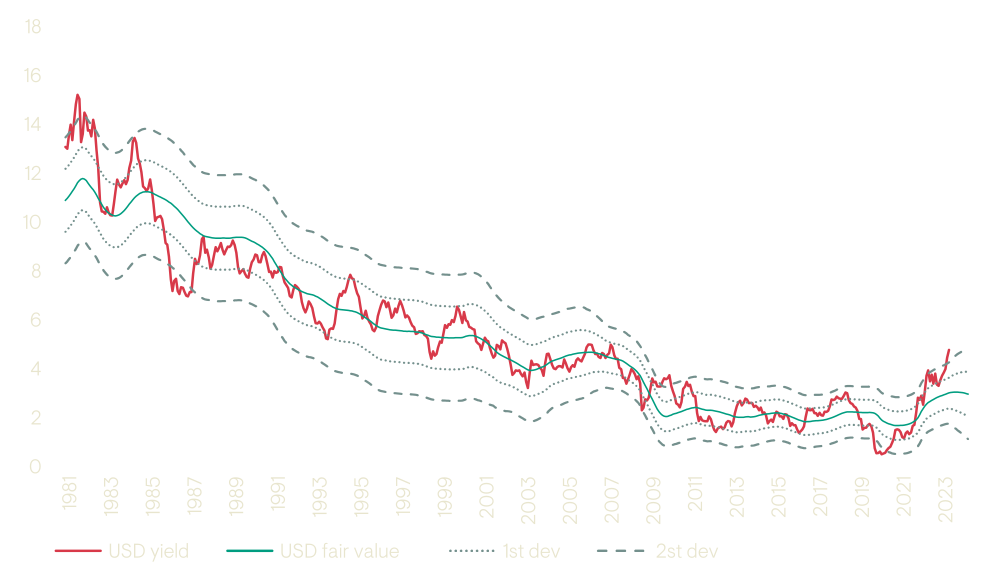
The bear market in bonds has been brutal. From a trough of 0.31% in early 2020, 10-year US Treasury yields have risen as high as 5%. The total return has been -26%. The loss on 30-year bonds has been 50%. Real long-term interest rates, which reached an extraordinary -1.2%, have rebounded to c.2.5%. The return of a positive term premium – the compensation investors require to buy longer duration assets – adds to the evidence that we may be near a secular inflection point. It looks as though the long bond bull market, in place since the early 1980s, has run its course and that we are experiencing a material reset in the cost of capital.
Bear markets are processes of discovery. We will learn the right level for bonds in due course. For now, it is highly likely that developed market bond yields are at or near cyclical peaks. For the first time since the 2008/2009 Global Financial Crisis (GFC), bond valuations in the US and Europe are competitive relative to other asset classes – provided inflation rates remain moderate, which we expect. Barring an event, the US Federal Reserve Board is likely to keep official rates on hold until inflation has been genuinely tamed. As things stand, significant relief for US bond markets on this front seems some way off. But the probability of it materialising should increase as 2024 progresses. To be clear, developed market bonds offer a tactical opportunity which will not signal a return to the prior ‘post-GFC’ inflation and interest-rate regime.
US 10-year yields vs. fair value
Source: Ninety One, Bloomberg, as at 31 October 2023.
By contrast, sharply falling inflation in Europe suggests more emphatically a peak in rates. Economic weakness is palpable in Europe. Eurozone GDP contracted in Q3 2023, with growth of just 0.1% year-on-year. The European Central Bank (ECB) has aggressively raised interest rates and run down its balance sheet by 19% of GDP, compared to the US Federal Reserve’s 8%. It is no surprise that we are seeing a strong transmission of monetary policy into European GDP trends. However, the recent run-up in US bond yields has spilt over to Europe, further tightening financial conditions at a time when the economy is at a standstill. While the ECB insists on keeping monetary policy as tight as it is, the economic risks in Europe will continue to mount. Defensive bonds look attractive.
Quantitative easing and ‘zero rates’ were never an option at scale for many emerging markets. Consequently, their response to COVID was much more fiscally conservative than developed economies. They are benefiting from that now.
To generalise, the emerging markets debt story in 2023 is as follows: positive fundamentals, falling inflation and high real interest rates have resulted in relative resilience in the face of the duration bear market and a strong US dollar.
Despite disappointing Chinese growth, net flows into emerging markets have remained positive since 2020. More stable foreign direct investment inflows have accounted for 60% of balance-of-payments funding, compared with 20% for portfolio inflows. Commodity-producing nations in particular have benefitted from the fact that commodity prices have generally remained firm. Their relative macro stability has resulted in steady capital inflows as other countries have sought to secure supply chains. New sources of industrial demand play into the hands of many emerging market countries, which are in fundamentally better shape than in previous times of stress in developed markets. An increasing trend of intra-regional trade has also broadened their sources of demand and reduced their sensitivity to developed markets.
Declining inflation will allow interest rates to fall in many emerging economies, providing opportunities in duration. This dynamic would be boosted by an inflection in US interest rates, which would reduce the risk to emerging market currencies as they progress on their easing cycles. We see Latin American economies such as Brazil and Colombia benefitting most, given their still very high real rates, positive inflation dynamics and solid external balances.
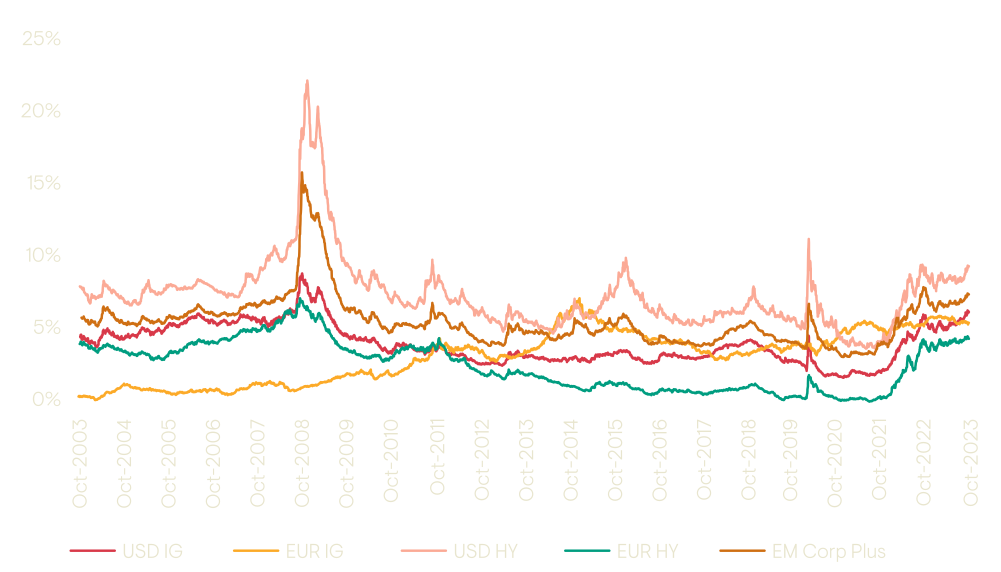
Credit has experienced a bear market in duration over the past year as developed market sovereign bond yields have risen. At the same time, continued low default rates and sharply reduced issuance have narrowed credit spreads. Where we are now is that nominal yields are back to levels last seen in 2009.
In our view, credit offers competitive prospective medium-term absolute and risk-adjusted returns compared to other asset classes. However, a weaker economic environment, and the reset in the cost of capital, are likely to increase default rates and consequently widen spreads in 2024.
This is particularly true in the high-yield sectors, which are discounting a continuation of a benign default cycle. Hence, we favour an approach focused on short duration and high carry for the time being, with the potential to extend credit duration were spreads to widen materially or cyclical conditions start to improve.
Dispersion within this asset class has been low in recent years. But it increased significantly in 2023, presenting opportunities for selective investors. We see interesting potential in specialist segments such as bank senior and subordinated debt, as well as structured credit, where we believe investors are overcompensated for credit risk compared to traditional high-yield and investment-grade corporate bonds. Generally, selectivity becomes more important as default rates rise and higher funding costs challenge weaker borrowers.
In emerging market corporate debt, investment-grade bonds (adjusted for liquidity) do not look especially cheap relative to developed market investment-grade bonds. However, it is worth noting that bottom-up credit quality – in terms of credit-rating trajectories and lower leverage – continues to be robust. Below the ‘single A’ category, dispersion is higher and these bonds have been more sensitive to headline risks. This has created plenty of potentially exploitable mispricings for those prepared to assume the broader risks.
Yield trends in US and European investment-grade and high-yield bonds, and EM corporates
Source: Ninety One, Bloomberg, as at 31 October 2023. USD HY = ICE BofA US High Yield Constrained Index; EUR IG = ICE Bof A Euro Investment Grade Contingent Capital Index; USD IG = ICE BofA US Corporate Index; EM Corp = ICE BofA Emerging Markets Corporate Plus Index; EUR HY = EUR ICE BofA Euro Corporate Index. For further information on indices, please see the Important information section.
The double-digit return on the S&P 500 Index in 2023 to date might make people forget that we remain in a bear market. Yet the US equity benchmark has still to regain its December 2021 high. In any case, this has been a low-quality rally, driven by a mixture of two things.
The first is composition. The larger technology and communication-services index constituents (dominated by Alphabet and Meta) effectively generated the returns. Both of these sectors had suffered disproportionately in 2022. The second is narrative, centred on the transformative potential of artificial intelligence.
The stock market’s winners always drive a disproportionate amount of a benchmark’s return, but this is extreme. The Nifty Fifty, the large-cap darlings of the 1960s and 1970s, were more than seven times as numerous. A truer story is probably told by the lacklustre returns on an equally weighted S&P 500 Index, the smaller-capitalisation US indices such as the Russell 2000, and ex-US global equity indices. They all highlight how narrow this rally has been.
Earnings have actually held up better than was expected coming into 2023, helping to bring valuations down. The forward price-to-earnings (PE) ratio of the S&P 500 Index has fallen from 22.5x at the market’s peak in 2021 to c.18x currently, though this is arguably still elevated given the radical change in the cost of capital. US mid- and smaller-capitalisation stocks at the time of writing have considerably less demanding forward PE ratios of 12.2x and 11.4x, respectively.
Leaving aside unforeseen events, the performance of developed equity markets in 2024 will be significantly impacted by the trends in inflation and economic growth in the US. As outlined earlier, we believe growth is likely to be progressively impacted by higher interest rates and a much tighter credit environment. Although this should help on the inflation front, it would not be good for corporate earnings. This will also be the year where companies begin to return in greater numbers to the bond markets as the debt raised prior to 2022 increasingly needs to be rolled, at substantially higher levels. Macro negatives would in all probability snuff out recent ‘bottom-up’ expectations of a pick-up in the latter. Much hope is riding on the US consumer’s ability to muddle through. It is also difficult to be positive about US corporate margins, which have benefitted from low interest and tax rates since the GFC.
The impacts of the change in market regime are clearer in Europe, where economies have already slipped into recession and inflation is falling rapidly. Japan could buck the negative trend, especially if the Chinese economy remains on a steady recovery trajectory. The ending of yield-curve controls, an extraordinarily competitive yen and scope for private-sector re-leveraging all suggest that secular factors have become more supportive.
The good news for medium- to longer-term investors is that there is now a lot of value dispersion within and across markets. Out-of-favour sectors (such as banks and energy-transition stocks) and regions (such as Europe and China) have aggressively de-rated. Even ‘defensive’ stocks such as utilities and consumer staples have seen their traditional characteristics undermined by rising rates.
Significant value dispersion is also evident among equity styles. Large-cap growth equities have re-rated, largely driven by the AI narrative around a narrow group of mega-cap US tech stocks. Valuation support also remains in many cases for more resilient quality ‘compounders’ (quality companies that can sustain strong and steady growth). Should macro conditions deteriorate and interest rates stay higher for longer, their attributes – such as earnings resilience and balance-sheet strength – would be even more highly prized.
Were rates to peak, traditional defensive and healthcare stocks have significant scope to recover. Meanwhile, ‘value of value’ as a style is trading at an historically extreme discount to growth and quality, and to the overall market. Looking ahead, market weakness on growth concerns, which are already partly discounted, should provide useful entry points into diverse areas with interesting long-term potential. Among them, natural-resources equities stand out, many of which are being positively impacted by the structural energy-transition trend.
Emerging market (EM) equities have been in a 13-year bear market relative to developed market stocks. That has left the former at a 20-30% long-term discount to the latter. We think the bottom is in sight, though to enjoy the next EM bull market, we first have to pass through the gathering macro storm we discussed earlier.
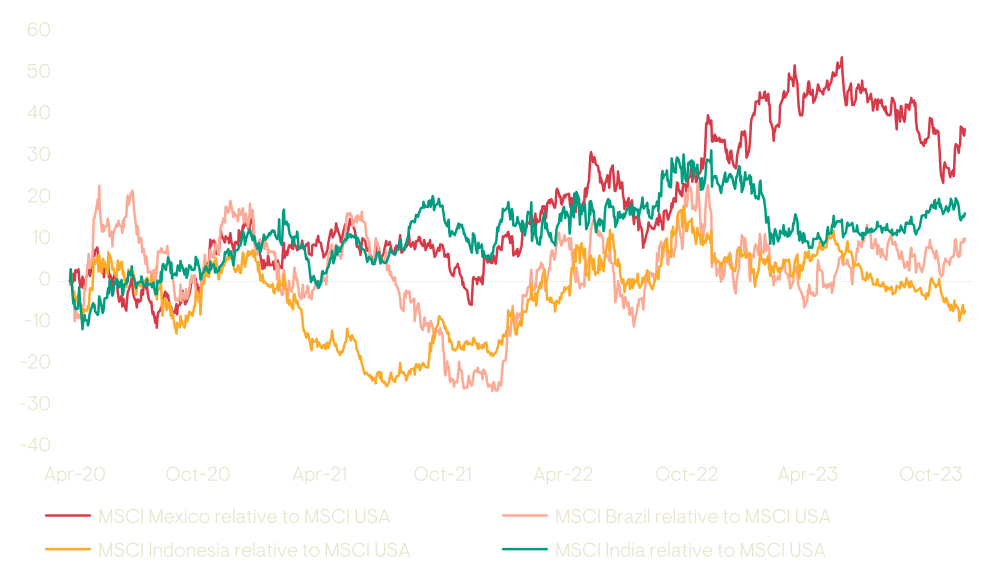
Why might the bottom be in sight? First, some emerging markets, like Mexico, Vietnam and India, are already starting to win big in the new multi-polar world economy. The chart below shows that a few EM stock exchanges have significantly outperformed the US since 2020, which we think partly reflects this. Second, if as expected the US economy continues to weaken, upward pressure on the US dollar will likely end. EM equities tend to outperform sharply in periods of US dollar weakness, because of the impacts on credit and trade in emerging markets.
Third, domestic currency strength would aid policy easing by EM central banks, and cutting interest rates would transform business investment in emerging markets. Fourth, with policy ‘normalising’ in developed markets and policy easing in emerging markets, the 15-year advantage of rock-bottom interest rates enjoyed by developed market companies will fade. Finally, EM equities are an early-cycle asset class and tend to perform strongly as the world recovers from a recession. After the long famine, the feast beckons.
By region, we think Latin American equities should continue to be buoyed by falling interest rates. We also see opportunity in China. The headwinds from policy opacity in Beijing and from significant structural change are priced in. But the tailwinds from a Chinese cyclical recovery are not, even though China’s authorities are highly incentivised to, and capable of, delivering one.
By industry, some large technology companies in emerging markets (falling not only within the IT sector, but within consumer discretionary and communication services too) have strong return potential. Separately, parts of the industrials sector will benefit from a strong investment cycle in the Middle East, as well as investment in the resilience of supply chains and the energy transition.
Investors should also pay attention to changing emerging markets risk characteristics over the coming year. In many investors’ mental models, emerging markets are riskier than developed markets, reflected in the former’s higher beta during market stress. However, EM equities have in fact exhibited lower beta and volatility than developed market assets in recent years. If geo-economic multipolarity further reduces the correlation of EM companies’ underlying cashflows, developed market investors may need a new narrative.
US vs. select EM equity returns since 2020
Source: Ninety One, Bloomberg, as at 31 October 2023.
Gold has had a remarkable year, holding its own against the US dollar and rising in terms of most other currencies despite sharply higher real interest rates. (The gold price unusually moves inversely to interest rates). The precious metal is now trading at an extreme vs. real long-term interest rates. The question is whether this is all driven by the spike in geopolitical risk (a ‘war premium’) or are other factors at work that could sustain a bull market in gold.
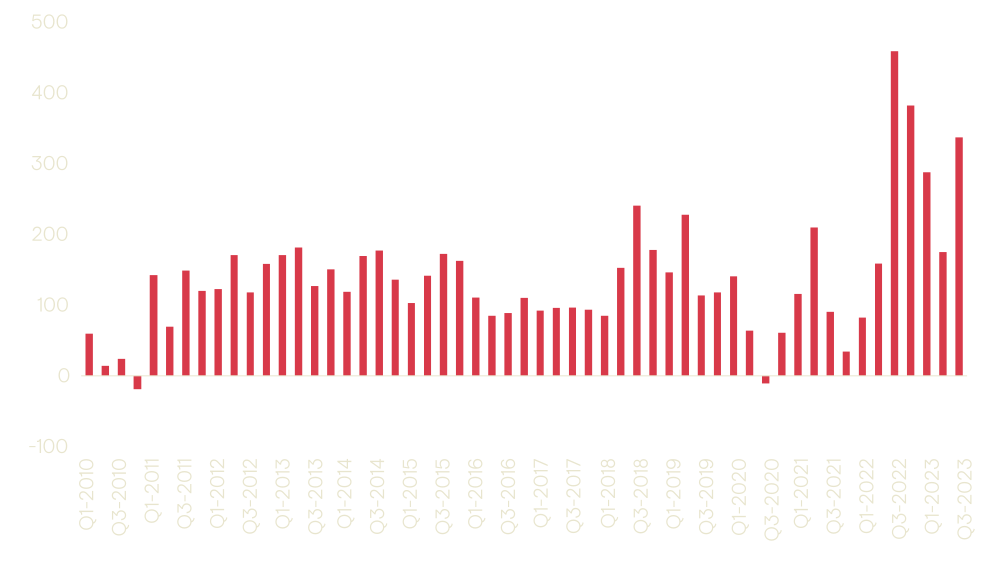
The bull case is supported by the fact that geopolitical risk is likely to remain elevated. Even if current conflicts moderate, the contest between America and China will continue. Also, US sanctions on Russia have highlighted the risk of holding too many US dollar-denominated assets, leading many countries to buy gold to diversify their reserves. Central-bank buying hit a record in 2022, remained strong in 2023 and we see no reason for this trend to reverse in the next few years. It is further supported by emerging countries having bolstered exchange reserves and now actively seeking to diversify their holdings.
Finally, gold’s appeal as a means of capital preservation has been rising across the developing world. As yet, gold has not regained its place as a standard portfolio diversifier in the developed world, but it could if faith in the typical 60:40 equity/bond portfolio continues to erode, and greater diversification of assets is once again sought. Gold-mining stocks, traditionally a geared play on the metal itself, have actually lagged gold’s recent rise. But they should benefit if gold remains well supported.
Central-bank quarterly gold purchases (tonnes)
Source: Ninety One, World Gold Council, as at October 2023.
Growth in demand for industrial metals is likely to slow or even decline in the first half of 2024. Most metals look adequately supplied, with some in over-supply. Prices are therefore likely to remain under pressure, all else equal. However, low inventories for many metals have supported prices in this cycle and should prevent steep falls. Longer term, the demand outlook remains buoyed by the intensive resource requirements of the energy transition. Notwithstanding the generally more constructive supply-and-demand picture, mining stocks have underperformed as investors have shunned cyclical assets. In 2024, we favour the diversified miners over more focused energy-transition plays, given shorter-term supply considerations in the likes of copper and lithium.
The oil price made a round-trip in 2023. Having traded from US$90 per barrel down to the ‘low-seventies’ over the first half of the year, it has moved back around the US$80 mark as we write. Expectations for over 2 million barrels/day of demand growth have remained constant. What changed was the scale of Saudi Arabian production cuts. There does not appear to be much of a geopolitical premium in the oil price. Previous conflicts in the Middle East have seen much sharper short-term price action.
Looking ahead, oil demand growth is forecast at c.1 million barrels/day. China is again the swing demand factor, although Indian oil trends now need to be watched carefully. On the supply side, whether Saudi Arabia can retain control of the oil market in 2024 will depend to a large degree on whether US shale responds to oil at US$80-100/barrel. We expect independent US shale producers to remain more disciplined and cost-conscious than in the 2010-2014 cycle. That could result in OPEC+ producers enjoying the best of both worlds: higher prices and higher volumes, along with the geopolitical leverage that bestows.
In the energy sector, 2023 was a year of consolidation. Two of the largest independent producers, Pioneer Natural Resources and Hess, were bought by industry giants ExxonMobil and Chevron, respectively. The US supermajors have set out their stalls, and will look to harvest industry- leading assets in the Permian (Pioneer) and Guyana (Hess) over the next 20 years. We still prefer the more diversified European oil majors, as well as independent US refiners.
When the US dollar hit its lows in July, a predictable flurry of ‘de-dollarisation’ commentaries made the case for further weakness in the American currency. Since then, the greenback has risen relentlessly, supported by US economic resilience and a hawkish Federal Reserve Board.
The US dollar is now close to its bull-market highs of January 2022. Other currencies have struggled. The Japanese yen recently recorded its lowest exchange rate against the US dollar in nominal terms for 33 years. The Chinese renminbi is down to levels last seen in 2007. As an asset, the US dollar has continued to display defensive qualities. But on a longer view, its valuation appears very extended. This is clearly a crowded trade. The US dollar’s weakness in the early part of 2023, although premature, serves as a pointer for what could happen when US rates eventually inflect.
Meanwhile, the eurozone is experiencing an unfolding recession and inflation is falling rapidly. This points emphatically to an earlier policy response from the ECB; however, we see the risk of a policy mistake with rates held too high for too long. Both scenarios point to further downside risks to the euro. Although somewhat behind the eurozone, especially in terms of inflation, the UK is in a similar position, rendering the British pound vulnerable. In contrast, the Japanese yen looks interesting: apart from Japan’s currency being abnormally cheap, the country’s central bank is backing away from yield-curve control and allowing rates to adjust, thus tightening policy.
EM currencies, particularly ex-Asia, have fared better because they have been supported by tighter monetary policy and higher real interest rates. The latter will fall as inflation pressures recede further, but carry should still be a supportive factor. We favour EM currencies with better fundamental support. Within Asia, much depends on Chinese growth. But given how weak expectations have become, there is scope for these currencies to recover.
US dollar real effective exchange rate
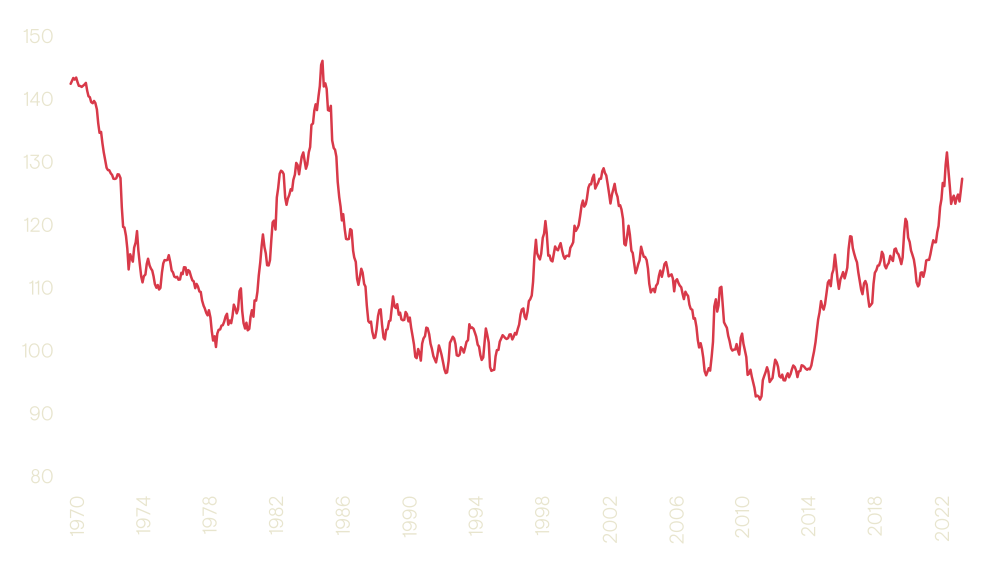
Source: Bloomberg, as at 30 September 2023.
We think several aspects of this new investment cycle will make it different from the previous one.
First is the strong likelihood of more macro volatility. Much of the current geopolitical malaise is the result of the rise of China – one of the five major structural macro themes in our ‘Road to 2030’ project – and America’s response to it. This is not simply a stand-off as a rising power challenges the incumbent. The integration of the Chinese economy into the global economy over the last 30 years has had a profoundly destabilising impact on Western societies, expressed in higher budget deficits, increasingly fractious domestic politics and the rise of populist leaders. The transition to a new status quo in the relative power status between the US and China is likely to take many years and be extremely difficult. While we think détente is ultimately far more probable than war, US-China competition is likely to result in more macro volatility in the years ahead.
Recent events have accelerated the move towards a more multi-polar world. US-centric 'Globalisation’, 1990s style, is waning as intra-regional trade booms. Paradoxically, this is probably supportive of global growth, provided the contest between the US and China does not degenerate into one between two global blocks. China itself is already rapidly reorienting towards the ‘Global South’. Having successfully moved up the value chain, it can competitively provide many of the products and technologies these countries need to develop. Concurrently, the West’s need to diversify its supply chains is benefiting countries such as Vietnam, India, Bangladesh and Mexico.
We suggested earlier (see ‘Commodities’) that the US’ weaponisation of its currency in response to first Iran and more recently Russia is likely to reduce reserve and transactional appetite for US dollars and US-dollar assets. However, this is unlikely to topple the US dollar’s status as the pre- eminent reserve currency any time soon.
Finally, on a nearer-term theme to watch, no outlook for 2024 would be complete without a reference to elections. Bloomberg calculates that about 40% of the world – measured by population or GDP – will have an opportunity to replace or re-elect their nation’s leaders during the year. Some 17 of the votes will take place in emerging markets. If nothing else, it will be a year for investors to keep their eyes on the ballot.
EM countries and regions heading to the polls in 2024 (general, presidential and local elections)
Venezuela’s elections are scheduled for sometime in H2 2024

Source: Ninety One, Bloomberg, Citigroup.
Investors are currently positioned for a soft landing. But soft landings rarely last long, and they are often a prelude to a choppy period, as in 2008, 2001 and 1990. So there will likely be a slowing global economy to navigate and the possibility of a less-than-benign outcome. More positively, cyclical bear markets are transitory. They typically offer attractive entry points to parts of the market that are supported by positive structural macro themes, as well as shorter-term cyclical opportunities.
With cash rates at a level not seen in well over a decade, many investors will be tempted to sit out challenging macro conditions. But be wary, because we see a high probability that rates will fall back sharply over the next 18 months, resulting in ‘reinvestment risk’.
This is a time to extend duration, lock in higher yields and acquire assets that have been excessively marked down due to their yield linkage. As the chart below suggests, buying 3-month Treasuries at current yields has historically meant having to roll over into lower-yielding bills over the subsequent three years.
When 3m Treasury bills yield 5%, the yield has been higher one year later just 12% of the time since 1945
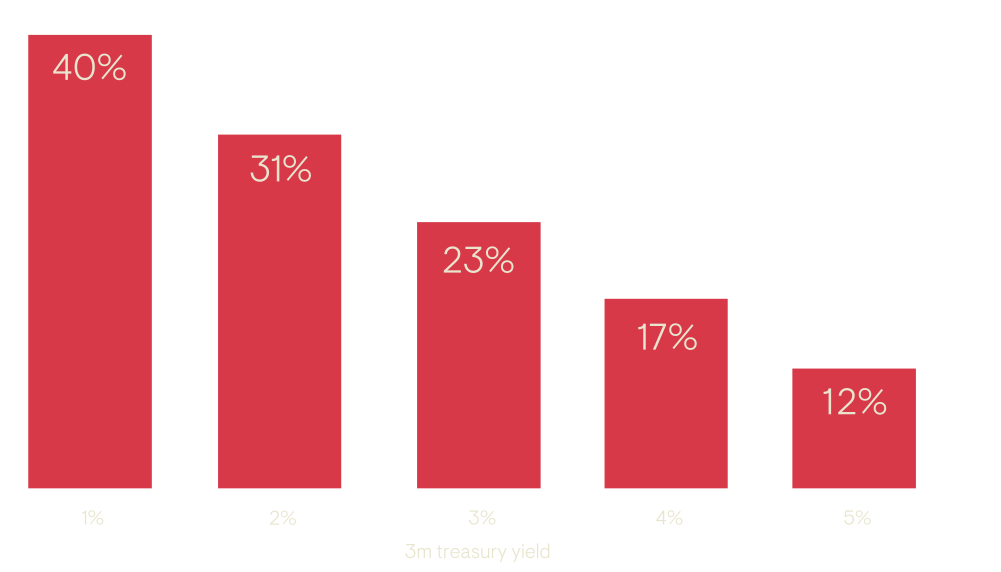
Note: the chart shows the percentage of the time the 3m Treasury bill yield has been higher than the levels shown (1-5%) one year later. Based on monthly data since 1945.
Source: Ninety One, Bloomberg.
While we believe we are ultimately moving into a new inflation and interest- rate regime, inflation could well surprise on the downside in 2024. Easing in response may set the stage for global inflation to reset at a higher level. This implies that the current opportunity in conventional government bonds is likely to be cyclical, and that we should favour assets that will be resilient to a structurally higher cost of capital, as well as other forms of diversification. Elevated real interest rates on TIPS (US inflation-linked bonds) offer attractive rates of return with an embedded inflation hedge. Credit markets have substantially repriced for such a scenario. However, selectivity is required to mitigate the risk of a cyclical rise in default rates. The fall-out among ‘zombie’ and overleveraged companies is likely to be protracted. Companies with stronger balance sheets and market positions should benefit from the reduction of competition.
Rising capital investment is a more general theme to watch in 2024 and beyond. Capital expenditure was weak during the era of easy money and extreme financialisation. Cyclical stocks, which currently trade at undemanding valuations, should benefit from this changing.
The energy transition is one of the important drivers for higher capital spending, with the need to cut emissions reinforced by a heightened desire for energy security. Yet transition-related equities have severely de-rated as interest rates have spiked. We see an attractive entry point into some of the best-positioned companies in this area. The transition will be hungry for raw materials, so we would include natural-resources stocks in this opportunity set.
We are positive on emerging markets’ prospects over the medium term. They were out of favour in the last cycle, which was dominated by the US. Today, fundamentals in many developing economies are much improved and underappreciated. The emergence of a multi-polar world should strongly boost capital investment and growth across many parts of the developing world.
Finally, much has been written about the loss of efficacy of traditional 60:40 portfolios. The repricing of bonds over the past three years has done a lot to mitigate one of the main arguments against such portfolios. But prospective returns arguably still do not provide a sufficient cushion, especially if we have to navigate a more challenging market environment, with a broader range of potential outcomes and higher macro volatility.
A simple mix of bonds and equities worked well during a multi-decade period of disinflation and falling interest rates. But it struggles when available returns are lower and correlation characteristics shift. This is not to say that bond- equity correlations are now set to be positive. Rather, they will be positive more often and weaker on average. For some, the answer is to add illiquid private-market exposure in equities and credit. But in our view, illiquidity premia in some established areas are depressed and liquidity is insufficiently prized. This surely implies the need to embrace greater flexibility in terms of asset allocation, as well to consider other liquid candidates for improving diversification characteristics, such as gold and commodities.
The views expressed are as at the date of publication and may no longer be current.
Opinions based on current market conditions; subject to change without notice and without any obligation to update.
General Risks. Forecasts are inherently limited and modelling involves risks, assumptions and uncertainties, they are forward looking and are not guarantees nor a reliable indicator of future results. Actual returns could be materially higher or lower than projected. This information is not intended as a recommendation to invest in any particular asset class or strategy or as a promise of future performance. The value of investments, and any income generated from them, can fall as well as rise. Costs and charges will reduce the current and future value of investments. Where charges are taken from capital, this may constrain future growth. Past performance is not a reliable indicator of future results. If any currency differs from the investor's home currency, returns may increase or decrease as a result of currency fluctuations. Investment objectives and performance targets are subject to change and may not necessarily be achieved, losses may be made. Environmental, social or governance related risk events or factors, if they occur, could cause a negative impact on the value of investments.
Specific Risks. Commodity-related investment: Commodity prices can be extremely volatile and significant losses may be made. Currency exchange: Changes in the relative values of different currencies may adversely affect the value of investments and any related income. Default: There is a risk that the issuers of fixed income investments (e.g. bonds) may not be able to meet interest payments nor repay the money they have borrowed. The worse the credit quality of the issuer, the greater the risk of default and therefore investment loss. Emerging market (inc. China): These markets carry a higher risk of financial loss than more developed markets as they may have less developed legal, political, economic or other systems. Equity investment: The value of equities (e.g. shares) and equity-related investments may vary according to company profits and future prospects as well as more general market factors. In the event of a company default (e.g. insolvency), the owners of their equity rank last in terms of any financial payment from that company. Interest rate: The value of fixed income investments (e.g. bonds) tends to decrease when interest rates rise..
For years, capital has gravitated to the US. A one-way trade powered by tech dominance and economic heft. But as the world tilts on its axis, the next cycle is unlikely to resemble the last, and the investment map is beginning to redraw itself.
A shrinking supply of shares has flattered US equity returns for years. The AI issuance boom is putting that into reverse.
Ninety One’s Capital Market Assumptions framework focuses on the key drivers of long-term performance. We do this to better understand possible future returns, enriching discussions with our clients.
Easy globalisation is over: multipolarity, bottlenecks and public dissatisfaction are reshaping the world. For investors, that means old assumptions are less reliable and resilience matters more.
War in the Middle East has brought one of the market’s long-standing geopolitical fault lines into sharp focus, particularly the risk of disruption in the Strait of Hormuz. Against an already fragile backdrop, the key question is whether this episode remains contained or escalates into a shock with global economic consequences.
Sahil Mahtani, Director of Ninety One’s Investment Institute, and Paul Gooden, Portfolio Manager for Global Natural Resources, discuss Venezuela and broader energy themes following the Goldman Sachs Global Energy Conference in Miami.
Sahil Mahtani, Director of Ninety One’s Investment Institute, and Nicolas Jaquier, EM Fixed Income Portfolio Manager, are joined by Phil Gunson, Senior Analyst at the International Crisis Group, who is based in Caracas for an on-the-ground perspective on the rapidly evolving situation in Venezuela.
Maduro’s exit raises the chance of change, but power is likely to remain with the security state as the US opts for pressure and negotiation over regime overhaul. Markets appear ahead of reality, with any improvement in oil and debt outcomes likely to be slow and uneven.
A major headwind to emerging market equity performance is fading. Read how this structural shift could lift future returns and reshape the case for EM allocations.
Ninety One’s Capital Market Assumptions framework focuses on the key drivers of long-term performance. We do this to better understand possible future returns, enriching discussions with our clients.
A new cycle reshaping global equity leadership.
Our research offers three reasons why the dollar’s upside is limited, while the balance of risks increasingly point lower.
Dollar cycles are longer than others because four self-reinforcing forces create inertia. They rarely reverse unless all four turn at once. Trump-era policies, fiscal strain and shifting global capital could trigger such a convergence.
Shifting from reducing financed emissions to financing reduced emissions. Using practical examples, this paper sets out how we can evolve the approach to net-zero investing to achieve the dual objectives of delivering decarbonisation in the real economy while optimising returns for clients and beneficiaries.
Ninety One’s Capital Market Assumptions framework focuses on the key drivers of long-term performance. We do this to better understand possible future returns, enriching discussions with our clients.
Trump’s sweeping trade reset marks the largest US tariff escalation in nearly a century. Ninety One’s Investment Institute unpacks the policy shift, outlines scenario-based outcomes, and explores what it means for markets.
Monetary, fiscal, migration. How the US recession was averted, 2022-2023.
US equity markets reacted favourably to the US election result. However, Philip Saunders, Director of Ninety One’s Investment Institute reminds us that regardless of the party in power, long-term market movements are driven by fundamentals – growth matters.
Ninety One’s Capital Market Assumptions framework focuses on the key drivers of long-term performance. We do this to better understand possible future returns, enriching discussions with our clients.
Ninety One’s Capital Market Assumptions framework focuses on the key drivers of long-term performance. We do this to better understand possible future returns, enriching discussions with our clients.

A radical reset in borrowing costs has changed the rules of the game for investors. Explore our global and emerging market outlooks and hear our portfolio managers discuss what this shift in market regime means for investors.
Important Information
This communication is provided for general information only should not be construed as advice.
All the information in is believed to be reliable but may be inaccurate or incomplete. The views are those of the contributor at the time of publication and do not necessary reflect those of Ninety One.
Any opinions stated are honestly held but are not guaranteed and should not be relied upon.
All rights reserved. Issued by Ninety One.