Many investors have made life policy wrappers the cornerstone of their portfolios. The Ninety One Life Portfolio and Ninety One Global Life Portfolio offer attractive tax and estate planning benefits – reducing the tax drag on capital growth and simplifying succession on death.1
One feature that is often underused, however, is the loan facility. For advisors who take the time to understand how this feature works, it opens up meaningful planning opportunities – from managing liquidity during a client’s working years to facilitating a smooth transfer of wealth to the next generation.
At its core, a loan from a Ninety One Life Portfolio is processed as a withdrawal, but with one important distinction: the investor has the option to repay it.2 For a comprehensive overview of how the loan facility works, see our FAQ document.
A planning tool across life stages
To illustrate how this feature can be used in practice, consider Tim – a 50-year-old South African entrepreneur who has built a successful business.
As a high-income earner, tax efficiency has become central to his portfolio planning. Tim meets with a financial advisor for the first time, five years before his planned retirement. He has built a retirement nest egg through retirement annuities and tax-free savings accounts for himself and his wife. These investment vehicles have provided Tim with tax-free growth and will be a key source of income in retirement. Tim kept surplus capital in a bank account to support his business when needed. As a conservative investor, he has never invested offshore.
As part of a thorough portfolio review, Tim’s advisor suggested reinvesting the cash across five local Ninety One Life Portfolio contracts, each invested in conservative unit trusts. The contracts still served as the safety net he required, while reducing his overall tax liability on invested capital when compared with investments in Tim’s own hands. His marginal income tax rate is 45% while income tax within the individual policyholder fund is fixed at 30% based on current legislation. Five separate contracts gave Tim liquidity flexibility – each carrying the option of one loan and one surrender during the first five years, with unrestricted access thereafter.
Tim also invested a portion of his surplus capital in a Ninety One Global Life Portfolio, recognising the need for offshore diversification.
During the working years: preserving flexibility
As Tim’s business grew, it periodically needed capital. Rather than surrendering from his Life Portfolios, Tim elected to take loans instead. This kept the contracts in force so that they continued to move towards maturity, and, critically, preserved his ability to repay capital back into them when surplus cash became available.
When Tim received distributions from the business, he repaid portions of the loans on the Life Portfolio contracts. Had he taken the previous withdrawals as surrenders instead of loans, he would not have been able to repay capital into the contracts because of the 120% contribution limits that traditionally apply to life wrappers.3 This demonstrates one of the practical advantages of using loans against a Life Portfolio rather than surrendering the investment.
Had Tim realised a capital loss as a result of any of his loans, Ninety One would have maintained a record of this and used it to reduce the tax liability against future capital gains realised within the relevant policyholder fund.
Approaching retirement: reinvesting business sale proceeds
As Tim neared retirement and anticipated a significant lump sum from selling his business, his advisor suggested repaying all remaining outstanding loans against the local Life Portfolios.
With the contracts now older than five years, the restricted period had passed. Repaying the loans allowed Tim to reinvest the sale proceeds into a tax-efficient environment – and to supplement his living annuity income with withdrawals from the Life Portfolios, which attract more favourable tax rates than investments held in his own hands.
Succession: keeping wealth out of the estate administration process
In the event of Tim’s death, the Life Portfolio contracts would not need to pass through the estate administration process. They would mature immediately and become available to his beneficiaries, who could continue the contracts, receive cash lump sums, or choose a combination of both.
Each beneficiary would inherit their share as a separate contract, allowing them to manage the capital according to their individual risk profiles and to nominate their own primary and alternative beneficiaries.
Where the beneficiaries elect to continue with the contracts, there would be no immediate capital gains tax (CGT) implications within the policyholder fund. Any unrealised capital gain rolls over to the beneficiary’s contract and will only be triggered on a future taxable event. There will also be no further restriction period. Importantly, since the 120% contribution limit remains in force for the full investment term, it may restrict beneficiaries from making further contributions. If, however, loan balances were outstanding at the time of death, beneficiaries may receive the right to repay those amounts – unlocking further investment opportunities for the beneficiary.
Ceasing tax residency: a deliberate final use of the loan
After turning 60, Tim and his wife decided to retire abroad. Following advice from their tax specialist, they chose to cease South African tax residency. Ceasing South African tax residency may trigger a deemed disposal of certain assets for CGT purposes, subject to statutory exclusions. For individuals taxed at the top marginal rate, the effective CGT rate on taxable capital gains may be as high as 18%. Fortunately, investments such as retirement funds, living annuities and Life Portfolios are sheltered from these exit taxes.
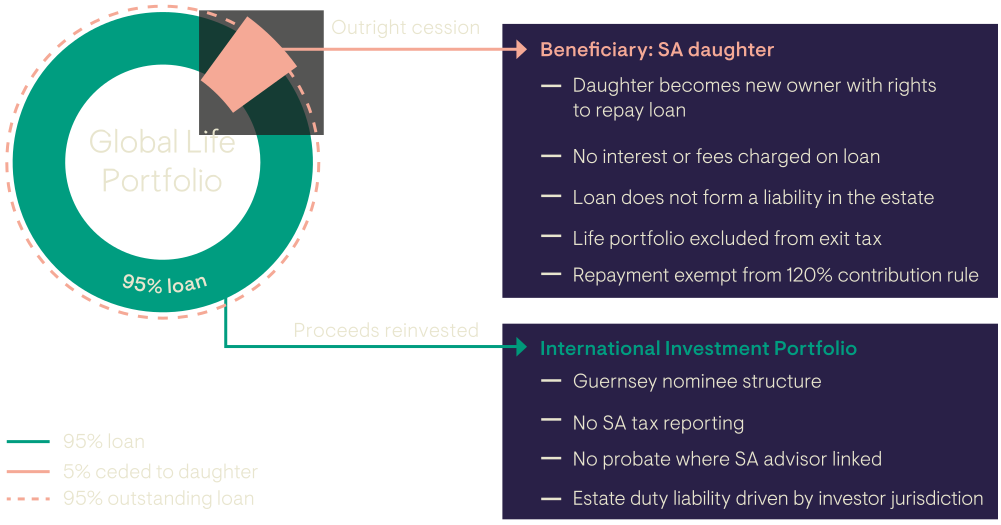
One month before ceasing tax residency, Tim’s advisor suggested taking loans up to the maximum permitted against all local Life Portfolio contracts. The loans – still processed as withdrawals – triggered CGT at 12% within the policyholder fund. Tim reinvested the proceeds in the Ninety One International Investment Portfolio, which was suitable for his new tax jurisdiction.
He also took a 95% loan against his Global Life Portfolio contract and reinvested those proceeds in the Ninety One International Investment Portfolio. Tim chose a loan rather than a surrender deliberately: he intended to cede the remaining balance and outstanding loan to his daughter living in South Africa, who is the primary beneficiary on the contract. The cession may be considered a donation for donations tax purposes, subject to available exemptions and thresholds, but does not trigger CGT on a change of ownership. His daughter becomes the new policy owner, subject to the policy terms, which may allow her to repay any outstanding loan balance on the contract. She can invest the funds according to her own risk profile and nominate primary and alternative beneficiaries. She can also contribute to the contract if permitted under the 120% contribution limits.
Utilising the loan when ceasing tax residency
Source: Ninety One.
The planning case in summary
The loan facility is not complex, but it rewards those who understand it. Because a loan carries no interest, no fee, and creates no estate liability, it can offer more flexibility than a surrender in the right circumstances. That said, a loan is still a withdrawal: units are sold, tax may be triggered within the policyholder fund, and the investor will not participate in market growth on the withdrawn amount until such time as the loan is repaid. The upside – particularly around the 120% contribution rule, capital loss recording and beneficiary planning – can be substantial.
Tim’s story illustrates how loans, applied thoughtfully across different life stages, can compound into meaningful planning outcomes. For clients who hold a Life Portfolio, the more useful question is not simply ‘loan or surrender?’ – it is whether a loan better preserves flexibility in their specific circumstances.
1. These policy wrappers are known as sinking funds as they do not have a life assured. They are governed by the Long-term Insurance Act, 52 of 1998, the Insurance Act, 18 of 2017, and the Income Tax Act, 58 of 1962.
2. Units are sold and tax may be triggered within the policyholder fund when the withdrawal is processed.
3. Any additional contribution to the Life Portfolio cannot exceed 120% of the highest annual contribution in the previous two years. This rule remains in force for the full investment term.