Background
In our previous case study, we explored how Michael, the beneficiary of a South African trust, evaluated offshore exposure for the trust’s investments, held in a matured Ninety One local life portfolio. The trust had inherited the matured policy wrapper from Michael’s mother, Susan. Two mechanisms were explored at that stage for the trust: investing in feeder funds within the wrapper or using asset swaps. With the wrapper structure preserved, Michael was able to explore tax-efficient ways to internationalise the family’s wealth.
In this case study, we turn to alternative offshore strategies – specifically, scenarios in which the trust chooses to distribute assets externally. We focus on two routes:
- Distributing assets from the SA trust to Michael as a South African tax resident, to invest offshore in his personal capacity or to fund an offshore trust via a loan account
- Making a direct capital distribution from the SA trust to an offshore trust
Each option presents important planning considerations, especially in relation to tax treatment, estate implications and long-term outcomes. Whichever route the SA trust takes, distributing the assets will result in a capital gains tax (CGT) event. Normally, an SA trust is taxed at an effective CGT rate of 36%, but as the investment is held in a local matured policy wrapper, the effective CGT rate is only 12%. This leaves a much larger value of the investment that can be taken offshore.
Example: CGT impact on distribution value
If the trust distributes a gross investment of R25 million, the lower CGT rate within the policy wrapper (12%) provides an additional R1.7 million to the beneficiary compared to the standard trust rate of 36%.1
- R23 902 672 (net of 12% CGT) – base cost: R15 855 604
- R22 164 659 (net of 36% CGT) – base cost: R17 124 052
Let’s take a closer look at the two distribution routes.
1 Distribute to Michael (as an SA tax resident)
This approach involves the SA trust distributing assets to Michael in his personal capacity. He could then externalise the funds via the authorised international transfer (AIT) process or by applying for special clearance. From there, he may invest the proceeds in his own name or fund an offshore trust via a loan account.
This option introduces several challenges:
- The distribution brings assets back into Michael’s personal estate, increasing estate duty exposure in the long term. It also exposes future income and capital gains to his personal marginal tax rate of 45%, raising his ongoing tax burden.
- If a loan is used to fund an offshore trust, it creates an interest-bearing loan account. This interest is taxable in Michael’s hands as the lender. If the offshore trust does not repay the loan, interest accrues – further inflating the value of the loan account and Michael’s estate duty liability.
- Rand depreciation can further increase the value of the loan account in rand terms, compounding the estate duty liability on Michael’s death.
Key takeaway: This route gives Michael flexibility – he can invest offshore in his own name or fund an offshore trust via a loan. However, bringing the assets into his personal estate increases exposure to income tax and estate duty. Where a loan is used, the growing value of the loan account – including accrued interest and currency effects – can further inflate the estate duty liability in Michael’s own estate.
2 Distribute to an offshore trust
Recently, it has become possible – subject to approval by the South African Revenue Service (SARS) and the South African Reserve Bank (SARB) – for an SA trust to make a capital distribution directly to an offshore trust. The SARB has not issued a formal circular on the matter, so there is no explicit regulatory guidance governing such transfers. Each application is assessed on a case-by-case basis.
This route is already being used in practice and offers distinct planning advantages once the required approvals are obtained. Distributing directly to an offshore trust avoids the complications of a loan account. It is important, however, to ensure that:
- The offshore trust exists and is named as a beneficiary in the SA trust deed.2
- The trust deeds of both entities allow for this structure.
- All related tax obligations are settled by the SA trust before the distribution is made.
If these conditions are met, this route results in a clean transfer of capital offshore and avoids the estate duty and loan-related complexities associated with traditional methods of funding an offshore trust.
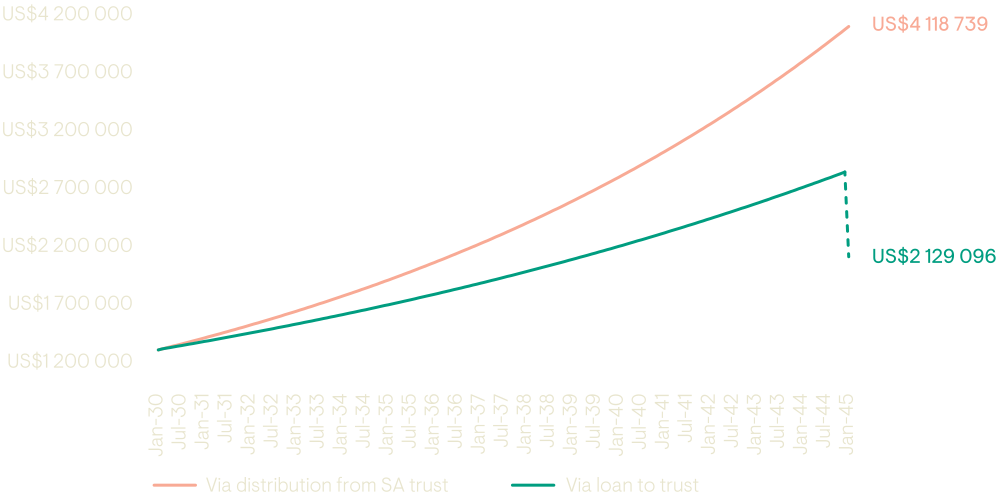
Our modelling (Figure 1) shows that distributing directly from an SA trust to an offshore trust delivers materially higher long-term value compared to funding the offshore trust via a loan account. The difference between the two outcomes is driven by the tax payable on interest in the loan structure (bottom line) and the estate duty implications of the loan account on death. In contrast, the direct trust-to-trust distribution (top line) avoids interest payments (and therefore there’s no tax to deduct), incurs no estate duty on death, and preserves more capital offshore.
The outcome can be enhanced where the SA trust makes the distribution from a local policy wrapper, as the CGT rate applied (12%) will be considerably lower than if the distribution were made from an investment held in the trust’s own hands (36%). This means more capital will be available to fund the offshore trust.
Figure 1: The benefit of avoiding a loan account is significant
Source: Ninety One. For illustration purposes only.
Key takeaway: Option 2 enables offshore planning beyond the SA trust without creating a loan account or drawing funds into a beneficiary’s estate. However, there are cost and administrative implications to establishing an offshore trust or an offshore freezer trust.
Successfully implementing this strategy will depend on a number of factors, including the size of the capital distribution.
Choosing a suitable offshore product structure
Once the SA trust has distributed assets, selecting the appropriate offshore product structure becomes crucial – particularly when considering long-term estate planning, tax exposure, investor residency and beneficiary location. This case study focuses on distribution strategies, but it’s equally important that product choice fits with an investor’s tax status, planning objectives and long-term intent.
Given the complexity of implementing a distribution strategy to externalise assets from an SA trust, it’s important to engage qualified professionals to navigate legal, tax and residency considerations. This case study highlights some options for SA trusts but is not exhaustive.
To learn more about Ninety One’s offshore solutions – the Global Life Portfolio, Global Investment Portfolio and International Investment Portfolio – please visit our offshore investing page on our website.
Key learnings
- Offshore planning within an SA trust is just one part of the picture – the distribution strategy and timing can be just as important.
- Where loan accounts are used to fund offshore trusts, they introduce layered complexity: tax on interest, potential estate duty growth and administrative drag.
- Direct distributions from an SA trust to an offshore trust – though still subject to approval – can offer a cleaner, more efficient outcome, particularly when capital is already housed within a local policy wrapper.
- Preserving flexibility through proper trust structuring (beneficiary nominations, trust deeds and offshore-trust readiness) is essential to long-term intergenerational planning.
- Selecting the appropriate offshore product structure should go hand in hand with distribution planning, especially as tax residency and beneficiary location may evolve over time.
1 For illustrative purposes only. The different base costs in this example reflect the impact of the inheritance structure used (i.e. the trust inheriting a policy wrapper versus inheriting assets directly). The net amount distributed depends on both the CGT rate and the applicable base cost at the time of disposal. Refer to Case Study 1 for more background on the use of policy wrappers in estate planning.
2 The trust can be an offshore “freezer” trust, i.e. it does not need to hold assets. However, it cannot be a testamentary trust, as it must be an established offshore trust with a valid trust deed.