Background
Susan, aged 82, recently widowed and in ill health, faced critical decisions about efficiently transferring wealth to her son and grandchildren. Despite significant wealth, her financial structure presented considerable exposure to estate duty and tax inefficiencies, threatening the smooth transition of assets.
Challenges and objectives
Susan’s assets included an R11 million living annuity, along with sufficient cash in her bank accounts to maintain a comfortable lifestyle. Additionally, she held R70 million in a local share portfolio. Her primary objectives were to ensure liquidity upon her death, optimise tax efficiency and facilitate the transfer of wealth to her only child, Michael, and his family.
Proposed solution
After a thorough analysis, Susan accepted an upfront capital gains tax (CGT) cost of R3.6 million by liquidating her R70 million local share portfolio. The net proceeds were strategically reinvested into several Ninety One Life Portfolios, each with different underlying investments. Importantly, Susan designated her existing inter vivos trust – of which both she and Michael were beneficiaries – as the nominated beneficiary.
Implementation and outcome
When Susan subsequently passed away, the implemented strategy significantly streamlined the wealth transfer process. Because of her chosen policy structure, the transfer to the trust avoided executor’s fees, Master’s Office involvement, and additional CGT liabilities, as the trust opted to continue with the various Ninety One Life Portfolios. Additionally, Section 7C of the Income Tax Act does not apply, given that the trust inherited the matured policies (with the remaining terms falling away upon Susan’s death). The value of the policies still formed part of Susan’s estate, but even if Susan had decided to retain her initial investment (the share portfolio), it would also have formed part of her estate.
Figure 1: Susan took the R 3.6 million CGT hit to move to an SA policy wrapper (Ninety One Life Portfolio)
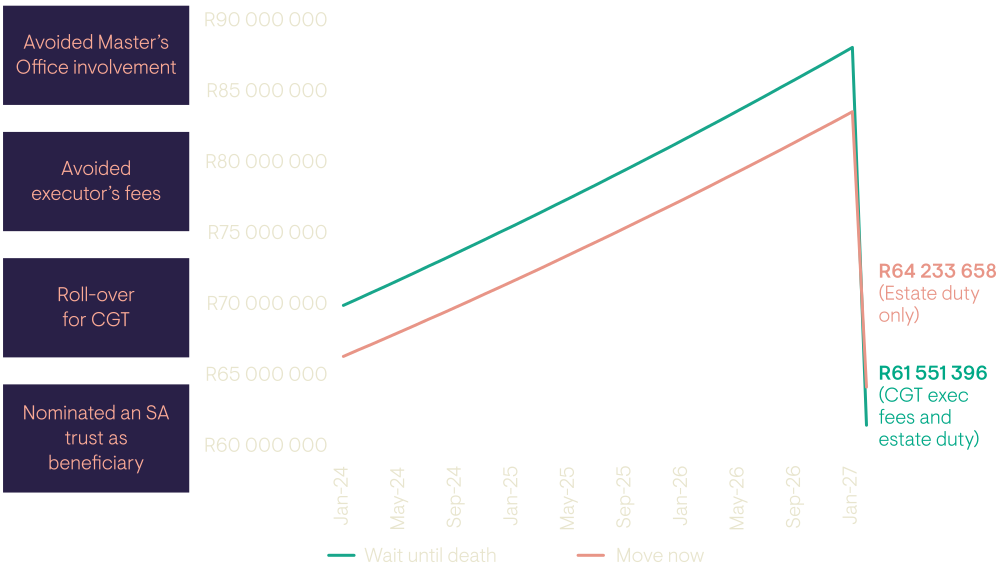
Source: Ninety One. For illustrative purposes only. Growth assumed to be 8% p.a. Higher rate tax applied to discretionary example and executor’s fees of 2%.
Crucially, by naming the trust as the policy beneficiary, Susan protected the assets from future estate duty liabilities in Michael’s own estate, materially enhancing the long-term wealth accumulation for her family over multiple generations. Figure 2 clearly illustrates the multi-generational wealth transfer efficiency.
Figure 2: Nominating a trust as the beneficiary of a policy wrapper helps to maximise potential estate-planning benefits
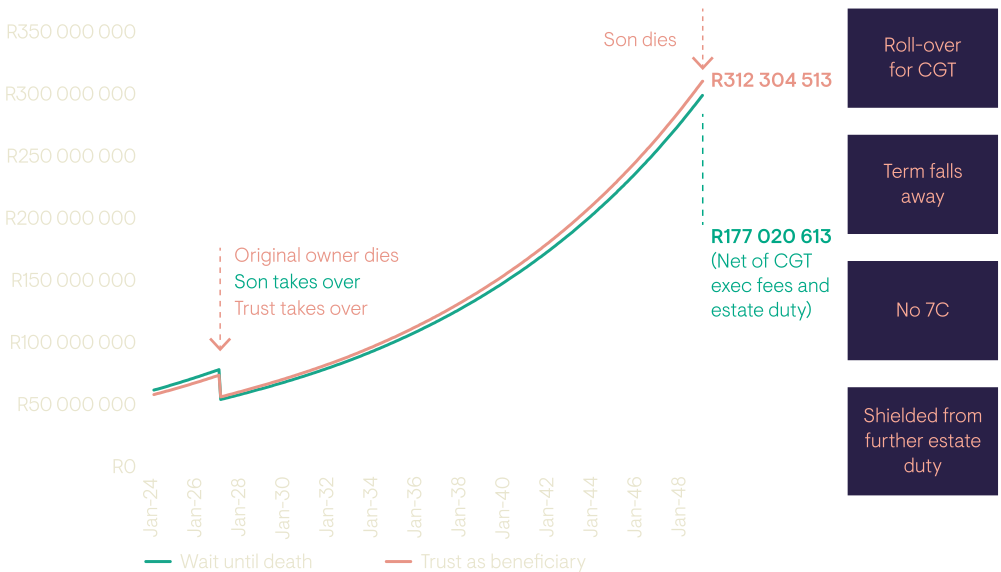
Source: Ninety One. For illustrative purposes only. Growth assumed to be 8% p.a. Higher rate tax applied to discretionary example and executor’s fees of 2%. Estate duty deducted at 25% on death of son.
Lessons and insights
- Proactive estate restructuring at any age, supported by strategic beneficiary nominations through appropriate financial products, ensures liquidity and delivers substantial long-term tax and cost efficiency.
- Accepting short-term tax implications (such as initial CGT) can yield significant long-term wealth preservation.
- With elderly clients, it’s important to look at the bigger picture and not focus solely on the elderly patriarch or matriarch. In Susan’s case, we anticipated the eventual transition of her portfolio into a South African trust. Our next case study will further explore this trust and the various ways it can gain foreign exposure.