Background
In the first case study, we explored how Susan, an elderly widow, restructured her estate to ensure liquidity upon her death, optimise tax efficiency and facilitate the smooth transfer of wealth to her son, Michael, and his family. She chose to liquidate her local share portfolio and reinvest the proceeds into several Ninety One Life Portfolios. Importantly, Susan designated her inter vivos trust – of which both she and Michael were beneficiaries – as the nominated beneficiary.
Following Susan’s passing, the inter vivos trust inherited the matured policy wrappers (the remaining term falls away on death), allowing for a seamless transition. As the trust had been nominated as the beneficiary of the various policies, this arrangement avoided executor’s fees and Master’s Office involvement. Furthermore, no additional CGT was triggered at death, as the policies rolled over CGT neutral from Susan, the deceased policyholder, to the new owner – the inter vivos trust.
With the structure preserved and the trust now holding the investments, attention turned to Michael, the trust’s beneficiary. While Susan had been comfortable with local assets, Michael was looking to diversify globally. As a high-earning professional with a marginal tax rate of 45%, his strategy would need to be tax-smart and carefully structured.
Challenges and objectives
The challenge was clear: how could the South African trust, now holding the matured Ninety One Life Portfolio,1 gain offshore exposure in a tax- and cost-efficient manner? As SA trusts do not qualify for approved international transfers (AITs), Michael had to consider other ways to achieve offshore diversification. In this case study, we focus on two options:
- A feeder fund within the policy wrapper2
- An asset swap implemented either via a direct stockbroker account or a global investment platform
Both routes carry distinct implications for tax, costs, flexibility and long-term outcomes. We first explore the benefits and drawbacks of these two offshore options and then illustrate the impact through two 10-year modelling scenarios.
01 Feeder fund
A feeder fund provides exposure to offshore assets through a rand-denominated unit trust that feeds into a direct offshore fund. Capital gains are calculated in rands – including rand depreciation – but taxed at a favourable CGT rate of 12% within the policy wrapper. This structure is especially cost-effective when managed as part of a broader family investment strategy such as Ninety One Family Office.
Key benefits of a feeder fund:
- Reduced tax rate: CGT is fixed at 12% within the policy (versus 36% for the SA trust).
- Simplicity and speed: no offshore exchange clearance required; the trust can simply switch the policy wrapper’s investments into a feeder fund (CGT of 12%).
- Popular offshore funds: these are typically available via feeder funds.
- Efficient cost structure: no asset swap fee or custody charges apply.
- Estate-planning benefits: no executor involvement or CGT on death if the investment is retained in the wrapper with a nominated beneficiary.
Drawbacks:
- More limited investment options are available than via an asset swap.
- Full rand depreciation is included in the capital gains calculation.
02 Asset swap
In our case study, the SA trust also has the option to obtain offshore exposure by making use of an asset swap facility – effectively exchanging rand-denominated investments for foreign-denominated investments. This can be implemented either via a stockbroker (outside a policy wrapper) or through a global platform, where the investment may be housed within a global wrapper.
Key benefits of an asset swap:
- Capital gains are calculated in hard currency and then converted to rand using the exchange rate at the time of disposal.3 This means that any rand depreciation over the investment period is effectively excluded from CGT, with only the market growth in hard currency included in the capital gains.
- Broader investment choice – asset swaps via a stockbroker or global platform typically offer a wider range of investment options.
Drawbacks:
- More complex to implement and manage, especially when accessed via a global platform, with added documentation, intermediaries and regulatory steps.
- Higher overall costs, including additional asset swap fees (typically 0.25–1%), platform charges, and possible custody or brokerage fees.
- Higher effective tax rate, with CGT of 36% if the trust invests directly via a stockbroker and not within a policy wrapper.4
- No tax benefit for companies, as gains are taxed in full and rand depreciation is included in the CGT calculation when using an asset swap facility.
- Potential balance sheet risk, particularly when offshore custodians are involved, adding operational and regulatory complexity.
- Minimum deal sizes often apply, making this option less efficient for smaller investments.
Evaluating offshore exposure outcomes: feeder fund versus asset swap
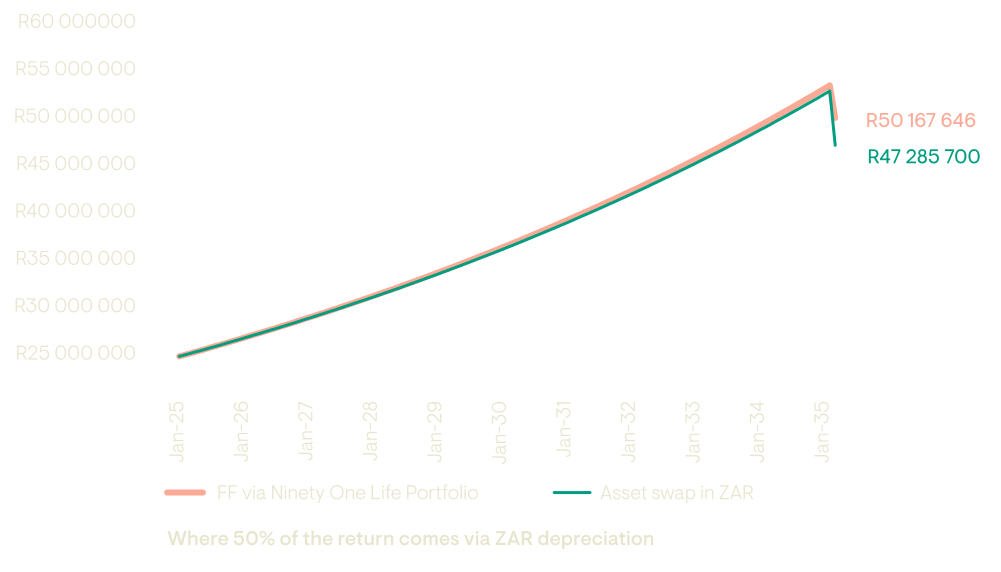
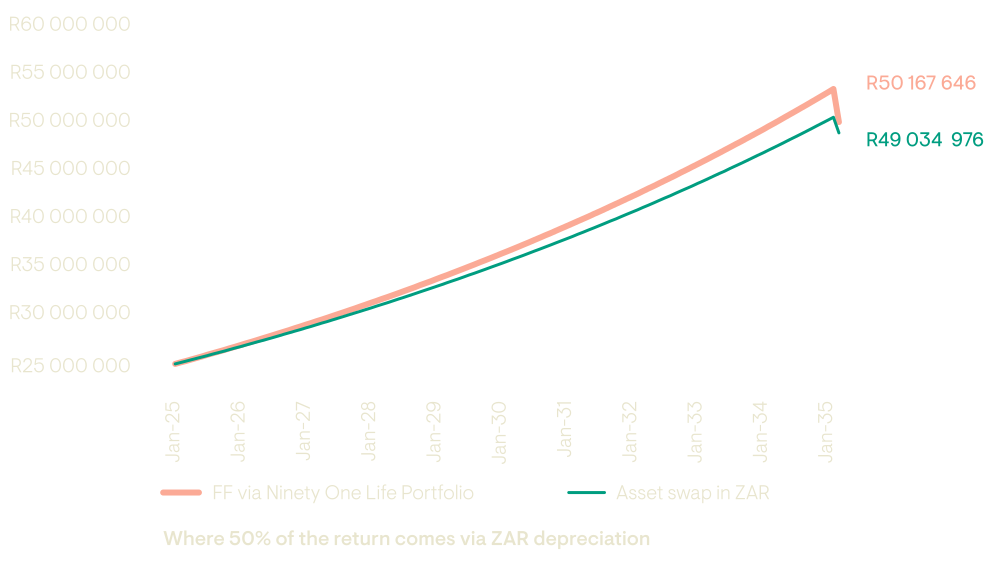
To assess the differences between feeder funds and asset swaps for the South African trust, we modelled two scenarios using a base investment of R25 million over a 10-year period. In both cases, we assumed an 8% annualised return, with 50% of the growth attributable to hard currency returns and 50% to rand depreciation. Costs and tax implications were factored into the outcomes based on the offshore route selected.
Figure 1: Feeder fund within a policy wrapper vs. asset swap via a stockbroker – both held by an SA trust
Source: Ninety One, for illustrative purposes only.
Despite the asset swap excluding rand depreciation from the capital gains calculation, the 36% CGT rate applied to the trust investment significantly reduced its net value. In contrast, the feeder fund – taxed at 12% within the policy wrapper – benefited from both a lower tax rate and reduced costs, leading to a stronger long-term outcome.
Figure 2: Feeder fund within a policy wrapper vs. asset swap via a global platform within a global policy wrapper – both held by an SA trust
Source: Ninety One, for illustrative purposes only.
In this scenario, the asset swap was executed via a global investment platform and benefited from capital gains calculated in hard currency and taxed at 12% within a global policy wrapper. However, the additional layers of cost, typically associated with global platforms, eroded much of the CGT advantage. In contrast, the feeder fund remained more efficient due to its simpler fee structure and overall cost effectiveness.
Broader modelling insights
We have conducted extensive modelling across a range of return scenarios and currency assumptions. In general, feeder funds tend to outperform asset swaps in most market conditions, largely due to their lower costs and more predictable structure. Asset swaps may deliver better results in specific cases – such as when rand depreciation accounts for 80% or more of the total return5 (typically in the case of asset swaps via a stockbroker). Feeder funds are also more suitable across a wider range of deal sizes, whereas asset swaps – particularly those executed via global platforms – generally require larger investment amounts to offset the impact of higher fees.
Key learnings
- Understand the wrapper: retaining the investment within the life policy structure created by Susan not only preserves tax advantages but also allows for efficient offshore exposure via feeder funds.
- Feeder funds are often the most effective starting point: despite being rand-based, feeder funds can outperform asset swaps in most scenarios when accounting for tax, cost and scale – especially when used within a policy wrapper.
- Align structure with objectives: Susan’s decision to prioritise tax efficiency and estate planning created the flexibility for Michael’s offshore ambitions to be implemented with minimal complexity.
- Plan with purpose: the chosen route to offshore exposure – whether via feeder funds or asset swaps – can significantly affect long-term value. As we often say: with an asset swap, you pay a certain fee for an uncertain outcome, while feeder funds tend to offer a more consistent and predictable path.
Our next case study will explore additional offshore planning opportunities once assets are distributed from a South African trust – either to a beneficiary or to an offshore trust.
1 While the trust inherited several Ninety One Life Portfolios, each with different underlying investments, this case study refers to a single policy wrapper for simplicity and consistency in the analysis that follows.
2 Please note that investors in the Ninety One Life Portfolio are subject to an offshore exposure cap of 45%.
3 You can also use the average exchange rate in the year of the disposal.
4 Given Michael’s marginal income tax rate of 45%, it is assumed that the trust does not apply the conduit principle to distribute gains to him for taxation in his personal capacity.
5 To put this figure into perspective: in our modelling example, an 8% total return assumes that 6.4% of that came from currency depreciation. It is worth considering how likely it is for that level of rand weakness to persist over the long term.