Get to know 4Factor Emerging Markets Equity
A core strategy seeking to generate alpha across emerging market cycles
The latest data indicates investors are re-building their exposure to emerging market equities, with net inflows into the asset class of US$31 billion in 2025 and US$15 billion in the first weeks of 2026.1 Most of these flows have been into exchange-traded funds, suggesting that many investors are opting for passive strategies. Yet, as we discuss in this paper, this is an asset class where it has paid to be active over the medium to longer term. That is why historically many large asset owners have tended to favour active strategies, which in our view are better able to capture the inefficiencies and growth potential inherent in EM equities.
We strongly agree that this is the right time to revisit EM equity allocations, and maintain a positive outlook for the asset class broadly. However, we believe the investment approach that investors choose may play a decisive role in the long-term return outcome they achieve.
The common narrative that most active managers fail to beat their passive counterparts tends to be framed over recent time periods, and in many cases captures the broadest sweep of the fund universe. Using eVestment data — a trusted resource for institutional strategy assessment — we analysed the performance of active global emerging market all cap equity managers.
The median active emerging market manager has delivered positive excess returns over 20-, 15-, 10-, and 5-year periods.
Long-term data further suggests that alpha generation is cyclical and more persistent over extended investment horizons, reinforcing the benefits of patient capital and strategic partnerships.
This is illustrated in Figure 1, where we plot rolling 3-year excess returns delivered by the median active manager over the past 20 years (an approach that accounts for different market regimes).
Figure 1: Active management in EM has generated alpha across market cycles
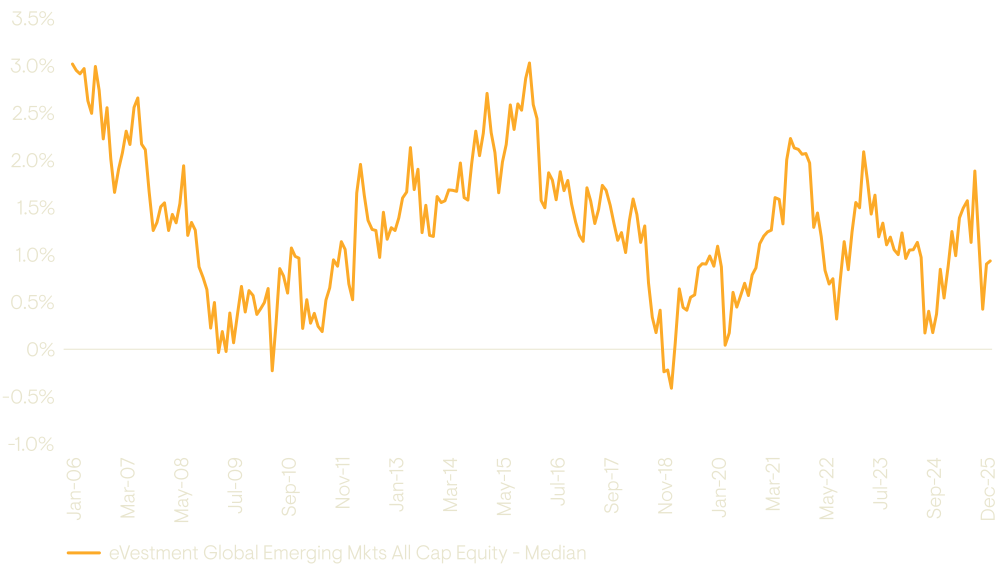
Source: eVestment, Rolling 3-year alpha 20-year data to end-Dec 2025 to give a long-term data horizon.
Median active managers in Global Emerging Markets have outperformed passive strategies for most of the past 20 years, despite cyclical variation reflecting changing market regimes. Median alpha has remained positive over the long term, highlighting the persistence of active opportunity in EM equities.2 Structural inefficiencies — including high retail participation and regulatory barriers in markets such as China — continue to support active outperformance, reinforcing the case for active management in emerging markets.
The obvious shortcoming of the above analysis is that it is based on gross returns. However, even after fees, alpha remains positive. Matching actual fee data paid by consultant-advised clients to eVestment, we find that active managers have typically generated positive net alpha and sometimes substantial alpha (see table below).3
Meanwhile, passive funds tracking an index have an inherent disadvantage, as they are almost certain to underperform after fees.
Figure 2: Net alpha estimate for median EM active managers
| Fund | Monthly average of 3Y rolling alpha since 2004 – gross | Actual fees for seg mandates4 at US$100m | Monthly average of 3Y rolling alpha since 2004 – net |
|---|---|---|---|
| Global EM All Cap Core Equity | 1.33 | 0.80 | 0.53 |
Source: Global consultant research, June 2022 (latest available).
The primary reason an active approach continues to be effective in emerging markets is that these markets are less efficient. In other words, asset prices may not fully reflect all available information, creating opportunities for skilled investors to generate alpha. The inefficiencies in EMs broadly fall into two categories: structural and behavioural.
Structural factors refer to the fundamental characteristics of EM financial markets that make price discovery less effective than in developed markets. These include:
The second category of inefficiencies arises from investor behaviour, particularly due to the retail-heavy composition of market participants in EM equities:
Figure 3 maps retail participation across emerging and developed markets showing data points collected over the last five years where data is available. The graph highlights that the four largest markets by weighting in the MSCI EM Index, which together account for c.76%, show significantly higher retail participation compared to their developed market counterparts.
Figure 3: Retail participation in stock markets by country and region

Source: Ninety One. Participation rates compiled or estimated and reported by local exchanges. Data points are drawn from available data over the last five years. See important information for sources for retail participation. MSCI, Jan 2025.
A combination of these structural and behavioural inefficiencies leads to persistent mispricings, regardless of investment styles. For active managers with a disciplined and repeatable investment process, these inefficiencies provide opportunities to identify underappreciated future winners and avoid value traps.
By focusing on long-term, risk-adjusted returns driven by stock-specific fundamentals — rather than broad market movements — active investors in EMs are better positioned to deliver sustained alpha than passive investors tracking an index. Furthermore, these inefficiencies are persistent and reflective of these nations’ status as developing economies, meaning an active approach will remain relevant for many years to come.
Investing in emerging markets is not just about what’s in the index — it’s also about what’s missing. Adding off-benchmark stocks to a portfolio has several well-documented benefits, including enhanced diversification, increased alpha potential, and the ability to access markets or regions underrepresented in traditional indices. Active EM investors can pursue off-benchmark opportunities by investing in EM stocks that are not included in benchmark indices or in DM-listed companies with significant emerging market exposure.
When evaluating EM-listed stocks outside the benchmark, it’s easy to assume their exclusion signals poor quality — but that’s not necessarily true. Many successful companies remain outside the index for reasons unrelated to their fundamentals. Some may be early-stage businesses experiencing rapid growth but not yet meeting market capitalisation, balance sheet strength, or liquidity thresholds. Others may face regulatory or transparency hurdles that could be addressed through improved governance and oversight.
Additionally, companies – or even entire markets - may be in the process of securing index inclusion, a transition that takes time to complete. Take Vietnam, a high-growth economy still classified as a frontier market but poised for MSCI EM inclusion. Passive investors miss early-stage gains that active managers can capture. Over the past year, Vietnam’s role as an AI supply chain hub has expanded as firms diversify away from China amid geopolitical and tariff concerns. Its omission from the index signals not inferiority, but future potential.
Including DM-listed companies with significant EM exposure brings a different dimension to the portfolio. In the instance of these larger, more established firms, their inclusion can enhance the overall growth and revenue profile of the portfolio, through their EM exposure, but also benefit from the enhanced downside protection inherent with being a DM-listed company; i.e., reduced direct geopolitical risk for example.
Skilled bottom-up stock pickers can identify mispriced opportunities irrespective of broader market valuations at any stage of the cycle. A sector or country may appear expensive at the index level, potentially deterring investment. However, active management allows investors to uncover individual companies with strong earnings potential or expanding market share, even in a higher-valuation environment.
In emerging markets, avoiding the bad apples can be as important as picking the winners when it comes to generating alpha. A key benefit of active over passive investing is the ability to navigate a variety of risks that can compromise alpha.
Investment approaches that incorporate deep fundamental analysis can help to mitigate risks. Emerging market companies that demonstrate strong operational and ethical standards will likely be less exposed to regulatory sanctions, reputational damage, consumer opposition, talent loss, and other risks to their intrinsic value.
There is a common perception that governance standards in emerging markets are lower. While this is not universally true, certain areas require heightened scrutiny from active investors. Passive investing provides broad exposure to underlying securities but lacks the ability to assess individual governance frameworks, such as board composition and related-party transactions. In contrast, active investors can conduct detailed evaluations of financials, director proposals, and key stakeholder dynamics, offering a more informed approach to managing financial and reputational risk.
Consumer expectations in emerging markets are also shifting. Just like in developed markets, people are increasingly focused on corporate responsibility, including environmental impact, labour practices, and ethical business conduct. Companies that fail to adapt to these changing priorities may face growing scrutiny.
Active investors play a critical role in engaging with companies to assess sustainability-related risks and opportunities. This is particularly valuable in emerging markets, where data availability is limited, and quality can be inconsistent.
Overexposure to either regulatory or geopolitical risks can potentially impair a company’s business model and operating performance. One market where these risks are particularly pertinent is China. A recent example is China’s crackdown on tech and internet companies, which began in earnest in 2020/2021, with the authorities citing a need to limit certain companies’ influence in order to promote ‘common prosperity’. Active managers are better placed to weigh these risks at the individual company level to navigate the regulatory uncertainties.
Furthermore, with Trump back in office, attention has once again turned to US-China geopolitical relations. After nine years of adapting to Trump-era trade policies, China is now far more resilient to such measures. Today, only around 13% of Chinese exports go to the US, down from 20% in 2014 — a 35% reduction. Active management enables investors to identify new beneficiaries of these shifting trade patterns and capitalise on evolving opportunities. While the future trajectory of trade tensions and tariffs remains uncertain, integrating geopolitical considerations into company-specific analysis is essential for assessing risk-return trade-offs.
Corporate governance also plays a critical role in mitigating value destruction from sanction risks. Active investors conduct in-depth analysis of ownership structures, business activities, and related-party transactions to assess potential exposure. By scrutinising value chains, they can identify and manage links to sanctioned entities, strengthening portfolio resilience.
Traditional emerging market indices contain fewer mega-cap companies than their developed market counterparts, often resulting in large-cap stocks carrying disproportionate weightings. Taiwan Semiconductor Manufacturing Company (TSMC) illustrates this dynamic when compared to US tech giant NVIDIA. NVIDIA, with a market capitalisation of approximately US$4.5 trillion6, represents nearly 5% of the MSCI All Country World Index. In contrast, TSMC, with a market cap of roughly US$1.2 trillion — one-fifth the size of NVIDIA — accounts for 12% of the MSCI Emerging Markets Index and 57.7% of Taiwan’s overall index weighting. While TSMC’s dominance in the semiconductor industry has driven significant growth, maintaining this position will be crucial for sustaining future share price performance.
This level of concentration is a key risk in passive portfolios, particularly if future returns do not align with past performance. While portfolio management constraints may limit exposure to individual stocks beyond 10%, active management provides the flexibility to size positions appropriately, mitigating the return impact of an over-weighted single stock.
Emerging markets remain a fertile ground for active management. Unlike developed markets, where efficiency has eroded alpha, EMs continue to reward research-driven stock selection and off-benchmark investing. These efficiencies are set to persist given the regions continuing economic development and rapid growth.
Long-term data shows that active managers have consistently delivered excess returns, even after fees. Market inefficiencies — stemming from drivers including lower liquidity, regulatory barriers, and high retail investor participation — lead to persistent mispricings that skilled investors can exploit. Moreover, active strategies provide the flexibility to navigate governance risks, geopolitical shifts, and index concentration, areas where passive funds fall short.
In a market where risk and opportunity are closely intertwined, a selective, research-led approach is essential. Active investors not only seek alpha but also manage risks that can erode returns, reinforcing their edge in capturing long-term value in emerging markets.
General risks: The value of investments, and any income generated from them, can fall as well as rise. Past performance is not a reliable indicator of future results. Environmental, social or governance related risk events or factors, if they occur, could cause a negative impact on the value of investments.
Specific risks: Emerging market: These markets carry a higher risk of financial loss than more developed markets as they may have less developed legal, political, economic or other systems.
Sources for retail participation China – Shenzhen Stock Exchange, 2021; India – NSE India Ownership Tracker, 2022; Taiwan – Taiwan Stock Exchange, 2023; Korea – Korea Securities Depository, 2023; Thailand – McKinsey Report, 2021; Turkey – Turkish Investor Relations Society, 2020; US – The Retail Investor Report, University of Pennsylvania, 2023; Europe – Financial News quoting SIX, 2024; Australia – CBOE Australia, 2022; UK – The Times referencing LSE, 2024; Indonesia – CMS Asia, 2020.
1 Source: J.P. Morgan.
2 From Warren paper: see Huij and Post, 2011(63); Dyck et al. 2013(64); Gallagher et al. 2017(65).
3 Global consultant research fee report.
4 Actual fees for seg mandates at US$100m for consultant-advised clients.
5 BofA Securities, January 2026.
6 MSCI, December 2025. This is not a buy, sell or hold recommendation for any particular security.
