EM corporate debt: A compelling and complementary asset class
EM corporate debt can bring distinct benefits to portfolios, making it a valuable addition to US high-yield credit allocations.
At the start of this year, long-term proponents of emerging market (EM) debt had just begun to bask in some long-overdue sunshine. Amid rising scrutiny of US-concentration in portfolios and growing awareness of EM debt’s structural strength and resilience, the asset class was firmly back in favour. But just as inflows began to rise in earnest, conflict in the Middle East and an energy price shock clouded the outlook.
This is not the first time an abrupt change in conditions has cast a shadow over EM debt. Yet an assessment of the current headwinds shows a nuanced picture in which risks are cyclical, manageable and non-uniform, creating mispriced opportunities for active investors. A wider perspective reveals a structural story that remains strong, and inflows continue apace.
A key concern since conflict broke out in the Middle East is that it would spark a flight to ‘safe haven’ assets like the US dollar. However, this historical playbook – a regular headwind for EM debt – appears to have changed: the US Dollar Index (DXY)1 appreciated by only 2.5% between the start of the conflict and the June ceasefire announcement.2 Even during the more recent conflict escalation, the dollar actually fell by 1.5% in July.
These dynamics reflect the rich valuation of the US dollar, with the real effective exchange rate well above its post-1973 average against EMFX, which offers attractive carry (income) and valuations and remains relatively under-owned by foreign investors.
The dollar is at the end of a long performance cycle and remains overvalued
US dollar real effective exchange rate
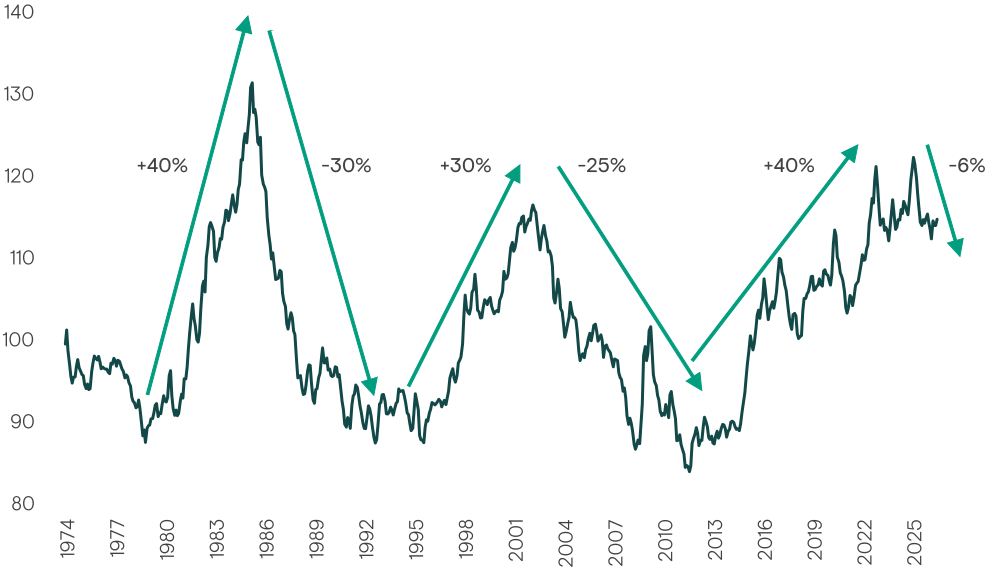
Source: US Federal Reserve, Broad US Dollar Real index, March 1973 – 31 July 2026. For further information on indices, please see the Important Information section.
Looking ahead, the path of Fed policy introduces further uncertainty to the outlook for the dollar. Markets are pricing several further hikes before a return to cuts. While an extended US hiking cycle is not our base-case expectation3, a resilient domestic economy and a steepening curve could force policy tightening (good for the dollar; bad for EM currencies). But the most recent FOMC meeting added a further complication to forecasting – signals of a preference for tightening via the Fed’s balance sheet rather than through rate hikes suggest a bearish outlook for the dollar and US duration and more supportive conditions for EM currencies.
From a more structural perspective, as diversification remains in focus and capital flows follow a less US-centric path, another decade-long US dollar bull market appears increasingly unlikely. Regardless, the path of the dollar is becoming less relevant for EM debt.
For investors, we think all of this paints a positive outlook for EM FX. But selectivity remains key: countries with weaker external buffers or higher inflation could see currency pressure if the Fed turns more hawkish than expected – these are factors to monitor closely.
A clear pattern to emerge from this year’s geopolitical turmoil is the overall resilience of emerging markets. In economies, this is reflected in broadly well-behaved inflation and resilient fundamentals; in financial markets, it is evident in the short-lived nature of initial sell-offs. However, this resilience is not uniform, and the dispersion across countries is what creates significant opportunities for active investors to exploit.
During the early stages of the conflict, oil exporters such as Angola, Nigeria, Brazil and Colombia benefitted; subsequently, supportive election outcomes drove rebounds in Colombia, Peru and Hungary, while better-than-expected data drove a broad-based recovery among oil importers. In addition, while terms-of-trade (the price of a country’s exports relative to the price of its imports) have improved in aggregate – making this shock very different to 2022 – there has been a marked deterioration in Asia (Thailand and India) and Central and Eastern Europe (Czechia and Poland).
In short, while the Middle East conflict remains a key risk and investors should closely monitor the external position of oil importers, a diverse impact means active investors can pivot towards pockets of the market that would benefit from energy market disruption.
While political risk has become a lesser force in emerging market debt, as noted here, it can still rear its head. In the past, credit rating downgrades have spilled over into broader EM sell-offs, either mechanically – as index exclusion forced passive funds to sell regardless of view (e.g., South Africa’s exclusion from FTSE’s World Government Bond Index in 2020) – or through sentiment, if investors view one country’s downgrade as a warning sign for its peers.
Indonesia is a live test case – political uncertainty and mounting fiscal risks prompted rating agencies to cut the outlook from stable to negative earlier this year. While we see a meaningful risk of a downgrade to Indonesia’s credit rating within 12 months, and scope for further credit spread widening if the fiscal trajectory turns negative, we believe there is limited risk of contagion; the sovereign upgrade cycle in EM is the strongest it has been in over two decades.
Given this context, investors can seek to pre-emptively position ahead of upgrades and take defensive positioning in markets – such as Indonesia – that are at risk of downgrade.
A further potential headwind to emerge this year relates to AI. The equity market sell-off seen in July sparked concerns across the EM asset class. Yet associated risk is concentrated in the AI and semiconductor space (Samsung and SK Hynix alone are more than half of South Korea’s KOSPI index), and neither Korea nor Taiwan appears in JP Morgan’s GBI-EM index at all.
In other words, the epicentre of the equity market move is largely absent from the debt universe, and debt flows have continued through it. While the equity market sell-off may impact currencies, even here the risk seems low: when the KOSPI was rallying, foreigners were forced sellers (to meet regulatory concentration limits), which put pressure on the Korean won; as the market has since sold off, that pressure has eased and the currency has strengthened.
For the structural reasons outlined below, we believe the risk of an equity market sentiment shift on weakening AI conviction will have a muted impact on the EM debt cycle.
Over the past decade, the EM debt asset class has matured – the universe now spans commodity exporters and importers, frontier reformers and global technology leaders. Furthermore, a far greater share of borrowing is done in local currency, which reduces sensitivity to the dollar and has built a domestic investor base that tends to absorb shocks rather than amplify them. That shows up in the volatility data: rolling three-year volatility has been falling across EM local currency debt while DM bond volatility has risen4, and Saudi Arabia’s local currency index entry in early 2027 should reinforce this trend further. This forms a broader structural shift we call the “EM’ification of DM”: developed market bonds are increasingly showing the volatility and fiscal risk once associated with emerging markets, while EM debt shows increasing resilience.
Resilient performance of EM debt
Cumulative relative return of GBI-EM Index vs. GBI Global bonds
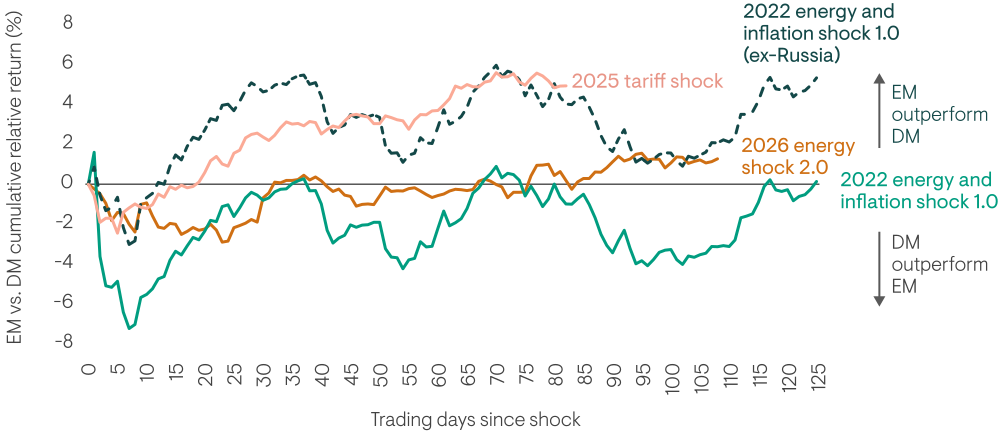
Source: JP Morgan, return analysis using local currency bonds. 2026 Energy shock = 27 Feb 2026 – 17 Jun 2026 (signing of MOU); 2025 Tariff shock = 2 Apr 2025 – 31 Jul 2025 (major trade deals had been agreed); 2022 Energy shock = 24 Feb 2022 – 24 Aug 2022 (six months post initial start of conflict).
In that vein, as the world faces repeated supply shocks, emerging markets are on more solid foundations to weather the storm: debt-to-GDP of around 88% against 117% in developed markets, real growth of 4.0% against 1.7%, an aggregate current account surplus for emerging markets against a deficit for DM (particularly the US), and a much more attractive benchmark yield in nominal and real terms relative to DM.5
Finally, the global growth outlook is becoming less US-centric, with an increasing number of positive growth surprises for Europe and across emerging markets. Emerging markets sit at the centre of supply chains, commodities and domestic-demand growth, and parts of Asia are emerging as the infrastructure backbone of the AI economy – the global AI factory on which US-developed models will increasingly depend. Investor behaviour is following. Inflows have continued through this year’s disruption, and long-term investors seem to grasp that EM debt has earned a more mainstream place in portfolios.
This year’s headwinds (a firmer dollar and uncertain Fed policy path, an energy shock, isolated rating pressures and AI-related volatility) are cyclical rather than structural, and their impact is far from uniform across countries. This dispersion creates opportunities for active investors able to distinguish between markets at risk and those simply caught in the crossfire.
Beneath these near-term pressures, the structural tailwinds supporting EM debt remain undiminished: a more mature, diversified asset class, stronger fundamentals than developed markets, and a dollar cycle that increasingly looks past its peak. For investors prepared to look through the noise and stay selective, the opportunity set has rarely looked more compelling.
1 A benchmark measure of the value of USD relative to a basket EUR, JPY, GBP, CAD, SEK, and CHF.
2 27 February to 17 June.
3 We expect the Fed to keep rates on hold through 2026, with scope for a hike in 2027 depending on the data, even with above-target inflation persisting.
4 Source: Ninety One, JP Morgan, Bloomberg, 30 June 2005 to 30 June 2026. JP Morgan GBI-EM and Bloomberg US Treasury Total Return Unhedged USD. For further information on indices, please see Important information section.
5 IMF April 2026 WEO 2026 Forecasts, JPMorgan benchmarks, Ninety One calculations. DM covers 13 developed markets in the JPMorgan GBI Benchmark. EM covers 19 emerging markets in the JPMorgan GBI-EM.
General risks. The value of investments, and any income generated from them, can fall as well as rise. Past performance is not a reliable indicator of future results. Environmental, social or governance related risk events or factors, if they occur, could cause a negative impact on the value of investments.
Specific risks. Emerging market (inc. China): These markets carry a higher risk of financial loss than more developed markets as they may have less developed legal, political, economic or other systems. Currency exchange: Changes in the relative values of different currencies may adversely affect the value of investments and any related income. Interest rate: The value of fixed income investments (e.g. bonds) tends to decrease when interest rates rise. Default: There is a risk that the issuers of fixed income investments (e.g. bonds) may not be able to meet interest payments nor repay the money they have borrowed. The worse the credit quality of the issuer, the greater the risk of default and therefore investment loss.
