Back on the radar – a renewed focus on EM local currency debt
Today, asset allocators are looking more closely at some of their underweight allocations, with asset classes like emerging market (EM) local currency debt back in the spotlight as a result.
A shift in asset-class behaviour is a key factor behind this renewed focus. Heightened volatility in developed market (DM) assets highlights a trend we have noted since 2022: traditional ‘safe haven’ debt markets have entered a new (higher) volatility regime, while supposedly ‘risky’ areas of the market – notably emerging market (EM) debt – have shown surprising resilience. In addition, financial markets are digesting the implications of a new era for US fiscal risks and the potential new cycle for the US dollar.
Few would dispute that EM local currency debt has been out of investor favour in recent years, not least given the lacklustre performance of the past decade or so, with the extended US dollar rally eroding returns. But the dollar tide may be turning, and with real (inflation-adjusted) yields in the EM debt market today at historically elevated levels, even a modest dollar decline could offer meaningful upside to the EM local currency debt asset class.
Cyclically, the asset class seems well placed. Crucially – and the focus of this piece – a significant and structural evolution has taken place in the flagship EM local currency debt market index (JP Morgan GBI-EM Global Diversified Index, referred to as “the index” in this paper), resulting in a market that looks and behaves differently today compared with a decade or so ago.
This paper considers how the asset class has evolved from three perspectives - credit quality, volatility, and ownership - before reflecting on other key considerations for investors.
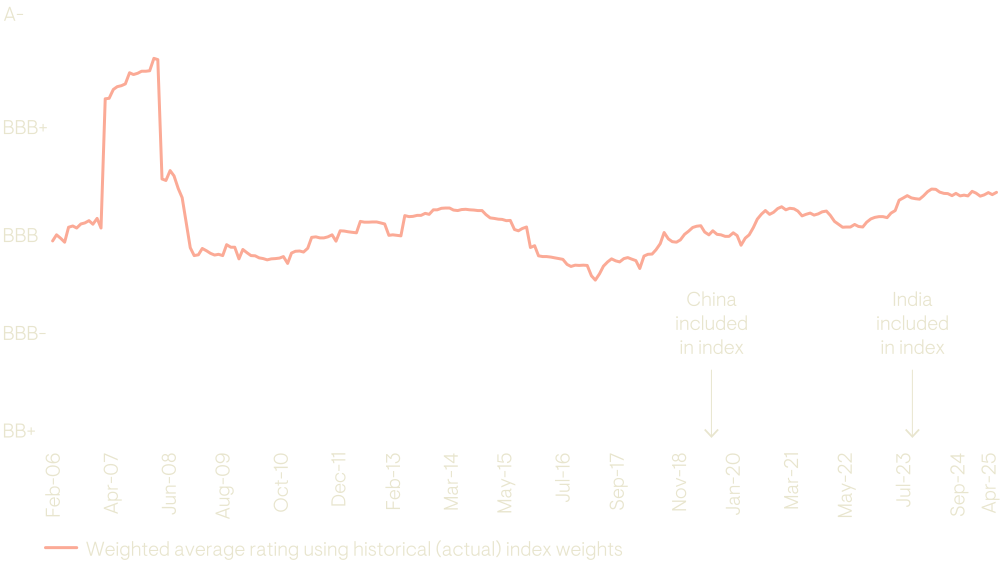
Over the past decade, the index has evolved in tandem with the growth of domestic debt markets across its constituent countries. New entrants have had a meaningful impact on the overall composition of the index, contributing to a steady improvement in credit quality (Figure 1). Structural improvements in the creditworthiness of underlying sovereign issuers, outlined later in this piece, also underpin this trend.
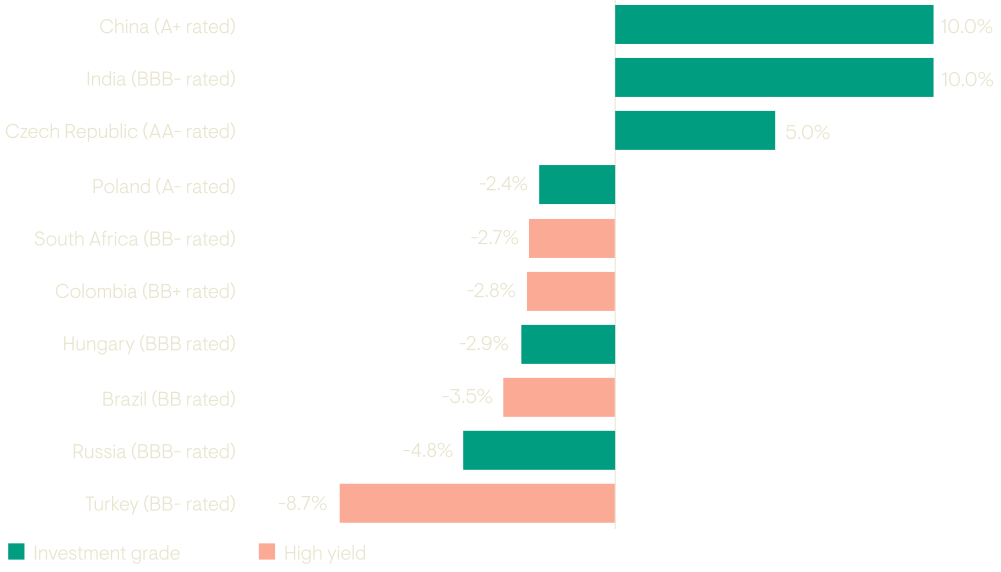
New entrants – including China and India – have increased the skew of the index towards investment-grade constituents (Figure 2). Meanwhile, the weights of markets with lower credit quality, such as Turkey, Brazil, Colombia and South Africa, have reduced. As a result, high-yield debt accounts for less than a fifth of the index (19%) today, and with Saudi Arabia on the radar for potential index inclusion, the overall quality of the index (now approaching BBB+) could rise further.
Figure 1: The quality of the index is high and improving
Overall index credit quality over time
Source: Ninety One, JP Morgan. As at June 2025. For further information on indices, please see Important information section.
Figure 2: In part, this reflects a skew in favour of high-quality markets
Top 10 markets by absolute change in index weight since mid-2015
Source: Ninety One, JP Morgan. As at June 2025. Top 10 largest absolute changes in weight since mid-2015 of JP Morgan GBI-EM constituent countries. For further information on indices, please see Important information section.
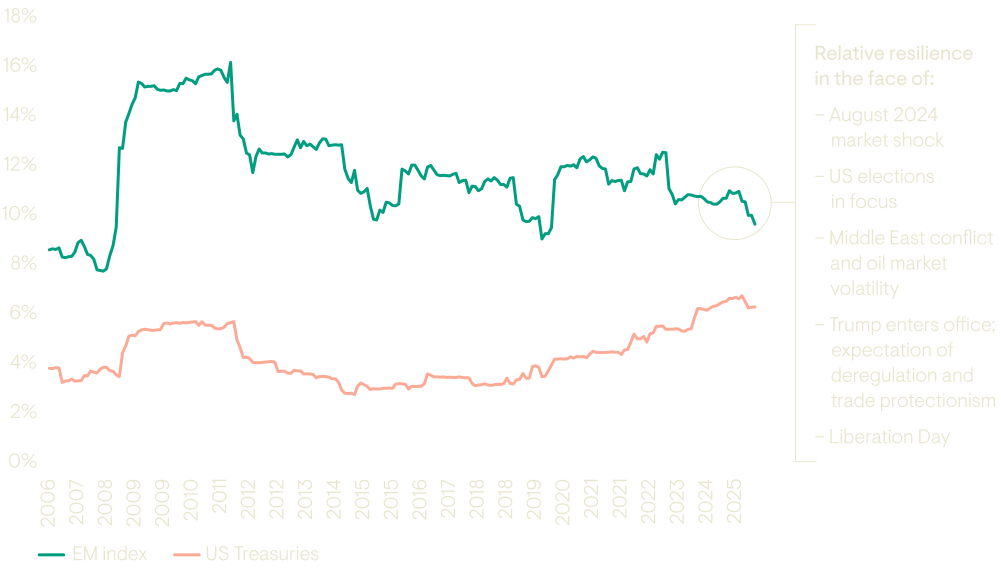
The EM local currency debt market is inherently volatile. What is remarkable in recent years is that the return path of the asset class has remained in-line with its historical behaviour, even when faced with heightened global stress. This contrasts starkly with developed market debt: as noted in a recent paper and shown in the context of US Treasury market yields in Figure 3, developed market debt has entered a new (higher) volatility regime.
If anything, EM currency debt market volatility has fallen. Zooming in on more recent behaviour, faced with episodes of macroeconomic and geopolitical turbulence seen over the last 12 months – including significant political upheaval, the re-emergence of global protectionism, and conflict-driven oil-price spikes – the EM debt market response has been relatively muted.
Figure 3: A more volatile regime in developed markets; early signs of falling volatility in EM
EM index and US Treasury market volatility, rolling 36 months (%)
Source: Ninety One, JP Morgan, Bloomberg, 30 June 2005 to 30 June 2025. JP Morgan GBI-EM and Bloomberg US Treasury Total Return Unhedged USD. For further information on indices, please see Important information section.
This increased resilience makes sense. First, a structural rebalancing has taken place in EM economies, as we discussed here. Second, in addition to lifting the overall credit quality of the market, the index composition changes noted earlier have also improved the strength of the market from a macroeconomic perspective.
Expanding on the latter point, one way to gauge resilience to external shocks is to consider current account balances. A common characteristic of the GFC, taper-tantrum and COVID-19 shocks – and associated sell-offs – was EM FX weakness, exacerbated by current account deficits1. Today, the GDP-weighted current account balance is in a small surplus in EM, contrasting with the deficit seen in DM.
Figure 4: A current-account surplus underpins EM resilience
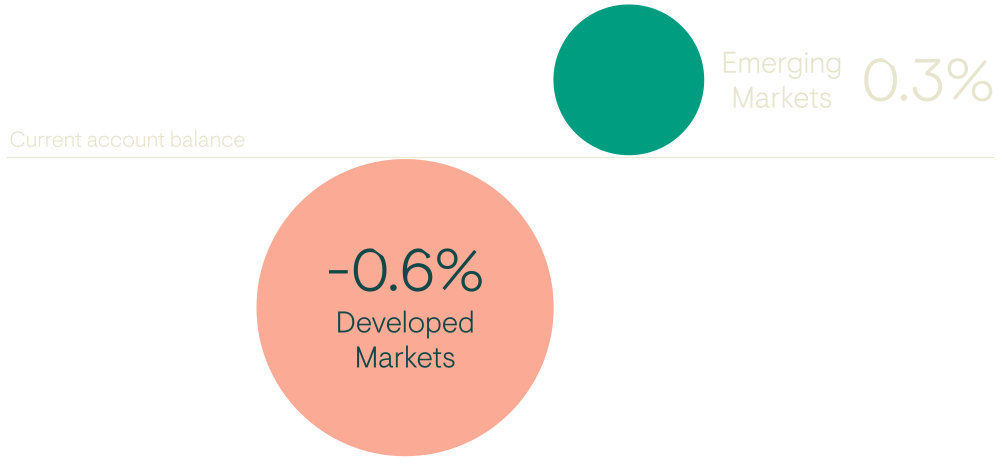
Source: IMF October 2024 WEO, Ninety One calculations. DM covers 13 developed markets in the JPMorgan GBI benchmark. EM covers 19 emerging markets in the JPMorgan GBI-EM. Data is weighted by GDP.
Since its peak at around 25% in 2014, international ownership of EM local currency central government debt has dropped to just 14.6% (Figure 5), as local debt issuance has continued to rise. While at the time of the taper tantrum, this shift reflected heightened investor caution around EM allocations, since then, domestic savings pools - including pension funds, insurance companies, and banks - have grown considerably, driving up domestic demand for local currency debt. These domestic investors now represent the lion’s share of local currency bond ownership.
Crucially, domestic investors are typically less sensitive to swings in global sentiment, reducing the risk of sharp outflows during periods of external stress. Lower foreign ownership also means the market is less vulnerable to forced selling by benchmark-driven or passive investors, supporting a more stable market structure overall. As a result, the index is now less prone to sudden, exogenous pressures when global liquidity conditions tighten, reinforcing its resilience today.
Figure 5: Foreign holdings of local currency sovereign debt have fallen steadily since peaking in 2014
Percentage of international holdings of local currency debt
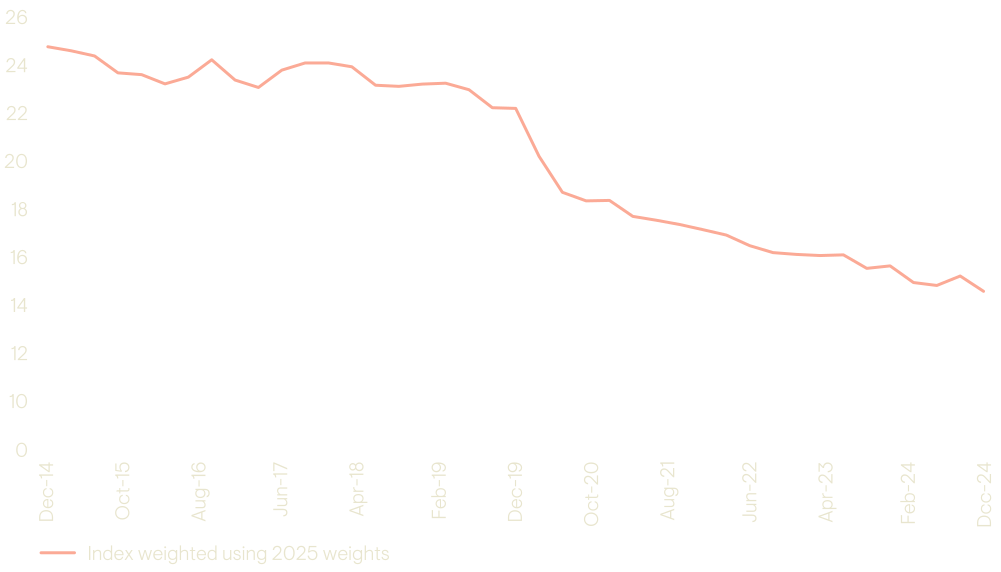
Source: Ninety One, Haver Analytics, December 2024. Weighted average ownership data was calculated using available country data.
Further considerations for investors
A highly diverse opportunity set lends itself to active management
Significant diversity is a key feature of the EM local currency debt market. This makes the asset class a useful portfolio diversifier, as we noted here. Crucially, it also creates a rich hunting ground for active investors.
An active management approach allows investors to take advantage of dispersion in country fundamentals and stages of monetary policy cycles. Active investors can also explore the growing frontier-market opportunity set; while the index remains relatively concentrated (comprising 20 countries), the investable universe has expanded dramatically. The number of investable EM local currency markets has grown from 30 in 2015 to 712, with frontier markets driving this. With characteristics such as high yields and low correlations to global markets, frontier local currency debt offers compelling off-benchmark opportunities to investors with the technical ability and research resources to exploit the full market. Among these markets, some compelling growth stories can provide additional diversification benefits as well as an additional yield pick-up given their lower credit rating than the overall index. Active management is particularly suited to frontier markets given the complexities of investing and hurdles to entry in some of these less established EM markets.
In short, the asset class has evolved to be one of huge breadth, offering high quality and liquidity while still providing an attractive yield pick up to developed market bonds.
Valuations point to a compelling entry point
While the evolution of the asset class has strengthened the structural investment case, there are also supportive cyclical arguments in favour of an allocation today. As shown in Figure 6, real (inflation-adjusted) yields in EM are at 20-year highs, presenting a compelling entry point for long-term investors.
This is not just a valuation anomaly; it reflects the prudent and proactive policy response to rising inflation post COVID-19 by EM central banks. In contrast to many developed markets, EM central banks began raising interest rates as early as 2021, pre-empting inflationary pressures in the wake of the pandemic and global stimulus. Their early and decisive actions - anchored by credible inflation targeting regimes – have earned market confidence. Notably, EM policymakers have also shown discipline during the easing cycle, refraining from making premature rate cuts and allowing real rates to rise meaningfully.
At the time of writing, the nominal yield of the index stands at 6.27%, while inflation has declined sharply, pushing the real policy rate to 3.23% - well above historical averages and levels seen in developed markets. The last time EM real yields were this elevated was in the early 2000s, a period marked by strong capital inflows, currency appreciation, and high total returns for the asset class.
Figure 6: Real rates are at a 20-year high
Nominal yields, real yields, and inflation
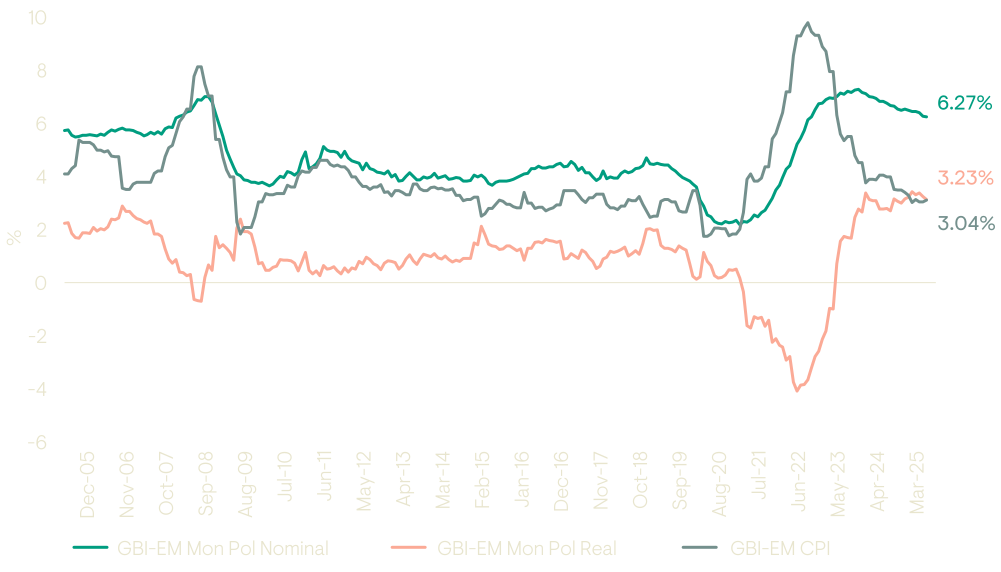
Source: Bloomberg, Ninety One, 31 July 2025, on a 1 -month rolling basis. EM is the weighted average of emerging market countries in the JPMorgan GBI-EM GD benchmark.
A tipping point for the US dollar
A further factor pointing to now being an attractive entry point into the EM local currency debt asset class relates to the path of the US dollar. After more than a decade of US dollar dominance, the currency’s extraordinary rally may finally be peaking. For EM debt investors, a weaker dollar could mark a long-awaited shift from headwind to tailwind.
The US dollar has appreciated by over 40% since 2011, reaching valuation extremes that have led to global imbalances and a loss of US manufacturing competitiveness. As noted here, purchasing power parity comparisons highlight the dollar’s overvaluation, with GDP in emerging markets on average 2.4x higher in PPP terms than in US dollar terms, and much higher than they were in 2011. The current divergence in PPP GDP versus US dollar GDP mirrors past US dollar peaks that preceded sharp corrections, such as the early 2000s and the 1985 Plaza Accord. A tipping point in the US dollar cycle seems to be upon us.
A 20–30% dollar decline would likely restore US competitiveness against other developed markets and serve as a major tailwind for EM debt, particularly local currency bonds, which have underperformed during the dollar’s extended rally.
In summary
A significant and structural evolution has taken place in the flagship EM local currency debt market index, resulting in a market that looks and behaves differently today compared with a decade or so ago. This reflects in a higher-quality index that is more resilient to external shocks and less volatile. Together with a cyclical tailwind in the form of high real interest rates, and a potential turn in the US dollar cycle, this strengthens the investment case for including the asset class in global fixed income portfolios today, but active management is key to capturing the full potential of this richly diverse asset class. We believe underweight allocations carry a significant opportunity cost.
General risks. The value of investments, and any income generated from them, can fall as well as rise. Costs and charges will reduce the current and future value of investments. Past performance does not predict future returns. Investment objectives may not necessarily be achieved; losses may be made. Target returns are hypothetical returns and do not represent actual performance. Actual returns may differ significantly. Environmental, social or governance related risk events or factors, if they occur, could cause a negative impact on the value of investments.
Specific risks. Emerging market (inc. China): These markets carry a higher risk of financial loss than more developed markets as they may have less developed legal, political, economic or other systems.
1 Current account deficits resulted in a heavy reliance on foreign capital inflows into emerging markets.
2 JPMorgan, October 2024. Number of countries with investable local currency market (either FX or bonds).
