Emerging Market Debt Indicator – February 2026
Reflections on developments across the EM Debt investment universe in February, with an update on portfolio positioning in the context of the current conflict in the Middle East.
Africa’s economies are among the fastest growing in the world. Driven by young, urbanising populations and expanding private sectors, the continent represents a strong long-term growth and development story. Many African countries are modernising institutions, investing in infrastructure and embracing technology – creating a powerful backdrop for investors. Yet the continent’s bond markets are still relatively untapped by global investors.
Africa’s GDP will continue to represent a larger part of the global economy
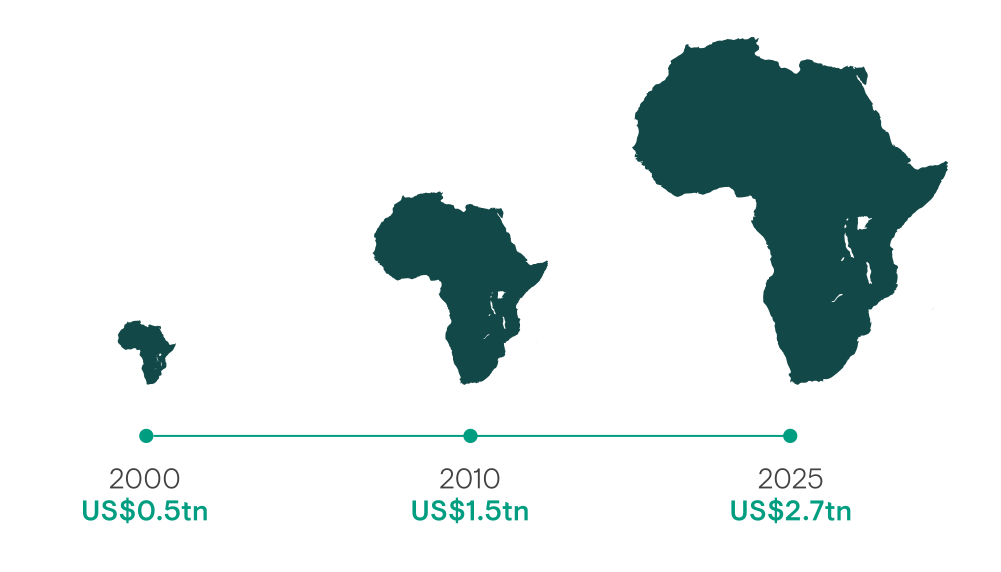
Source: IMF WEO, Ninety One calculations, as at 31 October 2025.
Despite being overlooked by many investors, Africa’s fixed income markets offer a very compelling mix of attributes, as outlined below. In short, African markets generally provide a significant yield pick-up for almost half the duration of more mature emerging markets. For investors, that’s a rare combination.
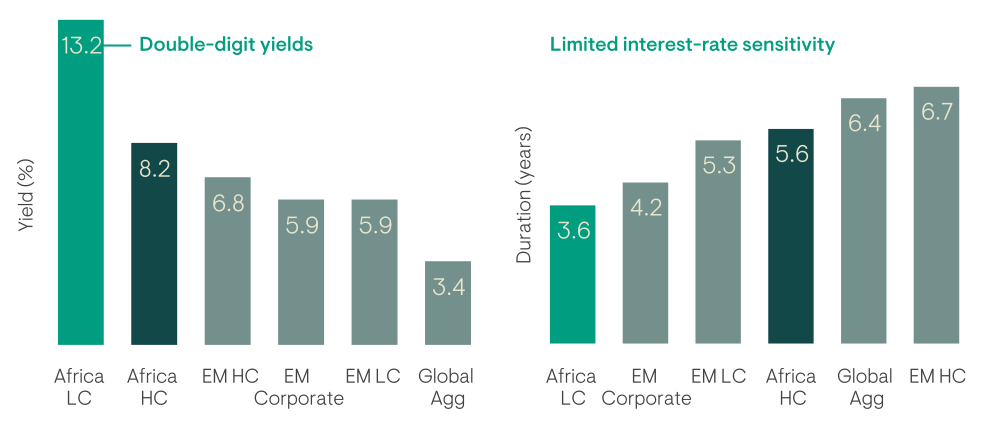
The amount of income payable may rise or fall.
Source: Bloomberg, Ninety One calculations, as at 31 October 2025.1
For further information on indices, please see the Important Information section.
A further compelling characteristic of the asset class is the diversification benefit it can bring to portfolios.
The asset class has a relatively low sensitivity to the global bond market
Past performance is not a reliable indicator of future results, losses may be made.
Source: Bloomberg, JPMorgan, BofA, Ninety One calculations, 31 December 2024. Beta is calculated relative to Barclays Aggregate Bond Index using monthly USD returns from December 2014 to December 2024.1
Africa’s political and economic fabric is typically misunderstood. Over the past few decades, democratic elections have become the norm, with a total of 133 multiparty elections held between 2011 and 2021, as highlighted by The Brookings Institution. More broadly, governance has transformed across the region; today, a growing number of African countries have independent central banks, which – like their developed market counterparts – have a clear mandate to manage inflation. In recent years, these institutions have demonstrated remarkable credibility, moving decisively to rein in inflation several years ago and then adopting a cautious approach to monetary policy easing – this has kept real (inflation-adjusted) yields elevated and inflation well-contained, allowing some central banks in the region to cut interest rates.
Naturally, there are exceptions to these positive dynamics, and it is crucial that investors get a clear picture of each sovereign issuer’s governance risks. To that end, Ninety One applies a proprietary forward-looking Environmental, Social and Governance (ESG) score and assessment framework to African markets in the same way as the rest of the global investment universe. While the starting point may be different for countries across the emerging market investment universe, including Africa, the ESG framework focuses on direction of travel. Today, over half of the 19 African markets in our ESG scorecard show a positive ESG trend. Highlights include Côte d’Ivoire, where governance has significantly improved in recent years, and Ghana, which continues to perform well on social indicators such as health and education.
Our ESG framework, plus the indices underpinning it2, provide the data that helps us focus our engagements with policymakers on the issues that can drive real progress. For example, our recent engagements in Egypt have focused on fiscal reforms aimed at simplifying the tax system to enhance the business environment and attract more investment. Policymakers have taken initial steps towards reform, but successful implementation is crucial to realise the expected economic benefits; our ongoing engagement will seek to ensure that reforms are followed through effectively.
Africa’s fixed income market has seen significant changes over the last 20 years. What began with only a few large issuers and debt issued predominantly in US dollars has evolved into a diversified and mature market comprising both local currency and US dollar debt. Most African markets today are reminiscent of the emerging market world in the early 2000s, when markets were characterised by significant risk-adjusted returns opportunities, high growth potential, and were less crowded.
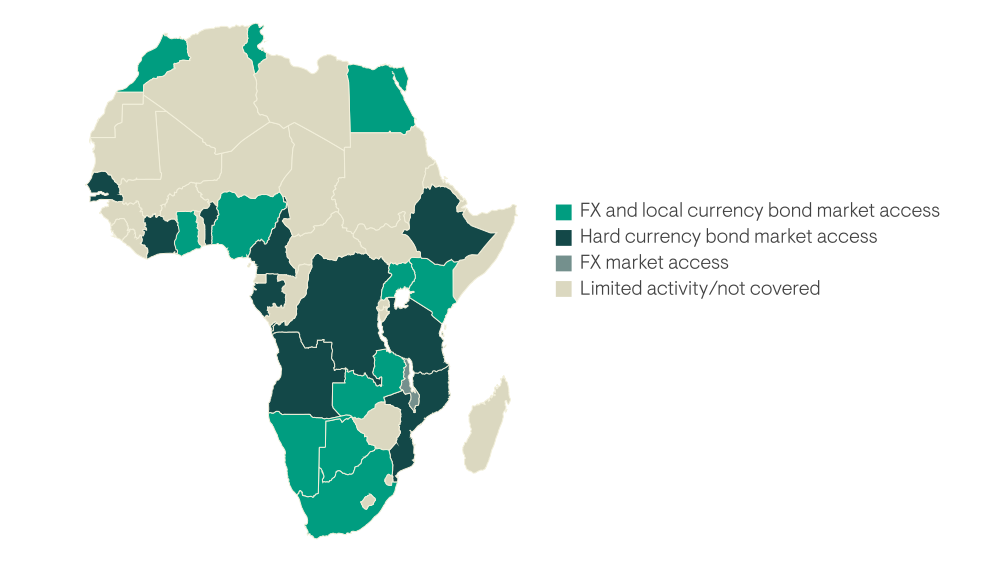
Significant diversification within the African fixed income universe means opportunities span a wide range of economies – from energy exporters like Nigeria and Angola to reform-focused markets such as Egypt, Kenya and Morocco. This means that investors not only gain access to compelling growth stories, but also can capture meaningful yield premia in markets that are still under-researched.
| Dollar debt | Local debt | |
|---|---|---|
| Definition | EM government and 100% state-owned company debt denominated in US dollars (and other hard currencies) | EM government debt denominated in the domestic currency of the issuer |
| Return drivers | US Treasury yield + spread | Local bond yield + FX return |
| Universe* | 17 countries | 11 countries + 16 FX markets |
Source: Ninety One as at 31 December 2024. *Universe is referencing the ‘liquid Africa universe’ which we define as having daily turnover of more US$20m a month (US$1m a day). Dollar debt/hard currency = portfolio of 17 equal-weighted Africa hard currency markets; Local debt = portfolio of 11 equal-weighted Africa local markets. For illustrative purposes only.
At first glance, double-digit yields, low volatility and stable fundamentals may seem too good to be true. The explanation lies in market inefficiencies, combined with a lack of research coverage and limited focus on Africa among global market participants. This creates a rich hunting ground for active investors and helps Africa fixed income to really stand out in today’s financial markets. With pricing often diverging significantly from fundamentals, there are ample opportunities for investors with the right expertise and local market knowledge.
A high-conviction, active investment approach can uncover significant mispricing opportunities to capture compelling upside return potential, while taking care to avoid the downside risks that come from weaker credit or unsustainable policies in this highly diverse set of markets.
In today’s context, valuations look compelling: credit spreads (i.e., risk premia) are generous, even as macroeconomic fundamentals have improved markedly in recent years across many of these markets, presenting a good entry point for global fixed income allocations.
Developed market bonds are experiencing a new regime of heightened volatility – stemming from negative fiscal headlines in the UK to threatened central bank independence in the US – blurring the traditional divide between emerging and developed markets.
In contrast, several African countries are taking tangible steps toward fiscal consolidation and policy reform. This has been recognised by credit rating agencies in recent months, including S&P upgrading Kenya to B on improved external balances, and Morocco to investment grade (BBB-) on stronger fiscal metrics.
For context, debt-to-GDP ratios across many African economies are stabilising3, driven by tighter fiscal policy and a rebound in growth. Many African economies have implemented fiscal reforms, while IMF-backed programmes are encouraging greater transparency and policy discipline – energy transition funding initiatives in countries like Senegal – a country we wrote about recently – and Rwanda further demonstrate the positive link between reform and sustainable finance. In addition, many are now running primary fiscal surpluses3, well above what’s required to stabilise or reduce debt levels.
Case study: Egypt’s reform story
Ninety One, founded in South Africa in 1991 and today a global investment manager, offers authentic expertise in African and broader emerging markets.
With African roots and a long-standing local presence, Ninety One brings an insider’s perspective to a region that many global firms approach from the outside in. The firm has played a pioneering role in the African fixed income market thanks to its African heritage, deep local knowledge of African markets, and rich history of investing significant capital in African markets.
|
1991
Founded in South Africa |
50+
people across Africa fixed income teams |
US$20bn
across African rates and credit strategies4 |
Our local presence allows us to actively engage with policymakers, affording us a privileged understanding of macroeconomic dynamics in the region. And with an African business that spans public and private markets, Ninety One is able to harness a significant amount of knowledge across countries and sectors when forming an investment view.
On the public market side, since the inception of our global emerging market debt strategies some 20 years ago, African fixed income has been an important focus area given the significant investment potential offered by this under-researched market. Today, our African fixed income portfolios benefit from global reach, supported by investment teams across North America, Europe and Asia. Turning to our private credit platform, since 2008, our African Private Credit platform has launched 20 vintages and deployed more than US$16 billion5 across corporate and infrastructure debt strategies. In managing strategies, including the Africa Credit Opportunity and Emerging Africa & Asia Infrastructure Fund (EAAIF), we’ve made more than 1,200 investments and returned investors’ capital on 11 fully realised vintages. This on-the-ground lending expertise strengthens our understanding of credit dynamics and complements our public-market insights.
Africa’s fixed income markets provide investors with exposure to significant structural growth underpinned by fundamentally improving economies. This rich opportunity set provides attractive yields and opportunities for capital growth. With a long-standing presence and expertise across the continent, Ninety One is well placed to navigate this evolving landscape and capture its long-term potential.
Past performance does not predict future returns; losses may be made.
For further information on investment team, please see the Important Information section.
1 Benchmarks: Africa LC = S&P Africa Sovereign Bond Ex-Tanzania and Ex-South Africa (15% Capped); Africa HC = NEXGEM Africa Index; EM HC = JPM EMBI GD; EM Corporate = JPM CEMBI BD; EM LC = JPM GBI-EM; Global Agg = Bloomberg Global Aggregate Index; Africa fixed income = blended benchmark comprising 70% S&P Africa Sovereign Bond Ex-Tanzania and Ex-South Africa (15% Capped) and 30% NEXGEM Africa; US high-yield credit = BofA US High Yield Index; and EM currencies = JPM ELMI+.
2 Sovereign Biodiversity Index, Net Zero Sovereign Index, and the Sovereign Climate Risk Index. For further information on the investment process, please see the important information section.
3 World Bank, Africa’s Pulse, Volume 32, October 2025.
4 Figure includes strategies investing in public and private markets, some of which are closed-end funds.
5 The capital deployed amount includes reinvested capital.
General risks: The value of investments, and any income generated from them, can fall as well as rise. Where charges are taken from capital, this may constrain future growth. Past performance is not a reliable indicator of future results. If any currency differs from the investor's home currency, returns may increase or decrease as a result of currency fluctuations. Investment objectives and performance targets are subject to change and may not necessarily be achieved, losses may be made. Environmental, social or governance related risk events or factors, if they occur, could cause a negative impact on the value of investments.
Specific risks: Geographic/Sector: Investments may be primarily concentrated in specific countries, geographical regions and/or industry sectors. Currency exchange: Changes in the relative values of different currencies may adversely affect the value of investments and any related income. Default: There is a risk that the issuers of fixed income investments (e.g. bonds) may not be able to meet interest payments nor repay the money they have borrowed. The worse the credit quality of the issuer, the greater the risk of default and therefore investment loss. Emerging market: These markets carry a higher risk of financial loss than more developed markets as they may have less developed legal, political, economic or other systems.
