A steadier stride: investing in a changed China in the Year of the Horse

As China moves from the Year of the Snake into the Year of the Horse, the next animal in the 12-year Chinese zodiac cycle, investors are asking whether the horse’s association with strength and dynamism will be reflected in how China’s markets are positioned to perform.

11 Feb 2026

12 minutes

Wenchang Ma
Alan Siow

The fast view

  • China in 2026 is fundamentally different from the China of 2014: more institutional, more stable and more innovation driven.
  • The economy has shifted away from property and exports towards advanced manufacturing, AI, clean energy and domestic innovation.
  • Equities and fixed income now tell divergent but complementary stories, with onshore bonds offering stability and offshore credit offering selective value.
  • Equity valuations in several areas still reflect excessive pessimism, especially given improved regulatory clarity and earnings growth.
  • The upcoming 15th Five-Year Plan is a key anchor, reinforcing quality growth, policy stability and industrial upgrading.
  • China’s cost-efficient AI model and sustainability leadership create spillover opportunities across emerging markets.

Entering the new year with momentum

As we exit the Year of the Snake, the next animal in the 12-year Chinese zodiac cycle is the horse, an animal characterised by a powerful, dynamic energy. As China enters another Year of the Horse, investors are again asking whether these attributes are a fair reflection of how its markets are poised to perform.

For investors in Chinese equities and fixed income, the coming year brings a combination of cyclical opportunity and structural recalibration. The anticipated release of the next Five-Year Plan in March, evolving attitudes towards market stability, rapid progress in cost-efficient artificial intelligence, and continued leadership in sustainability all shape the investment landscape. At the same time, China’s relationship with the US, and its deepening ties with emerging markets, will remain critical external variables.

A very different China from 2014

Compared with the last Year of the Horse in 2014, China today is a profoundly different economy and a markedly different investment destination. Its markets are more mature, its growth drivers more diversified, and its policy framework more clearly oriented towards stability, quality and long-term competitiveness.

The last Year of the Horse coincided with a period of opening and optimism in Chinese markets. It was the early phase of Stock Connect, when international investors were beginning to access China A-shares at scale. Participation from foreign capital was still tentative, market structures were immature, and retail trading dynamics dominated price action. This culminated in one of the fastest and most extreme boom-and-bust cycles in modern financial history, as excessive leverage and margin financing fuelled a bubble that burst in 2015, badly damaging investor confidence.

Since then, China’s equity market has undergone a long process of institutionalisation. The investor base today includes a higher proportion of professional and institutional participants, both domestic and international. Regulatory frameworks have evolved towards more market-friendly outcomes, with a greater emphasis on reducing disruption. While confidence was severely tested during bouts of regulatory tightening in areas such as education and gaming in recent years, the market structure itself is considerably more resilient than it was a decade ago.

A transformed economy opens up opportunities

The real economy has also materially changed. In 2014, the troubled property market accounted for close to 30% of economic activity, while exports contributed about one-quarter. Today, both figures have declined meaningfully. Property’s share is closer to the high teens, while exports represent nearer 20% of GDP. In their place, domestic innovation-led growth has become more prominent, supported by sustained increases in research and development spending over the past two decades. For instance, China contributed more than two-thirds of all patent applications filed within Asia and almost half of all applications filed globally during 2024, helping close the gap with the US in innovation.

Figure 1: Asia has filed 70% of patent applications worldwide, with much of this coming from China
Percentage of total patent applications filed by region
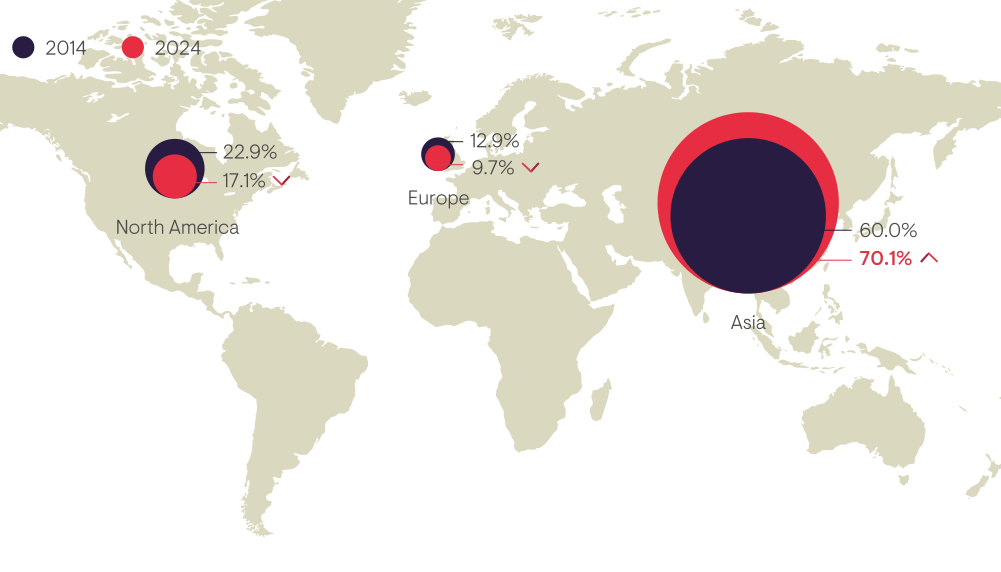
Figure 1: Asia has filed 70% of patent applications worldwide, with much of this coming from China

Source: WIPO Statistics Database, Ninety One. September 2025.
Note: Totals by geographical region are WIPO estimates using data covering 164 offices. Each region includes the following number of offices: Africa (34), Asia (46), Europe (44), Latin America and the Caribbean (31), Northern America (2) and Oceania (7).

This transformation has investment consequences. China is no longer primarily a cyclical property and infrastructure story. Instead, it is increasingly defined by advanced manufacturing, automation, renewable energy, semiconductors and applied artificial intelligence. These sectors benefit not only from domestic demand but also from growing export potential, giving the economy a broader and more resilient growth base. What’s more, this should be reflected in demand for both A-shares – which primarily reflect domestic sentiment – and H-shares, which serve as a gauge of international interest in Chinese stocks.

Fixed income: two markets, two narratives

The evolution since 2014 is equally stark in fixed income. China today effectively offers investors two distinct bond markets. The first is the onshore renminbi-denominated market, anchored by the Chinese government bond curve. The second is the offshore dollar credit market, which has followed a more turbulent and bifurcated path across investment grade and high yield.

In the offshore market, it is important to distinguish between segments. China investment grade credit has performed relatively well, supported by strong demand from domestic Chinese investors. While valuations in this segment may appear expensive in a global context, they provide exposure and technical support that is difficult to replicate elsewhere. By contrast, China high yield, where the bulk of the fallout from the property sector downturn has been concentrated, has experienced a far more challenging period. Valuations in high yield remain relatively cheap, largely reflecting markets continuing to price in a weak and uneven recovery in property, and sentiment remains cautious despite the passage of time since the initial crisis.

Figure 2: Property is becoming less of a problem as its GDP proportion declines
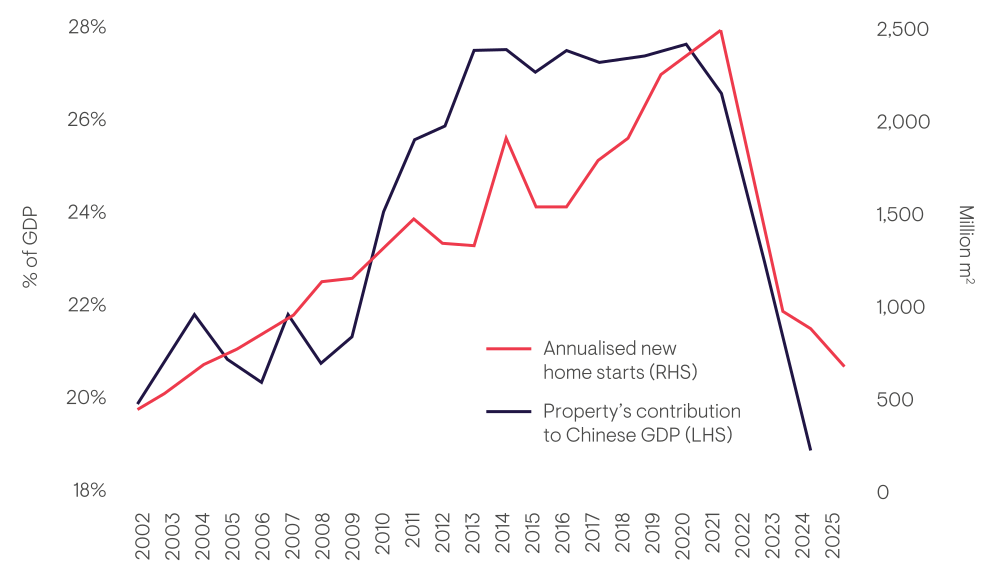
Figure 2: property is becoming less of a problem as its GDP proportion declines

Source: RHS Haver Analytics, Goldman Sachs International Research, January 2026.
This chart has been redrawn by Ninety One.

By contrast, the onshore bond market has continued to mature and increasingly functions as a defensive allocation within global portfolios. With low correlation to developed market rates and positive carry, onshore CNY and CNH bonds offer explicit diversification benefits in a world that is gradually reducing its reliance on the US dollar. While assets such as gold, and to a lesser extent bitcoin, have attracted much of the attention in this context, China’s onshore bond markets are deep and liquid enough to support growing Asian regional and intra-EM capital flows as financial integration across the region continues to gather pace.

Looking ahead, we believe cautious optimism is warranted. Sentiment appears to have passed its trough, and the upcoming Five-Year Plan could provide additional support, particularly if it signals renewed policy commitment to stabilising growth and financial conditions.
The Five-Year Plan as an anchor

China's 15th Five-Year Plan, covering 2026–2030, will be formally released and approved in March during the annual National People's Congress, and is without doubt one of the most important catalysts for the Year of the Horse. In a centrally planned economy, this document functions as far more than guidance. It has the power to reshape incentives, capital allocation and sectoral priorities in a way that few other governments can match.

Importantly, five-year plans are designed to provide continuity rather than shock. The draft direction released in October suggests a focus on higher-quality growth, industrial modernisation and moving further up the manufacturing value chain. Innovation remains central, particularly in areas where China seeks to preserve or extend competitive advantage, such as advanced manufacturing, clean energy and technology localisation.

A key theme is rebalancing supply and demand. Over the past five years, consumption has been subdued, while investment, especially in manufacturing capacity, has surged. This has created overcapacity and pricing pressure across multiple industries. Policy responses now aim to address this through so-called anti-involution measures, introducing greater discipline into pricing behaviour and encouraging consolidation where necessary.

On the demand side, the government continues to avoid direct cash handouts – which is against its philosophy, preferring instead to strengthen the social safety net. Measures targeting healthcare, childcare and elder care are intended to reduce precautionary savings and gradually lift household consumption. For equity investors, this points towards a slower but potentially more sustainable consumption recovery. For fixed income, it reinforces the emphasis on stability over aggressive stimulus.

Stability as an explicit policy objective

One of the defining questions for investors is whether Chinese policymakers now place greater value on stability than in the past. The abrupt regulatory interventions in sectors such as education and gaming were deeply unsettling, particularly given their timing during the pandemic.

Both equity and fixed income perspectives suggest that lessons have been learned. Policymakers acknowledge that earlier regulatory tightening was often uncoordinated, even if well intentioned. Since then, messaging has become more supportive of private enterprise, and there is greater awareness of the market impact of sudden policy shifts.

This does not mean that regulatory risk has disappeared. Rather, it has become more predictable. Targeted interventions, such as recent anti-monopoly actions, are now more likely to be signposted and framed within broader policy goals. Investors, in turn, have become more accustomed to operating within this framework. Stability is increasingly recognised as a public good, particularly given the role of capital markets in supporting innovation and employment.

China as a lower-cost AI pathway

Artificial intelligence is one of the most consequential themes shaping China’s outlook in the Year of the Horse. Unlike Western AI development, which is characterised by massive capital raising and highly visible marketing, China’s approach is notably more cost efficient and commercially focused. Chinese AI companies operate under capital constraints that force efficiency and rapid monetisation. Breakthroughs are often revealed through products rather than press releases, as illustrated by the viral emergence of DeepSeek through app-store adoption rather than promotional campaigns.

This cost discipline has broader implications. If China can achieve meaningful productivity gains from AI without the enormous infrastructure spending seen elsewhere, it offers a lower-cost model that is particularly attractive to emerging markets. AI then becomes a levelling force, allowing economies with fewer resources to leapfrog stages of development.

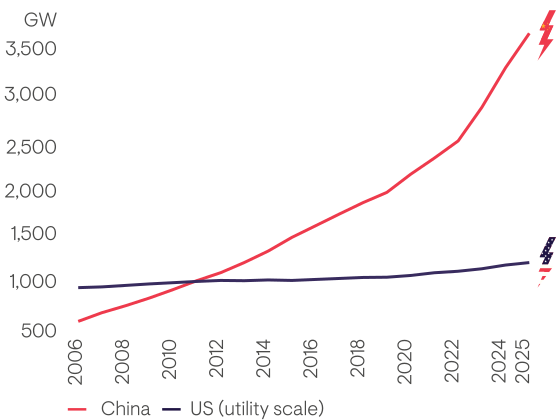
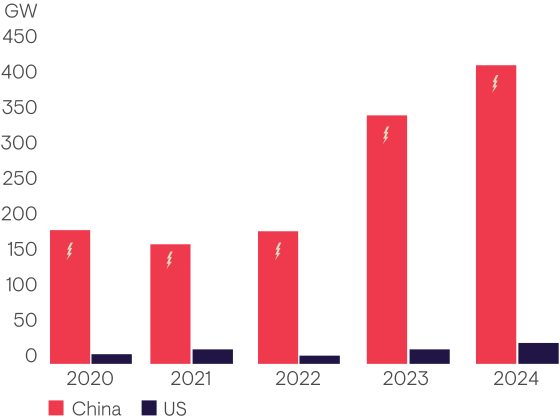
China’s structural advantage in power supply reinforces this narrative. While the country is short of chips – particularly high-end ones – China is adding more renewable-electricity capacity each year than its total demand growth, creating abundant and cheap clean energy for data centres and AI applications. In contrast, power availability is emerging as a bottleneck for AI expansion in the US.

Figure 3: Abundant electricity is currently China’s competitive advantage in the AI race

China and US (utility-scale) electricity generation capacity (stock) 1

China and US (utility-scale) electricity generation capacity (stock)

China and US YoY increase in total electricity generation capacity (net capacity added) 2

China and US YoY increase in total electricity generation capacity (net capacity added)

Source: China Electricity Council, US Energy Information Administration (EIA), CEIC Data, American Public Power Association (APPA).
1 China data up to September 2025, US data up to July 2025. US data based on capacity for utility-scale facilities with at least 1MW of capacity.
2 US data from APPA includes capacity in smaller scale facilities.

For equity investors, this supports opportunities across AI software, automation, data infrastructure and semiconductor localisation. For fixed income investors, it strengthens the credit profile of issuers aligned with China’s technology and energy strategy.

Spillover beneficiaries beyond China

Chinese policy choices rarely stop at the border. In the coming year, several regions stand to benefit from China’s strategic direction. ASEAN economies are already absorbing manufacturing activity as Chinese firms move labour-intensive production offshore while retaining higher-value activities domestically. This creates employment and investment opportunities in countries such as Vietnam, Malaysia and Indonesia.

At the same time, Chinese outward investment is strengthening trade and infrastructure links across Southeast Asia and beyond. Clean-technology exports, particularly batteries and renewable-energy components, are growing rapidly into emerging markets, reinforcing China’s role in shaping global decarbonisation pathways.

For investors, this suggests indirect China exposure through regional supply chains, as well as opportunities in countries that benefit from Chinese capital, technology transfer and demand.

The US relationship: rivalry with resilience

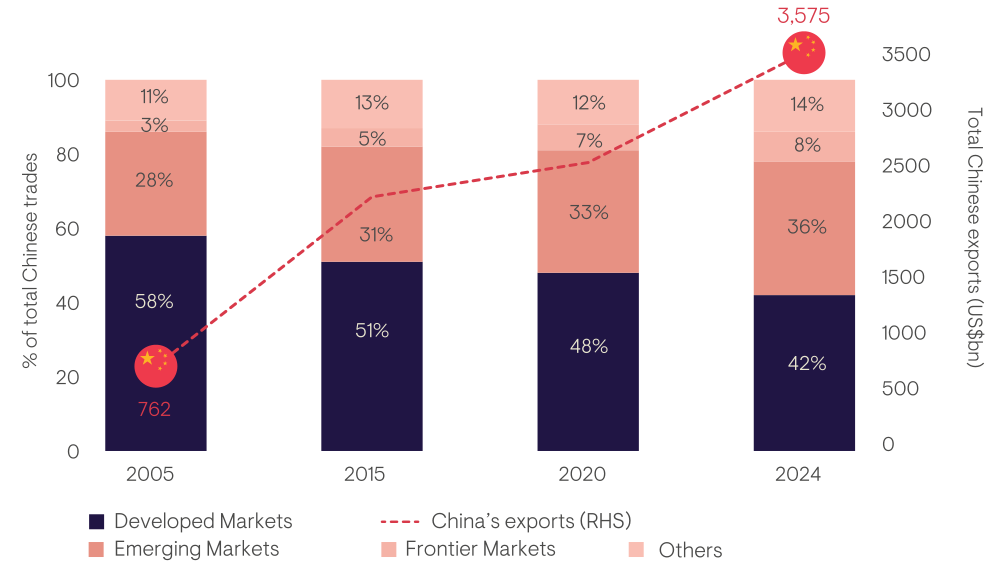
US-China relations will remain unpredictable, but the economic relationship has already adapted. China’s exports to emerging markets now exceed those to developed economies, reducing reliance on the US consumer. Despite tariffs and trade barriers, total exports have continued to grow, supported by improved efficiency, automation and product competitiveness rather than price alone.

Figure 4: China’s exports remain resilient as they rebalance towards emerging markets
Reliance on exports to developed markets is declining while total exports keep rising

Figure 4: China’s exports remain resilient as they rebalance towards emerging markets

Source: Haver, MSCI, Goldman Sachs Global Investment research, Factset. December 2025.

Technology competition is intensifying, particularly in semiconductors. Export controls have accelerated China’s push towards localisation across the semiconductor supply chain. While access to cutting-edge chips remains constrained, innovation has adapted around those limits. Interestingly, power availability rather than chip supply may prove a greater constraint on the US’ AI ambitions, highlighting the asymmetric nature of the rivalry.

Rather than convergence, the most likely outcome is further ecosystem separation, with China and the US developing parallel technology stacks. The most intriguing battleground may be outside both markets, where Chinese AI and technology solutions could gain traction in regions seeking affordable and scalable alternatives.

Sustainability leadership as a structural constant

China’s leadership in sustainability is unlikely to fade in the Year of the Horse. Electrification is already embedded in daily life, not a future aspiration. The country has effectively achieved its 2030 renewable capacity targets ahead of schedule, underscoring the scale and speed of its clean-tech deployment.

While periods of overcapacity have weighed on margins, government-led anti-involution reforms are beginning to restore discipline, particularly in solar and battery manufacturing. At the same time, demand for energy storage is proving stronger than expected, driven by both domestic needs and global AI-related power demand.

For investors, sustainability in China is no longer a niche thematic. It is a core component of industrial policy, export strategy and technological leadership. Even as some Western economies reconsider the pace of their energy transition, China’s commitment appears structurally entrenched.

A more measured and durable year ahead

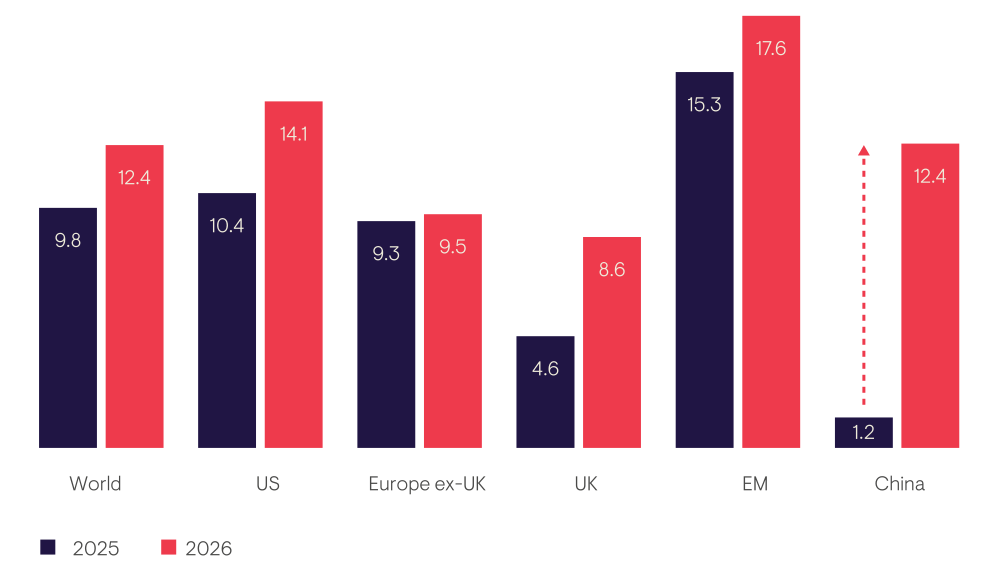
Taken together, China enters the Year of the Horse with a stronger emphasis on endurance than speed. Equities offer selective opportunities in innovation-driven sectors, particularly where policy support, cost efficiency and global relevance intersect. Valuations in several areas still reflect excessive pessimism, especially given improved regulatory clarity and earnings growth.

Figure 5: China leads the forecasted global earnings acceleration into 2026
EPS growth, 2025-2026

Figure 5: China leads the forecasted global earnings acceleration into 2026

Source: Bloomberg, December 2025.

In fixed income, onshore bonds continue to serve as a diversifying anchor, while offshore credit presents higher-risk, higher-reward potential for investors willing to tolerate greater volatility and policy uncertainty. Sustainability-linked and technology-aligned issuers appear best positioned.

The overarching theme is not a return to the exuberance of 2014, but a more measured and durable advance. In that sense, the symbolism of the horse is apt. China’s stride may be steadier, but it is also more balanced, better trained and ultimately more resilient than it was a decade ago.

Authored by

Wenchang Ma
Alan Siow
China - latest insights

Important Information

This communication is provided for general information only should not be construed as advice.

All the information in is believed to be reliable but may be inaccurate or incomplete. The views are those of the contributor at the time of publication and do not necessary reflect those of Ninety One.

Any opinions stated are honestly held but are not guaranteed and should not be relied upon.

All rights reserved. Issued by Ninety One.

For further information on indices, fund ratings, yields, targeted or projected performance returns, back-tested results, model return results, hypothetical performance returns, the investment team, our investment process, and specific portfolio names, please click here.