Key takeaways
- Rapid growth in developed market private credit has increased competition among lenders, lowering yields and weakening loan standards. Cracks are now appearing.
- In contrast, emerging markets (EM) can offer stronger lender protections, including tangible collateral and stricter covenants.
- US private credit faces added risk from AI disruption, with significant exposure to asset-light tech and software firms.
- EM private debt is increasingly funding tangible, future-focused infrastructure (e.g., renewables, data centres), backed by stable cashflows and real assets.
- Attractive returns in EM are driven by deal complexity and stronger lender bargaining power rather than fragile fundamentals.
- In addition to relatively low leverage, EM borrowers benefit from strong macroeconomic foundations that compare increasingly favourably with developed markets.
US private credit: a crowded market showing strain
Last year, two widely publicised failures – of sub-prime auto lender Tricolor and auto-parts group First Brands – highlighted weaknesses in lender oversight. The rise of ‘covenant-lite’ loan structures, which remove key early-warning protections, meant borrower distress went undetected until it was too late.
While many considered these failures to be anomalies, subsequent headlines and developments suggest they were early signals of a broader deterioration of credit standards. According to Fitch Ratings, the US private credit default rate reached 9.4% for the 12 months to January 2026, its highest level since the index’s inception, while payment-in-kind1 use has risen sharply across publicly traded private credit vehicles (BDCs).
These are the structural consequences of a market that grew too quickly – with competition among lenders driving down yields and eroding loan-structuring standards in what has become a borrower’s market’.
The US market's exposure to AI disruption adds a further layer of risk. More than a third of some US private credit portfolios are exposed to technology and business services: predominantly private equity-owned, asset-light software firms. This is a consequence of private credit funds investing heavily into this segment in 2021 and 2022, when yields were low, valuations were at all-time highs, and lenders were willing to overlook fragile fundamentals. Today, the problem is two-fold: the cash flows of these businesses are less predictable than loan underwriting assumed; and AI is compressing the competitive edge of the software companies. Even before AI pressure emerged, many of these borrowers faced a challenging debt-servicing outlook without the revenue growth to match, and a lack of tangible assets mean that when things go wrong, there is nothing for investors to liquidate when seeking to recover their losses.
EM private debt offers a distinctive proposition
The EM opportunity set is not simply protected from the risks currently weighing on the US market, it is actively on the right side of them, while also benefiting from some major structural growth themes.
Firstly, it is inherently dominated by heavy asset sectors – power generation, transmission infrastructure, water, logistics, digital connectivity – physically irreplaceable assets whose value is much harder to erode through AI developments. On the flipside, beneficiaries of AI are also prevalent in the EM opportunity set: data centres and digital infrastructure platforms that exist to meet the energy and capacity demands that AI growth is driving.
Beyond the theme of AI, EM private debt is also exposed to a strengthening structural tailwind: clean technology is already the cheapest form of new energy generation in the vast majority of regions, and a growing focus on energy security, accelerated by recent geopolitical events, is driving further momentum and creating compelling infrastructure investment opportunities.
Last but by no means EM private debt compares very favourably from the perspective of lender protections and underwriting standards, as we explore below. Deals are often made in collaboration with other banks, and stronger bargaining power allows lenders to take a conservative approach to underwriting deals.
A growing and evolving market
There is a powerful structural tailwind behind the EM private credit and infrastructure debt asset classes. With banks’ role in providing term lending reducing, primarily due to tighter regulation around capital requirements, the demand for alternative sources of credit continues to rise. On one hand, the requirement by banks to de-risk and recycle their balance sheets is creating demand for a further scaling of syndication channels; on the other, institutional investors are looking for yield, scale and diversification in their private-market allocations – this is driving demand for asset managers to create diversified pools of assets.
In parallel, there has been a shift in perspective on the asset class – in particular, in financing infrastructure development. While this has historically been centred around impact strategies backed by development finance institutions (DFIs) rather than return-seeking investors, large asset owners are now exploiting the commercial investment opportunities it offers. Part of this evolution relates to the development of more sophisticated rating approaches, enabling EM infrastructure debt funds, for example, to secure investment-grade ratings for certain vehicles to meet institutional investors’ rating requirements.
Where lenders have the upper hand
Unlike the increasingly crowded US private credit market, EM private credit remains lender-friendly. From the perspective of capital structure, the contrast is stark.
While in US direct lending, achieving attractive yields often means accepting unsecured credit or levering a fund vehicle. In emerging markets, the premium is available at the senior and senior-secured level – a reflection of origination complexity and lender bargaining power; investors are compensated for expertise and access, not for taking on more credit risk.
The reason for this favourable risk/return profile is an enduring barrier to entry. The inherent complexity of these markets and the years required to build local expertise and origination networks mean competition remains limited, and the premium shows little sign of eroding.
Investors in emerging markets need local-market experience to recognise where risk is mispriced and extensive expertise in deal structuring. Today, only a limited number of investors are seasoned in this space. A broad and deep origination network – something that cannot be bought or created overnight – also helps ensure diversification and allows lenders to select the best opportunities.
For lenders with the right expertise, the payoff can be compelling. Based on our experience at Ninety One, EM private credit deals benefit from a combination of:
- Conservative fundamentals and strong asset bases
- Deal documentation with comprehensive financial covenants
- Hard currency denominated deals made under developed market legal jurisdictions.
As a result, investors can access EM-level spreads on structures that look more like DM private debt before the space became crowded, and on deals with five-seven-year average tenors.
Higher yields coexist with robust fundamentals
The higher yield available in EM private credit is not explained by weaker fundamentals – quite the opposite. Unsecured lending is rare, and borrowers carry substantially lower leverage than is typical in DM: three to four times in EM versus six to seven times in developed market direct lending. Loan-to-value ratios are also lower, typically sub-40% in EM compared to 50-60% in developed markets.2
Furthermore, deals are frequently governed under UK or New York law, providing investors with the creditor protections of mature legal systems. The opportunity set is also more global than investors might expect, with many transactions underpinned by DM-linked revenues, sponsors or balance sheets. Today, it is not unusual to see the world’s largest sovereign wealth funds as deal sponsors and co-lenders, a clear vote of confidence in the asset class.
The EM private credit opportunity set is inherently heavy asset, low obsolescence (HALO) – think renewable power, telecom infrastructure, data centres and hospitals. These capital-intensive, physically irreplaceable assets contrast with the asset-light, software services business models that are increasingly prevalent in the US private credit market and appear most exposed to risks from AI disruption. This helps explain why annual credit loss rates in the EM private credit market are comparable with developed markets, despite the yield pickup.
The contrast with DM is stark. According to Fitch Ratings, the US private credit default rate reached 9.2% for the 12 months to January 2026 – a record high driven by floating-rate borrowers with minimal interest rate hedging and leverage that left little margin for error.
Against this backdrop, EM credit loss rates have historically been only around 20 basis points higher than DM, despite offering higher yields. These loss rates are consistent with the expected losses of a portfolio of investment-grade-rated assets. The risk premium in EM, in other words, is real – but it is not the credit risk premium investors might assume.
The metrics that matter dispel many myths around EM
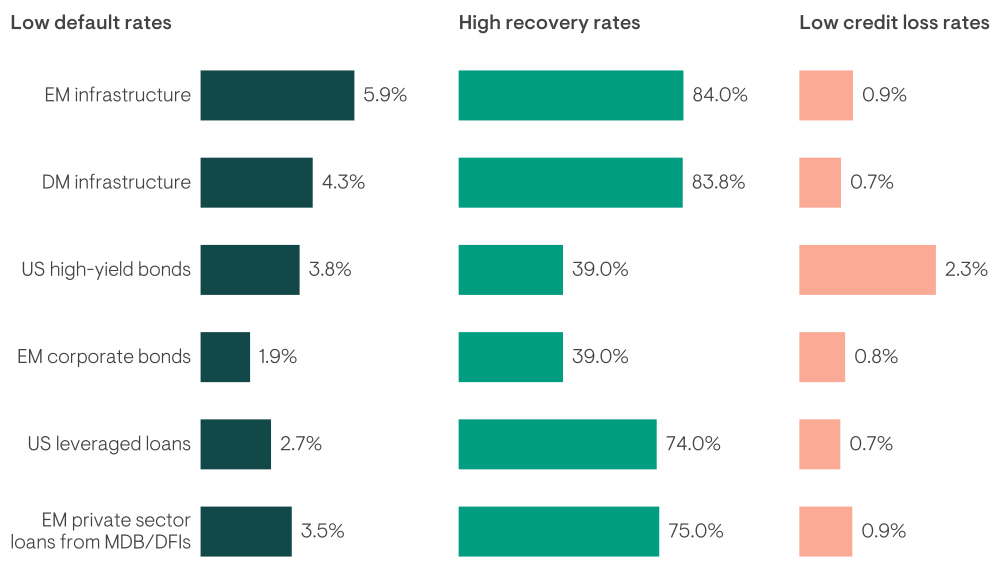
Past performance does not predict future returns; losses may be made.
Sources and notes: Data shown represents long-term averages and is not representative of any specific portfolio or investment. Definitions and methodologies may differ across asset classes and may not be directly comparable. Default and recovery rates are sourced from the following third-party providers: StepStone (DM direct lending), long-term averages 1998–2022; Moody's (EM corporate bonds, US high yield bonds, EM infrastructure and DM infrastructure), long-term averages 1998–2022; Cliffwater (DM direct lending), long-term averages 2004–2022; GEMs - Global Emerging Markets Risk Database Consortium (EM direct lending - MDB/DFI private sector loans), long-term averages 1998–2022. As structural long-cycle data, these figures are not expected to change materially in the near term. Credit loss rates are calculated figures and not independently sourced. Credit loss rate = Default rate × (1 − Recovery rate).
Underpinned by fundamentally sound economies
While perception problems are still common around EM investing, it is becoming harder to distinguish EMs from DMs. Nowhere is that more evident than in bond markets, which are in a new regime – ‘safe havens’ no longer behave as such, DM bond market volatility has risen, and DM yield curves have seen episodes of ‘bear steepening’ on rising fiscal concerns. In short, the lines between EM and DM have blurred.
Several factors help explain this: the economic rebalancing across EM in 2013-2016; more orthodox monetary policy and more restrained fiscal policy within EM; higher quality EM indices; and a more uncertain policymaking backdrop in DM, where institutional credibility is being questioned.
For concrete evidence of the trend of relative strengthening of EM, simply compare EM and DM economies (grouped into two distinct entities) across various metrics:
If ‘EM’ and ‘DM’ were countries, what story would they tell?
Source: DM covers 13 Developed Markets in the JPMorgan GBI Benchmark. EM covers 19 Emerging Markets in the JPMorgan GBI-EM. Where applicable, data is weighted by GDP. IMF October 2024 WEO, JPMorgan benchmarks, Ninety One calculations.
Providing exposure to structural growth areas
EM private debt is increasingly financing the infrastructure of the future. Renewable energy generation, data centre platforms, digital connectivity and electric mobility are among the sectors drawing private capital across emerging markets – driven by powerful structural demand and supported by stable, tangible cashflows and real collateral. These are not the asset-light, highly-leveraged businesses that characterise crowded developed market direct lending.
Recent transactions from Ninety One’s platform illustrate the breadth of the opportunity:
- A US$1.225 billion facility to a high-efficiency data centre platform spanning Mexico, Brazil, Colombia and Chile – powered predominantly by renewables and targeting zero-carbon operations by 2040.
- A US$610 million senior loan to one of India’s largest renewable and storage platforms, co-owned by two sovereign wealth funds.
- A US$439 million facility to a pan-African and Latin American tower company converting diesel-powered infrastructure to solar.
The rapid growth of AI is also giving rise to a new cohort of opportunities, as noted earlier. With data centre electricity demand projected to grow from approximately 2% of global consumption today to around 8% by 2040, EM operators that are aligning energy sourcing with sustainability commitments represent a compelling intersection of structural growth and creditor protection. In 2025, Ninety One lent to two separate data centre operators that have committed to source 100% of their energy from renewables.
In summary
As cracks emerge in US private credit – rising defaults, the proliferation of payments-in-kind, and fraud allegations – the contrast with EM private debt is becoming sharper. EM loans are structured conservatively: senior and senior-secured, covenant-rich, with lower borrower leverage and hard currency denomination. The return premium investors earn is a function of origination complexity and lender bargaining power, not elevated credit risk. EM economies, meanwhile, are structurally stronger than their reputation suggests – running lower debt burdens, faster growth and current account surpluses relative to DM peers. Taken together, this is a market where superior yields and robust downside protection are not in conflict. For allocators reviewing their private credit exposure, the question is no longer why EM – it is why not. In developed markets private credit has become a crowded trade. In emerging markets, it remains a lender’s market – and that makes all the difference.
1 Whereby in lieu of interest payments, the amount owed to lenders is added to the loan balance.
2 Source: Ninety One. For illustrative purposes only. The analysis above considers the publicly listed business development company (“BDC”) Ares Capital Corp (ticker: ARCC) as at 30 June 2025, this comprises 879 non-infrastructure private loans.
General risks. The value of investments, and any income generated from them, can fall as well as rise.
Specific risks. Currency exchange: Changes in the relative values of different currencies may adversely affect the value of investments and any related income. Default: There is a risk that the issuers of fixed income investments (e.g. bonds) may not be able to meet interest payments nor repay the money they have borrowed. The worse the credit quality of the issuer, the greater the risk of default and therefore investment loss. Derivatives: The use of derivatives may increase overall risk by magnifying the effect of both gains and losses leading to large changes in value and potentially large financial loss. A counterparty to a derivative transaction may fail to meet its obligations which may also lead to a financial loss. Emerging market: These markets carry a higher risk of financial loss than more developed markets as they may have less developed legal, political, economic or other systems. Liquidity: There may be insufficient buyers or sellers of particular investments giving rise to delays in trading and being able to make settlements, and/or large fluctuations in value. This may lead to larger financial losses than might be anticipated. Sustainable Strategies: Sustainable, impact or other sustainability-focused portfolios consider specific factors related to their strategies in assessing and selecting investments. As a result, they will exclude certain industries and companies that do not meet their criteria. This may result in their portfolios being substantially different from broader benchmarks or investment universes, which could in turn result in relative investment performance deviating significantly from the performance of the broader market. Credit Risk: Where the value of an investment depends on a party (which could be a company, government or other institution) fulfilling an obligation to pay, there exists a risk that the obligation will not be satisfied. This risk is greater the weaker the financial strength of the party. The Net Asset Value the portfolio could be affected by any actual or feared breach of the party’s obligations, while the income of the portfolio would be affected only by an actual failure to pay, which is known as a default. Borrowing/Leverage: Borrowing additional money to invest increases the exposure of the portfolio above and beyond its total net asset value. This can help to increase the rate of growth of the portfolio but also cause losses to be magnified. Private funds: An investment in the Fund is speculative and involves a high degree of risk. The program is not suitable for all investors. The shares are illiquid with restrictions on transferability and resale. Each investor or prospective investor should be aware that they may be required to bear the financial risk of this investment for an indefinite period of time. An investor may lose all or a substantial part of its investment. There can be no assurance that the investment objectives of the Fund will be achieved. The managers and portfolio structure provided herein is subject to change.
