Five reasons to allocate to natural resources equities (it’s not just about inflation!)
We see five compelling reasons for investors to revisit natural resources equities.
Investors seeking exposure to natural resources typically choose between:
These investments share many of the same drivers of risk and return. They tend to perform well when inflation is higher, and they offer exposure to real-asset cycles and structural growth themes such as electrification and AI infrastructure spending.
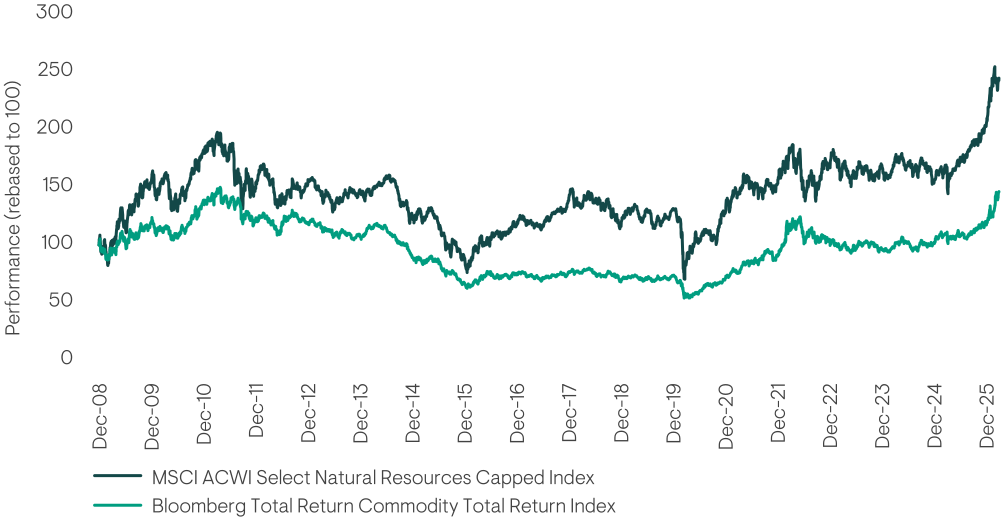
However, their risk and return profiles differ, and over the longer term natural resources equities have tended to outperform the underlying commodities (Figure 1). This paper explores why, and discusses the differences and trade-offs for allocators getting exposure to natural resources directly or via equities.
Figure 1: Natural resources equities have outperformed since 2008
Performance of Bloomberg Commodity Index and natural resources equity benchmark (2008 - 2026)
Past performance is not indicative or a guarantee of future results.
Index performance returns do not reflect any management fees, transaction costs or expenses. It is not possible to invest directly in any index.
Source: Ninety One, 31 March 2026. For further information on indices, please see the Important Information section.
Direct investments in commodities are passive exposures, whereas equities represent stakes in productive assets. A well-managed natural resources company can grow output and reserves, innovate to improve operating efficiency, and allocate capital dynamically across projects and cycles. This offers the potential for value creation independent of commodity price moves.
Put another way, while the returns on direct natural resources allocations reflect commodity price changes, the returns on natural resources equities are also impacted by management decisions and business quality. This highlights the potential value of active management in this part of the equity universe: skilled active managers can generate alpha from both bottom-up security selection (i.e., focusing the portfolio on companies with greater potential to create shareholder value), and from sector and sub-sector allocations based on directionally accurate commodity price forecasts.
Investing in commodities via benchmarks such as the Bloomberg Commodity Index typically involves futures-based exposure, which introduces structural performance headwinds. First, futures may experience a return drag from negative roll yield. This occurs when expiring contracts need to be replaced with more expensive contracts with longer maturities, which has historically been a persistent headwind in many commodity markets2. Physical commodity investments may also incur a performance drag from storage and insurance costs. Natural resources equities allow investors to gain commodity exposure without these structural inefficiencies.
Commodities do not generate income. Natural resources equities, in contrast, can deliver shareholder returns through dividends and share buybacks. This shareholder yield is particularly valuable when commodity prices are stable or range-bound. For example, at the time of writing gold miners’ margins are wide relative to history3. If the gold price remained flat and physical gold did not produce a return, gold producers would maintain a high level of profitability and could continue making cash returns to shareholders.
In addition, the value of natural resources companies can appreciate over time through the compounding of reinvested earnings. This is an important reason natural resources equities have tended to outperform commodities over longer periods.
Some commodities are difficult to access directly. Natural resources equities span a broader set of underlying commodities, giving investors the potential to select additional sources of potential return and diversification. Figure 2 shows the diversity of natural resources subsectors.
Active equity investors can also allocate across the commodity value chain of producers, processors and service providers. This expands the return-generation and risk-management options open to them, enabling active managers to fine-tune portfolio exposures in response to evolving market dynamics. For example, in the energy equity sector, exploration & production, refining and oilfield services are different exposures, and the performances of these equity subsectors can diverge significantly. In precious metals, equity investors can choose between companies with varying degrees of leverage to precious-metals prices, with royalty and streaming companies (which provide financing to mining companies in exchange for a share of future production or revenue) typically at the more defensive-equity end of the spectrum.
Figure 2: Natural resources subsectors
EnergyOil and gas Pipelines Liquified natural gas Renewable energy Uranium Thermal coal |

Metals and miningIron ore Metallurgical coal Copper, nickel, zinc, aluminium Lithium/battery minerals and metals Steel production Precious metals |

AgricultureSeeds, crop protection, fertilisers Agriculture and farm equipment Grains trading and processing Forest-based building products Pulp, packaging and paper products Protein |
Source: Ninety One.
The Bloomberg Commodity Index and natural resources equities have both outperformed in inflationary periods. Consequently, futures and equity natural-resources allocations could both have an important role to play in portfolios if, as we expect, this financial cycle is more inflationary than the previous one, due to structural factors including deglobalisation, electrification, and shifting debt and demographic trends.
However, since December 2001, natural resources equities have outperformed all asset classes, including global equities and futures-based commodities, during ‘high-inflation’ environments (Figure 3). They have also provided competitive returns in normal inflationary environments vs. global equities, while still outperforming futures-based commodities.
Figure 3: Natural resources equities tend to perform well in inflationary environments
| Annualised return during (2002 – 2025) | Fixed Income | Global Equities | TIPS | Futures-based commodities | Natural resources equities | Gold | Global Infrastructure | Global real estate |
|---|---|---|---|---|---|---|---|---|
| High inflation (>3.3%) | 0.2% | 9.6% | 3.5% | 15.4% | 22.2% | 16.2% | 11.5% | 8.1% |
| Normal inflation (1.6% – 3.3%) | 5.5% | 15.6% | 5.6% | 3.9% | 13.6% | 13.0% | 15.9% | 14.8% |
| Low inflation (<1.6%) | 2.2% | 1.0% | 2.5% | -16.0% | -10.5% | 6.2% | -3.6% | -1.2% |
Past performance is not indicative or a guarantee of future results.
Index performance returns do not reflect any management fees, transaction costs or expenses. It is not possible to invest directly in any index.
Source: Ninety One, Bloomberg. High inflation is above 3.3% (the 75% percentile of the data). Low inflation is below 1.6% (the 25th percentile of the data). Normal inflation is between 1.6% and 3.3%. Inflation proxied by CPI US YoY. Data from 31 December 2001 through 31 December 2025. Fixed income = Bbg Global Agg UH USD, Global equities = MSCI ACWI USD, TIPS = Bbg US Treasury Inflation Notes (TIPS), Futures-based commodities = BCOM Index (TR), Natural resources equities = S&P GNR Index, Gold = US4/oz, Global infrastructure = S&P Global Listed Infrastructure Index USD, Global real estate = MSCI World/Real Estate Index USD.
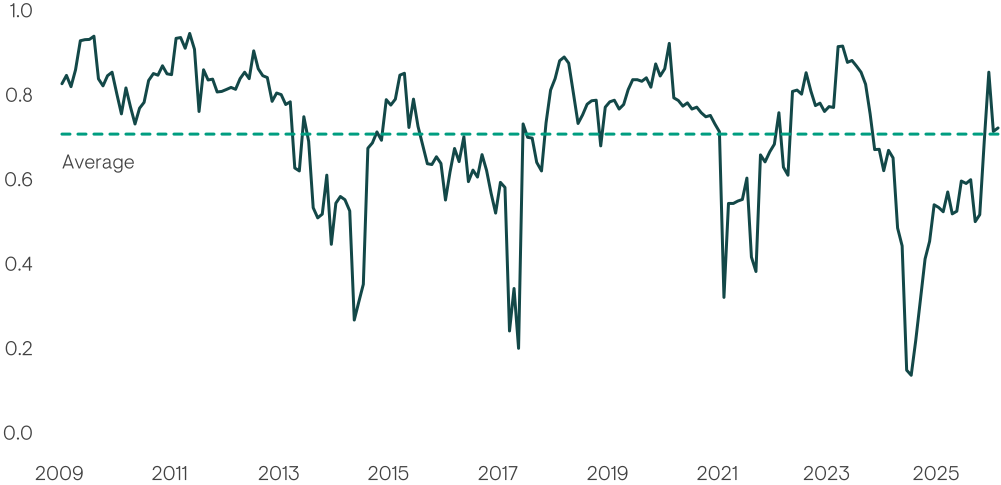
Commodity prices and natural resources equity prices do not move in lock-step. Conceptually, an important difference between them is that commodity prices are set to balance supply and demand, whereas equity prices are ‘anticipatory’ – they reflect expectations about the future and are influenced by discount rates, risk appetite, and broader equity market dynamics. As noted earlier, the profitability of natural resources companies is not solely tied to commodity prices. Figure 4 shows the rolling correlation of the Bloomberg Commodity Index and the MSCI ACWI Select Natural Resources Capped Index. The long-term average correlation since 2008 has been 0.71.
Figure 4: Natural resources equities can decouple from commodity beta
Rolling 12-month correlation: equities (MSCI ACWI Select Natural Resources Capped Index) vs. commodities (Bloomberg Commodity Index)
Past performance is not indicative or a guarantee of future results.
Index performance returns do not reflect any management fees, transaction costs or expenses. It is not possible to invest directly in any index.
Source: Bloomberg 31 March 2026.
For further information on indices, please see the Important Information section.
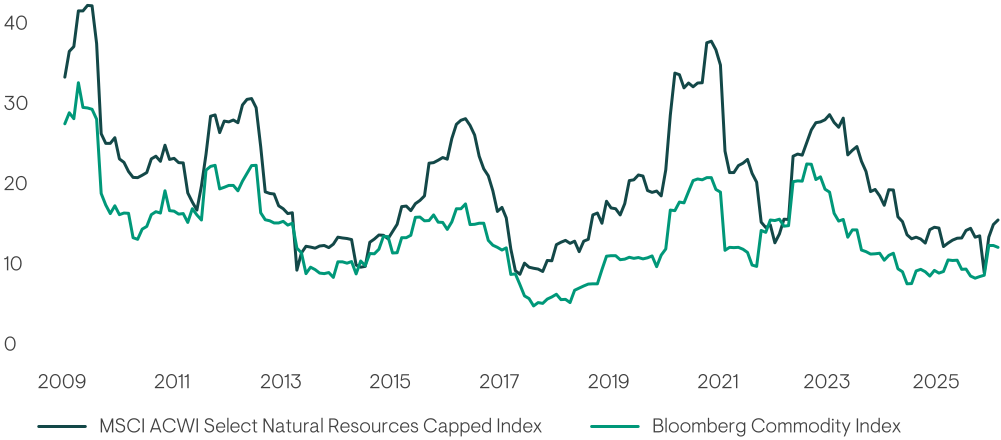
Natural resources equities tend to be more volatile than the underlying commodities due to embedded leverage in business models (Figure 5). Operational leverage (arising from the fact that commodity producers’ costs are often relatively fixed) means that changes in commodity prices translate into disproportionately larger changes in profitability and equity valuations. This is often amplified by financial leverage, broader equity market dynamics, and company-specific risks. Physical commodities are not exposed to these effects, resulting in comparatively lower volatility through time. For example, the shares of gold producers typically trend in the same direction as gold, but with perhaps 1.5-2x larger moves in both directions (this ratio varies considerably over time and from company to company).
While the natural resources sector remains cyclical and sensitive to commodity price swings, improved capital discipline and shareholder return frameworks have mitigated some of the causes of equity volatility in the past.
Figure 5: Equity volatility reflects additional risk beyond commodity exposure
Rolling 12-month volatility: equities (MSCI ACWI Select Natural Resources Capped Index) and commodities (Bloomberg Commodity Index)
Past performance is not indicative or a guarantee of future results.
Index performance returns do not reflect any management fees, transaction costs or expenses. It is not possible to invest directly in any index.
Source: Bloomberg 31 March 2026. For further information on indices, please see the Important Information section.
We believe there is significant potential for active managers to generate alpha in the natural resources equity sector. Relative to investors in commodities, active equity managers have two potential sources of alpha: bottom-up security selection, and dynamic sector and sub-sector allocations across the natural resources equity universe.
In our view, the optimal active investment approach to this asset class combines directionally accurate medium-term commodity price forecasts with deep fundamental analysis of the individual companies. Experience also matters: this is a relatively small sector and, in our experience, the insights into companies and management teams gained over many years of engagement as active shareholders are invaluable.
While both commodities and natural resources equities provide exposure to real assets and inflation dynamics, their investment characteristics differ. Natural resources equities offer a more complete way to access commodity-driven themes, combining exposure to price movements with additional potential return drivers including income, growth and active management.
While the equities come with higher volatility, their wider opportunity set and structural advantages have historically supported stronger performance outcomes than direct commodities over longer investment horizons.
General risks. The value of investments, and any income generated from them, can fall as well as rise. Costs and charges will reduce the current and future value of investments. Past performance does not predict future returns. Investment objectives may not necessarily be achieved; losses may be made. Target returns are hypothetical returns and do not represent actual performance. Actual returns may differ significantly. Environmental, social or governance related risk events or factors, if they occur, could cause a negative impact on the value of investments.
Specific strategy risks. Geographic / Sector: Investments may be primarily concentrated in specific countries, geographical regions and/or industry sectors. This may mean that, in certain market conditions, the value of the portfolio may decrease whilst more broadly-invested portfolios might grow. Currency exchange: Changes in the relative values of different currencies may adversely affect the value of investments and any related income. Derivatives: The use of derivatives is not intended to increase the overall level of risk. However, the use of derivatives may still lead to large changes in value and includes the potential for large financial loss. A counterparty to a derivative transaction may fail to meet its obligations which may also lead to a financial loss. Equity investment: The value of equities (e.g. shares) and equity-related investments may vary according to company profits and future prospects as well as more general market factors. In the event of a company default (e.g. insolvency), the owners of their equity rank last in terms of any financial payment from that company. Commodity-related investment: Commodity prices can be extremely volatile and losses may be made. Emerging market (inc. China): These markets carry a higher risk of financial loss than more developed markets as they may have less developed legal, political, economic or other systems.
1 Past performance is not a reliable indicator of future results, losses may be made. Compares performance of Bloomberg Commodity Index and the MSCI ACWI Select Natural Resources Capped Index. Please refer to Figure 1.
2 Storage costs mean physical commodity markets are typically in ‘contango’; i.e., longer maturity contracts are more expensive than shorter maturity contracts.
3 Based on spot gold prices as at end-March 2026.
