In the decade after the global financial crisis, the single biggest and most misunderstood drag on emerging-market equity performance has been net issuance, the mechanical effect of new shares entering an index faster (and often at richer valuations) than existing shares are being retired.
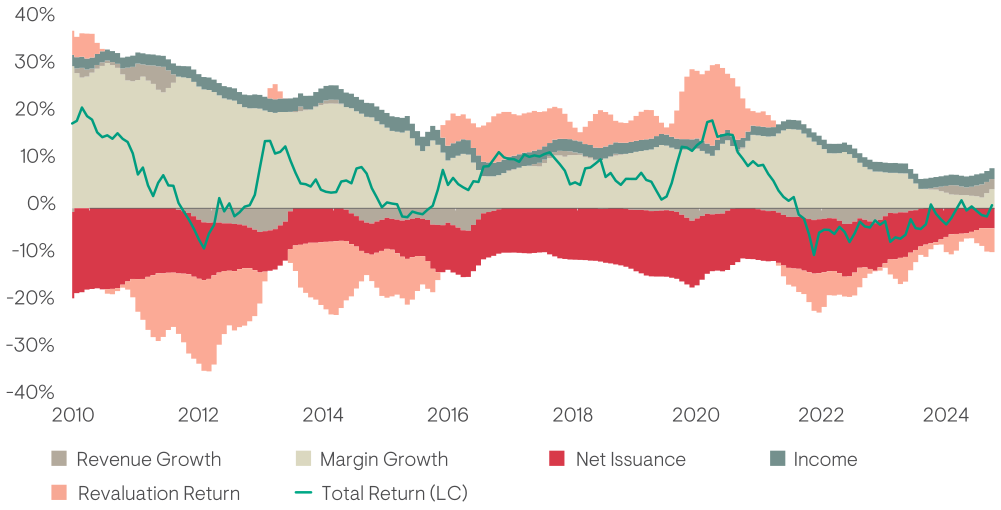
Between 2014 and 2024 EM investors received 6% annually in local currency returns, much lower than the 15% that was forecast.
What happened? Within our Capital Market Assumptions framework, which breaks expected returns into growth, income and revaluation, investors captured the anticipated 9% annual revenue growth that typically accompanies stronger EM GDP. Yet almost six percentage points of that return were erased each year by net issuance. Multiples expanded by less than one per cent, well below expectations, while dividends contributed around three per cent annually as forecast. Net issuance is always part of index-level maths, but this period of elevated EM issuance was highly idiosyncratic.
Why was the hit from net issuance so large? Two forces coincided. First, a wave of IPOs and secondary offerings, notably from China, priced at premiums to the incumbent index constituents. Second, a succession of index-inclusion events (US-listed ADRs from 2015, onshore A-shares from 2018 and periodic country reclassifications) forced passive and benchmark-aware active investors to add these new constituents near cyclical valuation peaks.
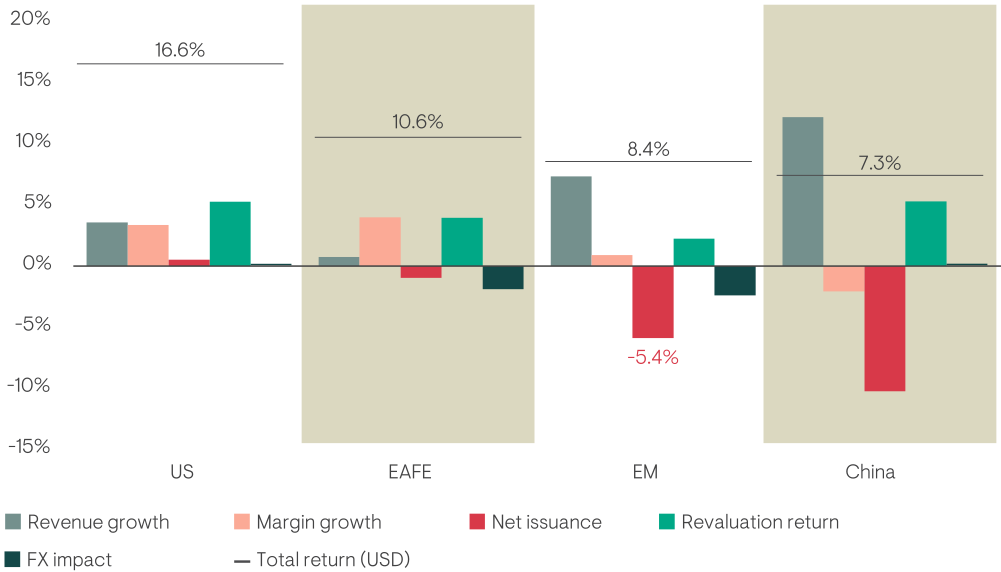
Our study of events in the 2011-2021 period (EM in the crossfire) shows that these contributed one-fourth of the negative returns from net issuance for EM (and around two-fifths for China). Without them, EM returns in that period would have been closer to 10% than the 8% delivered.
Figure 1: Decomposition of equity returns (2011-2021)
Source: Ninety One Capital Market Assumptions, MSCI (2011-2021)
Net issuance
Conceptually, net issuance measures the impact of entry and exit of shares into the index. Think of “net issuance” as a kind of “market composition adjustment” that adjusts as new capital comes into and out of the market. If capital comes in expensively, then future returns are lower. If capital comes in cheaply, then future returns are higher. In other words, high multiples at entry into an index cause a below-average contribution to earnings relative to the market caps (and therefore the index weights) of those businesses. Technically we measure “net issuance” or “market composition adjustment” using changes in the index divisor over time.
Does high “net issuance” mean EM companies were terrible capital allocators? No! Net issuance/market composition adjustment is comprised of two things: adjustments at the company level, and adjustments at the index level.
In the 2011 to 2021 period that we studied, company-level actions such as buybacks and share issuance reduced EM returns by only 0.5% a year. By contrast, index level adjustments including IPOs, M&A spin-offs, ADR inclusion, A-share inclusion, country reclassifications and other composition changes curtailed returns by 5.4% a year. The modest 0.5% drag at the company level matters. It shows that EM returns were not low over this period because of poor capital allocation by existing EM companies, but primarily because of index-level math.
The turn in the cycle
Fast-forward to today and those headwinds have faded materially, especially in China.
Rolling five-year net issuance in China has fallen to roughly one-third of its 2020 peak.
The pipeline of mega-IPOs is thin, valuations of prospective entrants are far less demanding, and Beijing’s tightening of domestic listing criteria has slowed the flow of low-quality issuance.
Share buybacks are rising.
Since 2022, many Chinese companies have announced or expanded repurchase programmes, encouraged by regulators and motivated by share prices trading at multi-year trough valuations relative to cash-flow. Every dollar of repurchases directly lowers the index divisor, offsetting previous dilution.
Index-inclusion risk has normalised.
The heavy lifting of ADR and A-share inclusion is behind us for now; MSCI has no plans to up its inclusion factor, and even then, given current valuations, any entry would imply a far smaller divisor jump than the one-off events of 2015-19.
Taken together, the net-issuance drag that clipped EM returns by nearly six percentage points a year is now running at an estimated two points or less, and the direction of travel is still lower as buybacks accelerate and new-issue premia compress. Even without any improvement in margins or multiples, simply removing this structural leak could lift expected EM hard-currency returns into the high-single-digit range that our capital-market assumptions already point to.
Why it matters for forward returns
- Restoring the revenue-to-return transmission: With dilution ebbing, the historically tight link between nominal GDP per capita growth and index-level revenue growth should once again flow through to shareholders. That alone argues for a meaningful uplift in prospective EM returns relative to the last cycle.
- China’s weight still counts: China is just under 30% of MSCI EM. A one-percentage-point swing in Chinese net issuance translates into roughly 30 basis points for the broader index. The sharp fall in Chinese issuance, helped by corporate repurchases, maturing private-equity pipelines and closer regulatory scrutiny of listing valuations, therefore sets a constructive baseline for EM beta.
- Valuation asymmetry: Net-issuance shocks hurt most when new shares arrive at high multiples and later de-rate. Today, we face the opposite: A-shares trade near or below long-run relative valuations, so any future inclusion lifts may occur at more reasonable entry prices, limiting potential slippage and possibly adding alpha if the cycle turns.
- Self-help via governance: Buybacks and progressively higher payout ratios signal that EM corporates, especially in North Asia, are converging toward developed-market capital-management norms. That cultural shift, accelerated by government encouragement in China and Korea, means future net-issuance is likely to stay capped.
Portfolio implications
Benchmark allocations
Passive or benchmark-aware investors who were forced to absorb dilutive inclusion events now stand to benefit mechanically from a shrinking divisor. In practical terms, this improves the odds that EM will deliver on its high single-digit return promise without requiring a heroic re-rating.
Active opportunity set
Lower aggregate issuance does not eliminate dispersion; it amplifies it. Companies funding growth internally or via moderate buybacks will compound faster than serial issuers. Active strategies that can discriminate along these lines should see a clearer path to alpha.
Bottom line
The heavy dilution that masked EM’s solid operational growth in the 2010s is receding. Net issuance has moved from a structural headwind to a manageable driver of returns. Even if net issuance does not continue to improve, the conditions are in place for stronger EM returns, given competitive revenue growth. Combined with undemanding valuations and still-favourable growth differentials, this sets the stage for EM, and China in particular, to regain relevance in global equity portfolios.
Investors who wrote off the asset class because “fundamentals didn’t show up in performance” should recognise that one of the key mathematical obstacles is finally being dismantled.
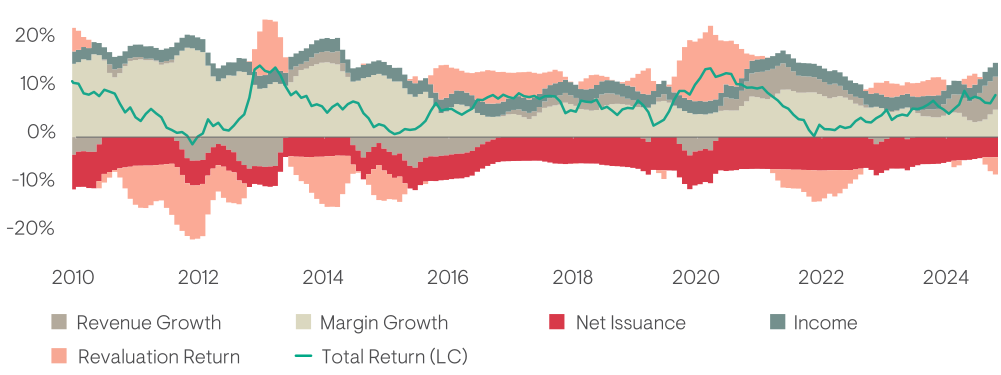
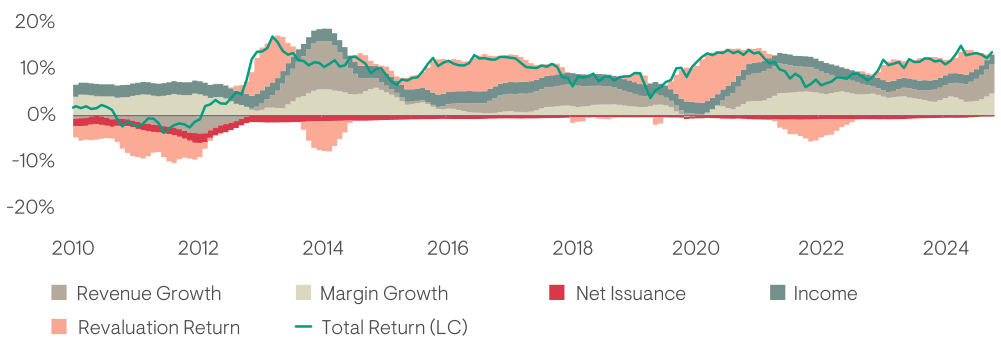
Figure 2: Decomposition of return drivers since 2010
China
EM
ACWI
Source: Ninety One Capital Market Assumptions, MSCI. September 2025.
