United Kingdom
Select your role
Capital Market Assumptions - October 2025
Ninety One’s Capital Market Assumptions framework focuses on the key drivers of long-term performance. We do this to better understand possible future returns, enriching discussions with our clients.
6 Nov 2025
20 minutes
Ninety One’s Capital Market Assumptions framework focuses on the key drivers of long-term performance. We do this to better understand possible future returns, enriching discussions with our clients.
Our framework emphasises income payments across asset classes, as they are both readily measured and pivotal in determining returns. In addition, long-term history is available, and income is less subject to manipulation than accounting metrics.
We divide returns into three components. The first – income – is a tangible, known entity, but the others are subject to material misestimation:
| 1 | Income Yield is historically the single most important explanatory factor for income-generating assets |
| 2 | Growth The extent to which income is expected to change over time |
| 3 | Revaluation The price per unit of income likely to apply at the end of the period (typically, 10 years) |
Capital Market Assumptions - October 2025
Key takeaways

Over the past six months, financial markets have demonstrated remarkable resilience, shaking off the jolt to the global trading system engineered by the US administration, along with growing concerns about fiscal sustainability and ongoing geopolitical crises. Against this backdrop, global equity markets have reached new highs, credit spreads have narrowed to historic lows and calm has largely returned to sovereign bond markets. Investors who maintained their resolve and held or even added to their risk positions during this period have been richly rewarded.
The medium-term outlook looks less promising. We firmly believe a focus on starting valuations is crucial when considering returns on a 10-year horizon. As a result, our latest Capital Market Assumptions present a picture of muted expected returns in aggregate. We anticipate that a traditional 60% global equity, 40% global government bond portfolio, hedged into US dollars, will deliver a 3.5% annualised return for the next decade in nominal terms. This represents a significant drop in prospective returns and an outcome that would place it in the bottom decile of historic 10-year outcomes.
We continue to see a need for considerable value-add from asset allocation and security selection decisions, as well as from identifying investments that will benefit from structural growth tailwinds to achieve investment objectives.
Forecasts are inherently limited and modelling involves risks, assumptions and uncertainties; they are forward-looking and are not guarantees nor a reliable indicator of future results. Actual returns could be materially higher or lower than projected. This information is not intended as a recommendation to invest in any particular asset class or strategy or as a promise of future performance.
Source: Ninety One proprietary Capital Market Assumptions as at 30 September 2025. These estimates are gross of fees (returns can be reduced by management fees and other expenses incurred) and reflect the view of Ninety One’s multi-asset team, whilst the views of other teams across Ninety One may differ. Details on our Capital Market Assumptions methodology available upon request.
Capital Market Assumptions - October 2025
Key takeaways
The tradeoff between risk and return in financial markets appears to be deteriorating as the cycle matures. Prospective returns are low relative to history and risk is increasing in the form of higher leverage and higher valuations.
Over the past six months, financial markets have demonstrated remarkable resilience, shaking off the jolt to the global trading system engineered by the US administration, along with growing concerns about fiscal sustainability and ongoing geopolitical crises. Against this backdrop, global equity markets have reached new highs, credit spreads have narrowed to historic lows and calm has largely returned to sovereign bond markets. Investors who maintained their resolve and held or even added to their risk positions during this period have been richly rewarded.
The medium-term outlook looks less promising. We firmly believe a focus on starting valuations is crucial when considering returns on a 10-year horizon. As a result, our latest Capital Market Assumptions present a picture of muted expected returns in aggregate. We anticipate that a traditional 60% global equity, 40% global government bond portfolio, hedged into US dollars, will deliver a 3.5% annualised return for the next decade in nominal terms. This represents a significant drop in prospective returns and an outcome that would place it in the bottom decile of historic 10-year outcomes.
We continue to see a need for considerable value-add from asset allocation and security selection decisions, as well as from identifying investments that will benefit from structural growth tailwinds to achieve investment objectives.
Forecasts are inherently limited and modelling involves risks, assumptions and uncertainties; they are forward-looking and are not guarantees nor a reliable indicator of future results. Actual returns could be materially higher or lower than projected. This information is not intended as a recommendation to invest in any particular asset class or strategy or as a promise of future performance.
Source: Ninety One proprietary Capital Market Assumptions as at 30 September 2025. These estimates are gross of fees (returns can be reduced by management fees and other expenses incurred) and reflect the view of Ninety One’s multi-asset team, whilst the views of other teams across Ninety One may differ. Details on our Capital Market Assumptions methodology available upon request.
Historical effectiveness
We tend to evaluate effectiveness in terms of getting the direction of travel correct.
Long-term predictions are fraught with uncertainty and open to error. We can, however, retrospectively apply our framework to assess its historical effectiveness. Because we focus on contextual information, we tend to evaluate effectiveness in terms of the reliability of the direction of the signal at market peaks or troughs; getting the broad direction of travel correct over a decade is a critical factor in an overall investment outcome.
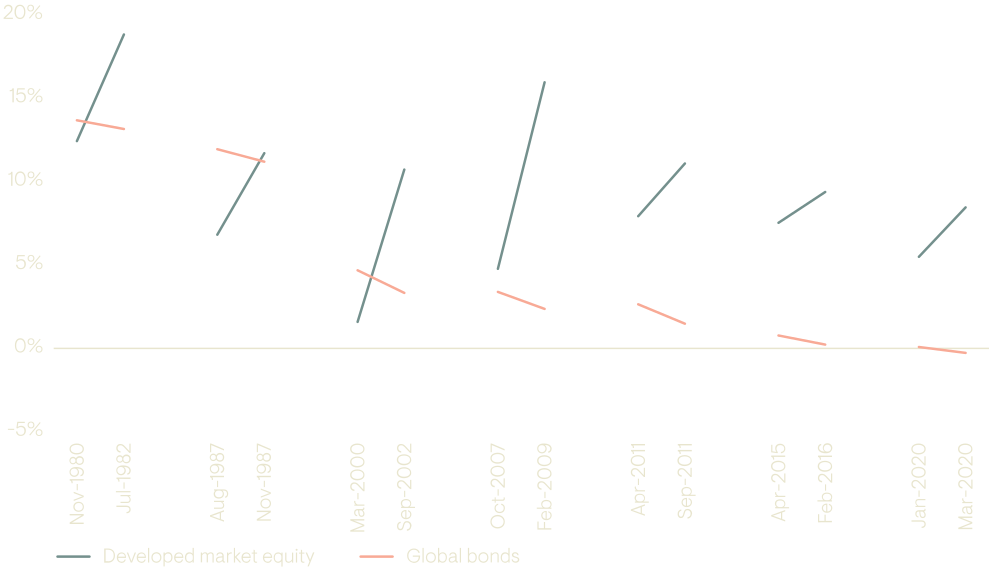
The figure below identifies a variety of market peaks and subsequent troughs, stretching back to 1980, for each of developed market equity and global bonds1. We then show the subsequent 10-year predicted returns at those points.
Figure 1: Expected returns can vary significantly depending on the point of the cycle
Source: Ninety One. Data is global since 2000; prior dates based on US outcomes. Bonds based on 10-year tenor.
For example, the first point on the previous chart corresponds to November 1980 (roughly a market peak) followed by a trough in July of 1982. The relevant 10-year forecasts in each instance were:
| Peak | Subsequent trough | |
|---|---|---|
| Developed market equity | 12.4% | 18.8% |
| Global bonds | 13.7% | 13.2% |
Indeed, global equities tripled in the decade from November 1980, and rose fourfold from July 1982. The chart illustrates the desired pattern — riskier assets tend to have lower anticipated 10-year returns at peak than they do at the subsequent trough; conversely, the more defensive bond asset tends to do better at the peak than the trough. Interestingly, although this pattern is repeated over time, it appears to be getting more compressed – perhaps due to the expansive liquidity provision over this period.
1 Developed market equities = MSCI ACWI and global bonds = FTSE WGBI.
Fixed income
Prospective returns from global government bonds are little changed but the extra yield for taking on greater credit risk has fallen to new lows.
The following chart examines fixed income assets in nominal, local currency terms, for 30 September 2025 compared to our last update, six months ago:
Figure 2: Sovereign bond yields are little changed but credit spreads have tightened further
10-year local currency, return forecast
Source: Ninety One (internal calculations based on Bloomberg, JP Morgan and Moody’s data).
EMBI = Emerging Markets Bond Index, EM LC = Emerging markets local currency debt; US IG = US investment grade; US HY = US high yield; CEMBI = Corporate Emerging Markets Bond Index.
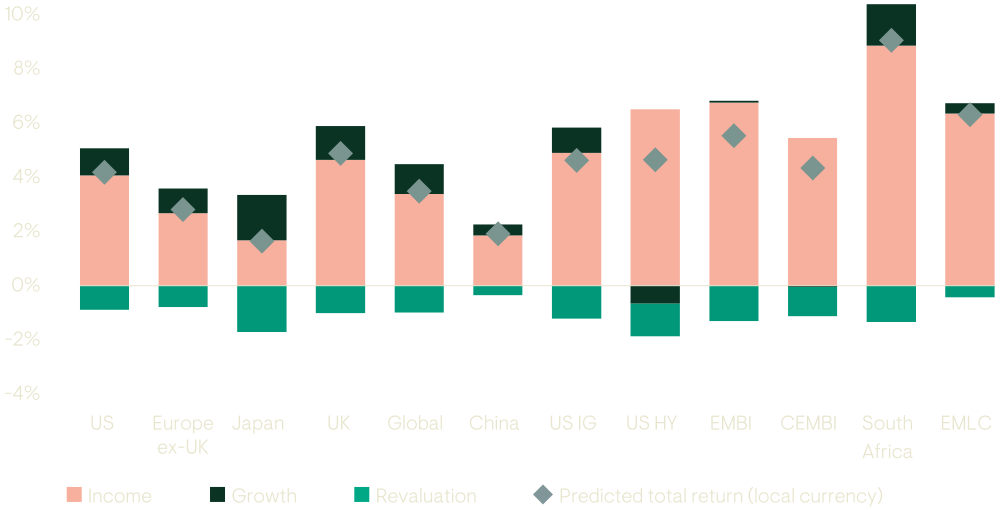
Prospective returns from developed market government bonds are unchanged over the last six months but emerging market government bonds have performed strongly, somewhat reducing their expected returns. Credit spreads have tightened further and are within touching distance of all-time lows.
Risk-free yields remain consistently lower than those implicit in forward yield curves, leading to negative revaluation effects across the board. Further monetary policy easing has taken place in many economies, leading to steeper yield curves and increased prospective roll returns.
The following chart sets out our return forecasts in more detail, dissecting fixed income regions in the context of our Capital Market Assumptions framework pillars: income, growth and revaluation.
Figure 3: Income accounts for the bulk of return potential across fixed income
Source: Ninety One (internal calculations based on Bloomberg, JP Morgan and Moody’s data).
EMBI = Emerging Markets Bond Index; EMLC = Emerging Market Local Currency; US IG = US Investment Grade; US HY = US High Yield; CEMBI = Corporate Emerging Markets Bond Index.
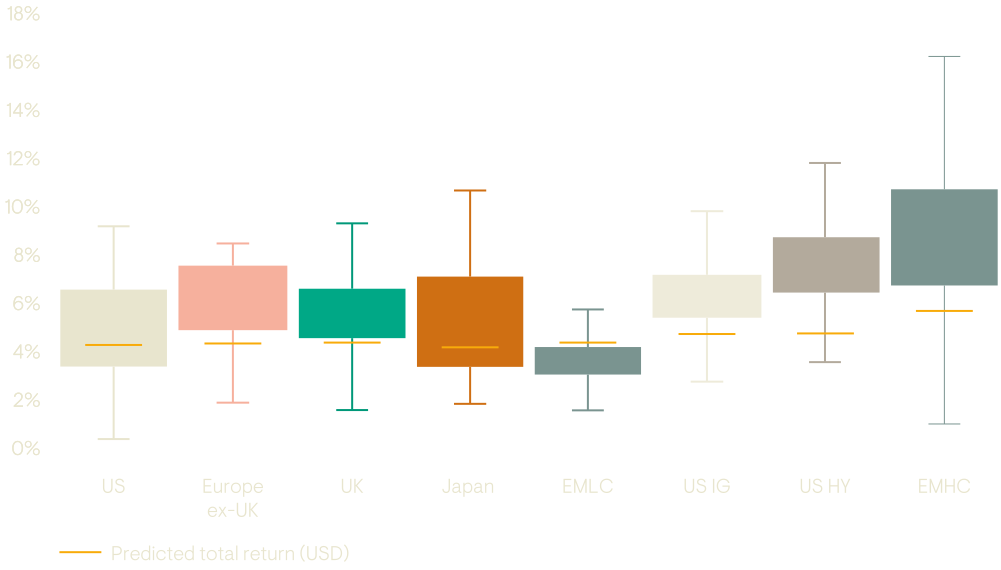
To give a further understanding of the relative attractiveness of prospective returns across fixed income markets, it is helpful to consider our return forecasts in the context of the historic range of outcomes for each market.
Figure 4: Return distribution of 10-year rolling historic returns
Source: Ninety One proprietary Capital Market Assumptions as at 30 September 2025. Based on monthly data from December 1987 to September 2025. Estimates are nominal, hedged into USD, gross of fees and ignore alpha. Modelling involves risks, assumptions and uncertainties. These estimates reflect the view of Ninety One’s multi-asset team, while the views of other teams across Ninety One may differ. Performance does not guarantee future results. Actual returns could be materially higher or lower than projected. For information on our Capital Market Assumptions methodology, please see Important information.
EMLC = Emerging Market Local Currency; EMHC = Emerging Market Hard Currency; US HY = US High Yield; US IG = US Investment Grade.
- The chart above shows the distribution of historic 10-year rolling geometric returns, hedged into USD, for the assets (in the box-and-whisker plot) versus the current forecast (yellow bar).
- The body of the box represents the interquartile range, while the ‘whiskers’ extend to the maximum and minimum historic rolling 10-year returns.
- It is evident that, bar EM LC (top quartile), fixed income returns are predicted to be consistently below historic median returns.
Case study: Fiscal sustainability
Government debt has risen sharply across developed markets, but not all countries are in the same position. This case study examines how differences in fiscal discipline are reshaping bond markets and why investors are increasingly distinguishing between stronger and weaker sovereign issuers.
Consensus thinking on fiscal policy has shifted dramatically over the past five years. For a decade following the Global Financial Crisis, Western governments and their economic advisors viewed excessive levels of government debt relative to GDP as a sure path to economic calamity. As a result, austerity policies were implemented well before the recovery from that crisis was complete.
This is now widely viewed as a failure, both on its own terms as the negative impact on growth meant that debt-to-GDP ratios remained elevated or even increased, and in terms of broader economic and political consequences. The combination of persistently tight fiscal and very loose monetary policy exacerbated widening inequality as real wages stagnated while asset values rose, feeding an environment of growing political polarisation and eroding trust in institutions.
The response to the COVID-19 crisis presented an opportunity to correct course. Not only was dramatically more fiscal firepower unleashed to manage the crisis, but there was also a determination to avoid undermining the recovery through premature policy tightening. In the first quarter of 2025, five years after the COVID shock, budget deficits remain at levels once only seen in the depths of recessions: almost 4% of GDP in the eurozone and a remarkable 7% in the US.
Beyond the simple arithmetic of debt and deficits, financial markets have focused on the credibility of government policy to balance growth and fiscal management. Achieving durable fiscal consolidation requires sustaining growth above the level of interest rates on government debt (often referred to as R minus G). Such credibility is hard-earned and easily squandered. For example, the UK gilt crisis in September 2022 was triggered by a loss of confidence in the policy agenda of the Truss government. More recently, the chaotic rollout of new US tariff rates in April 2025 prompted some to question whether US Treasuries can continue to serve as the safe asset underpinning the global monetary system.
An additional vulnerability for sovereign borrowers arises when there is a heavy reliance on international investors to buy their debt. International investors have greater flexibility in allocating capital, incur currency risk and cannot be coerced through capital requirements or financial regulation to hold government securities. This risk can be assessed through the lens of the Net International Investment Position (NIIP), the difference between the country’s ownership of financial assets in other countries and the domestic assets owned by foreigners.
We can use the four metrics highlighted above – debt, deficits, R minus G and NIIP – as a framework to understand the nature of fiscal risk around the world. The table below shows this information for global developed and emerging markets. Japan and China stand out sharply from these broader groupings, with much higher debt, lower interest rates and higher net foreign assets; therefore, we include aggregates excluding these countries.
Fiscal fundamentals in developed and emerging markets
| Debt/GDP 2030 |
Structural budget deficit 2030 |
Bond yield minus GDP growth 2025-30 |
NIIP 2025 |
|
|---|---|---|---|---|
| DM | 119% | -1.5% | -0.4% | -25% |
| EM | 82% | -2.9% | -0.3% | 12% |
| DM ex-Japan | 112% | -1.4% | -0.1% | -32% |
| EM ex-China | 59% | -0.9% | 0.3% | 2% |
Source: IMF, Bloomberg.
This reveals a stark differentiation between developed and emerging economies, excluding China: emerging markets are less indebted, closer to balanced budgets and hold positive net foreign assets. Interest rates minus growth appear more challenging for emerging markets ex-China as a result of currently elevated real interest rates in some of the markets, although there is scope for this to change over time.
This fundamental analysis is supported by converging risk characteristics across global markets, with developed market government bond markets becoming more volatile and susceptible to shocks, while emerging markets have demonstrated improved quality.
For developed market issuers in their own currency, hard default risk remains remote, although not impossible under certain political scenarios; however, higher inflation and currency debasement are very real risks. Rising fiscal risk in developed markets implies that investors now demand a higher term premium to own longer-dated bonds.
Fiscal risk therefore interacts with the CMA process via our revaluation return estimates. The downside risk to these estimates is that term premia rise further, leaving the yield on a 10-year bond in ten years’ time higher than markets currently expect.
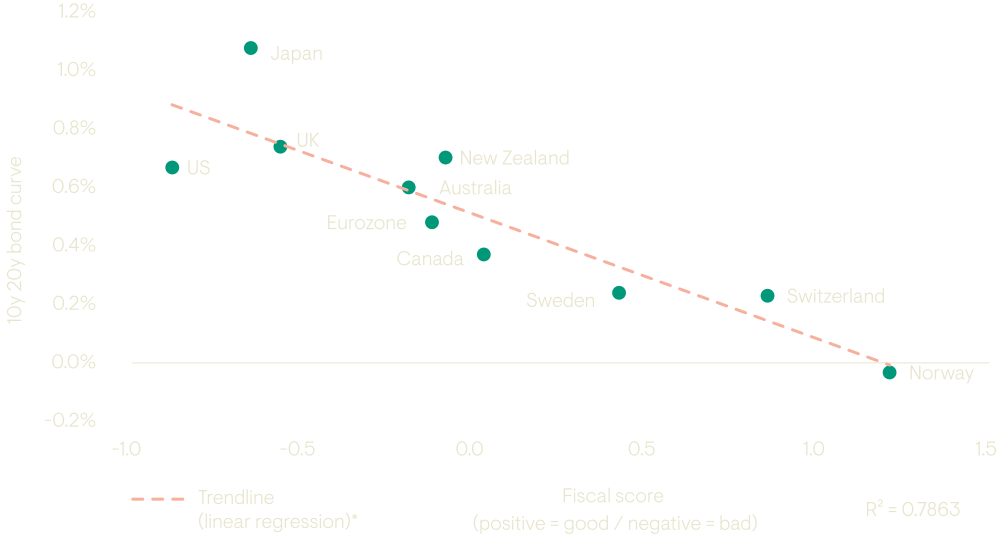
We can apply the same framework to assess where this risk is greatest across developed government bond markets. We calculate an overall fiscal score for each country as the simple average of the normalised values for the four metrics across the universe. The scores are intuitive and suggest that Norway has the highest quality public finances, followed by Switzerland and Sweden. At the other end of the spectrum, the US, Japan and UK have similarly elevated levels of fiscal risk.
When we plot these fiscal scores against the steepness of the long end of the curve for each market, we see a very clear relationship, with the fiscal scores explaining almost 80% of the variation in curve slope.
Figure 5: Higher fiscal risk is associated with steeper curves
Source: IMF, Bloomberg & Ninety One calculations.
*Showing the average relationship between the fiscal score (x-axis) and the 10y–20y bond curve (y-axis) across countries.
The markets which are furthest from fair value based on these fundamental metrics alone are the US, where fiscal risks appear underpriced, and Japan, where fiscal risks appear overpriced.
In part, this may reflect the divergent nature of monetary policy in these markets. Tight policy in the US and loose policy in Japan has an impact on the shape of the yield curve, which can extend all the way to the long end. It is also possible that the US dollar’s status as the dominant global reserve currency remains a driver of additional demand for US Treasury duration. Another consideration is that these relationships may become non-linear when debt rises beyond a certain point, which Japan may already have breached.
We can use the values for the curve suggested by this relationship to give an idea of the type of return impacts which might be seen if developed bond markets moved towards their fair values. This would represent a meaningful reduction in prospective returns from 10-year US Treasuries, smaller additional headwinds to eurozone and UK bonds and a slight uplift to Japanese government bond returns. Importantly, this analysis only accounts for current fiscal data and expectations. Policy changes which lead to either a further weakening or an improvement in fiscal outlooks could change the picture dramatically on a ten-year horizon.
Government bond returns in curve repricing scenario
| US | Eurozone | Japan | UK | |
|---|---|---|---|---|
| 10y 20y – current | 0.7% | 0.5% | 1.1% | 0.7% |
| 10y 20y – fair value | 0.9% | 0.6% | 0.8% | 0.8% |
| Return forecast (p.a.) | 4.2% | 2.8% | 1.6% | 4.9% |
| Curve repricing scenario return forecast (p.a.) | 3.7% | 2.7% | 1.9% | 4.8% |
Source: IMF, Bloomberg and Ninety One calculations.
Corporate credit in an era of fiscal excess
While debt sustainability trends appear negative for developed market sovereigns, fundamentals for corporate borrowers appear to be on a sounder footing in both developed and emerging markets.
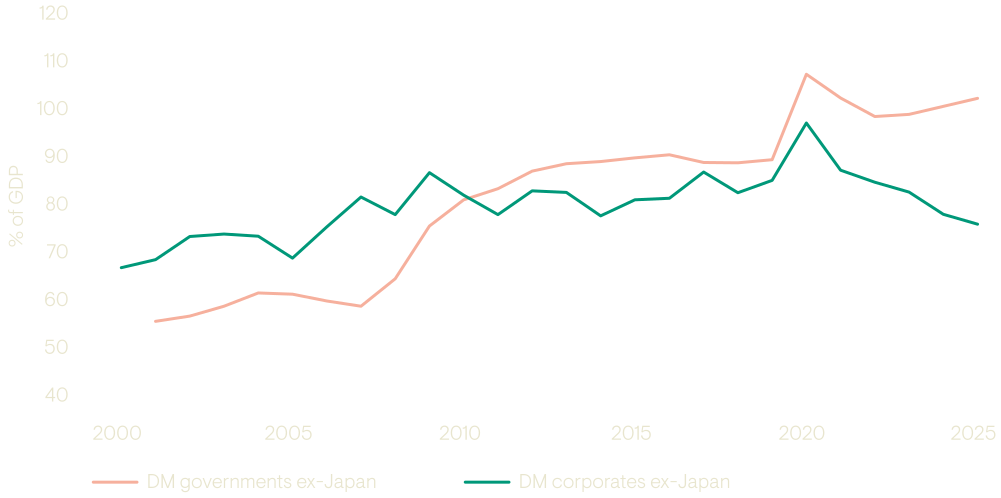
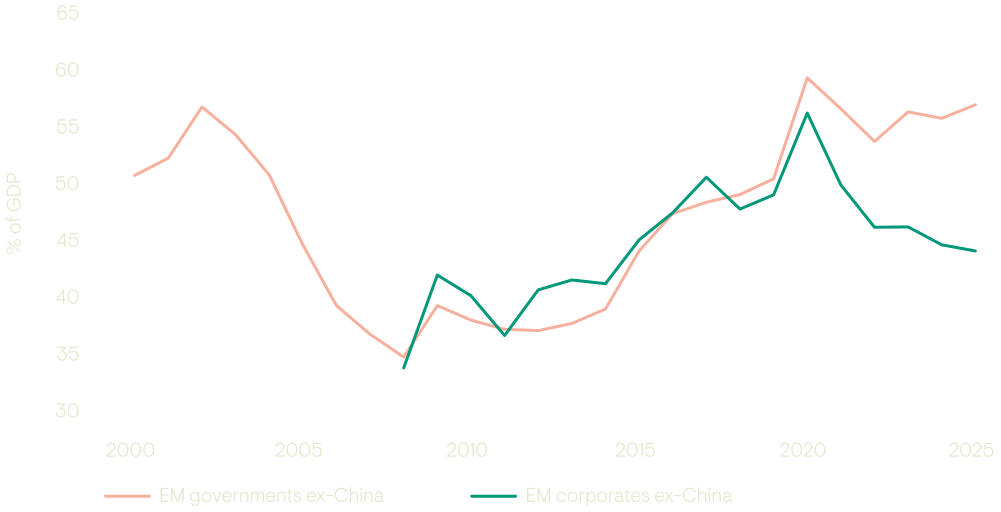
Leverage trends are moving in the opposite direction with the corporate sector deleveraging in the period since the COVID crisis, taking aggregate leverage to the lowest levels in a decade. As with sovereigns, EM corporate borrowers are on average much less indebted than DM corporates.
Figure 6: Government and corporate leverage in developed markets
Source: IMF, BIS, Bloomberg and Ninety One calculations.
Figure 7: Government and corporate leverage in emerging markets
Source: IMF, BIS, Bloomberg and Ninety One calculations.
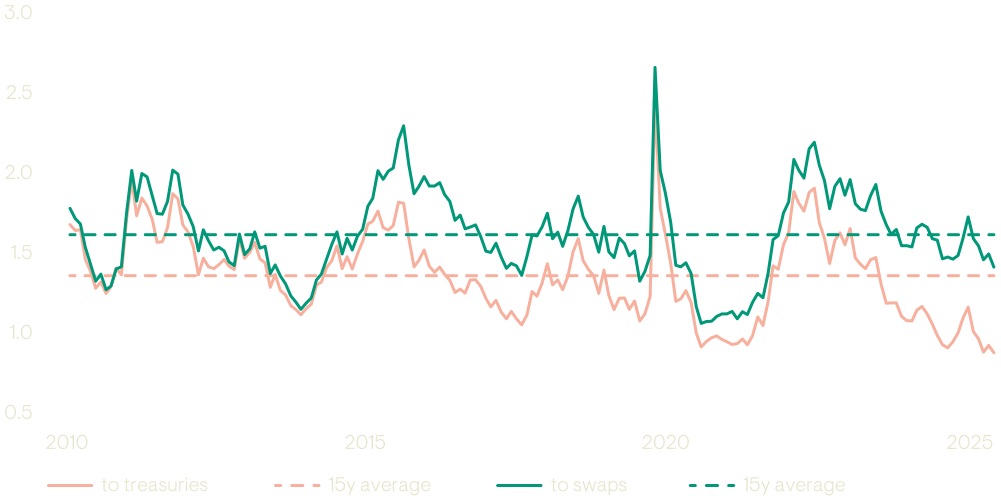
Market pricing reflects solid corporate fundamentals with credit spreads at historically tight levels. The increased risk now evident in government bond markets makes historical comparisons more complicated. A real question has emerged as to whether USD credit markets can continue to rely on US Treasuries as a straightforward risk-free reference, as they have done previously.
One potential response is to shift from viewing credit in terms of spreads over US Treasuries to also consider (or instead consider) spreads over USD swap rates. This is already common practice in EUR credit markets, partly because eurozone government bond markets differ widely in their fiscal risk premia and, or, convenience yields.
Figure 8: US investment grade corporate bond spreads
Source: Bloomberg and Ninety One calculations.
Another approach is to apply an absolute risk lens when assessing credit quality. This aligns with the framework we use in our credit loss forecasts, which do not differentiate between sovereign and corporate borrowers.
We also see evidence of an absolute perspective emerging in credit markets, as the ‘sovereign ceiling’ for corporates no longer holds in all cases. Across both emerging markets and the eurozone, there are corporate issuers trading inside their sovereign yield curves, and even instances where USD bonds issued by Microsoft and Johnson & Johnson2 have yielded less than the equivalent US Treasury issues. While technical factors partially explain these dynamics, they are only possible against the background of the fundamental changes we have described. Over time, we may see more corporate issuers with higher ratings and lower yields than their sovereigns, as the fortunes of high-quality global businesses can at times diverge dramatically from the domestic fundamentals of their home country.
The risk for corporates may be that government largesse becomes a more direct constraint on the private sector in one of two ways. First, private sector borrowing can be ‘crowded out’ by the public sector. In this scenario, increased supply of government debt limits the pool of savings available to lend to the corporate sector, pushing up yields across the economy. Second, in more extreme scenarios where there is a shortfall in government revenues, the sovereign has the power to change tax policy or legislation to extract value from corporates.
2 This is not a buy, hold or sell recommendation.
Equities
Return expectations have fallen to historically low levels. Prospective returns are somewhat higher in developed markets outside of the US and in emerging markets.
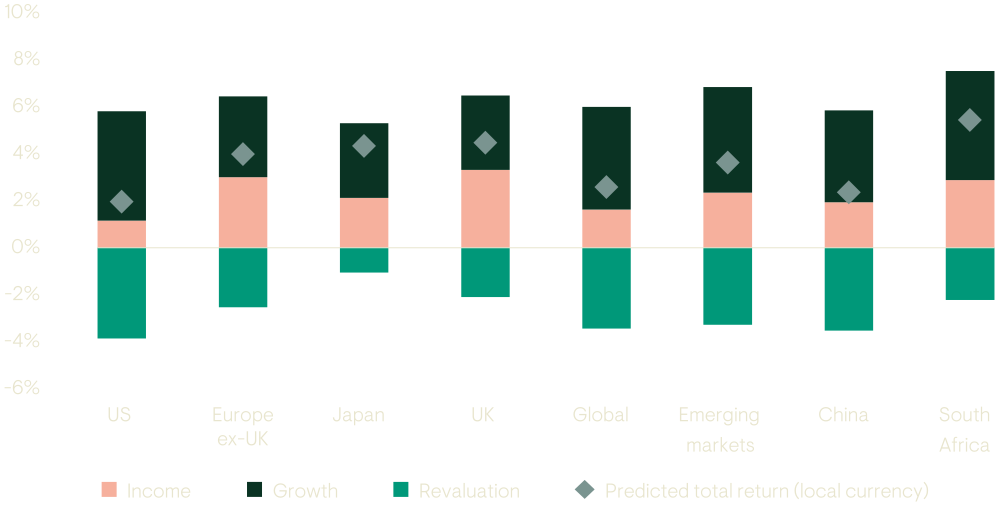
Prospective returns have fallen across global developed and emerging markets following strong price appreciation over the past six months. Global equities returned 20% over this period with the strongest gains in emerging markets and the weakest returns in Europe. This is reflected in the regional return forecasts, which have declined most in South Africa, China and the US, while rising slightly in Europe ex‑UK. Alongside higher prices, robust growth has lifted our estimates of underlying trend dividends, meaning valuations have not increased to quite the same degree as prices.
The following chart shows forecast returns for equity markets in nominal, local-currency terms, as at 30 September 2025, compared with our last update, six months ago.
Figure 9: Equity: 10-year local currency return forecast
Performance does not guarantee future results. Actual returns could be materially higher or lower than projected.
Source: Ninety One (internal calculations based on Bloomberg data).
Expected returns from global equities have dropped to the low end of 10-year rolling outcomes historically.
Figure 10: Growth dominates return expectations, with revaluation uniformly negative
Performance does not guarantee future results. Actual returns could be materially higher or lower than projected.
Source: Ninety One (internal calculations based on Bloomberg data). Estimates are nominal, gross of fees and ignore alpha. The final total returns are converted from logarithmic to geometric estimates. This means that the components of the return breakdown may not sum to the total return. Judgemental overrides may apply where deemed necessary – for example as currently applied to the UK assumption to account for the region’s current dividend yield which is in our view structurally out-of-kilter both with its own history, and that of peers. Modelling involves risks, assumptions and uncertainties. These estimates reflect the view of Ninety One’s Multi-Asset team, while the views of other teams across Ninety One may differ. For information on our Capital Markets Assumption methodology, please see Important information. Return breakdowns in local currency. For information on our Capital Markets Assumptions methodology, please see Important information. Return breakdowns in local currency.
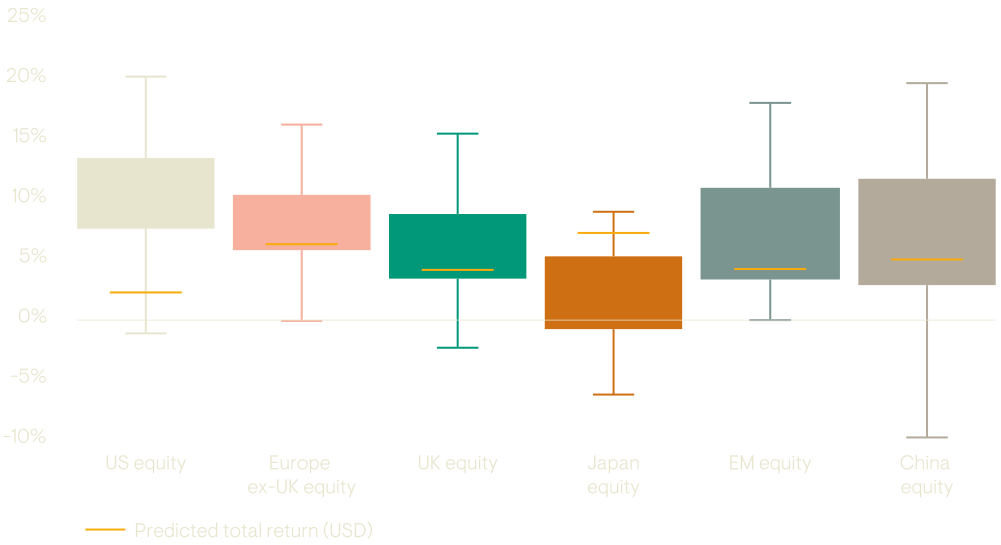
To give a further understanding of the relative attractiveness of prospective returns across equity markets, it is helpful to consider our return forecasts in the context of the historic range of outcomes for each market.
Figure 11: Return distribution of 10-year rolling historic returns
Source: Ninety One proprietary Capital Market Assumptions as at 30 September 2025. Based on monthly data from December 1987 to September 2025. Estimates are nominal, hedged into USD, gross of fees and ignore alpha. Modelling involves risks, assumptions and uncertainties. These estimates reflect the view of Ninety One’s multi-asset team, while the views of other teams across Ninety One may differ. Performance does not guarantee future results. Actual returns could be materially higher or lower than projected. For information on our Capital Markets Assumptions methodology, please see Important information.
- The chart above shows the distribution of historic 10-year rolling geometric returns, hedged into USD, for the assets (in the box-and-whisker plot) versus the current forecast (yellow bar).
- The body of the box represents the interquartile range, while the ‘whiskers’ extend to the maximum and minimum historic rolling 10-year returns.
- While forecast equity returns generally look unattractive in an absolute sense, Japan stands out, with expected returns near the upper end of their historical range. By contrast, US equities sit in the lowest quartile relative to both their own history and other markets, which mostly fall into the second quartile.
Case study: Blowing bubbles
Artificial intelligence has powered strong equity gains, but can the momentum last? This case study explores the link between AI and productivity and argues that, bubble or not, valuations could come under pressure if the promised efficiency gains don’t materialise.
Excitement around artificial intelligence has driven dramatic rises in equity prices, but financial institutions from the IMF to the US Federal Reserve and Bank of England are warning that a bubble may be forming in global equity markets. Indeed, history shows repeated instances where financial speculation takes over from rational analysis and booming asset prices are followed by painful busts. The similarities between these episodes and the present day are easy to see – the market becomes increasingly narrowly focused on a new technology which attracts growing excitement among investors and drives excessive outlays by both existing and new companies to capture new markets.
Fortunately, we don’t need to resolve the question of whether we are in a bubble to take an informed view of the risk-reward outlook for equities. Instead, we ground our assessment in historical data and the strong long-term relationship between starting valuations and prospective 10-year returns.
As a starting point, we can compare current valuations with past periods when our process would have forecast a more negative return impact from valuation mean reversion than the current -3.9% for the US equity market. There will always be differing views on whether each of these episodes should be classified as a bubble, but they stand out clearly within our valuation framework.
We draw on data from Robert Shiller to extend our US market valuation forecasts back more than 150 years. Over this period, two clear extremes stand out: the lead up to the Wall Street crash of 1929 and the tech bubble at the turn of this century. In the shorter histories available for other markets, Japan at the end of the 1980s and emerging markets in the mid-1990s are the clearest examples of similarly extreme valuations.
Forecast and realised valuation returns at valuation extremes
| Valuation return | ||
|---|---|---|
| Forecast | Realised | |
| US 1929 | -8.7% | -4.3% |
| Japan 1989 | -9.0% | -7.7% |
| EM 1997 | -5.7% | -6.4% |
| US 2000 | -4.7% | -6.5% |
| Average | -7.0% | -6.2% |
| US 2025 | -3.9% | |
Source: MSCI, Robert J. Shiller, Bloomberg and Ninety One calculations.
The current expected valuation impact is not as extreme as these events, but it is uncomfortably close to the levels that preceded some of the worst equity bear markets in history. While the realised impact of valuations on returns varied across these examples, mean reversion proved a powerful force in every case.
The downside risk from valuations appears very real, but it must be set against the potential for accelerating growth to drive much stronger outcomes. Artificial intelligence holds the promise of broad-based productivity gains as routine tasks are automated, freeing workers to focus on higher-value activities. A step change in productivity growth could help rationalise current pricing, but even then, markets appear priced for something close to the best conceivable growth outcome.
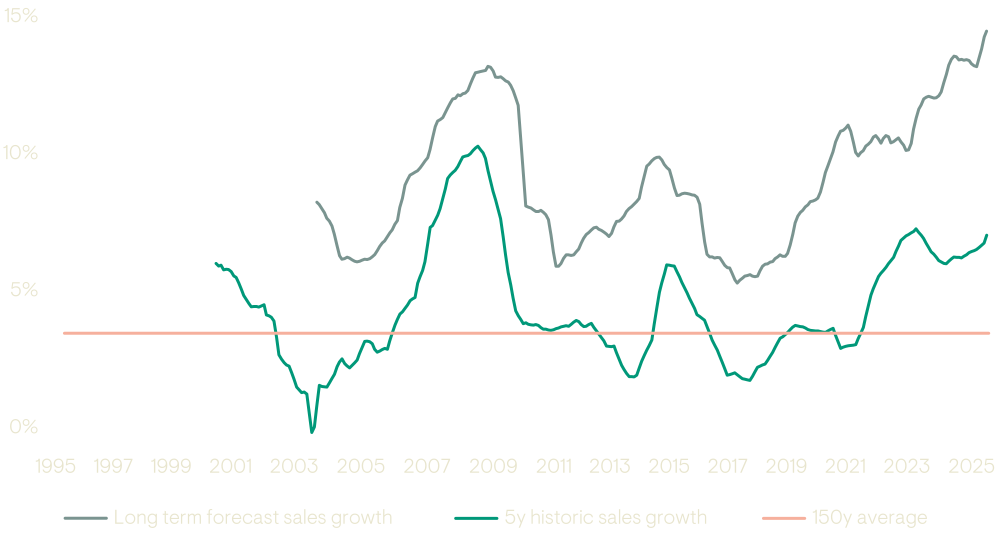
One way to illustrate this is to look at aggregated consensus forecasts for long‑term growth in the US equity market. On this basis, analysts are expecting US companies to compound sales growth at close to 15% over the long term. We need not take this figure at face value – equity analysts are well known for their tendency toward over-optimism. Even so, this is the highest rate in more than 20 years of data, and the gap between forecast and realised growth, both in recent years and over the long term, is also the widest ever seen.
Figure 12: Long term sales growth and consensus forecasts
Source: MSCI, Robert J. Shiller, Bloomberg and Ninety One calculations.
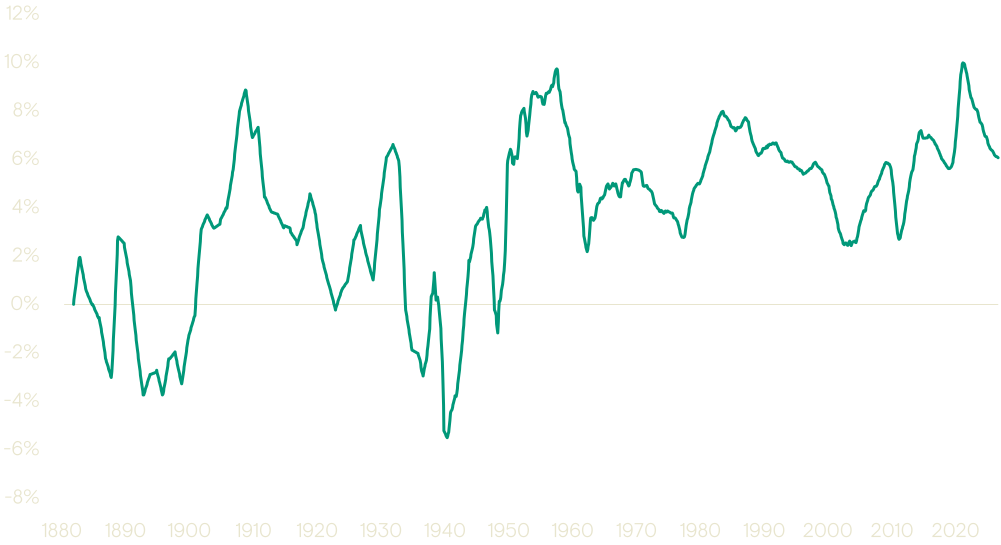
Alternatively, we can consider the growth uplift required to deliver an average historical return if we hold our income and revaluation assumptions constant. Over the last 150 years, US equities have returned around 9% per annum. To achieve a similar outcome over the next decade would require dividend-per‑share growth of almost 12% per annum, slightly lower than analyst forecasts but 2% per annum higher than the fastest growth rate achieved in any ten-year period in the last 150 years.
| US Equity forecast | 30-Sep-2025 | High growth scenario |
|---|---|---|
| Income | 1.1% | 1.1% |
| Growth | 4.7% | 11.8% |
| Revaluation | -3.9% | -3.9% |
| Total return | 1.9% | 9.0% |
Figure 13: S&P 500 dividend per share annualised growth over rolling 10-year periods
Source: Robert J. Shiller, Ninety One calculations.
Given the incredible pace of innovation in artificial intelligence, it is natural to focus on the risk of missing out on the investment opportunities it presents. Yet the history of equity markets suggests that, at the aggregate level, returns are likely to disappoint unless growth accelerates dramatically.
One way to frame these potential outcomes is that missing some of the potential upside may not be such a big risk after all. If AI were to deliver an unprecedented surge in economic growth over the next decade, the resulting welfare gains will be so substantial that a more modest portfolio return would hardly be a concern. Conversely, if the productivity uplift is more pedestrian, today’s elevated valuations imply unusually high prospective risk and unusually low prospective returns.
Currency
The currency decision – particularly whether to use ‘hedging’ or ‘conversion’ – can have a material impact on the outcome.
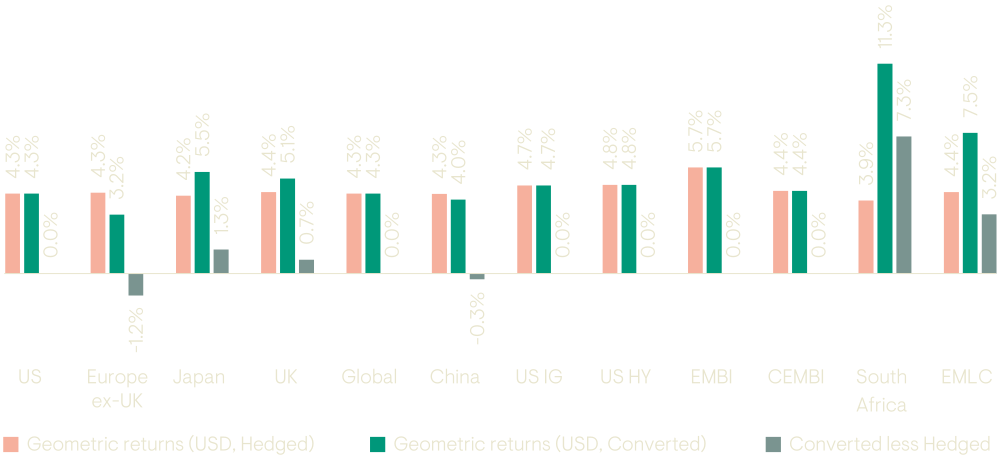
While we calculate our expected returns on a ̒local currency’ basis, we appreciate that clients need to make a currency decision – whether to hedge or not. We therefore show each of our equity and fixed income assumptions on these two bases – hedged (using interest rate parity) and unhedged/converted (based on real exchange rate reversion).
Figure 14: Fixed income expectations
Source: Ninety One (internal calculations based on Bloomberg and JP Morgan data).
US IG = US Investment Grade; US HY = US High Yield; EMBI = Emerging Markets Bond Index; CEMBI = Corporate Emerging Markets Bond Index; EMLC = Emerging Market Local Currency.
Figure 15: Equity expectations
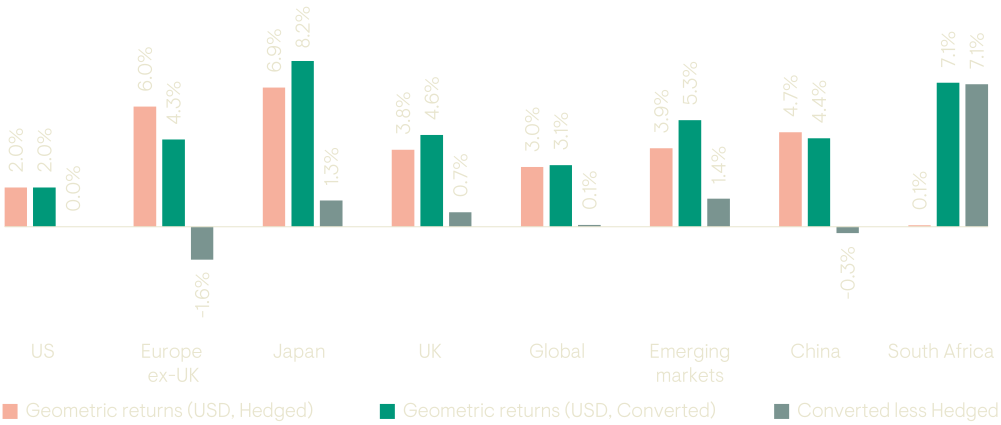
Source: Ninety One (internal calculations based on Bloomberg data).
Methodology
We focus on fundamentals. We divide returns into three components. The first is known and widely available, but the other two are subject to material misestimation.
Predicting long-term returns is fraught with difficulty; market values are not only determined by fundamentals, but also sentiment and exogenous events. We aim to keep things as straightforward as possible, and therefore focus on fundamentals. We:
|
Favour simplicity to capture the key drivers and accept wide uncertainty bands |
Strive for consistency with the investment process, focusing on cashflows |
Aim to be comprehensive across asset classes, with the ability to extend within |
We divide returns into three components. The first is known, more readily measured and widely available in the public domain, but the other two are subject to material misestimation:
|
Income – yield is the single most important explanatory factor for income-generating assets |
Growth – the extent to which income will likely change over time |
Revaluation – the price per unit of income likely to apply at the end of the period |
By default, we assume a 10-year investment horizon, to reflect the fact that we are long-term stewards of client capital. We do not consider tax, given different requirements pertaining to different mandates. The approach we outline is our baseline estimate; we may make judgmental adjustments to the underlying drivers if warranted.
Our approach mimics that of a systematic investor, buying the entire market.
Here we set out our methodology for equities, fixed income and currencies:
|
|
Equities |
Sovereign debt and credit |
|---|---|---|
|
Income |
Current dividend yield |
Current yield on notional bond5 |
|
Growth |
Nominal GDP per capita3 growth plus Market composition impacts (IPOs, M&A, index inclusion events etc)4 (Each based on a 15-year historic trend) |
Anticipated change in yield based on market-inferred future risk-free yields6 plus Roll-yield on the risk-free curve7 less Credit losses based on a 15-year historic average8 |
|
Revaluation |
Reversion to a cyclically adjusted price-to-dividend ratio (based on 15-year trend dividends per share) |
Reversion to the market-inferred future risk-free yields plus Reversion of credit spread to 15-year average |
|
Currency |
‘Hedging’ – based on current interest rate differentials on 10-year zero-coupon bonds or ‘Conversion’ – based on a reversion of the real exchange rate to the 15-year average, with an allowance for differences in inflation targets |
|
3 Where a market has a high proportion of overseas sales, we use the average of the local and global nominal GDP per capita trend growth rates.
4 Uses the average of local and global issuance trends given lower predictability for more specific universes and a belief in global convergence.
Overrides may also be applied where local figures are volatile.
5 Yield to Maturity based on notional 10-year bonds (except in the case of High Yield and EM Corporate, where 5-year bonds are used).
For EM Hard Currency, US High Yield and EM Corporate, we use the underlying risk-free curve plus spread-to-worst to construct the initial yield.
6 Credit spread curve data tends to be unreliable; we presume because the notion of quality changes with tenor. We therefore assume a constant spread.
7 This is an implicit allowance for rebalancing of the constant maturity bond.
8 Based on Moody’s default data.
Equities
Equities are assumed to be purchased on a buy-and-hold basis. We use relevant MSCI indices to reflect the regions.
We proxy income with dividends. While many equity investors prefer to focus on earnings, we regard dividends as being less subject to manipulation – these distributions are a tangible payment, and the information is publicly disclosed – and therefore more reflective of the long-term fundamental cash-generating properties of the broad market. While other metrics (e.g. free cash flow) have evolved, they do not yet have similarly long history.
Figure 16: The history of US dividends stretches back over a century
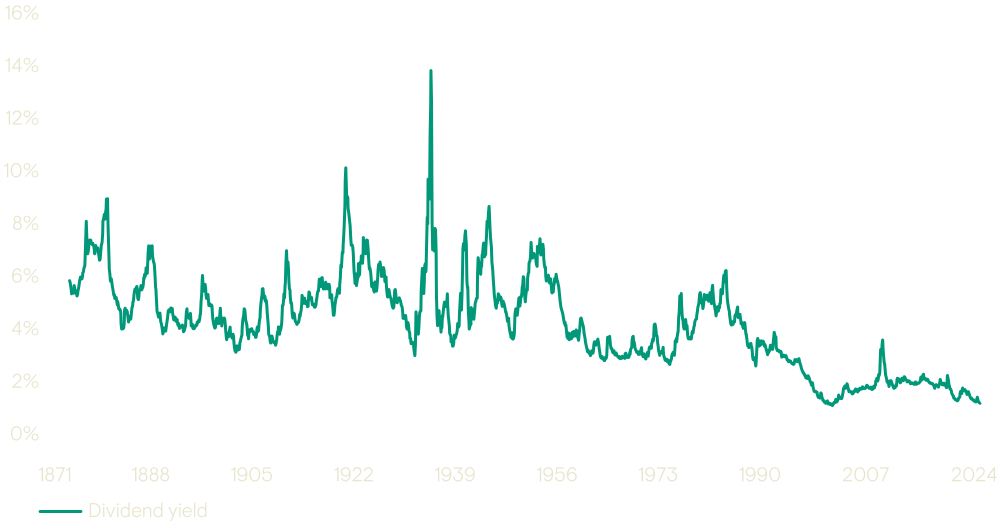
Source: Shiller, U.S. Stock Markets 1871-Present and CAPE Ratio.
In this context, growth primarily relates to an equity market’s ability to increase dividends over time. GDP per capita has historically proven to be a reasonable proxy for dividend growth – and a closer match than GDP itself, as illustrated in the next chart. We simply allow for the global effects of growth based on the extent of non-domestic revenue exposure, assuming developed market growth is an average of local and global growth, while emerging market growth is wholly determined locally9. Growth is proxied based on trailing 15-year trend growth, a period that captures the secular effects of a couple of cycles. We apply a market adjustment factor – which includes changes in market composition relating to primary and secondary issuance, M&A activity, buybacks, new index inclusions etc. In each case, an owner of the market would have to either inject or remove capital to remain fully invested.
Figure 17: Nominal GDP per capita has proved a useful proxy for dividend growth
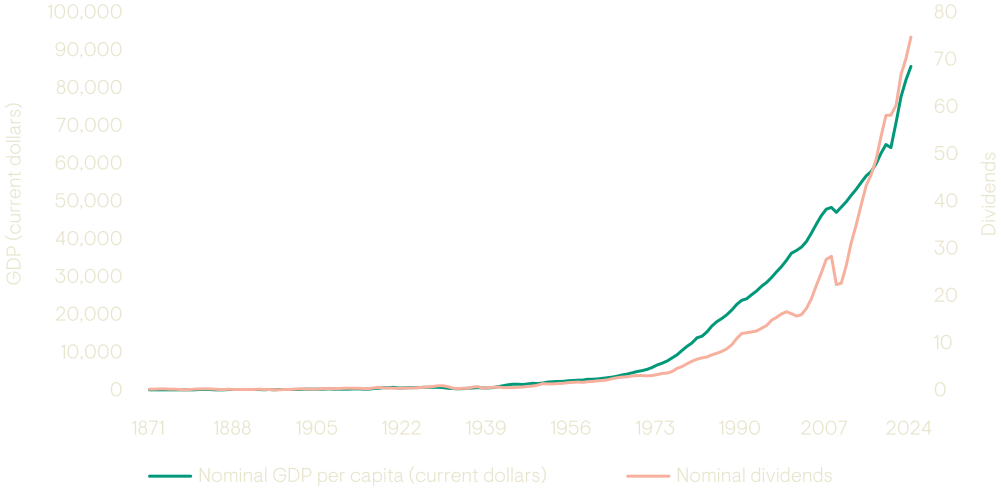
Source: Shiller, U.S. Stock Markets 1871-Present and CAPE Ratio; Louis Johnston and Samuel H. Williamson, “What Was the U.S. GDP Then?” MeasuringWorth, 2025.
Lastly, we factor in an adjustment for revaluation. We believe that valuation acts as a gravitational pull over long periods; however, changes in market composition and dynamic means that this is not a static metric. We use the price-dividend ratio and trend dividend yield as our valuation metric, assuming this reverts to a long-term (15-year) average. This allows us to both maintain consistency with our income-focused framework, and smooth out the cyclical nature of dividends. While we acknowledge full reversion is unlikely – prices tend to overshoot both on the upside and the downside – this simplification remains conceptually sound on average, as can be seen in Figure 18.
Figure 18: The actual price-dividend reverts reasonably neatly to the trend average over time
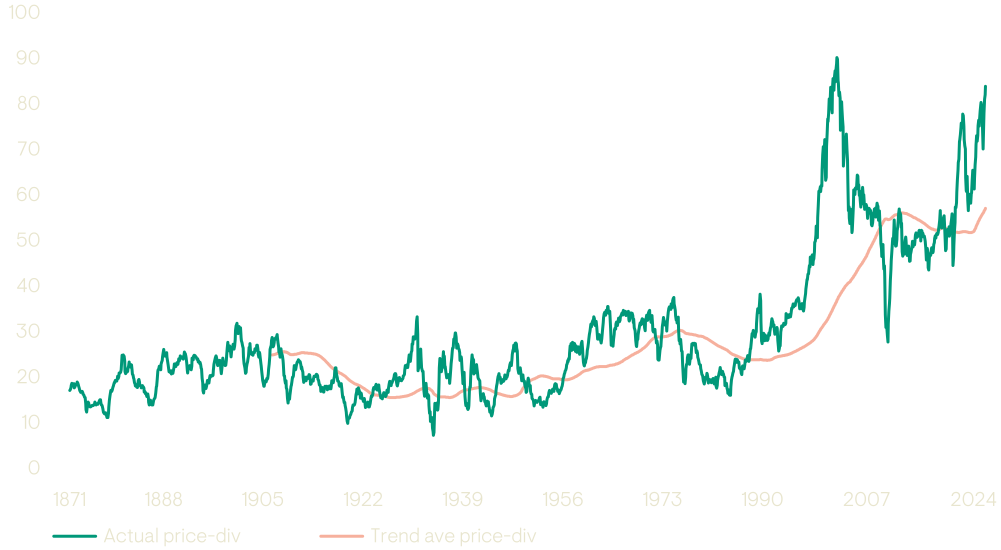
Source: Shiller, U.S. Stock Markets 1871-Present and CAPE Ratio, internal calculations.
Fixed Income
Our portfolios target specific duration contributions when allocating to bonds; therefore, we feel it appropriate to use constant maturity bonds as the basic building block. We further deconstruct bonds into risk- free and spread components, enabling us to cover both sovereign and corporate debt.
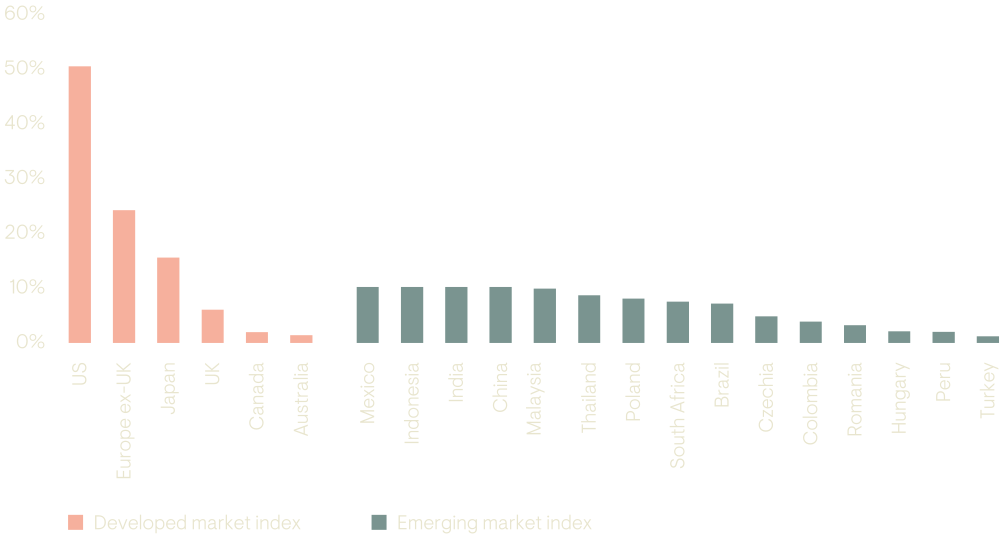
Income assumes the par yield of the bonds, typically for a notional 10-year bond. Regional indices are then generated by using the weighted average of the relevant market inclusions, as illustrated below.
Figure 19: Regional indices are generated using a weighted average of the relevant countries
Source: Ninety One calculations. Weights based on JP Morgan indices.
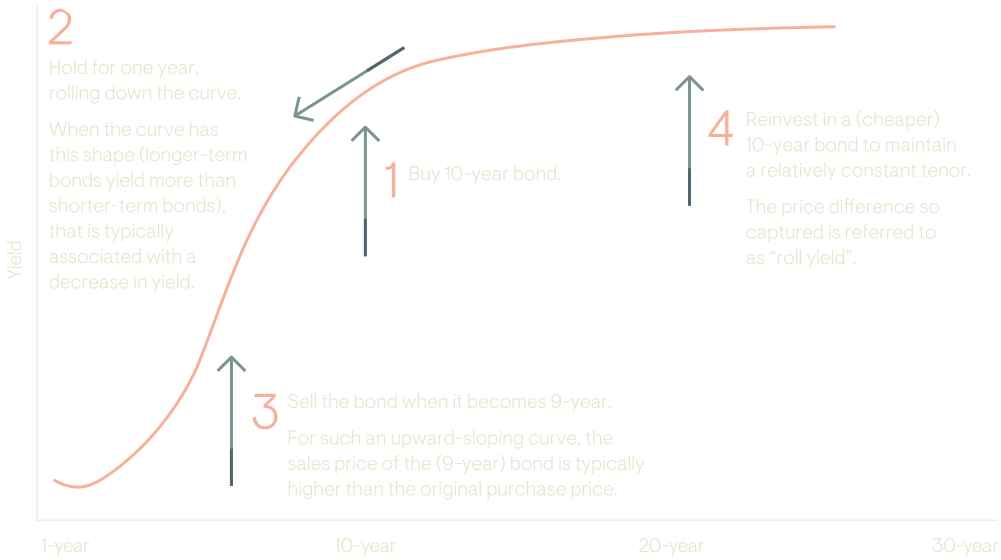
We define growth as being the roll yield obtained from consistently rebalancing the portfolio to maintain a constant maturity. So, for example, with a typical contango yield curve where the longer-term price is higher than the short-term, after one year the bond holder would sell the lower yielding, higher priced nine-year bond to buy a higher yielding, lower priced 10-year bond. Implicit in this view is a belief that the shape of the yield curve remains relatively consistent (including a constant spread component for credits).
Figure 20: Growth is the roll yield from consistently rebalancing the portfolio to maintain a constant maturity
Source: Ninety One. This graphic is for illustrative purposes only.
Revaluation is easier for government bonds than corporates; the former typically have liquid, traded markets enabling us to infer the forward market expectation of pricing. The implicit belief that markets converge to these expectations seems reasonable as a baseline for active management decisions.
Currency
We calculate currency returns in local currency. As explained in the currency section, we then adjust on two bases:
Hedging
Since it is common practice to hedge currency risk, and these costs are largely known at the date of investment, we use this as our base case. We assume that the position is hedged at inception for the 10-year horizon (essentially ignoring the small cash-flow differences that might occur), using covered interest rate parity. We derive the relative hedging cost from the zero coupon bond yields corresponding to the investment horizon.
Conversion
Many investors are willing to bear the currency risks, and therefore hold their assets unhedged. To proxy this, we use real effective exchange rates – i.e. adjusting the currency cross rates for relative inflation movements. We assume these exchange rates revert to their 15-year averages with an allowance for the difference in inflation targets, thereby allowing some currency mean reversion.
9 Based on the Morgan Stanley Global Exposure Guide 2022, Developed Markets tend to average c. 40% foreign exposure, while Emerging Markets are roughly 25%.
Frequently asked questions
To foster a sense of dialogue, we include a curated list of questions we have received from various stakeholders and our responses. We will continue adding to this section over time.
Q In equities, why have you used GDP per capita and not GDP itself?
GDP per capita has historically proven to be a reasonable proxy for dividend growth.
This is even though the relationship between fundamental company growth, in aggregate, and country-level economic growth is weaker than might otherwise be expected due to compositional mismatches. For example, GDP includes both private and public sector outputs; however, only the former are captured in aggregate via listed equities. Similarly, economic growth tends to be locally focused whereas listed companies often have substantial global operations.
Q What assumptions do you make for credit defaults?
We make allowances for credit defaults with the bond growth rate, using Moody’s long-term default histories. We use the Moody’s country rating for specific country sovereign debt, and the ratings banding for credit indices. By assuming that a AAA rating has similar meaning in both sovereign and corporate contexts, we can reasonably proxy a wide array of indices. (Based on history, we have applied an additional default factor for sub investment grade sovereign debt).
Q Why nominal (and not real) returns?
Inflation is notoriously difficult to predict; so much so, that our work suggested that nominal forecasts were often more reliable than real forecasts.
Q Why two currency bases – hedged and converted?
Both are common approaches to international exposure – some prefer hedging, whereas others are prepared to bear the resultant currency risk. We therefore thought it appropriate to include both so, irrespective of preference, the assumptions would be useful.
Q How are Capital Market Assumptions used within the Multi-Asset process?
Capital Market Assumptions are a framework for thinking about reasonable client outcomes and providing broad market context. These figures do not directly result in individual investment decisions.
Importantly, the Capital Market Assumptions represent the view of the Multi-Asset Capability within Ninety One; other investment teams are free to disagree.
Q Are the assumptions purely systematic?
We wish the framework to be consistent over time to help sharpen thinking on asset-level drivers; therefore, where possible, we prefer to use set assumptions.
We do, however, reserve the right to override specific assumptions where there is a strong market-specific reason to do so.
Q Why do you not predict macro-economic variables within the Capital Market Assumptions?
We wish to understand potential client outcomes over the long-term; therefore, our focus is on identifying those drivers which best explain and predict such outcomes. As can be seen in our framework, that can be done without specific macro-economic views.
Q Why do your growth assumptions look so much more pessimistic than the last twenty years of equity and/or dividend growth?
For corporate cashflows to continue growing at a significantly faster rate than the broad economy, one of three things needs to occur:
- Revenue grows faster than the broad economy – e.g. via the launch of new products which are far superior to competitors, or through the capture of new market segments. The former should not make a difference at the aggregate market level (one competitors revenue growth comes at the expense of another) but the latter may occur through, for example, internationalisation. That is why we link growth to a mixture of local plus global GDP.
- Costs fall (or, equivalently, margins increase) – e.g. via lower tax rates, more efficient use of resources, economies of scale, or regulatory capture. We think further margin expansion is challenging as tax decreases have likely reached their nadir, while regulatory capture cannot happen indefinitely. Since we have not yet found a reasonable long-term (10-year) predictive proxy, we prefer not to forecast this element, i.e. assuming that margins remain roughly constant.
- Business reinvestment increases (when returns are higher than the cost of capital) – If businesses are prioritising their investment, marginal investments will offer a decreasing rate of return, such that ultimately returns converge to cost of capital. If not, we’d expect competitors to enter. Again, a natural limit exists. Again, in the absence of a reliable predictive proxy, we essentially assume that pay-out ratios remain constant.
In short – because we focus on variables that have both been historically predictive and have a sensible fundamental interpretation, we continue to favour GDP as a predictor (implicitly, of revenue). We continue to actively research appropriate variables for margins and pay-out ratios; however, in an environment where we think each faces headwinds, we are comfortable to continue with our simplifying assumption.
Q How often are your assumptions updated?
We intend to update the Capital Market Assumptions twice each year – after the March and September quarter-ends.
We may also provide intra-period updates if we believe a market event is significant enough to materially change the 10-year outlook. For example, we released an internal update in late March 2020 to highlight the potential upside from equities and credit after the initial COVID-induced market collapse.
Q What is an index divisor and what causes this value to change?
The index divisor is defined as:
Index divisor = Index market cap/Index price
The index divisor is central to the calculation of equity indices because there are corporate actions and compositional changes which affect the aggregate value or market capitalisation measured by the index, but which do not impact the performance of the index. When the market value of the index increases or decreases because of one of these events, the index divisor is adjusted to ensure that the price of the index remains unchanged.
The impact of specific corporate actions or compositional changes can be either positive or negative for future returns, but they are aggregated into a single overall value.
A non-exhaustive list of some of the corporate actions which impact the index divisor is given in the table below.
| Corporate action | Impact on index divisor | Impact on index returns |
|---|---|---|
| Share repurchase (buyback) | Negative | Positive |
| Rights issue | Positive | Negative |
| Stock-based compensation | Positive | Negative |
| IPO | Positive | Negative |
| Cash acquisition (of index constituent) | Negative | Positive |
| Spin-off (where spin co is not an index constituent) | Negative | Positive |
In addition, the composition of the index can change as a result of index rebalancing events where index rules determine that existing companies be added to or removed from an index or that the proportion of a company’s shares which are included in the index changes. For regional indices, whole countries may also be added or removed from the index.
Items such as buybacks tend to be stable – their attractiveness is based on the regulatory and taxation basis applicable at a point in time, which tend to change infrequently. Other sources may be more volatile – for example, market changes due to M&A activity, views on the appropriateness of stock-based compensation, or even secondary issuance due to market stress. We infer the market adjustment impact from the change in MSCI Index Divisor over time.
Q Have you considered the impact of issuance or other corporate activity on the growth of income within equities?
Broad economic growth drives the growth generated by the listed corporate sector over the long run. However, it is accepted that corporate action, including mergers, acquisitions, research, and innovation ensure that the corporate sector is dynamic, undergoing compositional changes over time.
Our process starts with an assessment of the aggregate growth of the dividends paid by this dynamic mix of businesses. The next step is to make a market adjustment to capture all the corporate actions and index composition changes which directly increase or decrease the total value of equity measured by the market index.
As defined, the market adjustment factor is important as it changes the participation in the aggregate dividend growth of the entire market for an ongoing investor in the index. Market adjustments at the index level are analogous to but not identical to the way that equity issuance and repurchases affect returns for a single stock. To understand this, we must first recognise that to receive the index return, an investor must build a portfolio which holds every stock in the index in their index weights and which adjusts these holdings over time as index composition and weights change.
Any corporate action or index composition change which adds new equity capital into the index therefore dilutes future index returns in the same way that a company making a rights issue dilutes returns for holders of that stock. In both cases, if an investor does nothing, their ownership of the index or of the stock declines and the proportion of future value creation which flows to their shares falls. On the flipside, any corporate action or index composition change which removes equity capital from the index is accretive to future returns in the same way that a company repurchasing and retiring existing shares is accretive.
Importantly, these effects only directly impact an investor who seeks to own the entire market as defined by the index provider. For an active investor who does not hold the companies which launch these corporate actions there is no direct impact on their returns although there may be indirect impacts because of related capital flows or changes in the competitive environment.
Q How effective have your Capital Market Assumptions been?
As can be seen in this analysis, the Capital Market Assumptions have shown clear differences between market troughs and market peaks.
Q Given that Capital Markets Assumptions have so much associated uncertainty, what is the benefit of even attempting?
We see two key benefits:
- A clear understanding of return drivers enables sharper thinking about potential asset class outcomes, including under various scenarios.
- Insight into the likely direction and possible magnitude of returns helps our clients understand what outcomes may be reasonable.
Q Why use dividends/price-dividend rather than earnings and the more conventional price/earnings?
Dividends, being physical payments to shareholders, are less subject to manipulation than earnings (which are only book profits). We believe that results in stronger conclusions.
In addition, data sets tend to have a longer history of dividend payments, enabling us to consider the approach in a broader variety of historic contexts.
Q What key factors are not considered in your approach?
Our Capital Market Assumptions assume that the fundamental market drivers remain unchanged. They therefore ignore exogenous shocks – e.g. climate risks and geopolitical events (although we may update our assumptions in the event of a material shock).
We currently focus on single-asset return outcomes; therefore, we make no comment about potential changes in cross-asset correlations or asset-specific volatilities.We do not adjust for individual client circumstances either: client tax status may impact the relative attractiveness of asset classes.
Q Why a 10-year horizon?
As long-term custodians of our client’s capital, our focus is on helping our clients achieve suitable outcomes.
In addition, we require a timeframe long enough for fundamental drivers to be expressed, despite cyclical noise.
Ask a question
If you have any questions about our framework that you'd like to discuss further, please complete this form and we will respond to you directly
General risks. Forecasts are inherently limited and modelling involves risks, assumptions and uncertainties, they are forward looking and are not guarantees nor a reliable indicator of future results. Actual returns could be materially higher or lower than projected. This information is not intended as a recommendation to invest in any particular asset class or strategy or as a promise of future performance. The value of investments, and any income generated from them, can fall as well as rise. Costs and charges will reduce the current and future value of investments. Where charges are taken from capital, this may constrain future growth. Past performance is not a reliable indicator of future results. If any currency differs from the investor's home currency, returns may increase or decrease as a result of currency fluctuations. Investment objectives and performance targets are subject to change and may not necessarily be achieved, losses may be made. Environmental, social or governance related risk events or factors, if they occur, could cause a negative impact on the value of investments.
Explore more insights

Insights
Market and portfolio insights, webinars & events curated from across our investment teams to help you steer through changing investment landscapes.
Important information
Source: Ninety One proprietary capital market assumptions as at 31 October 2025.
These estimates are gross of fees (returns can be reduced by management fees and other expenses incurred) and reflect the view of Ninety One’s multi-asset team, whilst the views of other teams across Ninety One may differ. Details on our Capital Market Assumptions methodology available upon request.
Our expected returns estimates are for illustrative purposes only, are not a guarantee of performance and are subject to change. They are provided merely as a framework to assist in the implementation of an investor’s own analysis and an investor’s own view on the topic discussed herein. They should not be relied upon as recommendations to buy or sell securities. Forecasts of financial market trends that are based on current market conditions constitute our judgment and are subject to change without notice. We believe the information provided here is reliable, but do not warrant its accuracy or completeness. The outputs of the assumptions are provided for illustration/discussion purposes only and are subject to significant limitations. Expected return estimates are subject to uncertainty and error. Expected returns for each asset class are conditional on an economic scenario; actual returns in the event the scenario comes to pass could be higher or lower, as they have been in the past, so an investor should not expect to achieve returns similar to the outputs shown herein. Because of the inherent limitations of all models, potential investors should not rely exclusively on the model when making a decision. Unlike actual portfolio outcomes, the model outcomes do not reflect actual trading, liquidity constraints, fees, expenses, taxes and other factors that could impact the future returns. Note that these asset class assumptions are passive, and do not consider the impact of active management. All estimates in this document are in US dollar terms unless noted otherwise. The final total returns are converted from logarithmic to geometric estimates. This means that the components of the return breakdown may not sum to the total return. While useful for modelling and calculation purposes, the logarithmic return is theoretical (assumes continuously compounding returns) whereas the geometric estimate reflects practical experience (reflects discrete periods of compounded returns).
Indices
Indices are shown for illustrative purposes only, are unmanaged and do not take into account market conditions or the costs associated with investing. Further, the manager’s strategy may deploy investment techniques and instruments not used to generate Index performance. For this reason, the performance of the manager and the Indices are not directly comparable.
If applicable MSCI data is sourced from MSCI Inc. MSCI makes no express or implied warranties or representations and shall have no liability whatsoever with respect to any MSCI data contained herein. The MSCI data may not be further redistributed or used as a basis for other indices or any securities or financial products. This report is not approved, endorsed, reviewed or produced by MSCI. None of the MSCI data is intended to constitute investment advice or a recommendation to make (or refrain from making) any kind of investment decision and may not be relied on as such.
If applicable FTSE data is sourced from FTSE International Limited (‘FTSE’) © FTSE 2023. Please note a disclaimer applies to FTSE data and can be found here.
Global equities = MSCI All Countries World; Developed equities = MSCI World; US equities = MSCI USA; Continental Europe equities = MSCI Europe ex UK; Japan equities = MSCI Japan; UK equities = MSCI UK; Emerging equities = MSCI EM; China equities = MSCI China; Global sovereign bonds = Country-weighted composites, based on the JP Morgan Global Bond Index, of our regional estimates*; US, Europe, Japan, UK, China sovereign bonds = Notional 10-year bond; Emerging (Local Currency) bonds = Country-weighted composites, based on the JP Morgan GBI-EM Global Diversified, of our regional estimates*; US Investment Grade = Notional 10-year bond, using Bloomberg US IG Yield Curve; US High Yield = Notional 5-year bond, using ICE BAML US High Yield index for OAS; Sovereign Emerging (Hard Currency) = Notional 10-year bond using JP Morgan EMBI Global Diversified Index spread; Emerging Investment Grade = Notional 5-year bond using JP Morgan CEMBI Global Diversified Index spread.
*Not all of which are shown here.