How – and why – investors should compare ‘spread assets’
Fixed income investments that offer a yield over the risk-free rate1 to compensate for additional credit risk – known as ‘spread assets’ – form an important building block in investment portfolios. These can offer relatively high credit spreads, which can translate into attractive returns over time.
Investors face a variety of choices. Among these, the corporate bond market (in particular, the US high-yield market) and emerging market (EM) debt are often compared. In recent years, the US high-yield market has been the clear winner in attracting investment flows. Some investors have looked at the spreads on offer in each market and concluded that those offered by EM debt are insufficiently enticing to justify the (perceived) additional risk, with the comfort provided by the more-familiar US high-yield market also proving hard to resist.
However, taking a broader perspective can provide a more complete view of how these asset classes compare. This is gaining greater relevance: today, heighted uncertainty around policymaking and a recent credit rating downgrade for the US economy are among concerns that are prompting many investors to scrutinise their exposure to US assets and explore ways to improve portfolio diversification.
In this piece, we share some key perspectives that can help provide investors with a fuller picture of what EM debt has to offer, including:
- Making an apples-to-apples comparison
- Understanding how well a benchmark captures the market opportunity set
- Looking at the historical context
- Considering the underlying fundamental strength
We conclude with some broader portfolio considerations around EM debt and how it can benefit investor portfolios.
Defining EM debt
EM debt is a diverse investment universe underpinned by a wide range of growing economies and companies. The asset class comes in a variety of forms, each with something different to offer investors. The main types are:
- Hard currency government bonds: debt issued by EM governments and companies that are 100% state-owned. Denominated in US dollars (or other major global currencies, such as euros).
- Hard currency corporate bonds: debt issued by companies based in emerging market economies, usually denominated in US dollars (or other major global currencies).
- Local currency government bonds: debt issued by EM governments that is denominated in the domestic currency of the issuer. This also gives investors exposure to the local currency, which can be hedged away if required.
A blended approach combines all of these sub-asset classes into one portfolio.
The primary focus of this piece is the EM hard currency debt market as this is typically considered by asset allocators to belong to the same allocation bucket as US high-yield debt. In that vein, a typical question we have been asked in recent months by asset allocators is whether a ‘US Treasury+’ spread asset class such as EM hard currency sovereign debt warrants a place in their portfolio or whether a more focused exposure to US high-yield debt is more appropriate.
Apples to apples: make a fair comparison
Viewed through some lenses, the EM hard currency debt market does not appear as compelling as the US high-yield market. Considering a commonly used benchmark, ICE BofA, Figure 1 compares the overall (‘headline’) index credit spreads of the EM debt asset class with the US high-yield market. Offering some 70bps of additional spread, the US high-yield market comes out on top.
However, this is not an apples-to-apples comparison. By definition, the US high-yield market is comprised solely of sub-investment grade companies, but the EM hard currency debt market consists of both investment-grade and high-yield issuers – today, almost 60% of the market is rated investment grade. When comparing spreads on a like-for-like basis, the high-yield segment of the EM hard currency debt market (also shown in Figure 1) provides a spread of 386bps, which is 90bps more than the US high-yield market.
EM high-yield hard currency debt provides more compensation for risk than the US high-yield market
Figure 1: Spread levels (bps) – ICE BofA index
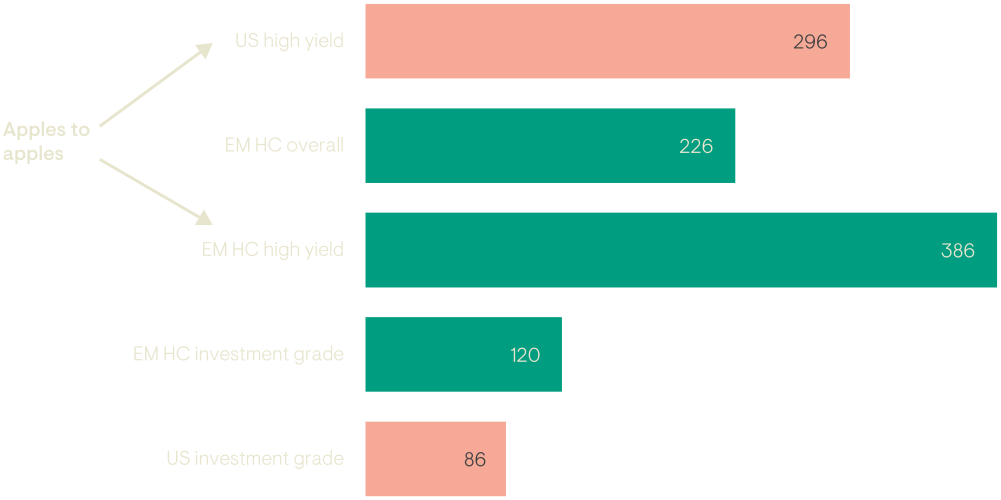
Source: ICE BofA, JP Morgan. 30 June 2025. Spreads used are OAS – see Appendix for details. For further information on indices, please see Important Information section.
Understand how well a benchmark captures the market opportunity set
The choice of benchmark – and how it is constructed – can have a significant bearing on how asset classes stack up against each other. Some UK investors prefer to look at the ICE BofA set of indices – as we did in Figure 1. However, the JPMorgan EMBI index is a more widely used benchmark by the global investment community for EM hard currency debt. One of the reasons for this is that it reflects more fully the investment opportunity set and includes a higher proportion of high-yield issuers. In contrast, the ICE BofA index shown above has greater exposure to investment-grade issuers – e.g., Saudi Arabia accounts for 10% of the BofA index but only 5% of the JPMorgan EMBI.
Repeating the credit spread comparison exercise using the JPMorgan EMBI (Figure 2) paints an even clearer picture of an attractive pick-up in spread offered by EM hard currency debt. This is even more compelling considering the superior average credit rating of the EM hard currency debt market (three notches higher than the US high-yield market) – the reward for risk in EM hard currency debt appears generous.
EM hard currency debt stacks up favourably when looking at a more representative index
Figure 2: Spread levels (bps) – JP Morgan EMBI index
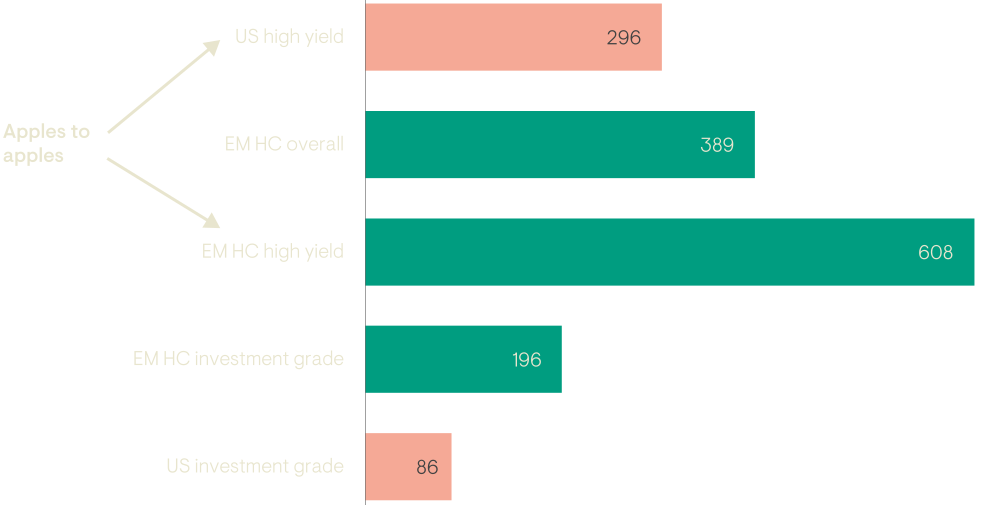
Source: ICE BofA for US indices, JP Morgan for EM indices. 30 June 2025. Spreads used are OAS for ICE BofA and Z-spread for JP Morgan indices – see Appendix for details. For further information on indices, please see Important Information section.
Look at the historical context
In addition to the current snapshot, it is also useful to reflect on how current spread levels compare with their historical values. Looking at this using percentile values, with 0 representing the tightest spread seen over the last decade (most expensive) and 100 being the largest (i.e., cheapest), we see that today:
- EM sovereign bond spreads are in their 52nd percentile, with the high-yield portion of the market in its 46th and the investment-grade bucket in the 64th.
- The US high-yield and investment-grade markets are both in their 4th percentile, respectively2.
In other words, spreads in EM hard currency debt are wide from a historical perspective – the asset class appears attractively valued; in contrast, spreads in the US high-yield market are near their tightest levels in a decade - the asset class appears very expensive.
Consider the underlying fundamental strength
Focusing again on the risk side of the risk/reward equation, as noted earlier, perceptions of excessive risk have been a key deterrent for some investors. The reality today tests this.
As we noted in a recent paper, many EM economies began laying the groundwork for a more sustainable path several decades ago. While recent geopolitical events and the COVID-19 pandemic tested certain segments of the investment universe, EM debt defaults represented only a small portion of the market. Since 2022, EM economies have continued to benefit from prudent policymaking, which has further reduced debt levels and external vulnerabilities. Today, credible monetary policy and fiscal reform clearly remain an ongoing trend across EM economies.
This trend of fundamental improvements has not gone unnoticed by credit rating agencies, resulting in one of the strongest outlooks for the EM rating cycle that we have seen for some time. In contrast, the US high-yield market is beholden to the fortunes of the US economy, where the operating environment for debt-issuing companies is looking increasingly uncertain.
A wider lens – broader portfolio considerations around EM debt
As noted earlier, EM hard currency debt is a spread asset class; hence, this paper’s focus is on comparing it to the US high-yield market as a direct replacement. However, the broader asset class – spanning hard and local currency debt markets, and sovereign and corporate issuers – has much more to offer investor portfolios, not least in terms of diversification properties, which is an area of focus asset allocators today.
The EM sovereign debt market is a diverse collection of markets, encompassing a broad range of economic structures and specialisations. This includes a sub-set of less-developed ‘frontier’ economies – markets that are undergoing crucial changes to their economic structure, such as moving from an agriculture-driven to a services-centric economy. The EM debt investment universe also comprises a wide range of successful corporations – many of which operate in global markets and are tapping international capital markets to help fund and grow their businesses. The varied behaviour of these individual asset classes across the cycle and the large dispersion across markets that sit within these make EM debt a powerful diversifier (Figure 3). Investors who choose a blended EM debt strategy – which invests across the EM debt asset classes – can benefit fully from the divergent dynamics across the asset class while also capturing bottom-up selection opportunities across and within markets.
Diversification properties of the broader EM debt asset class
Figure 3. Correlation between EM and DM assets from a GBP perspective (Jan 2003 - Jun 2025)
| EM hard currency sovereign | EM local currency sovereign | Global aggregate | Gilts | UK investment-grade corporate | |
|---|---|---|---|---|---|
| EM hard currency sovereign | 1.00 | 0.77 | 0.74 | 0.35 | 0.38 |
| EM local currency sovereign | 1.00 | 0.59 | 0.25 | 0.33 | |
| Global aggregate | 1.00 | 0.51 | 0.17 | ||
| Gilts | 1.00 | 0.57 | |||
| UK investment-grade corporate | 1.00 |
Source: Ninety One, Bloomberg, JP Morgan, as at 30 June 2025. EM hard currency sovereign: JPM EMBI. EM local currency sovereign: GBI-EM GD. Global aggregate: Bloomberg Global Aggregate. Gilts: FTSE 5-15 Yr Gilts. UK investment-grade corporate: from January 2003 to June 2007, Bloomberg Sterling Corporate Bond Index; from July 2007 onwards, iBoxx GBP Corp 1-15. For further information on indices, please see the Important Information section.
For investors who consider EM local currency debt specifically, currency risk is an important consideration. Since the inception of the JPMorgan EM local currency index (GBI-EM) in January 2003, in US dollar terms, currencies have been responsible for about a quarter of the index total returns, however over recent years, EM FX has, on average, been a headwind to returns. Independent of any views on whether this relationship will shift in the future, UK-based investors in EM local currency debt benefit from the fact that sterling acts as a partial natural hedge.
Our analysis shows that there is a roughly 50% correlation between EM local currency debt (JP Morgan GBI index) returns and GBP/USD, which has meant that at times, weakness from the EM debt asset class in US dollar terms has occurred at the same time as a sterling depreciation, resulting in significantly improved outcomes for a GBP investor.
In summary
When weighing the relative benefits of US high-yield debt and EM hard currency debt, a variety of perspectives – beyond a narrow focus on index-level spreads – points to a compelling investment case for EM hard currency debt. Furthermore, the broader EM debt asset class can provide valuable diversification benefits. Through a variety of lenses, EM debt appears compelling – it deserves a place in portfolios, in our view.
1 Typically, the yield on US Treasuries.
2 Source: Ninety One, JPMorgan, ICE BofA, 30 June 2025. EM indices used are JPMorgan, US indices used are ICE BofA.
General risks. Past performance does not predict future returns. Investment objectives may not necessarily be achieved; losses may be made. Target returns are hypothetical returns and do not represent actual performance. Actual returns may differ significantly. Environmental, social or governance related risk events or factors, if they occur, could cause a negative impact on the value of investments.
Specific risks. Default: There is a risk that the issuers of fixed income investments (e.g. bonds) may not be able to meet interest payments nor repay the money they have borrowed. The worse the credit quality of the issuer, the greater the risk of default and therefore investment loss. Interest rate: The value of fixed income investments (e.g. bonds) tends to decrease when interest rates rise. Emerging market (inc. China): These markets carry a higher risk of financial loss than more developed markets as they may have less developed legal, political, economic or other systems.
Appendix: definitions
Market snapshots
| ICE BofA: EM hard currency sovereign | JPMorgan: EM hard currency sovereign | JPMorgan: Hard currency corporate | JPMorgan: Local currency sovereign | ICE BofA: US high yield | |
|---|---|---|---|---|---|
| Definition | Debt issued by EM governments. Denominated in US dollars. | Debt issued by EM governments and companies that are 100% state-owned. Denominated in US dollars (or, for e.g., euros). | Debt issued by companies based in emerging market economies, usually denominated in US dollars (or, e.g., euros). | Debt issued by EM governments thatis denominated in the domestic currency of the issuer. | Debt issued by companies in the US, with a credit rating of BB+ and below, denominated in US dollars. |
| Index* | ICE BofA US EM External Sovereign Index | JP Morgan EMBI Global Diversified | JP Morgan CEMBI Broad Diversified | JP Morgan GBI-EM Global Diversified | ICE BofA US high yield constrained index |
| Index launch | 1991 | 1993 | 2008 | 2003 | 2002 |
| Market cap. (US$bn) | 1,029 | 1,300 | 1,130 | 5,620 | 1,367 |
| Countries | 75 | 69 | 65 | 19 | 1 |
| Issuers | 75 | 161 | 755 | 19 | 867 |
| Yield, % | 6.7 | 7.8 | 6.6 | 6.1 | 7.5 |
| Duration | 6.9 | 6.4 | 4.1 | 5.3 | 3.2 |
| Average credit rating | BBB- | BB+ | BBB- | BBB+ | B+ |
Source: Ninety One, JP Morgan EMBI Monitor, as at 31 May 2025. *The indices shown are those that are most commonly adopted as a primary benchmark by investment managers, however, other indices representing the investable universe exist, such as those provided by Bloomberg and ICE.
Understanding credit spreads
A credit spread refers to the additional yield a bond offers over the corresponding “risk-free” rate, typically a government bond. This spread compensates investors for various risk premiums, including credit risk and liquidity risk.
There are several ways to calculate credit spreads, with some of the most frequently cited being:
G-spread: The difference between the yield of a corporate bond and that of the closest-maturity government bond.
Z-spread: A constant spread added to the entire benchmark yield curve (such as the US Treasury curve) so that the present value of a bond’s cash flows equals its current market price.
Option-adjusted spread (OAS): A refinement of the Z-spread that adjusts for any embedded options in the bond, such as call or put features.
Headline spreads represent the overall spread of an index and are typically calculated as the weighted average spread of all the constituent bonds in the index.
