A major part of the global investment landscape
At over US$30 trillion1, the emerging market (EM) debt asset class is today an important component of the global debt market. This has helped put it on the radar of many asset allocators as they seek to improve portfolio diversification in response to shifting asset class behaviour.
In addition to its impressive growth, the evolution of the asset class over the past 10-15 years has been remarkable - spanning sovereign and corporate issuers, denominated in both ‘hard’ and local currencies. This has created a broader opportunity set and new considerations for investors.
Here we take stock of the asset class today and consider each component of the EM debt market in turn – its history, evolution and the implications for investment portfolios.
The asset class today
Figure 1: EMD index universe by region and asset class
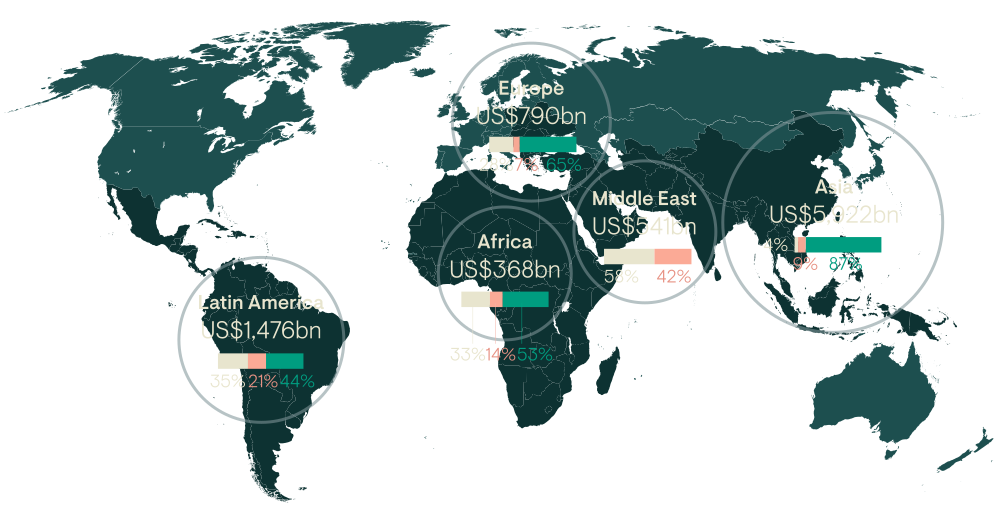
| ■ Hard currency sovereign | ■ Hard currency corporate | ■ Local currency sovereign | |
|---|---|---|---|
| Definition | Debt issued by EM governments and companies that are 100% state-owned. Denominated in US dollars (or, e.g., euros). | Debt issued by companies based in EM economies, usually denominated in US dollars (or, e.g., euros). | Debt issued by EM governments that is denominated in the domestic currency of the issuer. |
| Index* (launch) | JPMorgan EMBI (1993) | JPMorgan CEMBI (2008) | JPMorgan GBI-EM (2003) |
| Total debt stock (US$bn) | 1,832 | 2,623 | 15,646 |
| Average credit rating | BB+ | BBB- | BBB |
Sources: Chart: Ninety One as at 31 December 2025. Assets across JPM EMBI. JPM CEMBI and JPM GBI-EM Indices. Table: Ninety One, JPMorgan CEMBI Monitor, as at 28 February 2026. *The indices shown are those that are most commonly adopted as a primary benchmark by investment managers, however, other indices representing the investable universe exist, such as those provided by Bloomberg and ICE.
The journey to a US$30 trillion global asset class
The hard currency debt market today is highly diverse, spanning oil exporters and importers, regional manufacturing hubs and services-driven economies across the globe. The increased importance of frontier markets also offers the opportunity for investors to take meaningful – and diversified – exposure to a broad range of underlying return drivers.
The corporate credit market is now larger than the US high-yield market and provides access to some world-leading companies across a global opportunity set. The fast-growing and increasingly diverse asset class compares very favourably to developed markets; with higher yields, lower duration and less leverage than US debt for comparable credit quality, it can provide a high-grade complementary solution for institutional investors. In addition, the tendency for sovereign dynamics to overshadow fundamentals creates market dislocations that active investors can seek to exploit.
In a world in search of diversification, the EM local currency debt market’s low correlation to global markets is an attractive characteristic. The differentiated behaviour of local currency debt portfolios, especially for non-US dollar based investors, reflects the distinctive factors driving returns: differing interest rate regimes, divergent economic cycles and currency fluctuations. Furthermore, the diverse drivers of the local currency debt market make it an inefficient market that offers plenty of alpha-capture opportunities across various avenues – from hedging FX exposure to take advantage of monetary policy cutting cycles and to reduce currency risk, to yield-curve positioning strategies as inflation cycles adjust to proactive monetary policy. Frontier markets here also offer significant (off-benchmark) opportunities – exhibiting characteristics such as high yields and low correlation to global markets.
Where it all began: hard currency sovereign debt
The EM debt asset class was born in 1989, with the creation of ‘Brady bonds’ by then US Treasury Secretary Nicholas Brady. The debt-reduction plan enabled commercial banks to exchange their claims on developing market governments (mainly from Latin America) and convert them to more tradeable and liquid Brady bonds. Since then, hard currency debt markets have become an increasingly important source of financing for EMs and remain the main entry point for most countries when making their first foray into global fixed income markets.
Compared to the early 1990s, when four countries (Argentina, Brazil, Mexico and Russia) accounted for over 80% of the market, the size, complexity and diversity of the flagship EM hard currency debt index – known as the JPMorgan Emerging Market Bond Index (EMBI) – have changed significantly, and it now encompasses 682 countries.
Over the last decade, the average credit quality of the universe has remained steady despite significant global turbulence caused by the COVID-19 pandemic, Russia’s invasion of Ukraine, and other inflation shocks. The growth of frontier markets has led to a rise in the number of high-yield constituents within the EMBI, but the inclusion of more countries from the Gulf Cooperation Council (GCC) region3, which tend to be of higher credit quality, has counterbalanced this. The result is a greater dispersion of return outcomes, especially relating to the potential for rating upgrades, which creates a rich hunting ground for active investors.
Looking ahead, fundamental improvements in EMs are fuelling an improvement in rating dynamics. Combining the credit ratings of S&P, Moody’s and Fitch, ratings upgrades in 2025 outstripped downgrades across EM regions.
68countries |
6.5duration (years) |
160issuers |
6.6%yield |
Corporate credit: a rapid ascent
EM corporate debt is a more recent addition to the EM debt suite of asset classes, but rapid growth over the past 10-15 years means it is now almost double the size of the US high-yield market. It has transformed into a valuable portfolio allocation, both as a standalone asset class and within blended debt allocations.
Initially, EM corporate issuance was concentrated in a limited set of countries – primarily investment-grade corporates in Asia – and sector exposure was skewed toward financials and natural resources (oil & gas, metals & mining). Today, regions such as Latin America and the Middle East represent a meaningful share of the opportunity set, and investors in the asset class benefit from access to a wide range of sectors and credit ratings – from protein producers in Latin America to telecom issuers in Turkey.
Market-leading firms with strong balance sheets
It is an often-overlooked fact that EMs are home to many market-leading companies, with a global footprint and geographically diverse revenue sources. For instance, leading global brands owned by EM companies include GE Appliances, Samsung and Volvo.
Because EM corporate debt is a relatively new asset class (compared to DM debt), companies tend to have less frequent issuance needs, meaning they typically operate with lower leverage and shorter maturity profiles. This has been particularly evident since the COVID-19 crisis, as many companies pared back their expansion and capital expenditure, leaving them with healthy cash balances and strong buffers.
Today, the fundamentals of the EM credit opportunity set compare very favourably with developed credit markets.
An inefficient market provides generous compensation for risk
Across the EM universe, country-specific concerns can often overshadow a company’s underlying fundamental strength, pushing yields above those offered by DM bonds of a similar credit quality – we describe this as a ‘post-code premium’. This is reinforced by the fact many EM corporate issuers would have a higher credit rating today if they were not constrained by sovereign ratings. For example, Turkey’s banking sector ‘looks’ investment grade – benefitting from strong capital buffers and state support – but a challenging macroeconomic backdrop means that Turkish sovereign debt (and therefore corporate issuers) is stuck in the high-yield category.
In effect, investors can earn relatively high yields on high-quality bonds in this inherently inefficient market.
67countries |
4.2duration (years) |
726issuers |
5.7%yield |
Local currency debt – higher quality, broader and more diverse
In just over 20 years, the EM local currency debt market has grown to become the dominant segment of the EM debt universe. The composition of the main index (JPMorgan GBI-EM) has also evolved, with significant changes including the addition of China in 2020 and the exclusion of Russia in 2022. More recently, India’s inclusion in the index in 2024 underscores the quality, depth and liquidity of the asset class. JPMorgan has recently moved to reduce the maximum country weighting from 10% to 9%, to be phased throughout 2026, reducing concentration in the largest countries (such as China and India), while slightly increasing the weighting of smaller markets (such as Dominican Republic and Uruguay).
Crucially for active investors, while the index remains relatively concentrated (comprising 19 countries), the investable universe has expanded dramatically to include over 704 local markets, with frontier debt representing much of that growth.
Despite the fundamental improvements seen in this asset class, local currency debt remains under-owned in global investor portfolios. The gap left by this limited participation by international investors has been filled by domestic investors in EMs. This bodes well, as lower foreign ownership tends to mean that in times of market stress there is less forced selling and the (increased) local investor base typically acts countercyclically, with local investors more inclined to hold onto their assets through any bouts of market turmoil.
19countries |
5.4duration (years) |
19issuers |
5.8%yield |
Analysing the investor base
An understanding of the investor base is crucial to successful investing in EM local debt markets. While flows data typically focus on offshore investors, it’s interesting to look at who the real long-term investors are. EM debt has a very broad investor base and local investors – banks, assurance and insurance, as well as local pension markets – are very important for the asset class. That means local regulation is also an important driver, not only of holdings, but also of prices. For this reason, an understanding of the local backdrop is of paramount importance to understanding the fixed income market and yield curve. Local investors are the key holders of local debt in markets such as South Africa, Mexico and Brazil; the reasons behind this are varied and often country specific. Local holders are also a big consideration in corporate markets – given the low level of onshore local currency corporate bond investment by offshore investors – this market is dominated by local banks and insurers, who typically have very long investment horizons.
Frontier markets and the alpha-capture opportunity
A key trend across both the hard and local currency parts of the EM debt investment universe in recent years is the growth in issuance from an increasing number of smaller ‘frontier’ markets, including countries in central Asia and Sub-Saharan Africa.
Frontier markets today account for approximately a third of the EMBI constituents5 with this globally diverse opportunity set doubling in the past 10 years. These smaller and often less liquid markets are typically under-researched by the mainstream investment community and are therefore rife with information asymmetries, bringing greater potential for alpha capture to those willing and able to do the necessary analysis. For instance, investors can seek to benefit from rating upgrade stories among reforming economies, and alpha opportunities also exist around IMF programmes for asset managers able to see beyond the (often negatively skewed) headlines. Crucially, the conviction to stay away from more vulnerable markets is vital in this investment universe.
With characteristics such as high yields and low correlations to global markets, frontier local currency debt offers compelling off-benchmark opportunities to investors with the technical ability and research resources to exploit the full market. The asset class has evolved to be one of huge breadth, offering high quality and liquidity while still providing an attractive yield pick up to DM bonds.
In summary
In all parts of the market, a maturing of the asset class has created a diverse range of investment opportunities across the credit rating spectrum. Low correlations make this an increasingly important asset class in the context of portfolio diversification and the associated increased dispersion of return outcomes is an ideal backdrop for active investors.
The heterogeneous nature of the asset class today – in terms of the wide range of underlying credit quality, regional disparity, and unique idiosyncratic drivers – differentiates it from other fixed income markets, presenting opportunities investors should not overlook. While the wide range of return outcomes seen across and within parts of the EM fixed income universe makes this a complex market to invest in and necessitates a careful approach to risk management, the potential reward is significant for investors with the necessary expertise and local knowledge.
General risks. The value of investments, and any income generated from them, can fall as well as rise. Past performance is not a reliable indicator of future results. Environmental, social or governance related risk events or factors, if they occur, could cause a negative impact on the value of investments.
Specific risks. Default: There is a risk that the issuers of fixed income investments (e.g. bonds) may not be able to meet interest payments nor repay the money they have borrowed. The worse the credit quality of the issuer, the greater the risk of default and therefore investment loss. Emerging market (inc. China): These markets carry a higher risk of financial loss than more developed markets as they may have less developed legal, political, economic or other systems.
1. Source: Ninety One, JPMorgan, Bloomberg, as at 28 February 2026. This number includes EM local currency corporates, EM hard currency corporates, EM hard currency sovereign and EM local currency sovereign. For further information on indices, please see the Important Information section.
2. As at 28 February 2026.
3. Comprises Bahrain, Kuwait, Oman, Qatar, Saudi Arabia and the United Arab Emirates.
4. As at 28 February 2026. Number of countries with investable local currency market (either FX or bonds).
5. As at 28 February 2026.
