0:00
0:00
The great wealth transfer, where $83 trillion1 is expected to transition from the current asset owners to the next generation by 2048, creates both an opportunity and a threat for financial advisors.
Research by Cerulli Associates2 has found that a large majority of heirs plan to leave their parents' financial advisor once their estate has been finalised. The silver lining is that most Gen X and millennial heirs said they would retain their parents' advisor if that advisor had been involved in structuring the family's inheritance plan.
It is for this reason that Ninety One IP created our Family Office functionality, facilitating connections within families that span generations. While family pricing rewards consolidation of assets on one platform, the key tenet is to encourage financial planning behaviours that improve outcomes for the entire family unit.
In this article, we highlight the benefits that apply specifically to offshore investing.
Maximising annual externalisation
South African tax residents can externalise R2 million each year without approval, and a further R10 million with a SARS-issued Approval for International Transfer (AIT) PIN. Both allowances sit with the individual, not the household. In practice, this process is typically funded by one spouse, thus using only half the family's available capacity to move wealth offshore.
There's no tax cost to spreading this across both spouses. Transfers between South African-resident spouses are exempt from donations tax, so funds can move between them before externalisation without triggering a tax event. Running the process through both spouses' names doubles the family's annual capacity, from R12 million to R24 million at the maximum.
Where pricing is applied at family level, there is no cost penalty for holding investments in both spouses' names. Family-level reporting gives the advisor a single, consolidated view of the family's combined offshore position even though the underlying allowances are being used separately.
Making room for donations to children
Family pricing removes a key friction point in intergenerational wealth transfer, allowing parents to make smaller, incremental gifts to children without being penalised through higher platform fees as ownership of the asset changes. Parents who invest on behalf of a child can gradually reduce their own estate while witnessing the benefit to their children during their lifetime.
These accounts often start small, and a platform that prices at client level can make them feel like an expensive way to hold a modest sum. Family pricing removes that friction, which is important because it is often these smaller accounts, nurtured over time, that do the most to secure an advisor's relationship with the next generation.
Structuring assets within an offshore trust
For families with larger or more complex holdings, offshore trusts remain one of the most effective succession tools available. A trust can hold assets on behalf of multiple family members, ensuring assets continue to be professionally managed and distributed responsibly, rather than paid out as a single lump sum.
As wealth builds beyond certain thresholds and family circumstances become more complex, a family may decide to move assets out of an individual's name and into a trust structure. However, this decision should be driven by financial planning merits without platform costs clouding the decision. Under family pricing, restructuring into a trust carries no additional cost at platform level.
Sweetening the offering
The recent repricing of our offshore investment platform makes this a good moment to revisit what family pricing actually delivers. Previously, the first $300 000 in a portfolio was charged at 0.50%, the next $700 000 at 0.25%, and anything above $1 million at 0.15%. Under the new scale, the first $200 000 is charged at 0.50%, the next $800 000 at 0.25%, and anything above $1 million at 0.10%.
Bringing it all together: Where product, planning and pricing meet
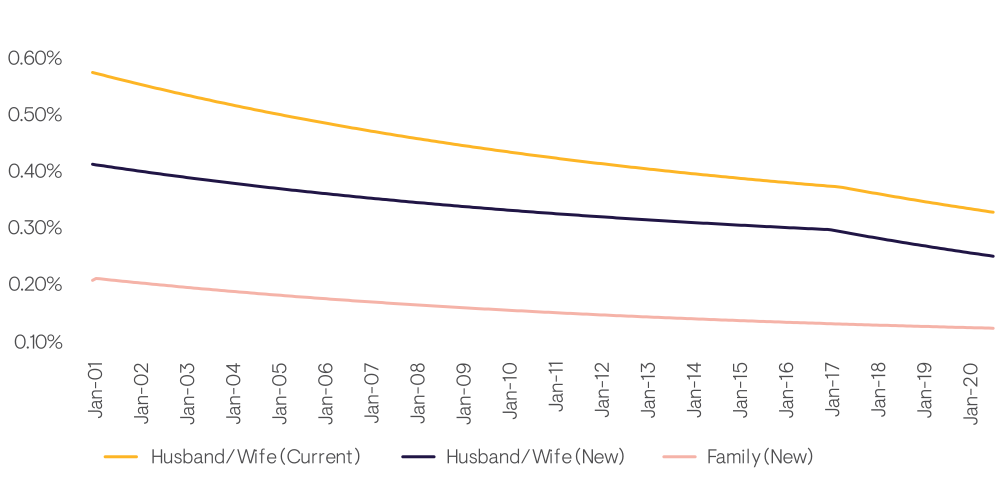
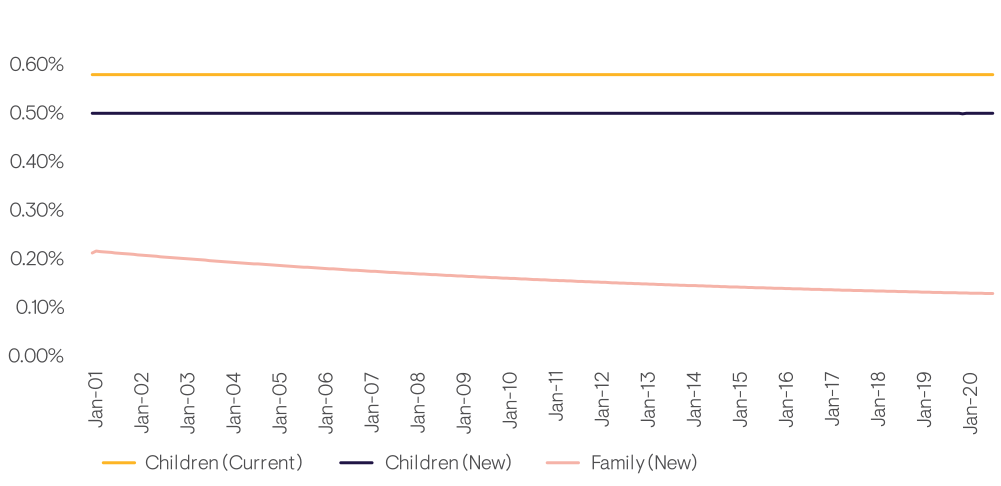
These fee savings can provide material benefit at client level, however the biggest benefit comes when shown in the context of a family. Consider a husband and wife with $300 000 invested each, together with their three children, who each have $50 000 invested following donations from their parents. The family also has an offshore trust holding a further $1 million for succession-planning purposes. In total, the family has $1.75 million invested across the platform.
If each investment were to grow at 8% per annum over 20 years, the difference between individual client pricing, the standard pricing structure and family pricing becomes increasingly meaningful. The children, in particular, benefit from the ability to participate in the family's overall scale, despite each having a relatively modest investment of their own. The same principle extends to the family trust.
Figure 1: Where product, planning and pricing meet
Parents
Children
Trust
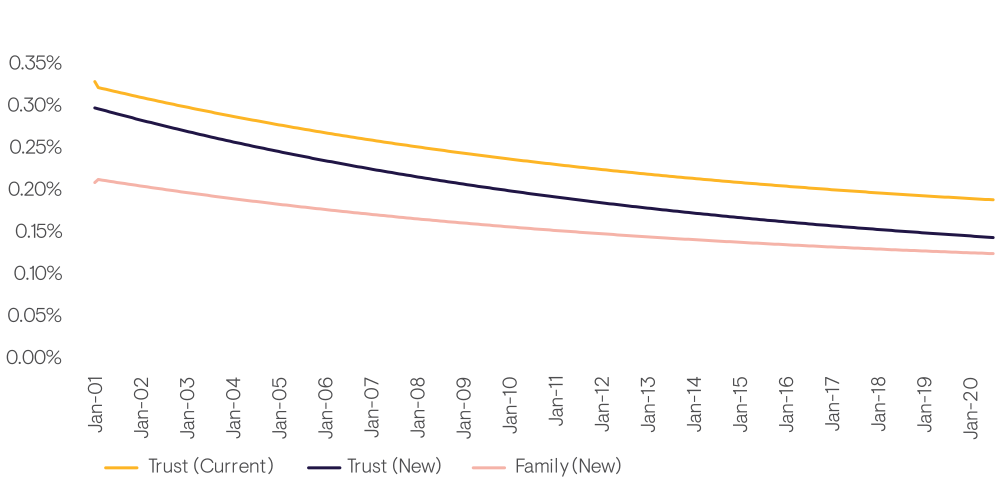
Source: Ninety One calculations, for illustrative purposes only. Growth assumed to be 8% p.a.
More importantly, however, family pricing creates flexibility for the advisor to implement the financial planning strategy that is right for the family without the platform fee becoming an unintended constraint.
The benefit of family pricing that probably receives the least consideration is the opportunity to maintain the benefit of scale on death. With client-level pricing, an estate that divides among three or four beneficiaries produces three or four smaller accounts, each falling into a more expensive tier than the large single account it replaced. Family pricing prevents this because the fee scale continues to apply to the family's combined assets. The benefit of scale built up over years is carried through the transition rather than eroded by it.
None of the financial planning ideas presented in this article are new. Families have long split offshore allowances between spouses, made gifts to children, and used offshore trusts. But where these assets are split between platforms and advisors, the fragmented nature can inhibit the achievement of these goals due to a lack of accountability. Family pricing encourages consolidation, increasing the probability of doing all of this coherently, on one platform, with one advisor ultimately responsible for the family outcome.
Advisors and platforms exist to deliver more than just investment returns. They have a role to play in helping families preserve the wealth those returns create and ensuring it can be transferred efficiently to the next generation. This is the thinking behind Ninety One's Family Office functionality, giving advisors the tools and flexibility to protect family wealth today, while preparing it for the great wealth transfer of tomorrow.
1. Source: UBS Global wealth report 2025.
2. Source: Cerulli Associates, "Ageing Boomers Bring Intergenerational Planning to the Forefront", press release, 19 July 2021.
