The fast view
- The return trade-off is changing – conservative investors face tougher choices between safety and growth, with fewer easy wins.
- Yield alone is no longer enough – rate cuts and modest inflation mean real returns from cash and bonds are under pressure.
- Multi-asset low equity funds deserve renewed attention – they can offer more flexibility, smoother participation and a hedge against inflation.
- Ninety One Cautious Managed Fund is built for this – a risk-aware blend of quality assets that can manage shifting regimes.
For conservative investors – especially those preserving capital in retirement – the goal isn’t to beat benchmarks. It’s to stay invested, stay protected and stay ahead of inflation. Real returns, low volatility and consistent income matter most.
Yet many portfolios today fall into one of two traps: taking on too much risk at the wrong time or being too cautious to meet future spending needs. Both can quietly derail long-term plans.
When yield doesn’t cut it
For much of the past decade, South African conservative investors enjoyed the benefits of high real yields. Whether through cash, money market, or flexible income funds, investors could generate attractive returns without leaning too far into risk. It was a golden period for fixed income – steady, sufficient, and largely unchallenged.
Figure 1: Real cash and bond rates
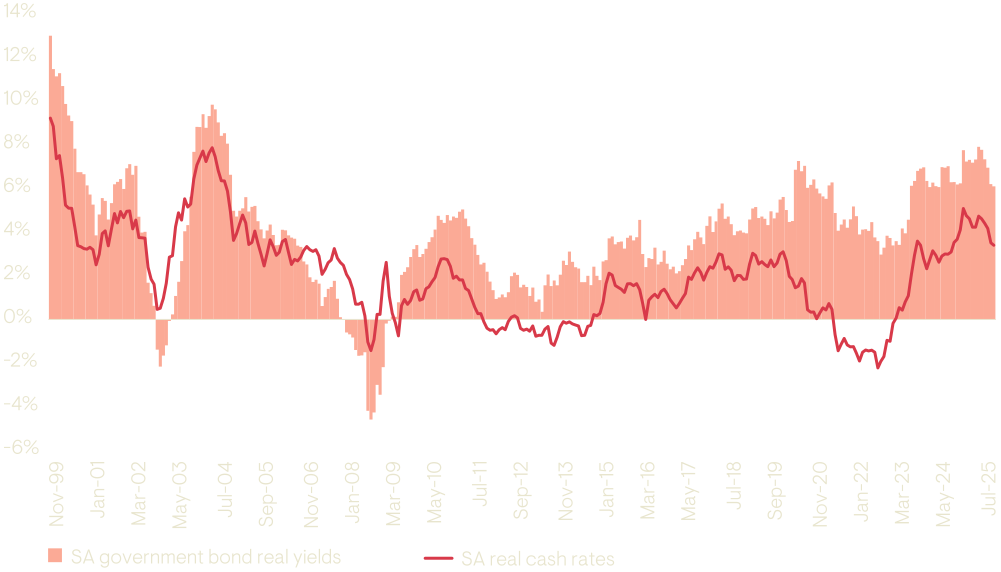
Source: Ninety One and Bloomberg, November 1999 to 31 August 2025.
But that favourable dynamic is fading. As policy rates trend lower coupled with modest official inflation, the real yield advantage that once made fixed income compelling, is steadily eroding. Put simply, we believe nominal bond and cash yields are likely to come down. In the short term, investors may still benefit from capital gains as yields decline. But over the medium term, we expect local bonds to deliver more modest outcomes – likely in the mid- to high-single digits. That’s still reasonable but meaningfully lower than the levels seen in recent years.
Many portfolios still reflect the world as it was – high real yields and a bond cushion that did much of the work. But that world is changing. And investor allocations that don’t evolve with it risk falling behind.
Anchoring to what worked in the past can be dangerous. When the regime changes, the opportunity set shifts – often subtly, but meaningfully. And by the time it’s obvious, the window may be closing.
This leaves conservative investors at a crossroads: either settle for structurally lower returns, or rethink how portfolios are built – with a more balanced, forward-looking design. The key is to structure portfolios that are fit for purpose, not just familiar.
The elephant in the room
Official inflation may appear modest, but it doesn’t reflect the true cost pressures faced by many investors, particularly those in or nearing retirement. Medical inflation, education fees and food costs often rise significantly faster than official inflation. These real-world expenses don’t pause when portfolios underdeliver. Inflation is personal.
Preserving capital in name is not enough. It must be preserved in purchasing power – and that means building in the ability to beat your inflation, not just the published figure.
As yield levels fall, conservative portfolios that rely solely on fixed income will find it harder to keep pace with these rising costs. The need for measured participation in growth assets becomes essential.
The illusion of safety
The cautious label is often associated with a reluctance to invest in equities. But there’s a difference between avoiding volatility and managing risk. The former may feel safe in the moment but can result in sustained underperformance when conditions change.
Portfolios that rely too heavily on fixed income today face three unappealing paths: stretch for credit risk, extend duration, or accept lower returns. None serve long-term capital preservation well – particularly for investors drawing income.
What’s needed is not more risk – but the right risk, taken deliberately and with discipline. Avoiding all growth exposure isn’t conservative. It’s incomplete.
A smarter role for multi-asset low equity funds
Multi-asset strategies with low equity exposure offer a potentially more adaptable framework. They balance income and the rewards of growth. These strategies also provide flexibility to shift to different asset classes as conditions evolve. And they allow for smoother compounding – the kind that builds wealth quietly and consistently.
The Ninety One Cautious Managed Fund is designed for this. We don’t rely on any single source of return. Instead, the Fund blends high-quality equities, local and global, with government bonds, inflation-linked instruments, and cash – each playing a role, each sized with care. There are no passengers.
In practice, this means adjusting allocations when conditions shift. A good example is June 2024, when we meaningfully increased our exposure to South African government bonds. Post-election, the political backdrop felt more stable, and yields provided investors with an unusually attractive cushion. That was the moment to act. But that case has now faded. Today, with yields moving lower and official inflation lower, we are shifting towards growth assets – adding to domestic, and to a lesser extent, global equities – where we see a more durable opportunity for conservative investors. This is not market timing. It’s long-term readiness. When real yields are compelling, we tilt towards income. When equities offer value, the portfolio participates. When risk is mispriced, we hold more cash. The result is a portfolio that doesn’t need perfect conditions to deliver steady outcomes.
Participation matters more than prediction
Investors don’t need to predict the next interest rate move or equity rally. What matters more is being positioned to benefit when those shifts occur.
As yields fall, the relative appeal of growth assets increases. Equities, in particular, become more attractive in a lower-rate world, and portfolios that are unwilling or unable to participate may miss the upside.
Figure 2: Real wealth index
Purchasing power growth: SA equities vs SA bonds and cash
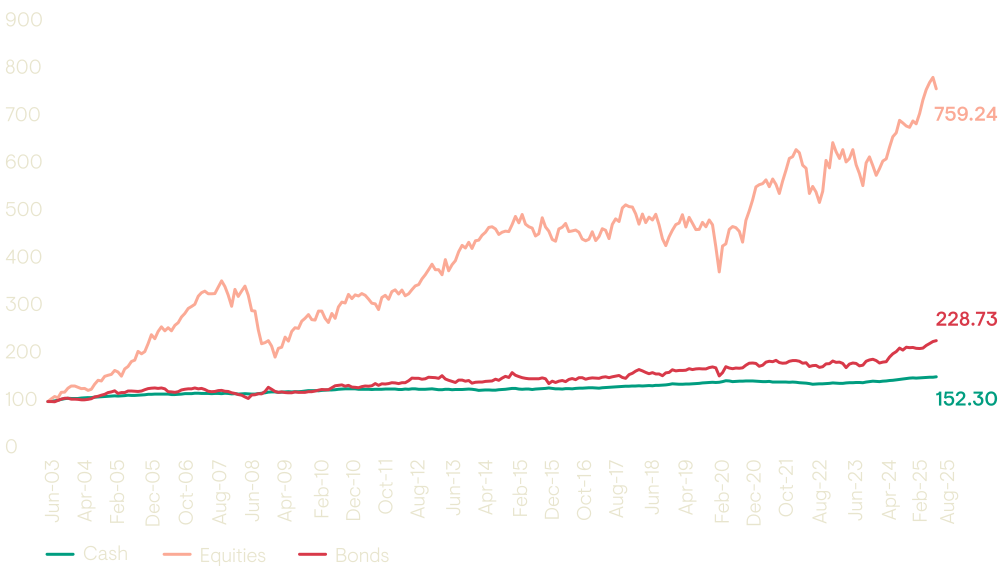
Source: Bloomberg and Ninety One. Data from 30 June 2003; indexed to 100, adjusted for CPI. SA equities – Capped SWIX. SA bonds – ALBI, SA cash – STeFI Composite.
Crucially, when we add equities, they must be the right equities. Not all companies provide the same valuation protection or compounding potential. Our focus remains on businesses with durable competitive advantages, consistent cash generation and balance sheet strength. These are the kinds of holdings that can help conservative investors participate in upside without taking on unrewarded risks.
Staying invested is the real edge
One of the most overlooked drivers of long-term performance is behaviour. When volatility spikes, many conservative investors reduce risk just as the recovery begins. It’s the retreat, not the volatility itself, that causes lasting damage.
Staying invested through the cycle requires confidence in the portfolio and clarity in the process. Multi-asset funds, if well designed, can provide that. By smoothing the return path and reducing emotional decision-making, they help investors avoid the costliest mistake: leaving at the wrong time.
The real strength of a cautious strategy isn’t just in avoiding drawdowns – it’s in managing them well enough to stay invested. Protecting capital on the downside matters deeply but so does being positioned to participate when conditions improve. It’s that balance – resilience through volatility and readiness for recovery – that defines long-term success.
A better foundation for conservative investors
Today’s conservative investor faces a more complex set of challenges than a decade ago: lower yields, rising personal inflation and narrow equity leadership. The solution isn’t to abandon caution, it’s to redefine it.
Caution doesn’t mean sitting still. It means being prepared. The Ninety One Cautious Managed Fund offers a more complete approach. It doesn’t avoid risk – it manages it.
For investors seeking to preserve capital in real terms – not just in theory, but in practice – this approach offers a stronger foundation for the road ahead.
Authored by

Actively managed ETFs signal a new chapter for South African investors
Active management has entered the exchange-traded space in South Africa, giving investors new ways to access skilled portfolio management with ETF efficiency. With global momentum building, the local market has started to embrace this evolution.