The fast view
- Exchange-traded funds (ETFs) are moving into a new phase with the rise of actively managed strategies.
- Globally, the adoption of actively managed ETFs (AMETFs) is accelerating.
- Younger, digital-first investors and intergenerational wealth transfers could drive future demand.
- Aligning settlement cycles across unit trusts and ETFs, as well as broader access on LISP1 platforms in South Africa, could encourage greater ETF adoption among professional investors.
The first ETF launched in South Africa as early as 2000, but ETFs remained on the periphery for many years. Although South Africa was an early adopter, the market developed slowly over the next two decades. In contrast, the US has been leading the ETF pack, accounting for more than two-thirds of global assets. While the US has been the big growth story (largely driven by region-specific tax considerations), ETF adoption is broadening across the world. The US is still growing at a healthy 18% per year, versus 26% for the rest of the world. Globally, the industry is worth US$17.1 trillion, with assets projected to grow to US$25 trillion by 2030.2
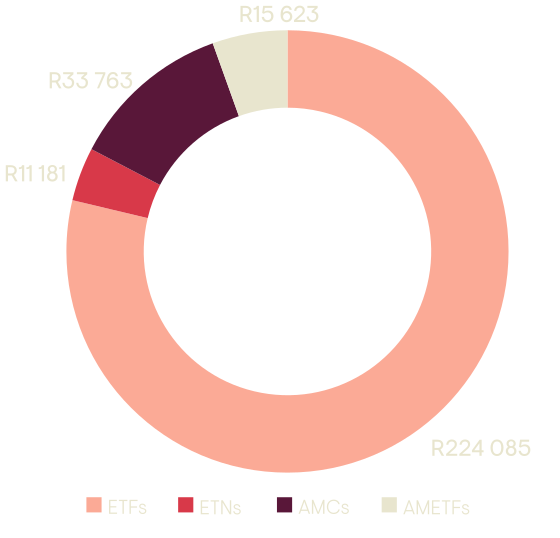
ETFs began to gain real traction in South Africa just before Covid-19, with the local market averaging annual growth of more than 18% over the past 5 years. Today, South Africa’s ETF industry is worth R224 billion,3 with demand continuing to grow as the sector evolves.
Historically, ETFs were limited to passive strategies, but regulatory changes have created opportunities for active investment managers. Unlike traditional passive ETFs, which simply replicate indices, actively managed ETFs aim to deliver better outcomes by dynamically responding to market conditions and uncovering opportunities through research and portfolio manager skill.
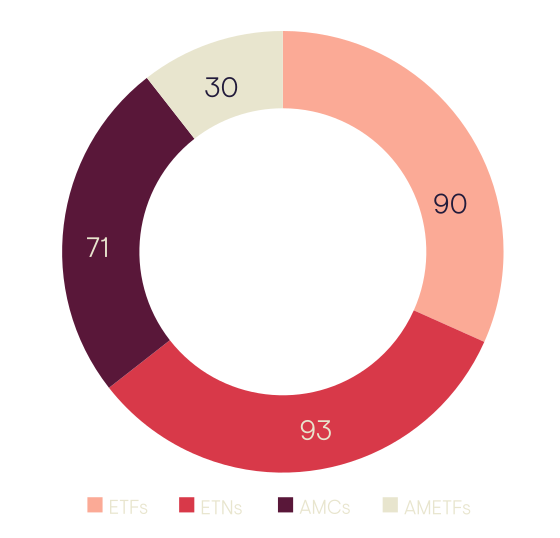
Figure 1: Overview of the exchange-traded product (ETP) market in South Africa
R285bn
AUM
284
Products
17.4%
5 year CAGR
AUM (R’million)
Number of products
Total ETP market capitalisation (R’million)
Your chart will be shown here
Source: ETFSA, State of the South African Exchange Traded Product (ETP) Industry, as at 30 September 2025. South Africa’s ETP market comprises investment products listed on the JSE that trade intraday and give investors exposure to an underlying asset, index or strategy. ETPs include ETFs, AMETFs, actively managed certificates (AMCs) and exchange-traded notes (ETNs).
Ninety One’s entry into the AMETFs space brings its investment expertise to a broader investor base and reflects the key themes influencing the evolution of investing:
- Active ETFs growing their share of global ETF flows
With more than 12 000 ETFs listed worldwide, the industry has become a central part of the global investment landscape. Recent regulatory changes across the US, Europe, Asia and now South Africa have paved the way for active management within ETFs. Since then, most ETF launches have been AMETFs. According to BlackRock,4 almost half of all global ETF launches in 2024 were AMETFs.
Active ETFs are steadily increasing their share of global ETF net flows, with assets expected to reach US$4 trillion in the next 5 years. While AMETFs still represent a small slice of total active assets globally, surveys from Brown Brothers Harriman and J.P. Morgan5 show that many institutional investors, fund managers and advisors plan to increase allocations in the near term.
Some managers have even converted their mutual funds into AMETFs. Regulators recognise the growing interest in AMETFs, and some are considering allowing mutual funds to launch ETF share classes. These trends support the expected increase in AMETF adoption. - Ease of trading and accessibility fuelling increased adoption of AMETFs
Some of the factors driving adoption are the enhanced trading and accessibility that ETFs offer. Investors can trade intraday, invest smaller amounts and access investment exposures easily on an exchange. From a manager’s (or issuer’s) perspective, an exchange listing provides distribution to a wider investor network and removes the need to place the ETF on multiple platforms. This supports a more digital and cost-effective servicing model.
Coupled with the potential to outperform passive benchmarks, it is little surprise that AMETFs are attracting increased attention. - ETFs appeal to younger investors
Across the world, the appeal of ETFs to younger investors (Millennials and Gen Z) stems from advantages that align closely with their digital-native lifestyles. Younger generations manage much of their lives through smartphone apps, and investing is no exception. ETFs, which trade on stock exchanges, can be bought and sold instantly throughout the trading day via user-friendly brokerage apps. This provides a sense of control and immediacy – appealing to a digital-first generation.
ETFs are well positioned to benefit from the significant intergenerational wealth transfer expected over the coming decades, as assets move to younger, tech-savvy heirs.6 This trend is global, but relevant for South Africa too, and could reinforce the appeal of ETFs for the next generation of investors. For advisors, these shifts highlight the opportunity to engage early with younger clients, guiding them as they combine digital investing habits with long-term financial planning. - Aligning settlement cycles in South Africa and LISP accessibility
In today's fast-paced global markets, operational efficiency and rapid settlement cycles are becoming increasingly important. Advances in technology have allowed most exchanges to shorten settlement cycles over time. Globally, exchanges have moved from T+5 to T+3 and then to T+2 – which became the standard in the US, most of Asia and Europe. More recently (2024), the US has adopted T+1, with the UK and Europe announcing plans to follow suit. Other markets are likely to come under pressure to keep pace with these exchanges.
The JSE has a settlement cycle of T+3 for equities. The global trend of a T+1 cycle may put pressure on the JSE to align with international markets. For AMETFs (which trade like equities or shares), such a change would also bring their settlement cycle in line with that of unit trusts, enabling investors to switch seamlessly between the two. Aligning settlement cycles between unit trusts and ETFs may make ETFs easier to use for professional investors, such as discretionary fund managers, funds of funds and financial advisors using model portfolios. Currently, ETFs are mainly accessible via share portfolios on LISPs. To enable ETFs to be more widely used in funds of funds or model portfolios, operational hurdles need to be overcome. This is key to driving broader adoption among professional investors. - Active management now on the JSE
The Johannesburg Stock Exchange (JSE) is evolving into a sophisticated, multi-instrument trading hub, enabling AMETFs to integrate seamlessly into this modern ecosystem. Investors now have access to a broad ‘supermarket’ of instruments via the JSE – from traditional equities and passive ETFs to AMETFs, exchange-traded notes and structured products. This means AMETFs are just as easily available on a familiar, well-regulated platform as any other listed asset.
Figure 2: Combining the benefits of active management with the efficiency of ETFS
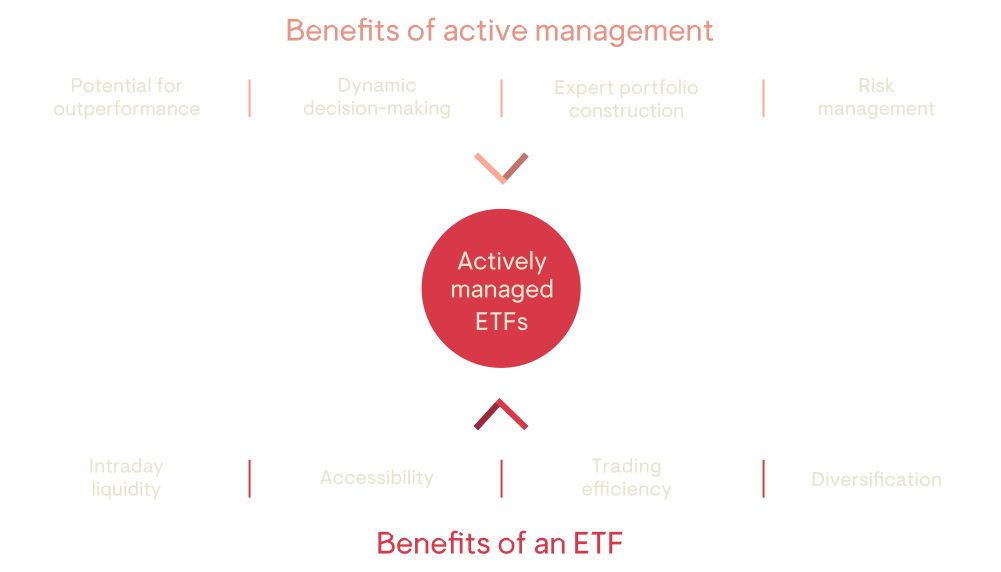
Source: Ninety One.
The rise of AMETFs signals a structural shift in how investors can access active management. With regulatory support, growing investor demand and evolving market infrastructure, South Africa is entering a new phase of investment innovation. As markets continue to develop, AMETFs may well become an integral bridge between traditional active funds and the dynamic world of exchange-traded investing.
Ninety One’s actively-managed ETFs
Ninety One recently announced the launch of two JSE-listed actively managed exchange-traded funds. The launch marks a significant milestone for the firm’s South African business and reinforces its leadership in actively managed strategies.
The Ninety One Diversified Income Prescient Feeder Actively Managed ETF (91DINC) and the Ninety One Global Diversified Income Prescient Feeder Actively Managed ETF (91GINC) grant investors access to multiple asset classes within each ETF. This represents a significant distinction from passive counterparts historically available on the exchange, which typically track a single-asset index. Furthermore, our AMETFs provide diversified exposure to asset classes that are currently less accessible, such as credit or emerging market debt.
91DINC – Diversified Income ETF
(ZAR-based)
91DINC gives investors access to Ninety One’s well-established multi-asset income strategy in a listed format, targeting stable, enhanced cash returns with downside risk management. The portfolio is Regulation 28 compliant and diversified across local bonds, credit, cash, property and offshore assets, with a strong focus on income generation and capital preservation.
91GINC – Global Diversified Income ETF
(ZAR feeder into USD fund)
91GINC offers offshore diversification through a global, low-duration, multi-asset income strategy aiming to deliver US dollar cash +1.5% over rolling 12-month periods, with no negative returns, also over rolling 12-months. With a focus on high-quality fixed income assets and built-in currency diversification, the Fund seeks to deliver consistent yield while limiting drawdowns.
Ninety One’s Diversified Income and Global Diversified Income AMETFs will list on 12 November 2025. The newly launched AMETFs are managed by Ninety One’s global fixed income and credit team comprising more than 70 investment professionals.
Ninety One actively managed ETFsDownload PDF
1 Linked Investment Service Provider (LISP).
2 Bloomberg, J.P. Morgan Asset Management, Guide to ETFs. Data as at 31 July 2025.
3 State of the South African Exchange Traded Product Industry, ETFSA, 30 September 2025.
4 BlackRock, Decoding active ETFS.
5 2025 Global ETF Investor Survey by Brown Brothers Harriman (BBH) and 2024 Trackinsight Global ETF Survey.
6 The great wealth transfer and the rise of the family office, Ninety One, June 2025.
Authored by

Where to find yield when the world is changing
Global and local bond markets are being reshaped by falling interest rates, volatile currencies, and inflation that remains unpredictable – keeping policymakers on high alert. Against this backdrop, Jason Borbora-Sheen and Adam Furlan share their outlook on the opportunities and risks across the local and global landscape, highlighting where diversified income funds can still provide attractive yield for conservative investors.