The fast view
- While global government bond markets wrestle with fiscal and political concerns, high-quality global credit offers a steady source of income.
- In South Africa, government bonds remain attractive, with the spread between 30-year and 10-year maturities among the widest globally.
- We believe our global and South African diversified income funds are ideally positioned to participate in these pockets of value, while protecting against the volatility.
Global bond markets are navigating a difficult transition. Growth forecasts have been revised marginally higher, but the path remains fragile. Inflation has moderated, yet renewed tariff pressures, shifting commodity prices and supply-side constraints have kept policymakers wary. Fiscal deficits are widening, while political turbulence adds another layer of complexity. The result is an unsettled global outlook: one in which opportunities still exist, particularly within investment-grade credit, but where caution needs to be exercised. Against this backdrop, South African government bonds, by contrast, are proving remarkably resilient, supported by orthodox monetary policy and attractive real yields.
Together, these dynamics highlight the nuances across fixed-income markets, underscoring the importance of selectivity and risk management in the search for diversified income exposure. We believe our global and South African diversified income funds are ideally positioned to navigate the complexities of this environment, while capturing the pockets of opportunities currently on offer.
A fragile global outlook
The headline data suggest the world economy is holding up better than expected. Growth forecasts have been nudged higher, and fears of recession have thus far been avoided. But this resilience is uneven and uncertain. The US continues to show momentum, although the recent steepening of the yield curve suggests investor unease. In Europe, the recovery has slowed, and Japan remains behind the curve in addressing persistent inflation.
Tariff policy is a growing risk. The potential re-escalation of trade disputes threatens to exacerbate price pressures as central banks continue their efforts to bring inflation back to target. For investors, the implication is that disinflation cannot be taken for granted, and that monetary easing will be slower and more conditional than markets had hoped.
Fiscal dynamics are also weighing on sentiment. In the UK, France and the US, larger deficits and heavy bond issuance have pushed longer-dated yields higher. Political instability, from French leadership turmoil to debates around the independence of the US Federal Reserve (Fed), compounds the challenge. Developed market bonds are behaving erratically, particularly at the long end, and investors are increasingly wary of duration exposure.
Investment-grade credit stands out
While global government bond markets wrestle with fiscal and political concerns, high-quality global credit has offered a steady source of income. As shown in the graph below, the yield differential between investment-grade credit and equities remains attractive, and flows into the asset class confirm its defensive appeal. Investors seeking yield without stepping into riskier territory continue to favour high-quality issuers, supporting valuations.
Figure 1: Yield differential between credit and equities
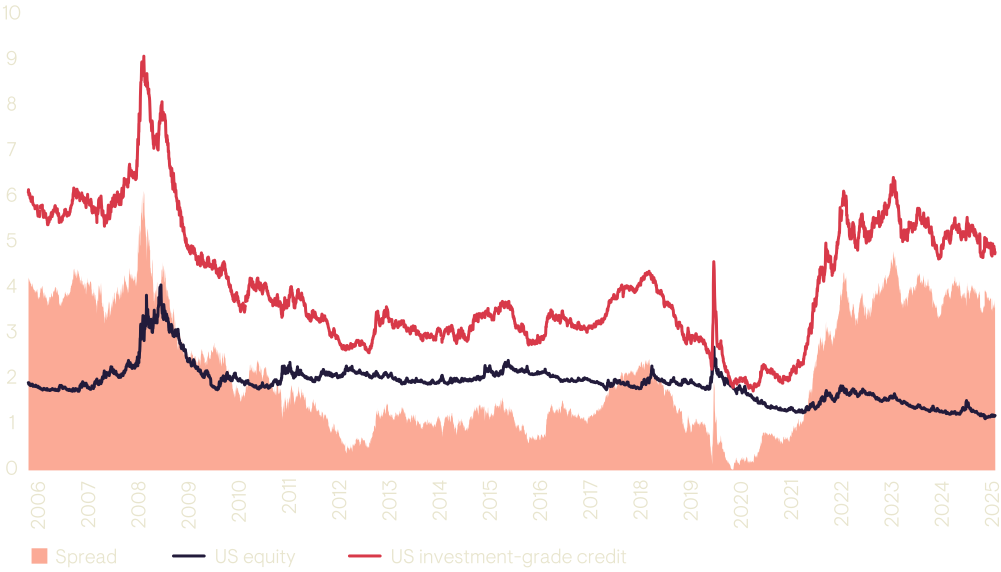
Source: Bloomberg and Ninety One: 31 October 2025.
Our Global Diversified Income Fund reflects this reality. The portfolio has select exposure to investment-grade credit and favours alternative credit assets such as mortgage-backed securities (MBS) and high-quality collateralised loan obligations (CLOs), harnessing strong demand for reliable yield.
At the same time, we have been selective with government bond duration, adding exposure to US Treasuries where the case for further rate cuts is building, while avoiding the longer end of yield curves where fiscal stress and political noise are distorting valuations. The result is a cautious but constructive positioning: seeking resilient income in the parts of the market where fundamentals remain supportive.
The South African outlook paints a contrasting picture
If developed markets highlight the risks, South Africa highlights the opportunities. South African government bonds have outperformed their global peers in recent months, supported by a combination of policy credibility and compelling valuations.
Since early April, the yield on the 10-year South African government bond (SAGB) has fallen considerably. The curve remains exceptionally steep: the spread between 30-year and 10-year maturities is among the widest globally. That steepness reflects risk premia, which, in our view, are excessive given the country’s fiscal and monetary stance.
The South African Reserve Bank has reinforced its reputation for orthodoxy by shifting its focus to the lower bound of its inflation target, aiming towards 3%. This commitment was recently underscored by a joint statement with the National Treasury, which has itself remained committed to fiscal consolidation and generating primary surpluses. The alignment of monetary and fiscal policy has bolstered investor confidence and set South Africa apart from many of its peers.
The rand, too, has been better supported. Solid terms of trade, firm commodity demand, particularly from precious metals, and a weaker US dollar have provided a firmer base. While volatility is inevitable, the currency is far better anchored than in previous cycles.
It is no surprise, then, that foreign interest in SAGBs has increased. For global investors seeking carry in a world of uncertain growth and fragile disinflation, South Africa offers one of the most attractive opportunities in fixed income today.
The case for diversification
Diversified income strategies are designed to capture sources of yield where opportunities are evident, while managing the risks inherent in a volatile world. Our philosophy is built on ‘participate and protect’: portfolios are structured to capture attractive yield, while striving to withstand shocks. This discipline allows us to stay invested when others are forced to retreat, delivering income without sacrificing resilience.
The Global Diversified Income Fund illustrates this approach. The portfolio maintains a BBB+ average credit rating (global investment grade), annualised volatility below 1%, and a yield close to 5%. It is positioned with overweight allocations to high-quality credit, selective exposure to US Treasuries, and the use of FX options to guard against currency swings.
Domestically, the South African Diversified Income Fund applies the same principles. Duration is managed conservatively at around 1.8 years in nominal bonds, with minimal inflation-linked or offshore currency exposure. Yet the Fund is constructive on the long end of the curve, recognising the potential for flattening as excessive risk premia unwind.
Conclusion
Understandably, risks, while mitigated, cannot be ignored. Inflation could re-accelerate, particularly if tariff disputes escalate. Political volatility remains a constant in both developed and emerging markets. But for investors willing to look beyond the noise, the opportunities are real.
For conservative investors seeking income with discipline, we believe our global and South African diversified income funds offer a way to participate in these pockets of value, while protecting against the volatility and uncertainty that defines today’s fixed-income markets.