Key takeaways
- Markets have spent five years rewarding a narrow group of momentum-led businesses. This has been a very specific cycle, and cycles tend not to persist.
- Our companies continued to compound earnings ahead of the market. The performance lag has been driven by valuation compression, not deteriorating fundamentals.
- This compression has created one of the most attractive entry points in the Ninety One Global Franchise Fund’s history: high returns1 on capital at a decade-low relative valuation.
- As the macro regime shifts toward lower growth and greater uncertainty, pricing power, balance sheet strength and resilience will matter more.
Markets have rewarded a very specific set of winners. What began as a concentrated group of mega-cap leaders has broadened into a wider set of AI-linked businesses. The underlying dynamic, however, remains similar, with dependence on a single theme still prevailing. Many portfolios appear diversified, but outcomes are still shaped by a small group of expensive leaders. Investors are effectively treating that concentration as if it carries limited downside risk.
The Ninety One Global Franchise Fund is also concentrated but in a fundamentally different way. We have built a portfolio from a select group of businesses with attractive returns on capital, durable competitive advantages and cash flows that reflect the current environment rather than a projected end state. This disciplined approach results in a portfolio that looks meaningfully different from the broader market. The portfolio can lag in momentum-led markets but tends to come into its own as those market conditions change.
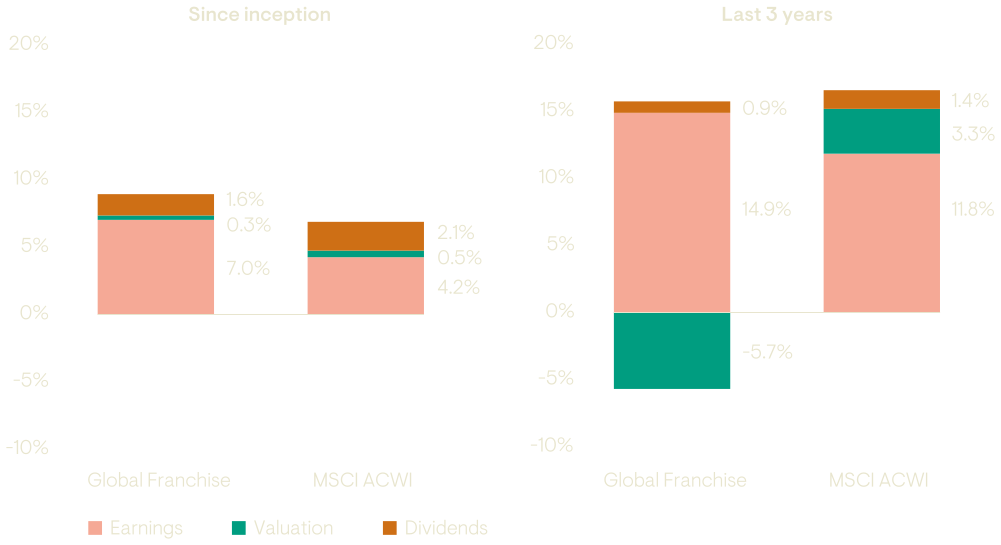
Portfolio earnings have compounded ahead of the market across meaningful time horizons. Over the past three years, earnings growth has been around 15% per annum versus roughly 12% for the broader market, with the gap widening further over longer periods. (See Figure 1.) The businesses have continued to deliver. What has changed is the valuation investors are willing to assign to those earnings.
Figure 1: Total shareholder return breakdown: earnings vs valuation
Earnings growth the primary driver of returns
Past performance does not predict future returns; losses may be made. For illustration purposes only and not representative of fund performance.
Source: Ninety One, FactSet, Bloomberg, 31 March 2026, inception based to April 2007. Weighting based on the Global Franchise strategy. Earnings based on blended 12-month forward earnings per share (EPS). Total shareholder return is derived from portfolio constituents through time and is based on the weighted average aggregation of EPS growth and dividend yield. Gross composite performance is then used to derive the residual rating change.
The last three years have been defined by a widening disconnect across parts of the market. Expensive growth companies have rerated higher, while high-quality, cash-generative businesses have rerated lower, particularly in software and information services, as markets moved quickly to price in AI-related disruption. The reaction has been broad and, in many cases, blunt. The ‘AI loser’ thesis rests on the premise that coding becomes commoditised, pricing models come under pressure and autonomous agents displace software. Each of these risks has some merit. Together, they have contributed to a sharp derating across parts of the portfolio.
However, these concerns may overlook something more structural. Enterprise software is not just code; it includes systems of record, embedded workflows, data, security and compliance frameworks that are deeply integrated into organisations and difficult to replace. As code generation becomes easier, these features could become more valuable – not less.
At the same time, the economics are evolving. If AI shifts software from enabling work to performing it, the addressable market could expand beyond traditional IT budgets toward labour budgets. What is currently being priced as disruption risk may, over time, prove to be an expansion of opportunity.
This distinction matters because valuation-driven underperformance behaves very differently from fundamental deterioration. The former tends to mean revert, while the latter compounds.
Positioning beyond a single theme
It is also important to recognise that the portfolio is not a single expression of this theme. While parts of the recent underperformance have been concentrated in software and information services, the Fund remains diversified across a range of high-quality businesses. Holdings such as Monster, Johnson & Johnson and Philip Morris reflect this broader opportunity set – companies with strong competitive positions, resilient demand and long-term compounding characteristics that extend well beyond any single market narrative.
Across the portfolio, businesses such as exchanges, payment networks, healthcare infrastructure, data providers and enterprise software platforms share common features: high returns on capital, recurring revenues and deep integration within customer workflows. These advantages are often reinforced by regulatory frameworks, proprietary data or network effects, making them difficult to displace.
In software specifically, these characteristics remain highly relevant. As AI evolves, value is likely to shift toward where data resides, how it is governed and how deeply it is embedded within enterprise processes, reinforcing the position of established platforms.
This leads to a different earnings profile – less dependent on macro acceleration, less sensitive to sentiment and more consistent over time. Historically, this resilience has resulted in a different pattern of returns from the broader market during periods of stress, including the global financial crisis, the COVID-19 sell-off and more recent tariff-related drawdowns. Our portfolio has tended to experience less severe declines during these periods and, in many cases, has recovered more quickly over time.
This resilience is not built for market stress alone; it is a by-product of owning businesses where the competitive advantages are grounded in data, workflow and scale. The market has increasingly rewarded businesses whose outcomes are tied to long-term expectations and future potential. In contrast, the Global Franchise portfolio is positioned differently. We invest in companies with distinct competitive strengths and where returns are already visible in current cash flows, rather than reliant on distant expectations.2
A compelling combination of quality and valuation
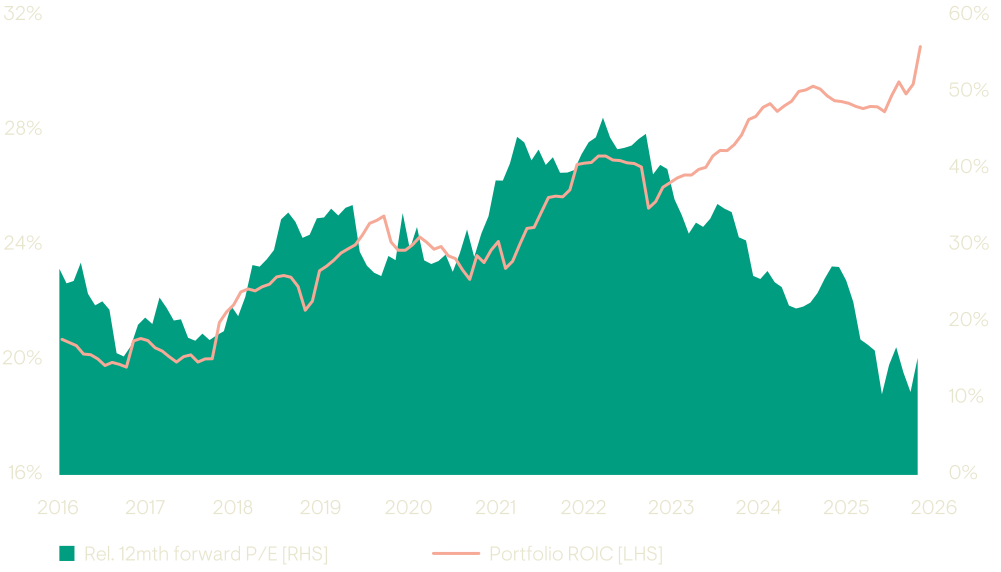
The portfolio is generating returns on invested capital above 30%, near historical highs.* Balance sheets are strong, with net cash across the Fund. Earnings growth remains consistent. At the same time, valuations have reset. The relative forward P/E sits near its lowest level in a decade, and free cash flow yields are now competitive with, and in some cases above, the broader market.
Figure 2: Quality at historically high levels and valuation at a decade low
Global Franchise return on invested capital (ROIC) vs relative valuation (last 10 years)
*Sources: Ninety One and FactSet, 31 March 2026. For illustrative purposes only. The data does not represent the historical performance of the Global Franchise strategy and is not indicative of the potential future performance of the strategy.
As shown in Figure 2, this is where the disconnect is most visible. Parts of the market tied to AI-led capital expenditure are being priced for durability, while software and information services businesses with recurring revenues and high switching costs are being priced for structural impairment. History has typically not favoured that kind of inversion.
If the past few years were driven by multiple compression, the path ahead may be more straightforward: continued earnings compounding from businesses with pricing power and structural growth, stabilisation in valuations as market leadership broadens, and the potential for rerating as capital rotates toward resilience. None of this requires aggressive assumptions – it simply requires normalisation.
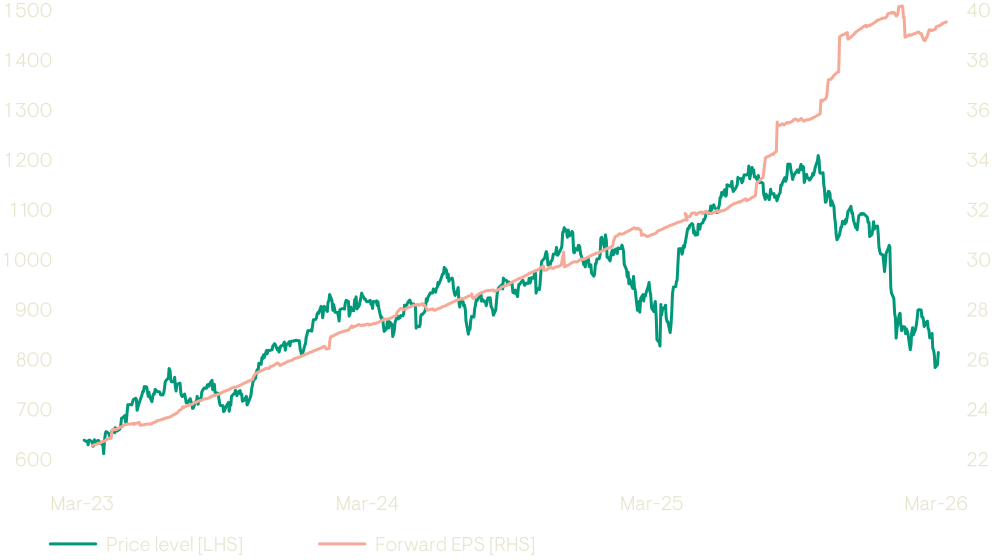
Figure 3: Select software opportunities increasingly attractive
MSCI ACWI Software Index - price vs fundamentals
No representation is being made that any investment will or is likely to achieve profits or losses similar to those achieved in the past, or that significant losses will be avoided. Source: Bloomberg, Ninety One, 31 March 2026.
The last three years have tested patience. That is often the cost of maintaining discipline when markets reward something different. But those same conditions have also created opportunity. Investors today are being offered a portfolio of high-return, cash-generative businesses at valuations that already reflect a degree of scepticism.
The balance of risk and return is shifting. We believe the gap between what these businesses are delivering and how they are priced should not persist indefinitely. When it closes, it is typically underlying economics – not the narratives that dominated before – that matter most.
Where this leaves us
Recent underperformance has been driven by valuation compression rather than weaker business fundamentals, with portfolio companies continuing to compound earnings ahead of the broader market. That divergence has left the Fund trading at one of the most attractive relative valuations in its history, despite maintaining high returns on capital and strong balance sheets.
As the market backdrop shifts toward an environment where growth is scarcer, characteristics such as resilience, pricing power and cash flow durability should become more valuable. This is particularly relevant in areas such as software, where disruption risks are being actively priced despite resilient underlying economics. (See Figure 3.)
Taken together, this creates a setup where the Fund is positioned to benefit from a normalisation between price and fundamentals over time, with outcomes ultimately driven by the quality of the underlying businesses.3
1 This refers to returns on invested capital of our portfolio holdings. Fund returns are not guaranteed.
2 Fund returns are not guaranteed.
3 The Fund is exposed to market and currency risk, which may impact fund performance.
Authored by

Control the controllables: building a solid foundation for retirement
A successful retirement is less about predicting markets and more about the decisions you make today. This piece explores how focusing on a few powerful, controllable factors can help to meaningfully improve your long-term financial security.