Key takeaways
- Set a realistic retirement target – a practical benchmark is accumulating around 15–20 times your final salary, depending on your expected expenses, to help sustain your income in retirement.
- Focusing on controllable factors can significantly improve retirement outcomes.
- The most important lever within your control is how much you save.
- Invest for long-term growth and avoid early withdrawals to help build real wealth for retirement.
Successful retirement planning is less about predicting uncertain market outcomes and more about managing the factors within your control. While investment returns, inflation and longevity are inherently uncertain, there are several key decisions that can materially improve your chances of achieving a comfortable retirement.
A useful starting point is understanding how much you need to save. As a general rule, to reduce the risk of running out of money in retirement, investors should target a starting income of no more than 5% of their retirement capital. This implies that you need to accumulate a capital amount equal to approximately 20 times your final annual salary to sustain an income equivalent to 100% of that salary, growing with inflation over a 30-year retirement.
For many individuals, a full income replacement may not be necessary. Expenses often decline in retirement as debt is repaid and dependants become financially independent. In such cases, a lower capital target – such as 15 times final salary – may be sufficient. However, the key is to define a realistic goal and plan accordingly.
Once the objective is clear, the focus shifts to how to achieve it. This is where controlling the controllables becomes critical.
The retirement equation
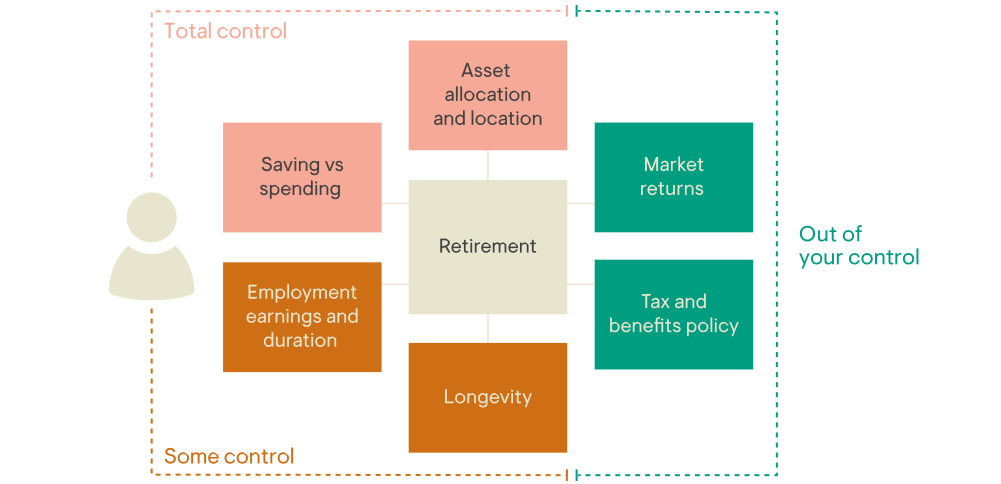
This J.P. Morgan Asset Management chart sets out the key drivers of retirement outcomes, highlighting that while some factors like saving habits and asset allocation are within our control, others, including market returns, are not. It underscores that successful retirement planning depends on focusing on what you can control, while building resilience against the factors you cannot.
Figure 1: The key drivers of retirement outcomes
Source: J.P. Morgan Asset Management. This chart has been redrawn by Ninety One.
Maximise your retirement contributions
The most important lever within your control is how much you save. The earlier you start, the more powerful the impact of compounding.
Consider the following:
- Saving 15% of your pre-tax salary for 40 years can result in retirement capital of approximately 20 times your final annual income.
- Delaying by 10 years means that you may need to save closer to 30% of your salary over 30 years to achieve the same outcome.
- Starting halfway through your career could require saving up to 60% of your salary over 20 years.
The implication is clear: time in the market is far more valuable than trying to compensate later with higher contributions.
Maximising available tax benefits is equally important. From 1 March 2026, retirement fund contributions are tax-deductible up to 27.5% of the greater of your remuneration or taxable income, capped at R430 000 per year. This applies to pension, provident and retirement annuity funds.
Where possible, increasing your contribution rate or allocating a portion of bonuses towards retirement savings can significantly enhance long-term outcomes.
Preserve your retirement capital
Accumulating retirement savings is only part of the equation – preserving those savings is equally important.
The two-pot retirement system allows individuals to access a portion of their retirement savings annually. While this provides flexibility, withdrawals from the savings pot should be treated as a last resort. Unfortunately, data from Alexforbes suggests a strong pattern of repeated access to the savings pot over successive tax years, with 31% of their members making withdrawals in all three tax years to date. Accessing these funds not only reduces your capital base but also forfeits the long-term growth that those funds could have generated.
A well-structured financial plan should include an emergency fund to manage unexpected expenses, thereby avoiding the need to draw on retirement savings.
Encouragingly, the two-pot system also enforces the preservation of retirement savings when changing jobs. Historically, early withdrawals at job changes were a significant source of retirement underfunding. Improved preservation should, over time, lead to better retirement outcomes.
Invest for long-term growth
Another critical decision within your control is how your retirement savings are invested. Investors often underestimate their true investment horizon. A young investor entering the workforce today may have a total investment horizon of 70 years or more – comprising several decades of saving, followed by a multi-decade retirement period. Even those midway through their careers are likely to have 40 to 50 years of remaining investment exposure.
This long-term perspective is important because it supports a greater allocation to growth assets such as equities. While these assets may be more volatile in the short term, they have historically delivered superior (inflation-adjusted) returns over time.
For example, South African equities have delivered real returns of approximately 7% per annum over the long term, compared to around 1–2% for more conservative asset classes such as cash and bonds. Maintaining sufficient exposure to growth assets is therefore essential to preserving and increasing purchasing power over time.
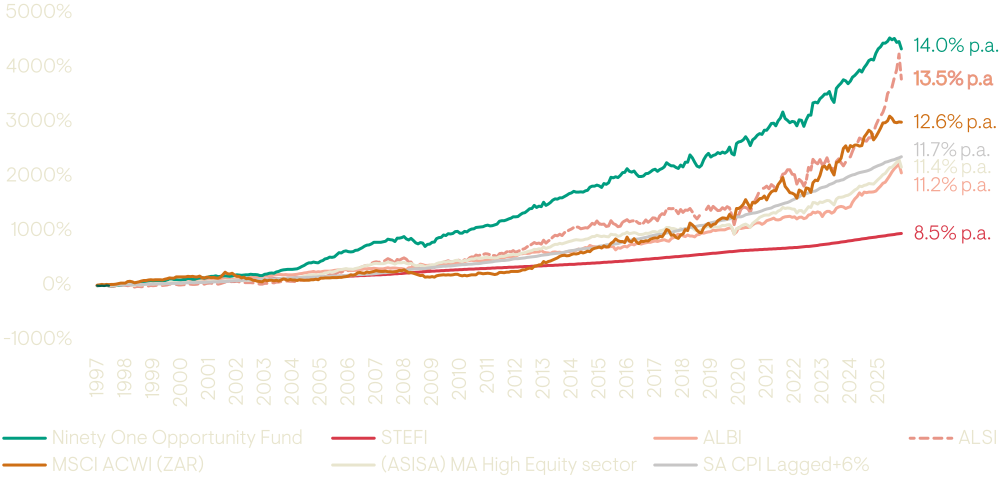
The Ninety One Opportunity Fund has provided equity-beating returns with significantly less volatility since its inception more than 29 years ago and is well-suited to investors seeking to materially outperform inflation.
Figure 2: Ninety One Opportunity Fund: delivering real wealth for investors
Past performance is not a reliable indicator of future results; losses may be made.
Source: Morningstar, dates to 31 March 2026. Performance figures above are based on a lump sum investment, NAV-NAV, net of fees, gross income reinvested. Fees are not applicable to market indices. Where funds have an international allocation, this is subject to a dividend withholding tax in South African rand. The performance quoted for periods before the launch of the A class is based on the older R class’s performance, is adjusted for any fee differences and is for illustrative purposes only. Opportunity Fund inception date: 2 May 1997. Highest and lowest returns are those achieved during any rolling 12 months over the period specified. Apr-99 61.0% and Feb-09 -15.9%. The Fund is actively managed. Any index is shown for illustrative purposes only.
The value of independent financial advice
Given the complexity and long-term implications of retirement planning, investors should consider seeking professional financial advice.
A qualified financial advisor can help structure a plan that focuses on the factors within your control – such as contribution rates, tax efficiency and appropriate asset allocation – while also helping you navigate factors that are less predictable, including market volatility and longevity.
A simple but powerful principle
While many aspects of investing are uncertain, the most important drivers of retirement success are often within your control. Saving consistently, starting early, preserving capital and investing for growth can have a far greater impact on outcomes than attempting to anticipate short-term market movements.
By focusing on these controllable factors, investors can significantly improve their ability to achieve a financially secure retirement.
Authored by