Key takeaways
- The conditions that have shaped the relative performance of emerging and developed market shares are changing.
- Several factors provide a supportive backdrop for emerging market (EM) equity allocations: a new US dollar cycle, robust earnings growth and relative valuations at historically cheap levels.
- While South African investors have emerging markets exposure via domestic portfolios, a broad EM portfolio may be a more effective way to access the opportunity and can complement existing holdings.
EM equities had a banner 2025, outpacing global equities and even the mighty US stock market. We think this outperformance is more than a flash in the pan. Don’t expect every year to be like 2025, but the conditions that have shaped the relative performance of emerging and developed market shares are changing.
This might sound like good news for South African investors, whose domestic investments already provide EM exposure. However, a broad EM portfolio may be a more effective way to access the opportunity, complementing both domestic holdings and developed market allocations.
A different backdrop
First, let’s examine the case for emerging market equities, an asset class that has been out of favour for more than a decade. A big headwind for EM stocks has been the strong US dollar (historically, the US currency has had an inverse relationship with EM equities). Over the past 15 years, the trade-weighted US dollar, which compares the greenback with currencies widely used in international trade, has appreciated by about 40%.
However, there are signs the dollar may have entered a new cycle, not least because the US administration appears to see a weaker currency as a lever to help reset global trade (see Figure 1). This matters for investors because dollar cycles are lengthy, lasting 18 years on average (the current one is decidedly long in the tooth at 20+ years old). If the dollar cycle has indeed turned, the headwind for EM equities could turn into an ongoing tailwind.
Figure 1: US dollar – a turn in the cycle?
EM equities tend to outperform when the US dollar is weakening (and vice versa)
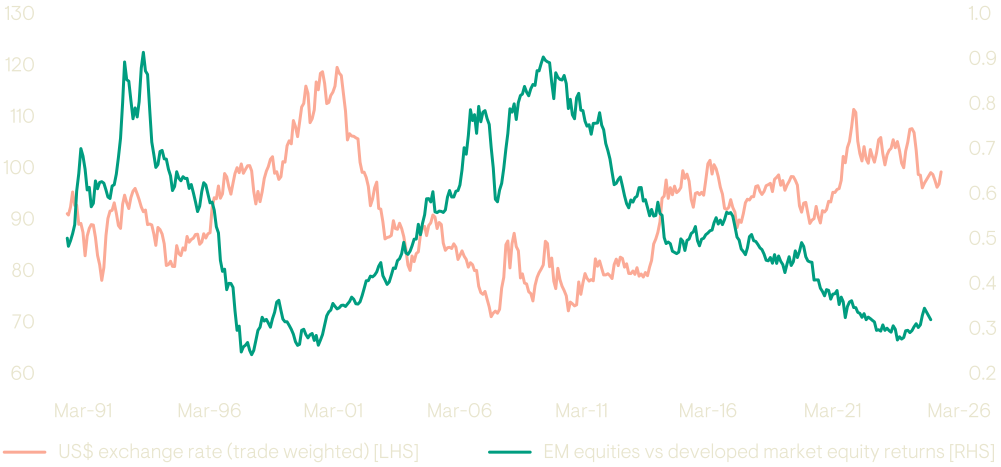
Source: FactSet, Emerging Markets Equities = MSCI Emerging Market, Developed Markets Equities = MSCI World, March 2026.
Second, earnings at EM companies are improving. Having bottomed in 2023, EM corporate profits maintained positive momentum through 2024 and 2025. EM companies are forecast to deliver c.30-35% earnings-per-share growth for FY2026, which is a positive indicator if historical relationships between earnings and stock-index returns hold true.
Finally, valuations are supportive. The relative value of EM versus US equities is at a multi-decade low. That indicates an advantageous starting point for an allocation: historically, when EM valuations have been in the top quintile (20%) of ‘cheapness’ relative to US equities, EM equities have on average outperformed US equities by >50% over the subsequent five-year period.
Broadening exposure beyond South Africa
All else being equal, South Africa’s stock market should benefit from these aligning stars. But in the wide and wonderful developing world, ‘all else’ is rarely equal. Individual emerging markets and regions have very different characteristics and are subject to idiosyncratic impacts. Consequently, return dispersion across EM countries can be wide.
For those looking to access the opportunity, we think a broad EM equity portfolio can be a more effective route. Such a portfolio can complement a domestic allocation in several important ways. Firstly, it helps mitigate the concentration risks inherent in a single-country portfolio. South African equities are relatively concentrated in a narrow set of sectors, notably banks and financial services (22% of the FTSE/JSE All Share Index1), resources (32%) and a handful of large index constituents. The broader emerging market opportunity set provides more diversified exposure across industries, including technology, advanced manufacturing, digital platforms and consumer-driven growth.
Secondly, a dedicated EM allocation offers access to structural growth themes that are not meaningfully represented in the South African market. These include areas such as semiconductor manufacturing in Asia, the rapid adoption of electric vehicles and renewable energy in China, and the expansion of middle-class consumption across parts of Asia and Latin America. Finally, investing across a wider set of emerging markets introduces additional sources of return through currency diversification and differing economic cycles. This can enhance portfolio resilience over time, particularly in periods where domestic growth and the rand are under pressure.
Our analysis of monthly returns over the past 10 years (see Figure 2) indicates that blending emerging market equities with a domestic equity allocation has historically been associated with improved return and volatility characteristics relative to a standalone domestic portfolio.
Figure 2: Blending analysis
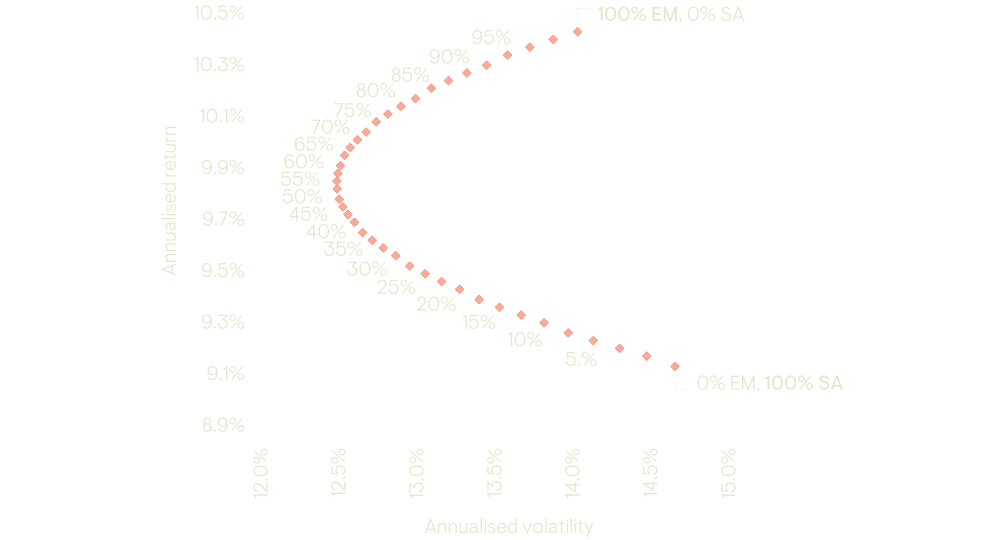
Past performance does not predict future returns; losses may be made.
These returns are hypothetical, were not attained by any client, or portfolio managed by Ninety One, and are for illustrative purposes only. Source: eVestment, June 2025. Returns are in ZAR, gross returns. For further information on Model return results, please see the Important information section.
How to build an EM portfolio
For those that decide to allocate to EM equities, there are multiple options. A useful starting point is to recognise that this asset class is cyclical and can be volatile: over the past two decades, EM equities have often tended to be one of the best- or worst-performing equity segments in any given year.
Diversification is therefore important. However, passive index funds may not spread risk as widely as expected. The MSCI Emerging Markets Index has a 13% weighting in a single stock, Taiwan Semiconductor Manufacturing Company.
Carefully constructed, an active portfolio that focuses on bottom-up stock-picking can mitigate such concentrations, as well as the risks of having a bias towards certain equity ‘styles’ such as growth or quality. The latter can make a portfolio vulnerable to shifts in the market regime, as we saw recently when fears about AI disruption sparked a sharp sell-off in many ‘growth’ equities, such as software providers.
EM equities are also well-suited to active investing because emerging financial markets tend to be less efficient than their developed peers. Structural and behavioural inefficiencies mean asset prices are less likely to reflect all available information, creating opportunities for skilled investors to generate alpha.
Time for a closer look
We believe the conditions that shaped the relative performance of EM and developed market equities over the past decade and more are changing. For those considering making an allocation, we would highlight the following:
- South African investors typically have exposure to EM equities via their domestic portfolios. However, a broad EM equity portfolio can give exposure to the full opportunity set and complement both South African and developed market allocations.
- EM equity portfolios should be planned carefully as this asset class is cyclical and can be volatile.
- Passive EM equity indices may be concentrated by region, sector and equity ‘style’. A carefully constructed active approach can mitigate these risks, while capturing the inefficiencies inherent in emerging financial markets.
Ninety One launches Emerging Markets Equity Feeder Fund
We are delighted to offer a new rand-denominated feeder fund of our Ninety One Emerging Markets Equity Fund, a core equity fund seeking to generate alpha across emerging market cycles.
1 As at 31 March 2026.