In a recent article, we examined South Africa’s shift towards a lower inflation target and the potential implications for cash investments over time. The outcome for corporate treasurers was relatively clear: if inflation moves structurally lower, nominal interest rates are likely to follow.
This development alone warrants attention, but it is only one component of a broader transformation. For treasurers, the environment in which they must allocate capital has become increasingly interconnected, more scrutinised, and less forgiving of structural weaknesses. Against this backdrop, corporate cash investments can no longer be treated as passive balances. Instead, they require deliberate design, active oversight and a framework built for complexity rather than convenience.
In this article, we explore some of the main forces reshaping the cash environment and the potential implications for corporate treasurers.
When global liquidity becomes a local variable
South Africa benefits from a credible central bank and a resilient, well-capitalised banking sector. Historically, these foundations provided a degree of insulation for domestic money markets. However, in an increasingly connected world, that insulation, while still meaningful, is no longer as strong as it once was.
Global liquidity conditions increasingly influence local funding dynamics. Shifts in US monetary policy affect the availability and price of global capital. Movements in developed market bond yields alter the relative attractiveness of emerging market assets. Changes in global risk sentiment can quickly reprice sovereign spreads and domestic funding costs, even in the absence of domestic deterioration.
In practical terms, liquidity can no longer be evaluated through a purely domestic lens. A tightening cycle in the US, a repricing of global term premia, or a broad risk-off episode can quickly transmit into South African short-term funding markets.
For treasurers, this means that monitoring domestic rate expectations alone may no longer be sufficient. Global monetary inflexion points, cross-border capital flows, and sovereign spread dynamics are now firmly integrated into the operating backdrop for corporate cash investments, and therefore need to be considered as part of the decision-making process.
Concentration risk in a structurally narrow banking system
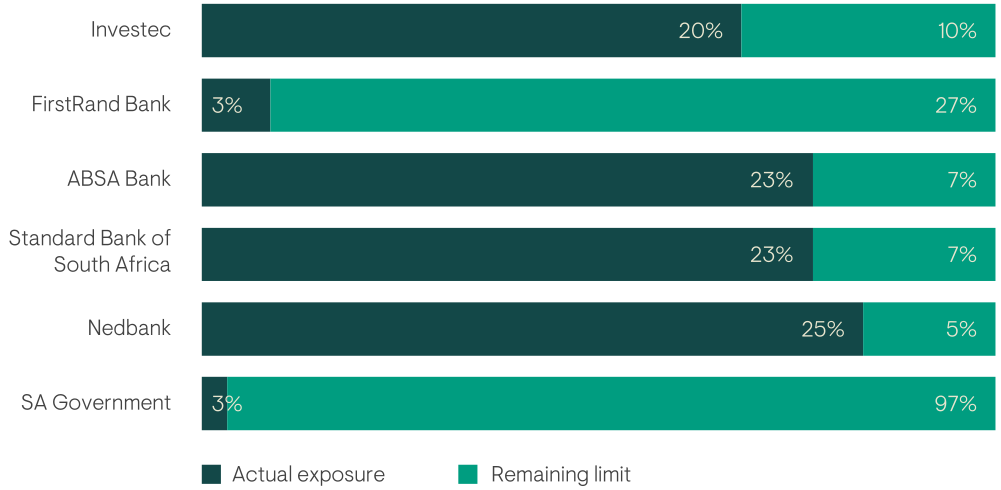
A second structural consideration is the composition of South Africa’s banking sector, which is concentrated among a small number of large institutions. While these banks are strongly regulated and capitalised, concentration is a defining characteristic of the market.
Figure 1: Top Issuer Exposure: Ninety One STeFI Plus Fund
Source: Ninety One, as at 31 January 2026.
This structural reality elevates the importance of counterparty management. Incremental yield may be available through selective exposure, but resilience depends on disciplined diversification and clear internal limits. Concentration risk can accumulate gradually and appear benign in stable periods, only to become more visible during episodes of stress.
Treasurers may therefore need to consider not only the standalone credit profile of individual counterparties, but also aggregate exposures across issuer groups, correlations under systemic strain and alignment with internal risk tolerances.
In an environment where counterparty options are finite, structuring becomes as important as selection. Yield optimisation, in this context, should not come at the expense of structural balance.
Rethinking liquidity: maturity versus behaviour
Liquidity is frequently described in terms of maturity profiles or dealing frequency. Assets that mature daily are often considered to be highly liquid. Yet liquidity that functions seamlessly in stable markets may behave differently during periods of volatility.
Emerging market dynamics – including currency volatility, fiscal developments, or externally driven risk aversion – can quickly alter funding conditions. Liquidity premiums widen. Secondary market depth contracts. Convertibility assumptions are tested.
The relevant question is therefore not simply whether instruments mature in the short term, but how portfolios would respond if funding conditions tightened abruptly. Would assets be readily convertible without material price concessions? How would duration exposures behave under rate shocks? What portion of the portfolio could be mobilised within defined timeframes under stressed assumptions?
Stress-testing these scenarios is increasingly central to prudent liquidity management. Liquidity must, therefore, be evaluated dynamically rather than assumed statically.
Governance, transparency and operational integrity
Alongside market complexity, governance expectations have intensified. Treasury functions now operate under greater scrutiny from boards, audit committees and regulators. Documentation, reporting and operational controls are central components of corporate cash management.
Transparent holdings, consistent and independent valuation methodologies, clearly defined dealing processes, and auditable transaction trails are no longer enhancements to short-duration strategies; they are integral. In many organisations, operational clarity is now inseparable from financial discipline.
This shift reflects a broader evolution in corporate oversight. Capital allocation decisions must not only be sound in substance but demonstrable in process. The ability to evidence risk metrics, concentration limits, stress assumptions and valuation approaches strengthens both internal confidence and external accountability.
In this sense, corporate cash management has become as much an exercise in governance architecture as in portfolio construction.
From yield to structural resilience
South Africa remains relatively high-yielding compared with developed markets. That differential can be attractive, particularly in a global context of moderating rates. But recent cycles have underscored a consistent lesson: yield that is not supported by structural resilience introduces vulnerability.
As highlighted earlier, in a lower inflation environment, the buffer provided by elevated nominal rates diminishes. With narrower margins, the robustness of the underlying framework becomes more consequential. Treasurers may therefore need to shift emphasis from incremental yield enhancement towards structural questions. How exposed is the portfolio to global liquidity shifts? How diversified are counterparty allocations? How would assets behave under stress? Are governance processes sufficiently robust?
The defining question is no longer simply what yield a portfolio delivers. It is whether that yield is generated within a framework designed for volatility, concentration and heightened oversight.
Navigating the evolving landscape
Corporate cash management has entered a more demanding phase. Global liquidity cycles, domestic structural features and governance expectations now intersect more visibly than before. Managing this intersection requires breadth of perspective as well as discipline of execution.
At Ninety One, we believe our corporate cash solutions are ideally positioned to help treasurers navigate this evolving landscape. Our global fixed-income platform provides continuous visibility into international funding dynamics and credit cycles, informing local liquidity positioning. Our institutional scale supports structured counterparty engagement across market conditions. Our investment process embeds duration discipline and stress-aware liquidity monitoring, while our operational infrastructure prioritises transparency, independent valuation and audit-ready reporting.
As corporate treasurers reassess cash allocations in a more complex environment, partnering with an asset manager with a proven track record across both global and domestic fixed-income markets is no longer merely an enhancement, but a growing necessity.
