0:00
0:00
South Africa’s decision to adopt a lower inflation target marks an important evolution in the country’s monetary policy framework.
While much of the early commentary has focused on the potential benefits for long-term interest rates and economic credibility, less attention has been paid to how this shift may change the return profile of cash investments over time. For corporate treasurers, this question matters not only in theory but also in practice.
A policy shift, not a shortcut
The move to a 3% inflation target aims to anchor inflation expectations more firmly and reduce the inflation risk premium embedded in the economy. If successful, this should lower borrowing costs over time and support more stable long-term planning.
However, success is not automatic. History suggests that lower inflation targets only translate into lower real interest rates when they are supported by consistent policy implementation, credible fiscal outcomes and public confidence in institutions.
In the absence of these conditions, the adjustment may not occur, and within a South African context, this risk cannot be ignored. Challenges such as infrastructure bottlenecks, exchange rate sensitivity and fiscal pressures can complicate the inflation outlook. As a result, the path over the short- to medium-term is unlikely to be smooth or linear.
What this means for interest rates in practice
As shown in the graph below, the policy rate required to maintain price stability should gradually decline as inflation expectations become firmly anchored around 3%. Over time, this would imply lower average nominal interest rates and a compression of real yields at the front end of the curve. As the central bank starts cutting interest rates and inflation stabilises at lower levels, returns are likely to move lower in lockstep. This outcome is central to how treasurers should interpret the new regime.
SA inflation and repo rate outlook
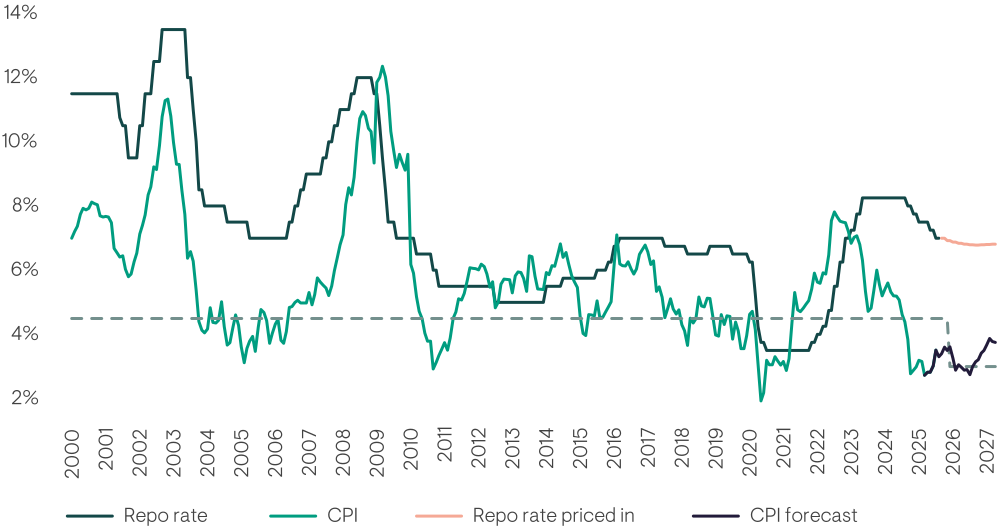
Source: Ninety One, RMB-MS, data as at December 2025.
Implications for cash and liquidity portfolios
For many years, South African corporates benefitted from an environment in which conservative cash investments delivered very attractive real returns. That experience shaped expectations and, in some cases, treasury policy frameworks. However, under a credible lower inflation regime, those outcomes are unlikely to persist. Traditional money market funds will remain appropriate for operational liquidity and capital preservation, but their ability to preserve purchasing power after tax may diminish over time.
Risk reassessment requires precision, not ambition
Without clarity on key considerations – such as investment horizon, tolerance for market volatility and the impact of accounting treatment on liquidity – incremental risk-taking can quickly become imprudent. In a new, lower-return environment, there is no universal obligation to increase risk.
For organisations with stringent liquidity needs, accounting constraints or a low tolerance for volatility, accepting lower real returns is a rational and defensible response.
For those with longer-dated surplus liquidity, a reassessment of risk may be appropriate. Enhanced yield strategies represent one possible response. By introducing limited duration or credit exposure within defined parameters, they aim to modestly improve expected returns while maintaining a focus on liquidity and capital stability.
On credit risk and state-owned enterprises
Discussions regarding increasing yield in South Africa inevitably raise questions about credit exposure, including exposure to state-owned enterprise (SOE) debt.
Past governance failures and fiscal pressures have rightly eroded confidence in many state-owned entities. While these concerns should not be minimised, market pricing does not always differentiate adequately between issuers. In certain cases, debt issued by strategically important entities with explicit and demonstrated government support may offer compensation that exceeds the underlying risk, particularly relative to conventional money market instruments.
For investors, it is important to partner with an investment manager with the capacity to conduct thorough credit analysis and ongoing monitoring. This will help ensure that exposure to government SOEs is both selective and offers meaningful risk-adjusted returns. What matters most is that any exposure is deliberate, limited, and aligned with governance frameworks, rather than driven by yield compression elsewhere.
The governance challenge ahead
The most significant implication of the new inflation target may be governance-related rather than purely financial. A lower return environment forces more explicit conversations about trade-offs that were previously masked by high yields.
Treasurers should engage boards and investment committees with greater clarity about what is achievable, the risks being assumed, and realistic outcomes. In this environment, transparency matters more than optimisation.
Maintaining existing strategies without reassessing their suitability is also a decision, and one that may carry real financial consequences under the new regime.
A measured outlook
South Africa’s revised inflation target should be viewed as an aspiration grounded in policy intent, rather than a guaranteed outcome. If successful, it will reshape interest rates, asset returns and investment behaviour gradually and unevenly.
For treasurers, the appropriate response is neither complacency nor urgency, but understanding. Reviewing assumptions and strengthening governance will matter more than tactical shifts. The era of easy real returns on cash is fading. What replaces it, however, will depend not only on policy outcomes, but on the discipline with which treasurers and organisations respond to the changing environment.
