Private credit in the spotlight
Private credit markets have been a regular feature of news headlines in recent months, with high-profile failures in the US market sounding alarm bells. While it is no secret that ‘covenant-lite’ deals1 have become more prevalent in this increasingly crowded market, the potential risks associated with this deterioration in loan structuring standards are now becoming clear.
A common perception is that if problems can surface in a developed market (DM) like the US, they may be even more prevalent in the ‘riskier’ EM private credit market. Our experience – and the data –
point to something different: investors can access EM-level spreads on structures that look more like DM private credit before the space became crowded.
Looking behind the ‘EM’ label, we outline the reasons behind this apparent paradox, but first we show it in practice – using the private deals in our Emerging Markets Transition Debt (EMTD) strategy as case studies. Specifically, we highlight how each deal benefits from:
- Conservative fundamentals and asset coverage
- No ‘covenant-lite’ structures
- Hard currency denominated and developed market legal jurisdiction
- Global linkages
Looking behind the ‘EM’ label in Emerging Markets Transition Debt
Portfolio metrics in context
Starting at the portfolio level – and focusing on the private loans in EMTD – despite offering a higher yield overall, the underlying fundamentals of these private loans are more robust than what is
typical in the developed market (DM) private credit universe.
In the figure below, we consider a representative US private loan portfolio and apply the same loan-to-value calculation methodology for the private loan portfolio in the EMTD strategy for a fair comparison.
EMTD private loan fundamentals compared to typical DM private loans
Source: Ninety One. For illustrative purposes only. The analysis above considers the publicly listed business development company (“BDC”) Ares Capital Corp (ticker: ARCC) as at 30 June 2025,
this comprises 879 non-infrastructure private loans.
Private investments in the portfolio
While the investments are wholeheartedly “EM”, we highlight the linkages the assets have to DM institutions. These linkages are not an attempt to proxy-justify an investment case but rather to indicate that the scale and quality of the companies and projects we target in EMTD are integrated into global supply and value chains.
Deep institutional oversight: the EM opportunity is linked to DM balance sheets and expertise
Snapshot of EMTD investments and their links to developed markets:
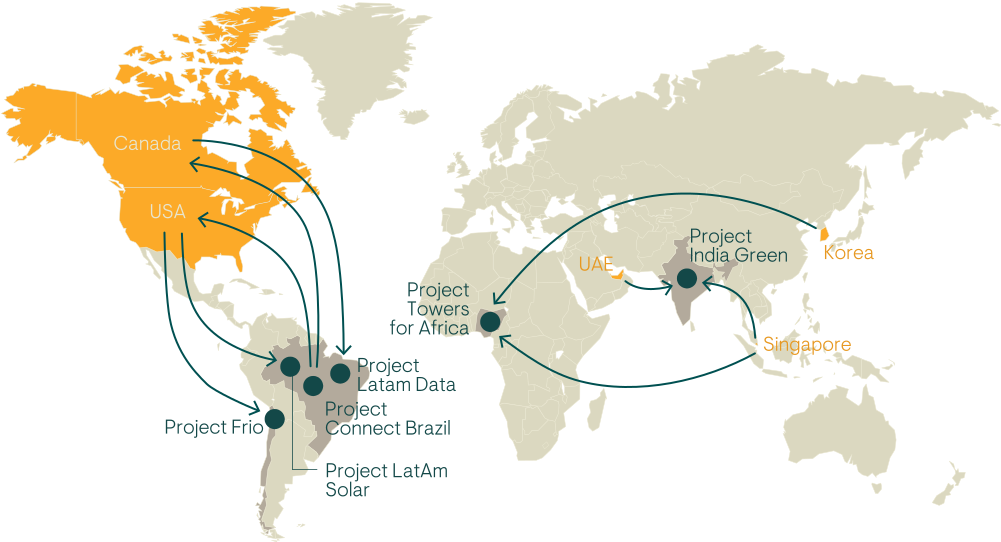
Source: Ninety One. For illustrative purposes only. As at October 2025.
Project India Green (India)
- US$610 million senior term loan facility. Financing one of India’s largest renewable and storage platforms, enabling expansion in hybrid power, pumped hydro, and emerging green hydrogen and ammonia infrastructure. The company underpins India’s 2070 net-zero pathway.
- Underwritten IRR: 14.0% gross / 13.4% net in USD.
- The platform is co-owned by two of world’s most sophisticated sovereign wealth funds.
Where performance is gross of fees, returns will be reduced by management fees and other expenses. Net performance is net of the highest institutional segregated portfolio management fee which is 0.6%.
Project Latam Solar (Brazil)
- US$150 million senior term loan facility. Financing the expansion of renewable power across Latin America through multiple operating and development-stage solar assets with long-term Power Purchase Agreements (PPAs) backed by investment-grade offtakers, providing stable dollar-linked cash flows and strong collateral coverage.
- Underwritten IRR: 9.0% gross / 8.4% net in USD.
- The portfolio is owned by a NYSE-listed Canadian company, which also provides a payment guarantee on the loan.
Project Connect Brazil (Brazil)
- US$155 million senior term loan facility. Financing a market-leading Brazilian manufacturer of aluminium wire and conductors used in transmission and distribution networks. The company plays a central role in enabling grid expansion and electrification across Brazil’s rapidly evolving energy system.
- Underwritten IRR: 11.2% gross / 10.6% net in USD.
- The borrower operates production facilities in Canada and the US, positioning it as a trans-American transmission supplier.
Project Latam Data (pan-Latin America)
- US$1,225 million term loan facility. Financing a high-efficiency data centre platform spanning Mexico, Brazil, Colombia, and Chile. The company designs energy-optimised facilities powered mostly by renewables and targets zero-carbon operations by 2040.
- Underwritten IRR: 8.1% gross / 7.5% net in USD.
- The platform is owned by a US-based data centre solutions provider, currently being acquired by Global Infrastructure Partners (GIP), affiliated with Blackrock, for c.US$40 billion.
Project Towers for Africa (Sub Saharan Africa and Latam)
- US$439 million senior term loan facility. Senior loan to a leading independent telecom tower company with 39,000+ towers across Africa and Latin America. The financing supports “Project Green,” an emissions-reduction initiative converting diesel-powered towers to solar, grid, and battery solutions.
- Underwritten IRR: 10.1% gross / 9.5% net in USD.
- The company is owned by global sovereign investors and an international finance corporation.
Project Frio (pan-Latin America)
- US$325 million senior term loan facility. Financing the largest third-party cold storage and logistics platform in Latin America, supporting expansion and facility retrofits to EDGE Advanced zero-carbon standards. The deal contributes to the decarbonisation of regional agriculture and food supply chains.
- Underwritten IRR: 11.4% gross / 10.8% net in USD.
- The company is owned by two US investment firms alongside a NASDAQ-listed logistics firm.
No representation is being made that any investment will or is likely to achieve profits or losses similar to those achieved in the past, or that significant losses will be avoided. Expected IRRs may not be achieved.
This is not a buy, sell or hold recommendation for any particular security.
Source: Ninety One.
Behind the paradox: why higher yields ≠ higher risk
Three factors help explain the apparent risk/return paradox embodied in our EMTD strategy:
- The macroeconomic fundamentals of emerging markets have strengthened in comparison with developed markets: old asset class distinctions are being turned on their head.
- Annual credit loss rates in the EM private credit market are comparable with developed markets, despite the yield pickup.
- The unexplored nature of private credit in emerging markets – including high barriers to entry and strong lender bargaining power – allows lenders to command very attractive deal terms.
1. Emerging markets are no longer the riskier destination
Perception problems are still common around EM investing. Yet it is becoming harder to distinguish EMs from DMs. Nowhere is that more evident than in bond markets, which are in a new regime – ‘safe havens’ no longer behave as such, DM bond market volatility has risen, and DM yield curves have seen episodes of ‘bear steepening’ on rising fiscal concerns.
In short, the lines between EM and DM have blurred. Several factors help explain this: the economic rebalancing across EM in 2013-2016; more orthodox monetary policy and more restrained fiscal policy within EM; higher quality EM indices; and a more uncertain policymaking backdrop in DM, where institutional credibility is being questioned.
For concrete evidence of the trend of relative strengthening of EM, simply compare EM and DM economies (grouped into two distinct entities) across various metrics:
If ‘EM’ and ‘DM’ were countries, what story would they tell?
Source: IMF October 2024 WEO, JPMorgan benchmarks, Ninety One calculations. DM covers 13 Developed Markets in the JPMorgan GBI Benchmark. EM covers 19 Emerging Markets in the JPMorgan GBI-EM. Where applicable, data is weighted by GDP. For further information on indices, please see Important Information section.
2. The risk/return profile in EM private credit is particularly compelling
As we touched on earlier, the EM private credit opportunity set is more ‘global’ than investors may realise. In addition to the global linkages outlined in the investment case studies earlier, in many instances, the EM jurisdictions of deals are countries with well-developed legal systems, which offer robust protection for investors. These markets tend to have more robust legal frameworks for enforcing contracts, protecting creditor rights, and resolving disputes, which can mitigate risks for private debt investors.
Related to this, a key metric in assessing credit risk is the default rate – and, where defaults occur, the loss-given-default is equally important. While default rates in EM are slightly higher, recovery rates are broadly comparable to those in DM. In fact, annual credit loss rates in EM have been found to be only around 20 basis points higher than in DM, despite EM assets offering significantly higher yields. These low actual loss rates are comparable to the expected losses of a portfolio of investment-grade-rated assets.
The metrics that matter dispel many myths around EM
Source: Ninety One, Moody’s based on long-term averages over the period 1998 to 2022.
3. Strong bargaining power for lenders with EM expertise
The need for global EM expertise and the deep origination platform necessary for building diversified portfolios has deterred broader participation in the EM private credit market, creating a barrier to entry. With competition relatively limited, experienced investors have strong bargaining power; rather than having to compete on loan pricing and protections, they can stipulate lender-friendly deal terms – including robust protections – and focus on the most compelling opportunities.
Building on deep experience in closing deals in uncrowded African markets, Ninety One’s EM private credit investments feature many layers of protection, including low corporate leverage, lending to high-quality borrowers, and structuring deals to include robust covenants – with active loan monitoring conducted throughout the life of each loan by a dedicated team. And having built a proprietary network of more than 500 sourcing partners across emerging markets, Ninety One is able to be highly selective in the private market opportunities it participates in.
This extensive reach allows Ninety One to uncover deal flow that rarely appears in syndicated or brokered markets. Unlike in the crowded and increasingly binary (sponsored/non-sponsored) developed market, we work with a combination of sponsors, local entities and governments – the common denominator is an attractive risk and return profile for each deal we participate in.
Furthermore, while lenders in developed markets often compete with banks, Ninety One has a long track record of partnering with them. This is a structural growth area: on the one hand, banks’ need to de-risk balance sheets is creating a demand for syndication channels; while on the other, institutional investors need scale and diversification – Ninety One works with both to create diversified pools of assets.
Building a global EM private credit platform
Ninety One began building its private credit platform in South Africa during the global financial crisis. When international capital retreated and high-quality South African borrowers were left stranded, we stepped into that gap, underwriting senior loans at attractive valuations and laying the foundation for a high-yielding credit strategy named Credit Opportunities. From those beginnings came the African Credit Opportunities strategy for international investors looking to secure uncorrelated hard currency returns. This led to Ninety One being awarded the mandate to manage the Emerging Africa & Asia Infrastructure Fund (EAAIF – part of the Private Infrastructure Development Group), backed by a consortium of global development finance institutions, and more recently the SA Infrastructure Credit Fund. Launched in 2024, our Emerging Markets Transition Debt strategy follows the same guiding principles: a strong network of deal origination to facilitate diversification; a focus on higher-quality credit; careful and conservative deal structuring to mitigate downside risk.
Today, the platform manages over 1,200 investments, with 11 fund vintages across our emerging market credit strategies now fully realised. Our team of over 40 investment professionals, based in Cape Town, London, New York and Singapore, includes deep legal and ESG specialists to assess each transaction directly. With annual loss rates of below 0.5% achieved on US dollar-denominated portfolios managed since 2014, Ninety One’s EM private market strategies align with an investment-grade profile.
In summary
Unlike in the US market, where structuring standards have deteriorated, the private loans in EMTD benefit from robust protections and strong underlying foundations. The result is that this relatively unexplored opportunity set offers a surprisingly compelling risk/return profile. The strengthening of EM economies relative to their DM counterparts, together with the untapped nature of private credit markets, help explain the apparent paradox of superior yields and risk premia going hand-in-hand with strong downside risk management.
Download PDF
All investments carry the risk of capital loss and past performance does not predict future returns.
1 Structures that typically lack maintenance covenants (financial metrics tested every quarter); instead, they rely on incurrence covenants (if any), which only restrict the borrower if they choose to take a new action, e.g., make an acquisition. This lack of early warning system means – as a recent high-profile failure has shown – that a borrower’s core financial health can degrade over multiple months (layering billions of dollars of complex, opaque off-balance-sheet financing) without triggering a covenant breach, preventing lenders from intervening until it is too late.
Specific risks: Currency exchange: Changes in the relative values of different currencies may adversely affect the value of investments and any related income. Default: There is a risk that the issuers of fixed income investments (e.g. bonds) may not be able to meet interest payments nor repay the money they have borrowed. The worse the credit quality of the issuer, the greater the risk of default and therefore investment loss. Derivatives: The use of derivatives may increase overall risk by magnifying the effect of both gains and losses leading to large changes in value and potentially large financial loss. A counterparty to a derivative transaction may fail to meet its obligations which may also lead to a financial loss. Emerging market: These markets carry a higher risk of financial loss than more developed markets as they may have less developed legal, political, economic or other systems. Liquidity: There may be insufficient buyers or sellers of particular investments giving rise to delays in trading and being able to make settlements, and/or large fluctuations in value. This may lead to larger financial losses than might be anticipated. Sustainable Strategies: Sustainable, impact or other sustainability-focused portfolios consider specific factors related to their strategies in assessing and selecting investments. As a result, they will exclude certain industries and companies that do not meet their criteria. This may result in their portfolios being substantially different from broader benchmarks or investment universes, which could in turn result in relative investment performance deviating significantly from the performance of the broader market. Credit Risk: Where the value of an investment depends on a party (which could be a company, government or other institution) fulfilling an obligation to pay, there exists a risk that the obligation will not be satisfied. This risk is greater the weaker the financial strength of the party. The Net Asset Value the portfolio could be affected by any actual or feared breach of the party’s obligations, while the income of the portfolio would be affected only by an actual failure to pay, which is known as a default. Borrowing/Leverage: Borrowing additional money to invest increases the exposure of the portfolio above and beyond its total net asset value. This can help to increase the rate of growth of the portfolio but also cause losses to be magnified. Private funds: An investment in the Fund is speculative and involves a high degree of risk. The program is not suitable for all investors. The shares are illiquid with restrictions on transferability and resale. Each investor or prospective investor should be aware that they may be required to bear the financial risk of this investment for an indefinite period of time. An investor may lose all or a substantial part of its investment. There can be no assurance that the investment objectives of the Fund will be achieved. The managers and portfolio structure provided herein is subject to change.
