United Kingdom
Select your role
Why a just energy transition requires an all-systems approach
A just energy transition is about more than decarbonisation. Using South Africa as a live example, this paper explores why credible transition outcomes depend on the alignment of policy, infrastructure, capital and communities, and the role investors can play in supporting them.
1 Jul 2026
5 minutes
Ann-Maree Tippoo
Faye Watts
Chapters
Key takeaways
- The energy transition will only endure if it is investable, workable and socially credible.
- In South Africa, decarbonisation cannot be separated from energy security, jobs and economic stability.
- A just transition enables better risk management and therefore better investing.
- Experience shows that transitions fail when coordination is weak and communities are left behind.
- Investors can help turn transition ambition into delivery through capital, engagement and stewardship.
Chapters
Key takeaways
- The energy transition will only endure if it is investable, workable and socially credible.
- In South Africa, decarbonisation cannot be separated from energy security, jobs and economic stability.
- A just transition enables better risk management and therefore better investing.
- Experience shows that transitions fail when coordination is weak and communities are left behind.
- Investors can help turn transition ambition into delivery through capital, engagement and stewardship.
Introduction
South Africa’s energy transition is a live test of how to decarbonise, while maintaining energy security, affordability and livelihoods. Investors are not bystanders – they have an active role to play in this transition.
South Africa’s energy transition is unfolding in real time. It is not a closed case study or a completed programme, but a complex, contested process shaped by economic realities, political constraints and social expectations. For a country heavily reliant on coal for both power generation and employment, the shift to a lower-carbon economy raises fundamental questions about timing and trade-offs, fairness and delivery - questions that matter not only for policymakers, companies, workers and communities, but for investors exposed to the risks and opportunities of that transition.
Across the country and in other coal-dependent economies, these questions are actively debated. Policymakers must weigh climate ambition against energy security, affordability and economic stability. Companies face the challenge of adapting legacy business models while remaining commercially viable. Workers and communities seek credible alternatives to industries that have sustained local economies for generations.
Thus, the energy transition is not only about how quickly countries can decarbonise, but also about how they do so while maintaining a reliable power supply, affordable energy and viable economic livelihoods. This reinforces the need for an integrated, all-systems approach that recognises the interdependence of policy, infrastructure, capital, and social outcomes.
Komati power station in Mpumalanga has become a reference point in this wider transition. It offers an early test of what repurposing coal assets looks like in practice, including the uncertainty faced by affected communities.
Assets do not transition in isolation. Success depends on policy clarity, institutional capability, capital allocation, company execution and whether affected communities see the transition as credible and workable. This is what we describe as an all-systems approach.
As investors, our role is to use capital allocation, engagement and stewardship to support credible delivery. That means assessing the credibility of transition plans, understanding their social and economic implications and engaging to strengthen delivery over time. It also means recognising when coordination gaps, infrastructure constraints or workforce challenges pose risks to long-term value.
In the sections that follow, we consider what a just transition means in investment terms, how system-level risks shape outcomes and how engagement can support more durable delivery.
A just transition is simply a better investment
A just transition recognises that decarbonisation is also a social and economic shift. Where workers and communities are left behind, transition plans can lose legitimacy, delaying delivery and weakening long-term investment outcomes.
A just transition recognises that decarbonisation is not only a technological shift, but a social and economic one. When coal plants close or supply chains restructure, livelihoods and local economies are disrupted, often unevenly and over extended periods.
In South Africa, the transition intersects with high unemployment, skills mismatches and regional economic concentration. Workers who have built careers in coal and energy cannot simply “pivot” overnight into new sectors. Skills, institutions and trust adjust gradually.
For investors, this matters because social disruption can translate directly into project risk – and ultimately into investment risk. Job losses, inadequate reskilling pathways and widening regional inequality can lead to execution delays, litigation and stranded assets. Economic dislocation may fuel project resistance, labour unrest and political backlash, increasing the likelihood of delays, regulatory shifts and policy reversals. Projects that lose community trust risk losing their social licence to operate, undermining delivery, cash flows and long-term asset performance. In contrast, transitions that support workers, strengthen local economies and align with institutional capacity are more likely to endure.
At the same time, transition pathways must work within the economics of the energy system. Where cleaner technologies become cheaper, new industries generate employment and companies can adapt profitably, the transition tends to accelerate. China’s rapid expansion of renewable energy and electric vehicle manufacturing illustrates how falling technology costs and industrial policy can turn decarbonisation into a source of economic growth rather than a purely policy objective.
In investment terms, a just transition depends on timing, institutional readiness, social legitimacy and commercial viability. Where these align, capital can support durable value creation. Where they do not, capital risks being deployed ahead of the system’s ability to absorb change.
Patterns from transitions: contemporary realities and historical lessons
Energy transitions rarely move at the speed of policy ambition. International experience shows that plans are more likely to endure when they are negotiated, phased and grounded in the commercial, institutional and social realities at a rate that communities can absorb.
Transitions rarely follow simple policy timelines; they are shaped by economic, political and institutional constraints. Coal-dependent economies must reconcile climate ambition with energy security, industrial policy and the financial realities of existing infrastructure.
For instance, Indonesia’s Just Energy Transition Partnership (JETP), the largest in the world and launched in 2022, a year after South Africa’s, highlights the commercial tensions inherent in decarbonising coal-heavy power systems.
Much of Indonesia’s coal fleet was built recently under the government’s coal power programme and is financed through long-term power purchase agreements, meaning plants cannot simply be shut down without addressing the debt structures and contractual obligations attached to them. The transition, therefore, requires not only climate ambition but credible financial mechanisms to refinance, retire or repurpose these assets.
International partners pledged around US$21 billion through the JETP to support this shift, but progress has been uneven: early coal-retirement transactions have stalled and disbursements have lagged commitments, particularly following the withdrawal of US support.
Historic transitions show that abrupt change without support leads to disruption. The UK coal closures of the 1980s offer one example: rapid mine shutdowns, without sufficient preparation or alternative industries in place, led to long-term social and economic dislocation.
In contrast, where governments, industry and labour planned together over extended timeframes, as in Germany’s Ruhr region, coal phase-out was accompanied by retraining, regional investment and industrial diversification. The process was not painless, but coordination reduced the scale of social rupture and political backlash.
Spain’s negotiated coal phase-out in 2018 further illustrates the value of planning and early engagement. Compensation agreements, retraining and regional redevelopment funds were structured alongside plant closures, helping manage the transition at a pace communities could absorb.
More recent cases underline that strong design alone is insufficient. Canada’s coal phase-out, affecting roughly 42,000 direct jobs, was supported by a just transition task force and detailed policy proposals. Yet delays in implementation left communities in prolonged uncertainty. Poland’s transition remains structurally complex, with regional coal dependence slowing economic diversification.
For investors, the implication is practical: transitions are shaped as much by political will and institutional capacity as by technology. Plans that are negotiated, phased and grounded in local economic realities are more likely to endure; those that move faster than communities can adapt are more likely to stall.
| Transition | Success or failure | Key takeaways |
|---|---|---|
| Agricultural transition in Europe and the US (1880s–20th century) | Largely successful | Falling prices and rising debt pushed farmers toward instability, but interventions like the US New Deal and Europe’s Common Agricultural Policy stabilised markets and enabled diversification. Modernisation achieved with limited social fracture. |
| UK coal closures (1980s) | Unsuccessful | The abrupt shutdown of mines without adequate support led to mass unemployment and decades of regional decline. Resulted in long-term hardship and political polarisation. |
| Germany’s Ruhr Region (1960s–2018) | Success | Decades of planning, union dialogue, retraining, and regional investment enabled a smooth coal exit. Resulted in a more resilient and diversified economy. |
| Spanish coal transition (2018) | Success | Negotiated phase-out deal between government, unions, and industry ensured compensation, retraining, and investment in new industries, minimising job losses. |
| Canada’s just transition task force (2018) | Mixed | Produced strong recommendations for Alberta’s coal workers, but implementation has lagged. Highlights the gap between policy design and execution. |
| Poland’s efforts to support a just transition from coal (2000s–present) | Commercial and political constraints slow transitions | Gradual mine closures supported by EU just transition funds and regional diversification plans. Still in progress, with outcomes dependent on sustained coordination and economic diversification. |
| China clean energy industrial transition (2000s–present) | Ongoing, accelerating | Industrial policy, falling renewable costs and supply-chain scale have turned the transition into an economic growth engine, illustrating how commercial incentives can accelerate decarbonisation. |
| Indonesia Just Energy Transition Partnership (2022–present) | Commercial and political constraints slow transitions | Transition success depends on credible refinancing mechanisms and alignment with domestic economic priorities. |
Source: Ninety One. Illustrative examples of historical economic transitions and their outcomes. Sources include ILO (2015), OECD (2020), European Commission (2020), Government of Canada (2019) and related literature.
An all-systems approach to investing in the transition
South Africa's JETP, which brings together international finance, domestic policy reform and institutional restructuring to support the shift away from coal, is a work in progress.
South Africa’s energy transition reflects these same dynamics. The country’s coal fleet is ageing but remains central to electricity supply and regional employment, creating tension between decarbonisation, energy security and fiscal constraints.
The JETP launched in 2021 was designed to help coordinate finance, policy reform and institutional restructuring around this challenge. In practice, progress has been uneven and contested.
As elsewhere, the durability of the transition will depend on whether renewable energy and new industries can compete economically with the legacy coal system while maintaining reliable supply.
At the national level, this remains the most visible attempt to coordinate this process. Launched at COP26, the partnership brings together international finance, domestic policy reform, and institutional restructuring to support the shift away from coal while managing its economic consequences. Collective commitments have increased to roughly US$13.7 billion, alongside reforms aimed at restructuring the electricity market and strengthening governance arrangements. It remains a work in progress, providing a framework for coordination.
Within that system, Eskom – South Africa’s primary electricity utility – is central.1 How the utility transitions will shape not only South Africa’s emissions pathway but also energy security, fiscal sustainability and the prospects of coal-dependent regions. Its trajectory is linked to coal suppliers, industrial off-takers, transmission capacity, regulatory reform and the confidence of affected workers and communities.
Around Eskom, other parts of the system are adjusting. Suppliers are reassessing their own transition pathways; development finance institutions are structuring concessional capital; policymakers are refining regulatory frameworks and civil society and labour groups are engaging on employment and regional development. No single institution controls this process; progress depends on whether these actors move in concert rather than at cross-purposes.
1. No representation is being made that any investment will or is likely to achieve profits or losses similar to those achieved in the past, or that significant losses will be avoided.
Our role as an investor in an all-systems transition
Capital is not neutral in the transition. Through allocation, voting, engagement and research, investors can help credible plans attract financing, challenge weak delivery and support more resilient outcomes across the wider energy system.
At Ninety One, we see ourselves as participants in the transition, not observers of it. Our role is to use capital allocation, engagement, voting and research to support credible transition pathways. This is not only at the company level, but across the value chain and the wider policy and finance ecosystem.
We do not stand outside the system. Through our investment decisions and stewardship, we influence which transition plans attract financing, how risks are priced and how companies are held to account. Capital is not neutral: it can reinforce credible delivery or allow weak plans to persist. Our approach is therefore practical and collaborative, focused on strengthening implementation across the system.
This work operates at multiple levels – company-specific, sector-wide and, where relevant, in dialogue with policymakers – recognising that transition risk is shaped not only by individual boards but also by industry standards and regulatory settings. Structured collaboration ensures that engagement is consistent rather than episodic and that companies view the climate transition as a matter of financial resilience rather than reputational positioning.
One lever is collective engagement. As lead investors in Climate Action 100+, a global investor-led initiative engaging with the world’s largest corporate emitters, we help coordinate peer activity to set clear expectations on governance, implementation and disclosure. In this role, we contribute to defining priorities, monitoring progress and escalating where commitments lack follow-through – including commitments to a just transition. Where relevant, voting can help us achieve our engagement objectives, providing a structured escalation pathway where implementation falls short.
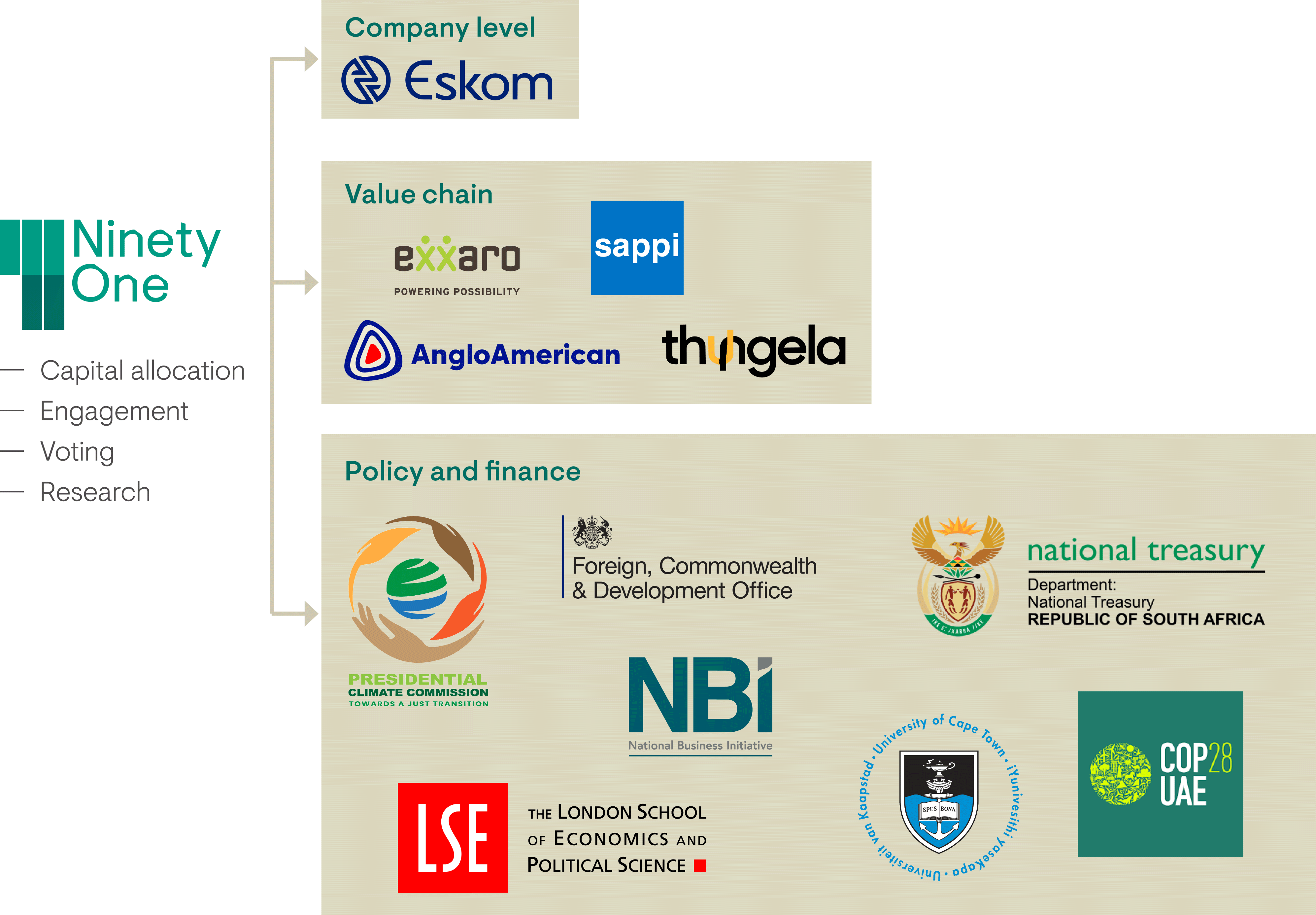
Source: Adapted from stakeholder ecosystem frameworks used in South Africa’s Just Energy Transition discussions (NBI/PCC workshops).
At the company level, we engage directly with Eskom as debt holders, with capital exposed to the delivery of its transition strategy. Our focus is on whether plans are workable within South Africa’s energy constraints, whether financial structures are robust enough to sustain investment, and whether decommissioning decisions are matched by realistic alternatives. These considerations directly shape credit risk, cost of capital and long-term portfolio stability.
We also engage across the coal and energy value chain, including suppliers such as Exxaro and other entities exposed to structural change. Exposure to transition risk does not sit within a single balance sheet. When suppliers, utilities and off-takers move at different speeds, risks migrate across the system. Understanding those linkages and engaging accordingly is essential to managing structural risk within portfolios.
Beyond individual companies, we contribute to system-level dialogue. This includes engagement with bodies such as the Presidential Climate Commission (PCC) and input into discussions on regulatory reform and transition finance frameworks. The objective is not to direct policy, but to help surface implementation bottlenecks and support clearer conditions for capital deployment.
Recognising that workforce transition is central to long-term value preservation, we co-fund research with the African Climate Foundation and researchers at the University of Cape Town’s Development Policy Research Unit (DPRU) on skills and occupational matching. Decarbonisation reshapes labour demand. Where institutions can support workers into viable new pathways, transitions are more stable; where they cannot, social strain translates into financial risk. This research informs how we assess both company plans and broader transition exposure.
Taken together, this is what an all-systems approach looks like from an investor perspective: using the tools available to investors – capital, voting and engagement – to support credible transition pathways within a complex and evolving system.
Conclusion - from intent to delivery
South Africa’s just transition will be judged not by ambition alone, but by whether it can be delivered in the real economy. For investors, that means looking at the strength of the whole system, namely the assets, people, institutions and infrastructure.
South Africa’s just transition is unfolding in real time. It is shaped as much by power shortages, fiscal pressure and local realities as by climate ambition. Komati power station, and the wider energy system around it, illustrate that tension.
For investors, the point is practical rather than academic. A transition plan that focuses only on assets, without considering people – and the institutions and infrastructure that support them – is unlikely to hold, and therefore unlikely to protect long-term investment value.
An all-systems approach recognises that investors are one actor within a broader system. Governments, companies, financiers, workers and communities all influence how the transition unfolds. Our role is to engage constructively, support credible plans and allocate capital with a clear understanding of the economic and social context.
Transitions take time. Where institutions strengthen and coordination improves, outcomes become more durable – and it is that durability that makes the transition investable.
Authored by
Explore more insights

Insights
Market and portfolio insights, webinars & events curated from across our investment teams to help you steer through changing investment landscapes.
Important Information
This communication is provided for general information only and should not be construed as advice.
All the information in this communication is believed to be reliable but may be inaccurate or incomplete. The views are those of the contributor at the time of publication and do not necessarily reflect those of Ninety One.
Any opinions stated are honestly held but are not guaranteed and should not be relied upon.
All rights reserved. Issued by Ninety One.
For further information on indices, fund ratings, yields, targeted or projected performance returns, back-tested results, model return results, hypothetical performance returns, the investment team, our investment process, and specific portfolio names, please click here.