When OpenAI announced its Stargate project in January, many investors greeted the US$500 billion headline figure with disbelief. Since then, new agreements with AMD, Nvidia and Oracle have raised expectations for the scale of the AI build-out. These deals imply more than US$1 trillion in infrastructure spending before the decade is out, sparking debate about the sustainability of the cycle.
We believe the more likely path is not a dramatic end to the boom but a modest correction that reprices risk, resets unit economics and sets up the next leg of AI valuations. What is clear is that the next wave will rest on the hardware - the logic, memory, networks and power systems that make large-scale AI possible.
These technologies are largely produced by a group of emerging-market companies whose valuations have not kept pace with their strategic importance – we call them the Secret Seven.
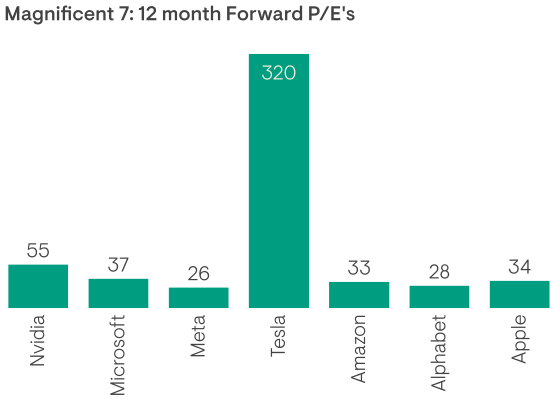
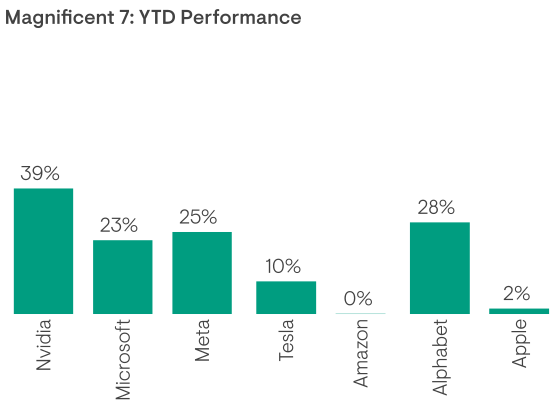
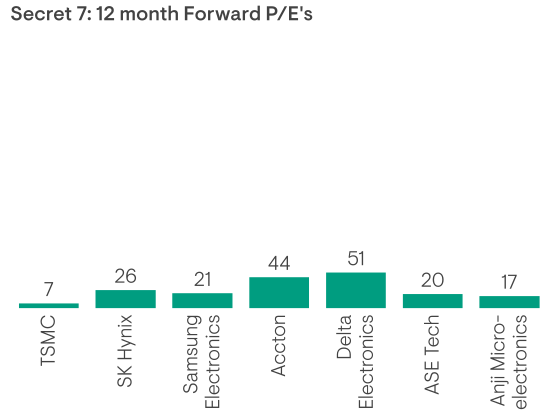
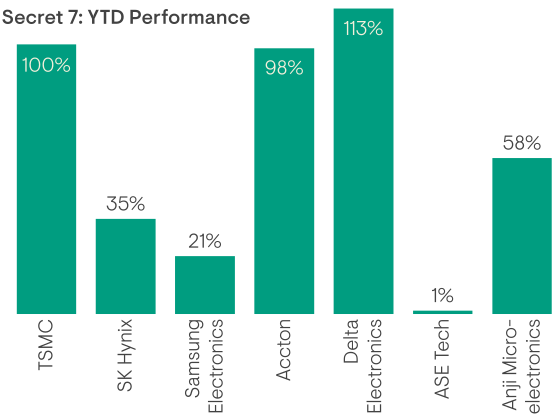
They sell into every layer of the AI stack yet trade on earnings multiples far below their US counterparts. We believe this is a once-in-a-generation opportunity for investors.
Who are the Secret Seven?
Before turning to the broader investment case, it helps to be clear about who the Secret Seven are:
- TSMC the world’s largest independent contract manufacturer of semiconductors
- SK Hynix the primary volume supplier of Nvidia-qualified high bandwidth memory
- Samsung Electronics the world’s largest producer of memory
- Accton a specialist in highspeed network switches for hyperscale data centres
- Delta Electronics which provides the power and cooling systems to run them
- ASE Tech a global leader in advanced semiconductor packaging
- Anji Microelectronics a high-end semiconductor materials company
Figure 1: EM tech trades at a discount to DM peers
Source: Bloomberg, as of 27 November 2025.
Asia as the world’s AI factory
The leading frontier AI models may be trained in the United States, but the equipment they run on is built in Asia. Taiwan, South Korea and parts of Southeast Asia form the most concentrated manufacturing cluster in the global technology system, anchored by deep engineering talent, dense supplier networks and unusually high levels of research and development. South Korea and Taiwan allocate nearly 5% and 4% of their GDP, respectively, to R&D, among the highest ratios in the world. This investment has created a set of firms that operate less as stand-alone companies and more as parts of a single industrial system.
Figure 2: The AI hardware stack
| Adopters |
|---|
|
Pharmaceuticals
E-commerce
Finance
Logistics
Travel
Education
Robotics
Space and exploration
Autonomous driving
Online shopping
|
| Integrators | |
|---|---|
Devices     |
Partners   |
| Applications Text/copy | Code/dev tools | Visual/design | Audio/speech | |
| Platforms |
|---|
Models





|
Cloud platforms





|
| Enablers |
|---|
Chips





|
Manufacturing and tools




|
| Resources |
|---|
Materials: power, efficiency, cooling




|
Source: Ninety One.
Pushing the technological frontier
The heart of this system runs through three companies that determine the pace at which AI hardware can advance. TSMC sets the ceiling for compute. As the world’s largest manufacturer of logic semiconductors, it fabricates the dies that sit at the centre of today’s accelerators. Its advantage is both institutional and technical. The decision to operate as a neutral foundry created a structure customers could trust, reinforced by a culture that treats confidentiality and process discipline as fundamental. Japanese materials, Dutch lithography tools, American design customers and Taiwanese engineering work as a single system around its fabs. This is why new facilities such as the Kumamoto plant, built with Sony and Denso, function effectively: they plug into dense local ecosystems of universities, suppliers and engineering talent. Chipmaking is not a plug-and-play export, it depends on an institutional base that only a handful of firms can build and maintain.
Next to compute sits the memory, which now defines the limits of AI throughput. SK Hynix manufactures the HBM (high-bandwidth memory) that sits beside the GPU (graphical processing unit) die and feeds it data at the speed modern models require. OpenAI’s January outline of its proposed US$500 billion Stargate data centre project was followed later in the year with a strategic supply partnership with SK Hynix and Samsung to secure future HBM production. The memory required for this project alone could exceed twice the industry’s current capacity, and next year’s output is already allocated under long term contracts.
Converting production lines to new HBM generations takes months, constraining supply and rewarding early leadership. SK Hynix controls more than half of the global HBM market because it has mastered the precision in stacking, thermal management and yield that advanced memory requires.
Samsung brings scale and breadth. It is one of the few firms capable of producing HBM for training large language models, as well as the DRAM (dynamic random-access memory) and NAND (flash memory) that store and move datasets at the volumes required by large AI clusters.
One sign of how tight the memory market has become is the behaviour of the buyers themselves. Consumer-facing companies, such as Xiaomi, have publicly warned that rising DRAM and NAND prices are driving up device costs, directly linking the increases to demand from AI infrastructure. Industry data supports this: according to Bernstein Research1 DRAM prices have more than doubled since early 2025, an unusual trend in an industry accustomed to falling production costs.
Controlling the flow of data and power
Most of the conversation about AI centres on the chips, yet even the best accelerator will slow if data movement or power stability falter. Accton supplies the high-speed switches that connect thousands of GPUs and custom accelerators inside hyperscale data centres. The industry is transitioning from 400-gigabit networks to 800-gigabit and 1.6-terabit speeds, which stretches the physical limits of switch design. Accton is one of the few companies able to build hardware that holds up at those speeds.
The other system constraints are power and cooling – two sides of the same physics problem: AI servers draw power the way a furnace takes in air, expelling heat just as fast. This is where Delta Electronics comes in: it has developed expertise in the systems needed to manage this equation. When Nvidia’s server power requirement jumped from 8 kW to 12 kW in early 2024, Delta re-engineered and ramped production in three months, while competitors needed a year.
It’s a valuable niche: the global data centre UPS market, worth about US$4.0 billion in 2024, is projected to reach US$6.2 billion by 2030.2
Making the system work
ASE sits within the small group of firms that bring GPUs and HBM together, allowing them to function as a single unit. The firm works directly with customers such as Nvidia, AMD and Broadcom to co-design next-generation packages, giving it visibility into new architectures before they reach the market.
Anji Microelectronics shows another side of the region’s strength. It sits upstream in the manufacturing chain, supplying the slurries and wet chemicals used in advanced-node fabrication. These materials are consumed at every stage of chipmaking and become more important as memory makers ramp high-density DRAM and NAND. Anji is gaining share as China expands domestic capacity, particularly in memory, and has made progress in upstream materials and more advanced processes. It adds depth to the regional supply chain at a point where materials capability is becoming strategically important.
It’s a valuable niche: the global data centre UPS market, worth about US$4.0 billion in 2024, is projected to reach US$6.2 billion by 2030.
When buyers become designers
Chip design is no longer the preserve of suppliers alone. The large cloud providers are now building their own accelerators, from Amazon’s Trainium to Google’s TPUs. This has raised questions about whether the companies that support Nvidia today will be bypassed. Our view is that the opposite is more likely. Custom chips still rely on the same manufacturing and memory constraints. They need TSMC to fabricate the logic, SK Hynix and Samsung to supply high-bandwidth memory, Accton to move data and Delta to manage power and heat. They also need advanced packaging to bring these components together, which is where firms such as ASE come in.
The USD tailwind
A weaker dollar would reinforce this shift. The dollar has been strong for over a decade, a period during which global portfolios became heavily concentrated in the United States. Ninety One’s Institute paper, The great rebalancing, suggests this cycle may be turning, with capital flows and valuations starting to rebalance toward the rest of the world. For companies that already sit at the centre of the AI hardware supply chain, this matters. Dollar down-cycles have historically supported emerging-market returns and even a modest reallocation away from the US could provide a material tailwind to firms whose strategic relevance is rising while their valuations remain low.
Why now?
The opportunity in these companies comes from a simple mismatch. They sit at the physical limits of the AI cycle, in the parts of the system where performance is constrained by fabrication, memory and power, yet their valuations still carry the discount applied to traditional emerging-market stocks. Much of their near-term output is already tied to customer roadmaps and earnings have held up through several cycles. Capital commitments remain high and several hold meaningful shares in parts of the stack where supply is tight. This combination of strategic relevance and emerging-market pricing is unusual, creating an opportunity worth exploring.
1 Apple most immune to memory price rises, others more impacted: Bernstein.
2 Data Center UPS Market Size, Share | Industry Report, 2030.
General risks. All investments carry the risk of capital loss. The value of investments, and any income generated from them, can fall as well as rise and will be affected by changes in interest rates, currency fluctuations, general market conditions and other political, social and economic developments, as well as by specific matters relating to the assets in which the investment strategy invests. If any currency differs from the investor’s home currency, returns may increase or decrease as a result of currency fluctuations. Past performance is not a reliable indicator of future results. Environmental, social or governance related risk events or factors, if they occur, could cause a negative impact on the value of investments.
