Key takeaways
- A low multiple is not necessarily a sign of value. Genuine value arises when there is a gap between the market value of a company and its true intrinsic worth.
- Share prices can become dislocated from intrinsic values because of investors’ behavioural biases, which create market inefficiencies.
- Value investing can form part of a strategic asset allocation – provided the focus is on identifying real value, rather than simplistically investing in stocks with low multiples.
Most active equity investors will agree that their job description is to buy securities for less than they are worth. Value investors try to do this by exploiting the over-reactions of other market participants.
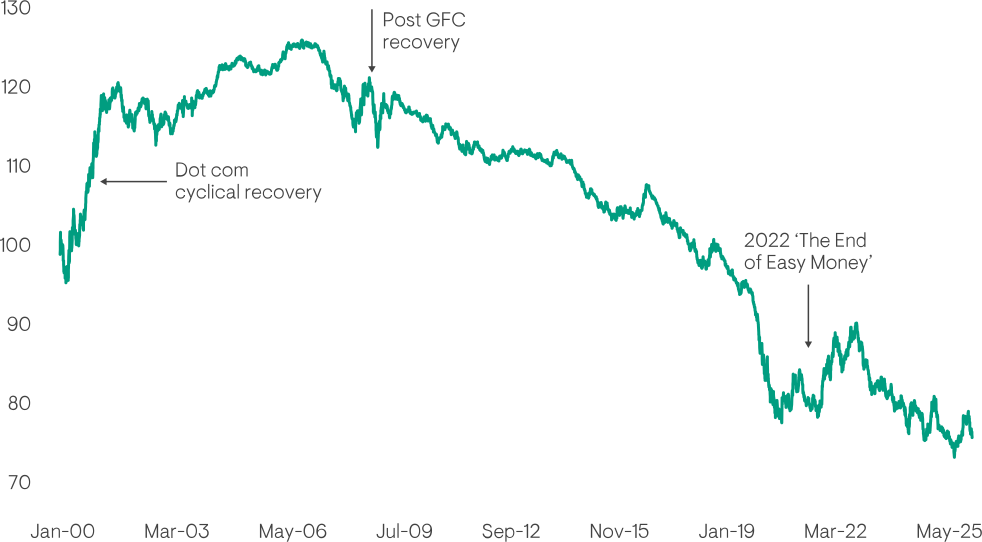
Traditionally, an expeditious way to find ‘over-sold’ stocks has been to focus on the companies trading at the lowest share prices relative to their historical earnings (P/E) or the book value of their assets (P/B). This narrow way of screening for value performed strongly for much of the late 1990s and early 2000s. Since the Global Financial Crisis (GFC) in 2008/2009, however, it has disappointed, leading investors to question whether value investing works at all, and, if it does, whether it should be treated as a tactical rather than a strategic allocation.
We suspect that value’s recent underperformance may have more to do with the narrow way in which it has been defined, rather than the basic premise of using periods of uncertainty to buy good assets when they are available cheaply. We also think that an allocation to a more nuanced implementation of value investing can form part of the long-term structure of an equity portfolio, as we discuss here.
What is value investing?
In our view, value investing is about using times of uncertainty to construct a portfolio of attractive long-term assets at prices that are cheap relative to the assets’ underlying intrinsic values. Instances of uncertainty are by their nature unpredictable. But when they occur, they can cause market participants to overreact and discount securities relative to their long-term value. Overreactions are caused by human cognitive biases, of which there are many. However, we believe that most stock market sell-offs can be explained by loss aversion, social proof and intolerance of uncertainty.
Common cognitive biases
|
Loss aversion |
Social proof |
Intolerance of uncertainty |
For the patient investor, the gap between share price and intrinsic worth can be an attractive source of return. However, we would caution that intrinsic values are highly idiosyncratic, and care must be taken to use the right framework to value each business.
Why traditional value has disappointed
From a long-term perspective, value investing has worked: over the past 50 years, the ‘value factor’ has clearly outperformed the ‘growth factor’. By ‘factor’, we mean a systematic source of return associated with a particular group of stocks – in this case, those on low multiples versus those expected to deliver higher future growth.
The early 2000s, in particular, were fantastic for value investors. Valuation discipline led most of them to sit out the dot-com mania, which paid off when the bubble imploded. During this period, the reputations of many of today’s large, institutional value investors were forged.
However, since the GFC, value has significantly underperformed other equity investment styles (Figure 1). Various reasons have been put forward for this, including:
- One of the largest value-creation events in modern history, the emergence of scaled technology platforms, benefited a small group of companies that became large weights in broad market benchmarks.
- The simplicity of the mathematical approach to value investing made it susceptible to being arbitraged away.
- The ‘value effect’ was spurious to begin with.
Figure 1: The value factor has underperformed since the Global Financial Crisis
Relative performance of the MSCI ACWI Value and the MSCI ACWI1
Source: Ninety One, Bloomberg, January 2026. MSCI ACWI Value vs. MSCI ACWI.
We think that the third bullet point above – that the value-effect was spurious to begin with – is unlikely. There are sound philosophical and theoretical reasons, backed up by empirical studies on human behaviour, to explain why the value premium existed. However, the first two bullet points cannot so easily be dismissed. It is entirely possible that the institutional conflation of value with low multiples was simply too easy a definition for the market not to compete any excess returns away. The emergence over the last two decades of a few large and incredibly profitable technology platforms might have exacerbated this effect.
Our approach to value investing
Our own approach to value investing reflects the above thinking. Our starting point is the belief that markets are largely efficient. Most of the time investors are rational, have the time to judge the worth of business, and correctly ascribe a value to it. Yet in certain moments, particularly during periods of stress at a macro or company level, investors become irrational. They sell first and ask questions later.
Our preferred approach is therefore to focus on areas where behavioural inefficiencies might exist, and to identify gaps between share prices and the intrinsic value of the underlying businesses2. Our objective is to maximise potential returns by buying good businesses at heavily discounted multiples or, more accurately, buying growing cashflow streams at a significant discount to their intrinsic value (see Figure 2).
We prefer low multiples (e.g., P/E and P/B ratios): not only are they initial indicators of potential value, but they are also a clear signal that the market has low expectations for that company. However, much of our work is aimed at discovering when a low multiple might be hiding a company that is worth even less than its share price (and thus should be avoided), and when a high(er) multiple might be obscuring a stock is in fact attractive compared to its intrinsic worth. The deep fundamental research that we do is primarily aimed at estimating (conservatively) the gap between price and intrinsic value and identifying where that gap is widest.
Figure 2: Ninety One’s approach to value investing
We seek significantly mispriced assets
We aim to exploit behavioural biases which draws us to areas of uncertainty
We undertake intensive fundamental research to identify genuine value, not simply a low multiple
We are a team of contrarian investors who thrive on collaboration and debate
A bigger opportunity set
We have observed that because uncertainty strikes different areas of the equity market at different times, the value opportunity set changes over time across industries and regions. Our approach to value investing therefore requires a broad approach to idea generation. While we use screens to identify stocks that may be priced too low, as many value investors do, they are not our only source of ideas. We are agnostic as to the type of price dislocation we look to take advantage of. We will consider ideas that are contrarian in nature but may not fit a simplistic, mathematical definition of value.
We categorise our ideas into four buckets, as follows. Over time, our portfolios’ exposure to these buckets evolves as the underlying value opportunity set changes.
Types of value opportunity
|
Fallen angels |
Cyclical leaders |
|
Special situations |
Deep value |
A structural allocation to value
We believe our approach leads to a more durable role for value in portfolios. Our aim is not simply to capture a short-lived rally in the cheapest or lowest-quality stocks and then try to time an exit. Instead, we want to buy businesses at attractive prices when there is scope both for sentiment to normalise and for intrinsic value to build over time.
At times, this may lead us into areas of the market that do not appear ‘value’ in the traditional sense. The common thread across our portfolios is not whether a stock carries a value label, but whether our conservative analysis suggests a meaningful gap between its share price and its underlying worth.
In our view, this is the true definition of value today: not the pursuit of low multiples for their own sake, but a disciplined search for mispriced businesses where uncertainty has created opportunity.
1 For further information on indices, please see the Important information.
2 For further information on investment processes, please see the Important information section.
General risks. The value of investments, and any income generated from them, can fall as well as rise. Costs and charges will reduce the current and future value of investments. Where charges are taken from capital, this may constrain future growth. Past performance does not predict future returns. If any currency differs from the investor’s home currency, returns may increase or decrease as a result of currency fluctuations. Investment objectives may not necessarily be achieved; losses may be made. Target returns are hypothetical returns and do not represent actual performance. Actual returns may differ significantly. Environmental, social or governance related risk events or factors, if they occur, could cause a negative impact on the value of investments.
Specific risks. Currency exchange: Changes in the relative values of different currencies may adversely affect the value of investments and any related income. Derivatives: The use of derivatives is not intended to increase the overall level of risk. However, the use of derivatives may still lead to large changes in value and includes the potential for large financial loss. A counterparty to a derivative transaction may fail to meet its obligations which may also lead to a financial loss. Emerging market: These markets carry a higher risk of financial loss than more developed markets as they may have less developed legal, political, economic or other systems. Equity investment: The value of equities (e.g. shares) and equity-related investments may vary according to company profits and future prospects as well as more general market factors. In the event of a company default (e.g. insolvency), the owners of their equity rank last in terms of any financial payment from that company. Concentrated portfolio: The portfolio invests in a relatively small number of individual holdings. This may result in wider fluctuations in value than more broadly invested portfolios. Style Bias: The use of a specific investment style or philosophy can result in particular portfolio characteristics that are different to more broadly invested portfolios. These differences may mean that, in certain market conditions, the value of the portfolio may decrease while more broadly invested portfolios might grow.
