United Kingdom
Select your role
Q2 in review
It was a mixed second quarter for capital markets, with various election results driving up volatility. In the US, another strong run for AI-related tech stocks helped lift equity indices. In Europe, the ECB joined the growing list of G10 banks to start cutting rates; while in France, the announcement of a snap election weighed on sentiment.
8 Jul 2024
15 minutes
Chapters
Global equities

Major global equity indices advanced in the second quarter (Q2) of 2024, driven by US tech euphoria and hope for a soft landing for the US economy, supported by emerging signs of growth in Europe, China and Japan. However, June presented a mixed picture for global markets on a month-by-month basis.
In the US, the S&P 500 reached another all-time high, fuelled primarily by big tech and growing optimism around the prospect of a US Federal Reserve (Fed) rate cut later this year, following a more benign inflation print in June.
In Europe, gains for far-right parties in the European Parliamentary elections led French president Emmanuel Macron to call a snap election, putting equities under pressure. While the Euro Stoxx 600 was up over the quarter, it dipped into negative territory in June. Similarly, the FTSE 100 performed strongly over the quarter, but lost ground in June amid election concerns.
In Asia, Hong Kong and Chinese mainland stocks fell for the second consecutive month in June, with markets lethargic ahead of a July meeting of China’s top leaders. However, stocks delivered a positive performance over the quarter. In Japan, the Nikkei rallied on a weakening yen, but was unable to sustain the forward momentum of Q1, over the second quarter.
At the US sector level, earnings growth broadened over the quarter, with eight sectors reporting year-on-year (y/y) increases. Of these, communication services, healthcare, information technology, and energy delivered double-digit growth.
| Index | June (%) | Q2 (%) |
|---|---|---|
| S&P 500 | 3.6 | 4.2 |
| Nasdaq Composite | 6.0 | 8.4 |
| MSCI ACWI | 2.2 | 2.9 |
| Nikkei 225 | 3.0 | -1.8 |
| EuroStoxx 600 | -1.3 | -0.2 |
| FTSE 100 | -1.1 | 3.7 |
| Hang Seng Index | -1.1 | 8.9 |
| SSE Composite | -3.9 | -2.4 |
Source: Bloomberg as at 30 June 2024.
Chapters
Global equities
AI and the interest-rate outlook were the dominant themes over the quarter, with political news starting to grab headlines.
Major global equity indices advanced in the second quarter (Q2) of 2024, driven by US tech euphoria and hope for a soft landing for the US economy, supported by emerging signs of growth in Europe, China and Japan. However, June presented a mixed picture for global markets on a month-by-month basis.
In the US, the S&P 500 reached another all-time high, fuelled primarily by big tech and growing optimism around the prospect of a US Federal Reserve (Fed) rate cut later this year, following a more benign inflation print in June.
In Europe, gains for far-right parties in the European Parliamentary elections led French president Emmanuel Macron to call a snap election, putting equities under pressure. While the Euro Stoxx 600 was up over the quarter, it dipped into negative territory in June. Similarly, the FTSE 100 performed strongly over the quarter, but lost ground in June amid election concerns.
In Asia, Hong Kong and Chinese mainland stocks fell for the second consecutive month in June, with markets lethargic ahead of a July meeting of China’s top leaders. However, stocks delivered a positive performance over the quarter. In Japan, the Nikkei rallied on a weakening yen, but was unable to sustain the forward momentum of Q1, over the second quarter.
At the US sector level, earnings growth broadened over the quarter, with eight sectors reporting year-on-year (y/y) increases. Of these, communication services, healthcare, information technology, and energy delivered double-digit growth.
| Index | June (%) | Q2 (%) |
|---|---|---|
| S&P 500 | 3.6 | 4.2 |
| Nasdaq Composite | 6.0 | 8.4 |
| MSCI ACWI | 2.2 | 2.9 |
| Nikkei 225 | 3.0 | -1.8 |
| EuroStoxx 600 | -1.3 | -0.2 |
| FTSE 100 | -1.1 | 3.7 |
| Hang Seng Index | -1.1 | 8.9 |
| SSE Composite | -3.9 | -2.4 |
Source: Bloomberg as at 30 June 2024.
US
The Magnificent Seven led the charge for US equities, supported by cooling inflation.
US equities closed the second quarter of the year in positive territory, largely supported by further gains for the Magnificent Seven (Tesla, Apple, Amazon, Microsoft, Nvidia, Alphabet, and Meta Platforms). The quarter began on a relatively weak note after inflation continued its upward trajectory, printing above expectations for the fourth consecutive month, prompting significant weakness across US equities. May and June brought a sharp turnaround, with the S&P 500 reaching new record highs, supported by signs of easing inflation. The rally remained narrow, however, with the equal-weighted S&P 500 losing ground in Q2, as did the small-cap Russell 2000 index.
On the economic front, GDP growth came in below expectations at 1.4% for Q1, while unemployment rose to 4% in May, its highest level since January 2022. Meanwhile, consumer sentiment continued to show signs of cooling after retail sales for May missed expectations, expanding just 0.1% following the previous month’s 0.2% decline.
South Africa
A market-friendly outcome from the general election helped lift SA equities higher.
South African equities closed the second quarter of the year in positive territory. April started on a strong note as optimism over corporate earnings lifted domestic equities, with further support coming from better-than-expected economic data. In May, national elections took centre stage, with various surveys suggesting that the ruling ANC could lose its parliamentary majority for the first time in 30 years. Speculation over possible alliances dominated headlines in June after political surveys proved to be correct and the ANC failed to win an outright victory at the polls. The prospect of a market-friendly outcome helped lift domestic equities higher by month-end, buoyed by news that the ANC would enter into an agreement with the Democratic Alliance and other smaller parties to form a Government of National Unity.
In other news, South Africa's economy contracted by 0.1% quarter-on-quarter (q/q) in Q1 2024, missing market expectations and falling below the 0.3% posted in the previous quarter. Main detractors included manufacturing, mining, and construction, as loadshedding (power outages) continued to weigh on economic growth. Factory activity (PMI) fell sharply to 43.8 in May from 54 in the prior month, largely due to weak demand and uncertainty surrounding the national elections. The South African Reserve Bank kept the repo rate unchanged at 8.25%, as expected, noting inflation risks to be balanced. Annual inflation remained steady in May at 5.2%, in line with April’s print and slightly below the 5.3% posted in March. In other positive news, mining production recovered in April, rising by 0.7% compared to the sharp decline recorded in the previous month.
Indices (total return in ZAR)
| Index | June (%) | Q2 2024 (%) |
|---|---|---|
| FTSE JSE All Share Index | 1.0 | 7.3 |
| FTSE/JSE Financials Index | -0.1 | 0.7 |
| FTSE/JSE Industrials Index | 1.7 | 6.0 |
| FTSE/JSE Resources Index | 1.0 | 21.2 |
| FTSE/JSE ALBI | 0.8 | 0.2 |
| STEFI | 0.7 | 2.1 |
Source: Bloomberg as at 30 June 2024.
China
Oscillations in sentiment make for a mixed quarter.
A lot of the heavy lifting in China’s equity market performance was done in the first half of the quarter. The quarter was largely characterised by initial optimism which then faded amid ongoing challenges, despite government efforts to sway investor sentiment.
In April, investor optimism improved due to historically low valuations and supportive government policies, with performance outpacing developed markets. Strong GDP figures and a 14-month high in manufacturing PMI data painted an encouraging picture, though retail sales and industrial production lagged. Positive housing market signs emerged from a Chinese Politburo meeting aimed at addressing oversupply and weak demand in low-tier cities. May saw mixed performance as optimism faded despite stronger exports, industrial production, and lower CPI data. The government introduced measures to stabilise the housing market, but weak retail and property sales and US tariffs on Chinese exports dampened sentiment. June was marked by continued government intervention, but the stock market remained unsteady amid an uneven economic recovery. The technology sector, particularly semiconductors and AI, offered some relief, while real estate and manufacturing struggled. Retail sales improved slightly due to travel-related spending and online sales, but challenges such as property market fragility, weak consumer confidence, and geopolitical tensions persisted.
Emerging markets
A strong quarter for EMs, buoyed by Asian markets.
Emerging Market equities (MSCI EM Index) delivered a strong 4.1% gain over Q2, outperforming their developed markets counterparts (MSCI World Index) which returned 2.8% in US dollars.
The Chinese government's initiatives to bolster the real estate sector had a positive impact on Chinese stock markets, although this momentum faded somewhat in June amid ongoing challenges in the property sector and weaker domestic demand. Elsewhere, Taiwan’s stock market (+16%) delivered robust performance, given its significant exposure to AI companies, leading Asia ex-Japan equities during the quarter. The substantial representation of Asian markets in the broader emerging market landscape played a crucial role in emerging market equities outperforming their developed market counterparts. Despite support from stronger commodity prices, Latin America held back EM performance, with economic and credit quality concerns and the added uncertainty around elections continuing to weigh on equities in the broader region. Indian equities played their part, fuelled by strong economic growth and significant net inflows into Indian-focused exchange-traded funds, while a positive election outcome offered another tailwind. Emerging European markets continued to find comfort in a supportive macroeconomic backdrop, while corporate fundamentals remain resilient.
Europe and UK
Politics and rate cuts dominated headlines over the quarter.
European stocks were slightly down in June and ended the quarter largely where they started. There are promising signs for the European economy with business and consumer confidence rising in June. The European Central Bank (ECB) was also the first major central bank to start reducing interest rates, cutting key rates by 25 basis points (bps) in June, shrugging off May’s higher-than-expected inflation print of 2.6%. Emmanuel Macron, the French president, announced a snap election in the wake of disappointing European parliamentary election results. The market responded negatively, mainly relating to concerns around the spending plans of the leading right-wing party, National Rally, which led the first round of voting on 30 June. France already runs a larger fiscal spending deficit and government debt burden than EU rules allow. French assets underperformed European peers, with the CAC 40 index having its worst quarter for two years. The second round of voting takes place on the 7 July.
UK stocks were down in June to finish an otherwise strong quarter in which the FTSE 100 hit a new high. The economy's faster-than-expected 0.7% GDP growth in the first quarter boosted confidence, ending the recession. The Bank of England (BoE) kept interest rates unchanged in June, but a close decision raised expectations for a rate cut in August. Inflation data also showed that price increases slowed down to the BoE’s target of 2% for the 12 months to the end of May, the first time this has happened since July 2021. The market’s focus turns to UK elections on 4 July, with a victory for the opposition Labour Party currently priced in.
Global fixed income
It was a mixed second quarter for capital markets, with various election results driving up volatility.
US Treasury market remained volatile over the second quarter. During April, a combination of continued sticky inflation, signs of labour market resilience, and hawkish comments from the Fed caused a sharp rise in US Treasury yields; market participants continued to postpone interest-rate cut expectations. Subsequently, weaker-than-expected US non-farm payrolls data and lower-than-expected US inflation helped US Treasury yields to retreat and reignited hopes of a rate cut later in the year, despite a hawkish-leaning Fed meeting. The 10-year Treasury yield ended the quarter 20bps higher at 4.40%.
In Europe, the ECB began its rate-cutting cycle as expected in early June, with a 25bps cut (the ECB’s first rate reduction in five years). The accompanying messaging was slightly hawkish, with ECB President Lagarde saying that the bank will keep rates high for as long as needed. Overall, bond yields rose over the quarter, driven by sticky inflation and better-than-expected economic data earlier in the period. The rise in yields was particularly pronounced in France, with French assets selling off significantly following the snap election called by President Macron. Elsewhere, the Swiss National Bank cut rates for the second time this year, by 25bps to 1.25%.
In the UK, headline inflation slowed to 2% in May as expected, hitting the BoE’s target rate for the first time since July 2021. However, the services component of inflation – the main focus of the BoE – was higher than expected, and gilt yields rose as a result. Gilt yields then fell back in June as the UK market mirrored moves in the US Treasury market. However, this was insufficient to offset an overall rise in yields over the quarter, with the 10-year yield ending Q2 some 24bps higher at 4.17%.
Turning to Japan, bond yields continued to rise on expectations of a more hawkish Bank of Japan (BoJ), with the yield on 10-year government bonds exceeding 1% for the first time in 12 years during the quarter. At the BoJ’s June meeting, rates were left on hold as expected, but market participants’ expectation for the BoJ to cut its Japanese government bond purchases did not materialise. Instead, the BoJ will decide on its asset purchase reduction in its July meeting. This dovish-leaning stance caused yields to drop back slightly, ending the quarter at 1.05%.
Indices (total return in local currency)
| Index | June (%) | Q2 2024 (%) |
|---|---|---|
| The Bloomberg US Treasury Index | 1.0 | 0.1 |
| Bloomberg Global-Aggregate Total Return | 0.1 | -1.1 |
| The Bloomberg EuroAgg Index | 0.3 | -0.9 |
Source: Bloomberg as at 30 June 2024.
Global credit
Another positive quarter for credit markets, as momentum continues from last quarter.
Credit markets had a positive quarter from a total return perspective across the asset class. In a similar theme to the first quarter, the top-performing areas of the credit market were assets with floating-rate coupons, such as leveraged loans and collateralised loan obligations (CLOs). Both benefited from the rising risk-free rates at the start of the quarter, and were helped by the high carry over the rest of the period, despite the fall in risk-free rates over June. The loan market was also aided by credit spread tightening, helped by continued strong demand for the asset class. In the more traditional corporate bond markets, high-yield bonds in the US and Europe performed well from a total return perspective, with returns primarily driven by carry.
Turning to the investment-grade space, the fall in US Treasury yields over June helped US investment-grade bonds deliver a slightly positive quarter for total returns. Q2 returns in European investment-grade bonds were also subdued, albeit still in positive territory. Despite the rally in June, the rise in government bond yields over the quarter weighed on total returns.
EM fixed income
Another mixed quarter for EM fixed income, as politics and central banks take centre stage.
It was a mixed quarter for EM sovereign debt markets. Starting on the local debt side, the JP Morgan GBI-EM fell 1.6% over the quarter. This was driven by EM FX (-2.2%), which weakened from the strength of the US dollar and an unwinding of carry trades in Latin America. Conversely, hedged EM local bonds returned a positive 0.5%, despite the rise in developed market bond yields. In the hard currency sovereign debt market, the JP Morgan EMBI GD continued to perform, gaining 0.3%, with similar contributions from high-yield and investment-grade markets.
Central banks in Latin America turned notably more hawkish in June, with examples including Brazil, Chile, Peru and Mexico. Currencies in the region also suffered a significant sell-off over June as the market began to unwind its carry trades following the surprise results in the Mexican election. Mexico’s incumbent Morena party performed better than expected to secure a ‘super’ (two-thirds) majority in the lower house and just short of this in the Senate. As this would allow the party to push through amendments to the constitution, the Mexican peso sold off sharply and other regional currencies followed suit.
Elsewhere, in China, fresh stimulus measures were announced in the property sector, while the government staged its Politburo meeting in April. China’s authorities appeared to be satisfied with the Q1 GDP data, but they recognised that domestic demand was weak, and that the external environment remained challenging, hence the policy stance looks set to remain accommodative. In Africa, Zambia exited its default status and the Egyptian pound performed well as a result of ongoing financial-account inflows from the large property deal with the UAE. In South Africa, the incumbent ANC lost ground at the general election, failing to win an absolute majority for the first time since 1994. Although domestic financial markets have been volatile, the agreement for an unprecedented Government of National Unity can be seen as a positive outcome and prompted a significant recovery in South African assets.
The EM corporate debt market had a positive quarter. Positive total returns in May and June helped the JP Morgan Corporate EMBI BD to deliver a return of 1.5% for the quarter. Performance was driven by high-yield issuers (2.1%), while investment-grade bonds lagged, delivering 1.1%. With US Treasury yields 20bps higher over the quarter, carry and spread compression were the drivers of returns. Credit spreads in the high-yield segment tightened (in reflection of the improving macroeconomic backdrop), boosting performance, while investment-grade spreads were broadly unchanged over the period. Within the index, all sectors delivered positive returns, led by real estate and metals & mining issuers, while Argentina led returns at the country level as bond prices continued to benefit from optimism surrounding the new administration under President Milei.
Turning to market dynamics, although primary market activity has picked up compared to 2023, new issuance remains subdued, with net financing turning negative again during May, which continued to be supportive for credit spreads.
Indices (total return in local currency)
| Index | June (%) | Q2 2024 (%) |
|---|---|---|
| JPM GBI-EM | -1.1 | -1.6 |
| JPM EMBI | 0.6 | 0.3 |
| JPM CEMBI | -1.1 | 1.5 |
Source: Bloomberg as at 30 June 2024.
Commodities
Despite June being a weaker month for commodity markets, a stronger first period helped drive quarterly reruns higher.
After gains broadly in April and May, commodities and natural resources equities were mixed in June. Gold was approximately flat in June, ending the month at US$2,327 per Troy ounce, leaving the precious metal up by approximately 4% over Q2 overall. The equities of gold-sector companies outpaced gold, with an 8% quarterly gain. Gold stocks and gold were supported in the three months by continued strong central-bank buying and geopolitical tensions. Oil was volatile. After a near 6% rise in June, on expectations of stronger global demand, the price of a barrel of Brent crude finished Q2 at about US$86, down 1% over the full quarter. Moderate downside pressures on oil in the period came from some mixed macro data, lingering China worries and an easing of fears that the conflict in the Middle East could spread, causing some of the risk-premium to come out of the market. Among industrial metals, copper’s strong run – fuelled by hopes for a recovery in demand driven partly by the clean-energy sector and supply constraints – reversed towards the end of Q2 on higher Chinese inventories and signs that elevated prices could lower manufacturing demand as producers switch to alternative inputs. The metal finished the period at about US$9,600 per tonne, below its recent peak but still close to its highest levels for several years.
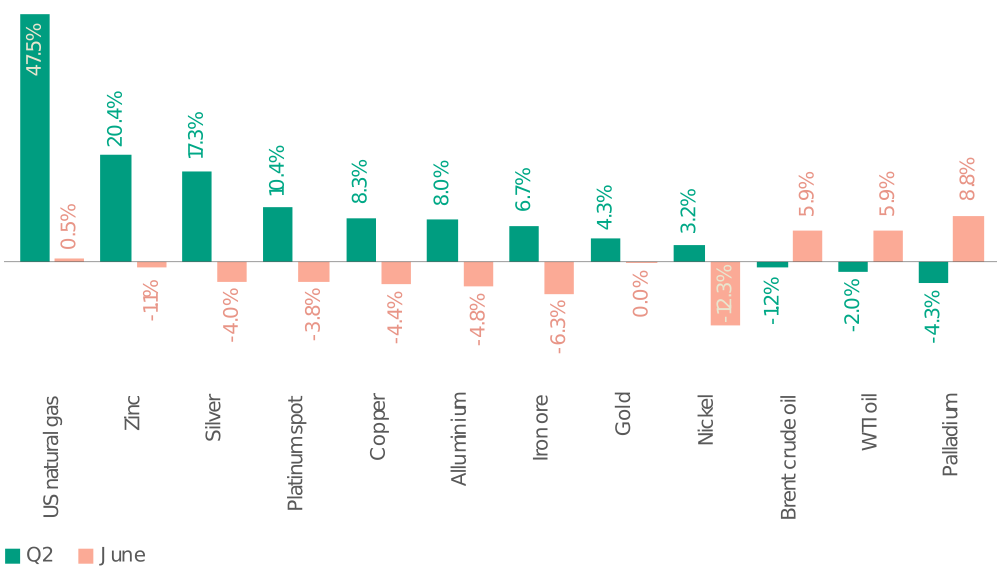
Source: Bloomberg as at 30 June 2024.
Explore more insights

Insights
Market and portfolio insights, webinars & events curated from across our investment teams to help you steer through changing investment landscapes.
Important Information
This communication is provided for general information only should not be construed as advice.
All the information in is believed to be reliable but may be inaccurate or incomplete. The views are those of the contributor at the time of publication and do not necessary reflect those of Ninety One.
Any opinions stated are honestly held but are not guaranteed and should not be relied upon.
All rights reserved. Issued by Ninety One.