Key takeaways
- Global equities are transitioning into a new market regime, one with markedly different characteristics — a shift that has driven a notable increase in searches for core managers as investors seek repeatable alpha through the cycle.
- Style leadership has broadened, and rotations have become more abrupt, making core approaches much more appealing as foundational allocations.
- 4Factor’s core, bottom-up investment process is designed to capture inefficiencies across quality, value, operating performance and investor attention, with a key focus on taking stock-specific risk.
- Since inception, 4Factor has generated alpha through a range of market environments, with 2024 and 2025 providing recent examples of contrasting conditions.
- The next decade is unlikely to look like the last. In a more uncertain world, consistency matters. 4Factor offers a disciplined, balanced and all-weather core approach that aims to help investors capture opportunities, manage risks and pursue more resilient outcomes across changing market regimes.
A shift in market regime plays to our core strengths
Global equities are undergoing a profound transformation, altering how investors think about risk, return, and the repeatability of outcomes. In light of recent market regime changes, with volatility and factor rotations becoming more frequent, attention is increasingly turning to all-weather core approaches that aim to generate consistent alpha through the cycle. This is driving a resurgence in searches for core managers. By casting a wide net across styles, sectors and regions, a core, bottom-up approach maximises the breadth of opportunities available. 4Factor’s Global Equity Strategy, which typically operates within a 2-4% tracking error range and holds approximately 70 stocks, seeks to deliver outperformance through stock specific risk, while limiting reliance on less predictable macro or style driven regimes.
How the market is changing
Macro drivers
Equity market leadership over the 10-15 years to the early 2020s was dominated by growth stocks, particularly US stocks, underpinned by ultra-low interest rates and abundant liquidity. In that environment, long-duration assets – particularly those whose earnings lie far into the future – benefitted. Many passive and quant strategies, or style-dominant strategies, especially those tilted toward growth, thrived during that period.1 Furthermore, we witnessed the rise in popularity of concentrated equity portfolios as a more direct way for investors to target specific styles or themes.
Yet today, evidence is building that investors are facing a new market regime, with markedly different characteristics. Inflation has returned as a more persistent feature; interest rates have normalised, and geopolitical uncertainty has shifted the policy focus away from hyper-globalisation towards resilience, security and self-sufficiency. Furthermore, some investors are reassessing the balance between US and non-US allocations as relative valuations, concentration and diversification benefits evolve.
Style rotations
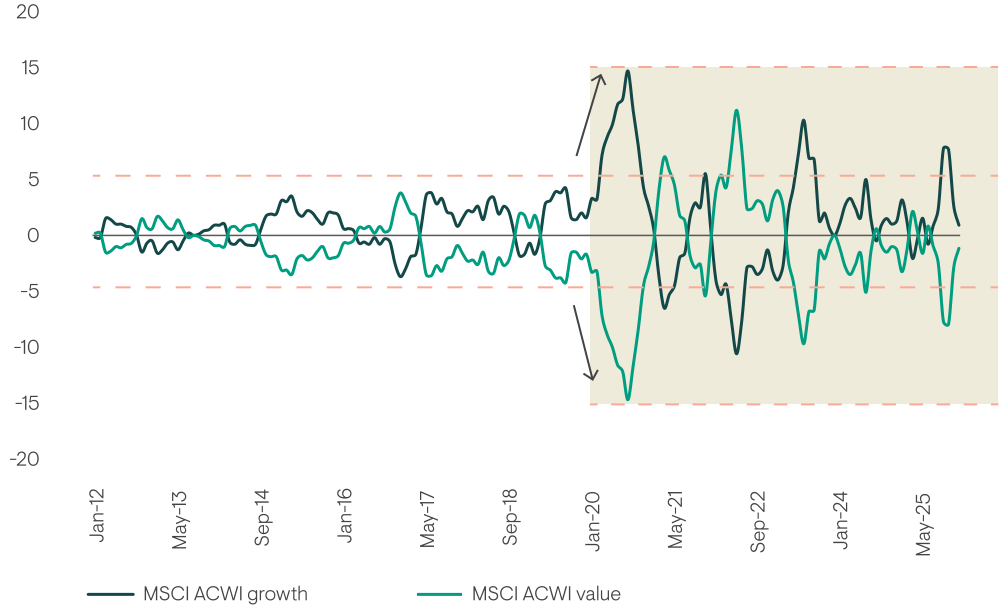
Style shifts have become greater in frequency and scale since 2020 (Figure 1), reinforcing the difficulty of factor timing. In 2020, the market pivoted from a position of hyper-growth to a relief rally in value stocks later in the year. We witnessed a similar Ukraine-driven value shock in early 2022, while peak interest rates in mid-2023 shifted momentum back towards growth. Style volatility continued in 2025, all of which underscores the need for a nimble, style-agnostic approach.
Figure 1: Big swings in style rotations since 2020
Rolling six-month excess return vs. MSCI ACWI
Past performance does not predict future returns; losses may be made.
Source: Morningstar Direct, December 2025. For further information on indices please see the important information section.
Broadening out of styles
Under today’s very different macroeconomic conditions, market behaviour has also shifted. In recent years, leadership across global equity styles has broadened and become more variable, with periods of outperformance moving across styles rather than concentrating in one area (Figure 2). The key takeaway is that market leadership is rotating more frequently. In this more changeable environment, we believe the flexibility to allocate across value, growth, quality and momentum exposures is essential.
Figure 2: Evidence of change in global markets
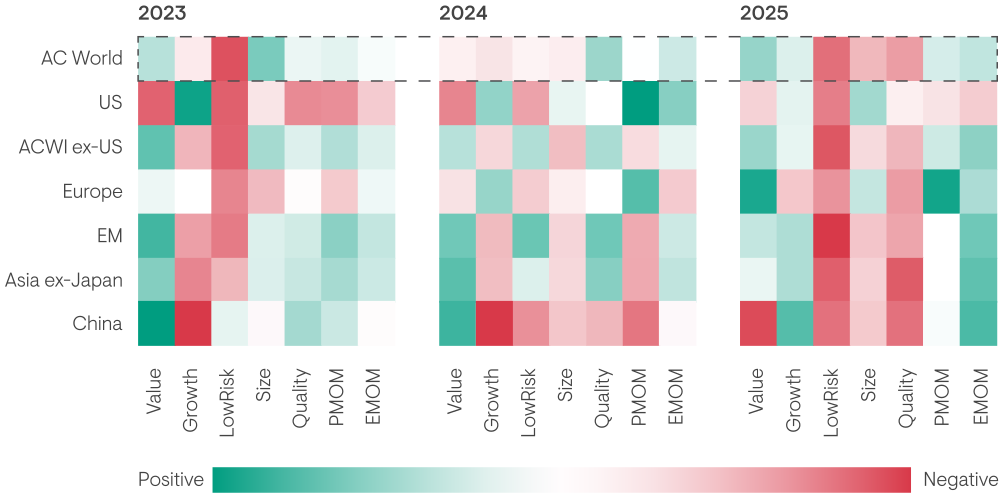
Source: Citigroup, as at 31 December 2025. Data shown without degree of magnitude for illustrative purposes only, indicating the relative performance of stocks within the top quartile of the respective style baskets as defined by Citi Research.
PMOM = Price momentum, EPOM = Earnings momentum.
How 4Factor implements a core approach
For 25 years, 4Factor has delivered core equity solutions grounded in a consistent philosophy and process. Our approach targets market inefficiencies using four factors - quality, value, operating performance and investor attention - that have proven effective across time and regions. As a core manager, we maintain balanced style exposures recognising that markets move in cycles and that sustainable performance requires adaptability.
According to eVestment data, across the global equity universe spanning all styles and disciplines, only c.25%2 of global managers have delivered positive alpha through the varied market conditions in 2024 and 2025, of which we are one. Of that cohort, Ninety One features among the leading core fundamental managers, underscoring the strength of our approach to variable market conditions. By blending value, growth, quality and momentum, we aim to mitigate style risk and deliver alpha consistently across market regimes through disciplined stock-specific risk taking.
Taking the right kind of risk
Constructing core portfolios with a high degree of stock-specific risk is central to true bottom-up investing. As Figure 3 illustrates, the 4Factor Global Equity Strategy has historically maintained a risk profile where stock-specific risk drivers dominate outcomes. We actively minimise exposure to sources of risk where we do not expect to be compensated, such as broad country or style effects, so outcomes are not dependent or driven by a macro event or factor regime.
Instead, the 4Factor process focuses on identifying and understanding the key drivers that matter for share price performance over the next 12 to 24 months, with particular attention paid to marginal rates of change, incremental improvements or deteriorations that tend to be mis-modelled by consensus. We believe that both forward-looking human judgement and analytical rigour gives us greater clarity over the risks we take and the sources of return within each portfolio.
Figure 3: Stock specific risk is the dominant source of active risk
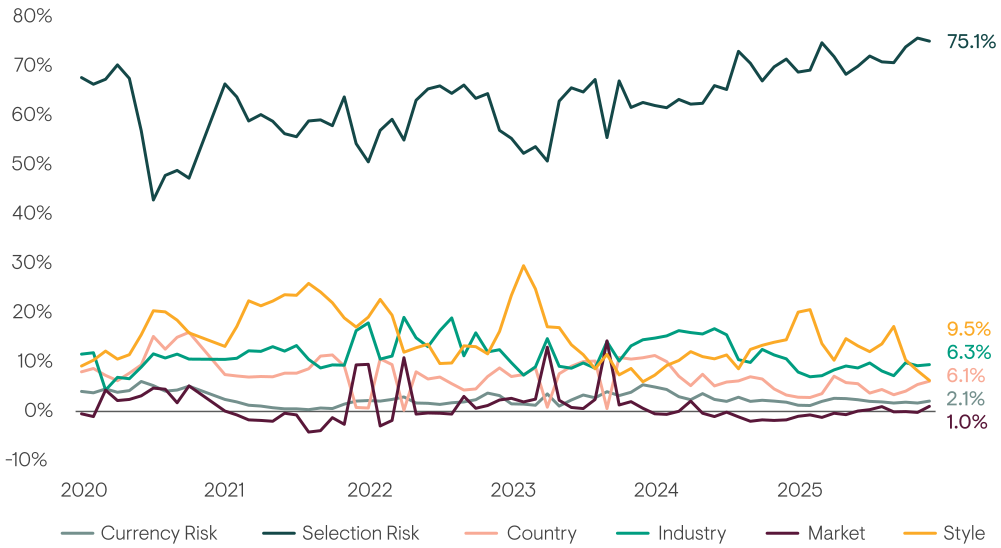
Source: Ninety One, Global Equity portfolio, 31 December 2025.
The portfolio may change significantly over a short space of time. For further information on investment process, please see the Important information section.
Constructing portfolios with this philosophy gives us the flexibility to participate in an evolving opportunity set as new winners and losers emerge. Our disciplined risk management aims to avoid reliance on a few outsized positions driving excess returns, seeking instead to generate alpha across a broad range of names.
Figure 4 shows the excess return and tracking error of a sample of managers, spanning value, growth, active quant and fundamental strategies over a rolling three-year period. The standout message is clear: core fundamental managers have delivered far stronger outcomes. Within this group, the Ninety One 4Factor Global Equity Strategy has demonstrated particularly compelling performance. This reinforces the broader trend that, as market leadership has broadened and style rotations have accelerated, balanced, style-agnostic core approaches have demonstrated resilience in capturing opportunities and navigating evolving market conditions.
Figure 4: Ninety One Global Equity’s rolling three-year TE and IR versus peers
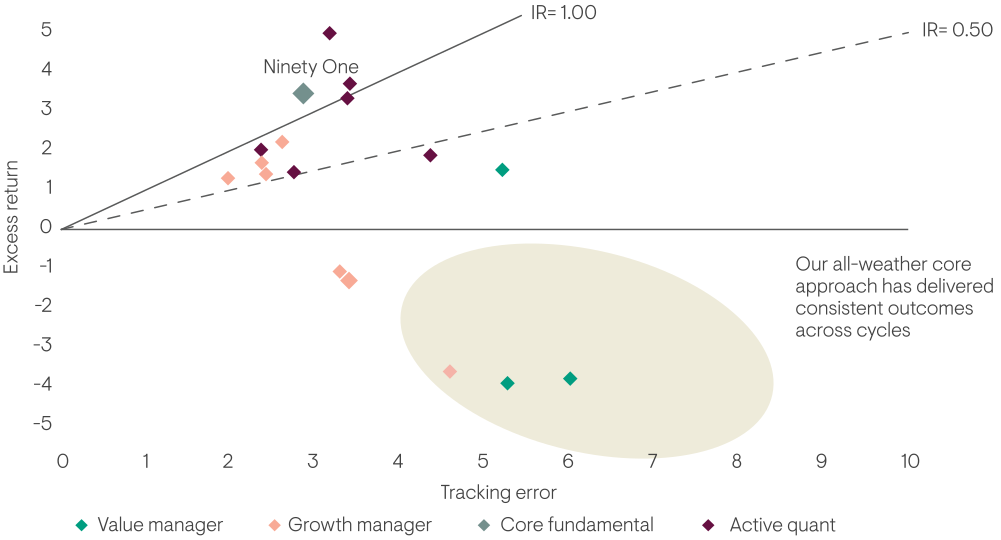
Source: Ninety One, eVestment, gross returns, USD, 31 December 2025. Each bucket represents the largest managers by AUM as defined by eVestment style emphasis and investment approach, sourced from All Global Equity universe. eVestment collects information directly from investment management firms and other sources believed to be reliable. Data shown buckets the rolling 3 yr batting average, over a 10 yr trailing period, with performance shown covering the 3 yr trailing period.
Resilient batting averages
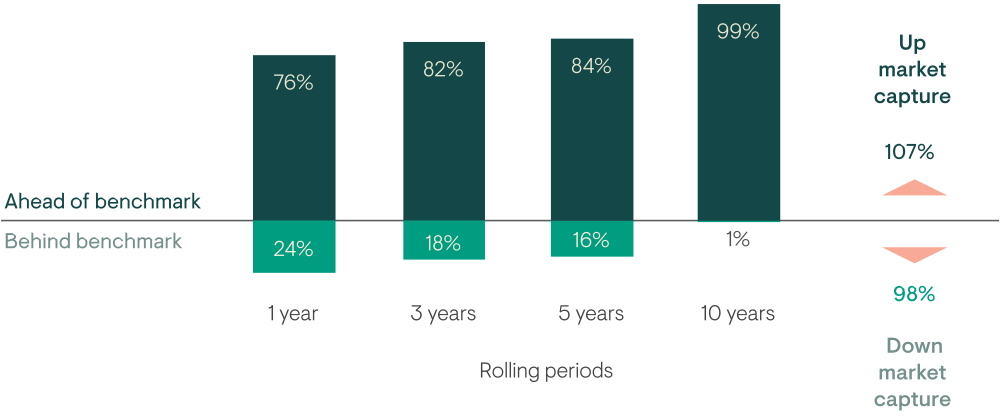
Ultimately, investment approaches are judged on their ability to deliver alpha across market cycles. Strong client relationships are built on a clear understanding of what drives this alpha, enabling transparency around both outperformance and, perhaps more importantly, underperformance. ‘Batting average’ characterises a type of alpha, referring to the percentage of time periods in which a strategy outperforms its benchmark. It offers insight into the consistency of returns. Figure 5 showcases how the 4Factor Global Equity Strategy has outperformed its benchmark in 82% of rolling three-year periods, 84% of rolling five-year periods, and 99% of rolling 10-year periods over its 25-year track record. This reflects the strength of our repeatable process, style-agnostic approach, with focus on stock-specific risk.
The batting averages are complemented by attractive up- and down-market captures, where our core approach has shown that we appreciate more in rising markets while limiting losses in downturns.
Figure 5: Batting averages and market capture since inception
Past performance is not a reliable indicator of future results, losses may be made.
Performance is gross of fees (returns will be reduced by management fees and other expenses incurred), income is reinvested, in USD. Source: Ninety One, 31 December 2025. 4Factor Global Equity inception date: 01 August 00.
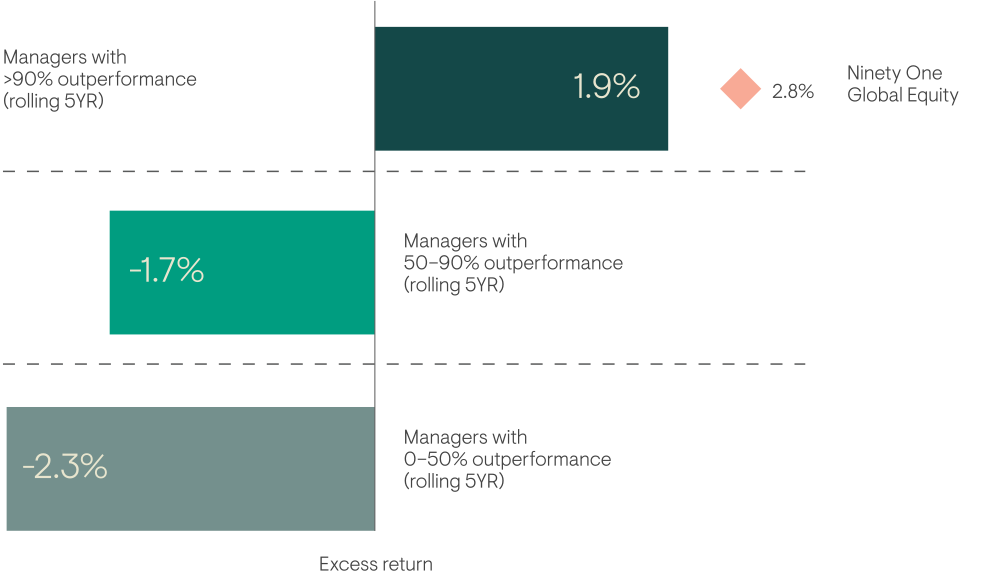
In an uncertain world, consistency matters more than ever. An all-weather core approach, grounded in steady, repeatable outperformance, allows investors to benefit from the power of compounding over time. Figure 6 shows that managers who deliver >90% consistency in excess returns (i.e. have higher batting averages) perform better than managers who are less consistent (i.e. have lower batting averages). Our disciplined and balanced core approach (as denoted by the coral diamond) can help investors capture opportunities, manage risks, and pursue more stable outcomes, amid the volatility and structural shifts shaping today’s markets, as well as those likely to define the decade ahead. For long-term investors, these characteristics remain essential, and they underpin the way 4Factor is designed to operate.
Figure 6: Consistent managers delivered nearly 2x the alpha in global equities
Past performance is not a reliable indicator of future results, losses may be made.
Source: Ninety One, eVestment, 31 December 2025. Gross returns, USD, September 2025. Each bucket represents the largest managers by AUM as defined by eVestment style emphasis and investment approach, sourced from All Global Equity universe. eVestment collects information directly from investment management firms and other sources believed to be reliable. Data shown buckets the rolling 5 yr batting average, over a 10 yr trailing period, with performance shown covering the 5 yr trailing period.
Looking to the future
The next decade is unlikely to look like the last. The growth-led rally, that has dominated global equity markets for that recent 10-15 year period is unlikely to repeat itself. We are now transitioning into a new regime driven by real-world investment, rising capex, geopolitical shifts and rearmament. This includes the energy transition, the growing importance of AI, and increased defence and infrastructure spending.
As these structural themes unfold, we expect to see growing opportunities across a range of industries. Companies involved in grid infrastructure, power equipment, and renewable energy components stand to benefit from the surge in capital investment towards energy transition. In parallel, the rapid development and adoption of AI is likely to support demand across the technology value chain, for ever more powerful chips, data centres and cooling technology. Rising geopolitical tensions and national security concerns are driving increased defence and aerospace spending, which supports companies supplying military systems and related engineering services. More broadly, we expect elevated public and private infrastructure spend to support construction materials, heavy equipment manufacturers, industrial automation, and select financials exposed to long-duration asset financing. In this environment, a style-agnostic approach allows us to remain well positioned to identify and capture opportunities across industries and market segments.
Appendix 1
Strategy composite performance (USD)
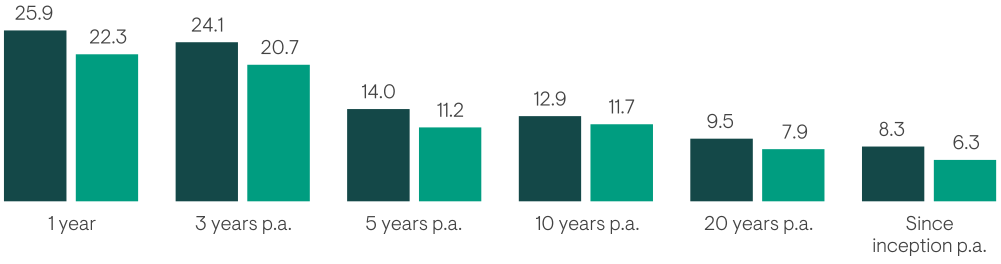
| Calendar (%) | 2016 | 2017 | 2018 | 2019 | 2020 | 2021 | 2022 | 2023 | 2024 | 2025 |
|---|---|---|---|---|---|---|---|---|---|---|
| Composite (gross) | 3.9 | 25.5 | -11.0 | 26.6 | 19.1 | 20.2 | -16.0 | 19.8 | 26.7 | 25.9 |
| Benchmark | 7.9 | 24.0 | -9.4 | 26.6 | 16.3 | 18.5 | -18.4 | 22.2 | 17.5 | 22.3 |
| Active return | -3.9 | 1.5 | -1.6 | 0.0 | 2.9 | 1.7 | 2.4 | -2.4 | 9.2 | 3.6 |
Past performance does not predict future returns; losses may be made.
Source: Ninety One, 31 December 2025.
Performance is gross of fees (returns will be reduced by management fees and other expenses incurred), income is reinvested, in USD.
Performance start: 01 August 2000.
Strategy: Global Equity.
Benchmark: MSCI AC World NDR (pre Oct-10, MSCI World NDR). Indices are shown for illustrative purposes only.
General risks. The value of investments, and any income generated from them, can fall as well as rise. Where charges are taken from capital, this may constrain future growth. Past performance is not a reliable indicator of future results. If any currency differs from the investor’s home currency, returns may increase or decrease as a result of currency fluctuations. Investment objectives and performance targets are subject to change and may not necessarily be achieved, losses may be made. Environmental, social or governance related risk events or factors, if they occur, could cause a negative impact on the value of investments.
Specific risks. Currency exchange: Changes in the relative values of different currencies may adversely affect the value of investments and any related income. Derivatives: The use of derivatives is not intended to increase the overall level of risk. However, the use of derivatives may still lead to large changes in value and includes the potential for large financial loss. A counterparty to a derivative transaction may fail to meet its obligations which may also lead to a financial loss. Emerging market (inc. China): These markets carry a higher risk of financial loss than more developed markets as they may have less developed legal, political, economic or other systems. Equity investment: The value of equities (e.g. shares) and equity-related investments may vary according to company profits and future prospects as well as more general market factors. In the event of a company default (e.g. insolvency), the owners of their equity rank last in terms of any financial payment from that company.
1 eVestment, Ninety One as at 31 December 2025. See page 4 of 25 years of 4Factor Investing. Prior to 2005, the data is less informative.
2 Source: eVestment, December 2025, eVestment All Global Equity universe, Strategies benchmarked to MSCI ACWI, excludes dedicated sustainable and thematic strategies, and dedicated small/mid cap strategies. Shows strategies defined as ‘core’ by strategy type. 347 strategies listed, with 89 generating positive returns in 2024 and 2025. Ninety One is further defined as ‘fundamental’ by investment approach on eVestment.
