0:00
0:00
The start of the new tax year has triggered a fresh wave of withdrawals from the savings pot under South Africa’s two-pot retirement system.
Pension fund administrators have reported that requests began almost immediately after the new tax year opened, in some cases within minutes of midnight on their digital platforms.
This tells us two things.
- First, there is clearly real financial pressure among a group of retirement fund members.
- Second, the withdrawals appear to be concentrated among repeat users of the system – the same individuals who withdrew from their savings pot last year and are now doing so again.
While the behavioural pattern is understandable, the timing of this year’s withdrawals could hardly be worse.
A double whammy for investors
Towards the end of February the market backdrop looked relatively constructive. South Africa’s Budget was broadly well received and sentiment towards local assets had improved.
But global events have quickly turned the picture on its head. A sharp spike in oil prices following the war in the Middle East triggered a broad market pullback. In the space of a few days, many investment portfolios experienced meaningful declines.
This creates a “double whammy” for investors making two-pot withdrawals right now.
Not only are they reducing their retirement savings, they are doing so after markets have already fallen, effectively locking in those losses.
The mathematics of investing makes this particularly damaging. If a portfolio loses 50%, it doesn’t require a 50% gain to recover. It requires a 100% gain. By withdrawing after a drawdown, investors reduce the capital base and increase the return required to rebuild their retirement savings.
Behavioural mistakes during market stress
This pattern reflects a classic behavioural finance mistake.
When markets fall sharply, investors often feel compelled to “do something” in response to the volatility. But reacting during periods of stress typically leads to decisions that permanently impair long-term wealth. Selling or withdrawing from equity-based investments immediately after a market decline is one of the most common and costly examples.
For investors who genuinely face a financial emergency, the situation is understandably difficult. If money is urgently needed, there may be limited alternatives.
But where possible, investors should think carefully before withdrawing from retirement investments after a market drawdown.
Short-term liquidity solutions, such as temporary financing or alternative funding sources, may be less damaging than crystallising losses in long-term retirement assets.
The bigger long-term cost of two-pot withdrawals
Even without market volatility, repeated withdrawals from the savings pot carry a significant long-term cost.
Every withdrawal reduces the capital that would otherwise compound over decades. In practical terms, consistently withdrawing from the savings pot before retirement can reduce an investor’s eventual retirement nest egg by roughly a third.
That is the real long-term risk embedded in the system. The two-pot structure was designed to provide flexibility during financial hardship, but frequent use undermines retirement security.
South Africa already faces a severe retirement savings shortfall. If two-pot withdrawals become a regular habit rather than an emergency measure, the gap between what people save and what they need for retirement will widen even further.
Figure 1: Frequent withdrawals from your RA savings pot will deplete your retirement nest egg
RA with and without annual savings pot withdrawals (AUM in real terms)
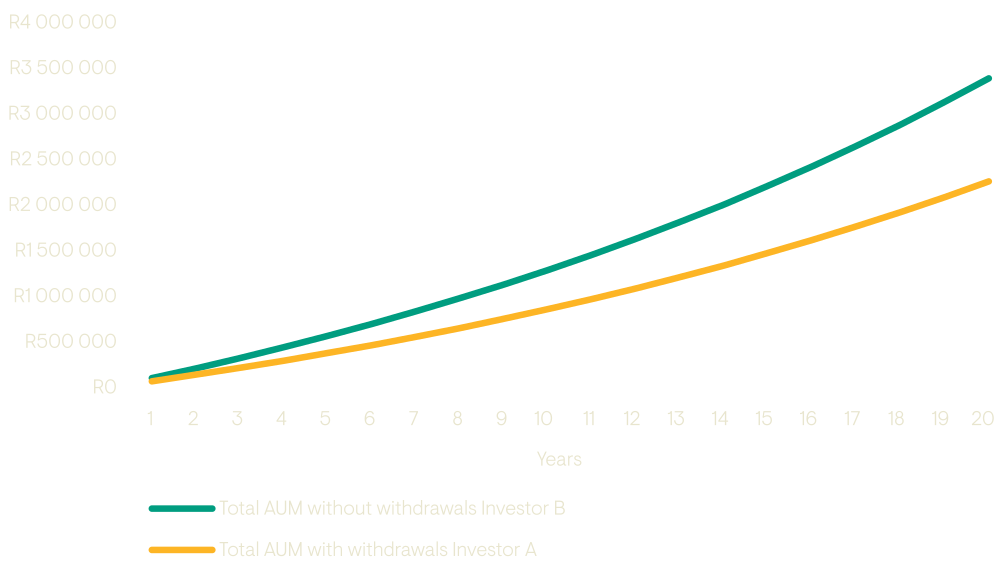
Source: Ninety One. For illustrative purposes only. Losses may be made. The assumed return of CPI + 5% p.a. is used for illustrative purposes only and does not take into account market conditions or the costs associated with investing. The assets under management (AUM) shown in the chart are in real terms (i.e. in today’s money terms).
What investors should focus on now
Periods of market turbulence are uncomfortable, but they are also a normal part of long-term investing.
Historically, markets have experienced many short-term shocks from geopolitical events to oil price spikes, inflation scares and recessions. Yet over time, they have consistently recovered and moved higher.
The key principle for long-term investors remains unchanged: stay invested, avoid locking in losses, and allow time and compounding to do their work.
For retirement savers considering a two-pot withdrawal right now, the most important question is simple: Is this truly necessary?
If the answer is yes, then the system has served its purpose by providing financial relief.
But if there are alternatives, delaying the withdrawal – especially during a market downturn – could make a meaningful difference to long-term retirement outcomes.
In investing, timing the market is extremely difficult. Unfortunately, withdrawing during market stress is often the exact opposite of what long-term wealth building requires.
Authored by
Two-pot retirement reform

