Adrian Gore, founder and CEO of Discovery, unpacks the four principles that he believes allow people to maximise their potential in his excellent book; The Four Principles: Multiply your Impact in Life and Leadership (Pan Macmillan South Africa, 2026). They are:
- Disciplined optimism: belief and positive action drive history, cynicism sits on the sidelines.
- Focused urgency: you have less time than you think, and to make a meaningful difference you need to get on with it.
- Declared goals: once you have stated a goal publicly, you have something to lose and therefore you are more committed to realising it.
- The Pareto Tail (also known as the 80:20 rule, where roughly 80% of the outcomes result from only 20% of the inputs): this principle builds on the first three and makes the point that you need to identify and target a few high-power decisions, which can then change your life trajectory
How then do these four principles relate to investment management? Consider the long-term performance track record of John Biccard, portfolio manager of the Ninety One Value Fund — a case study, as it turns out, that touches all four.
Figure 1: The Ninety One Value Fund performance since inception
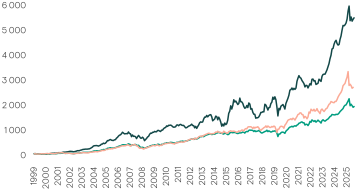
| Ninety One Value Fund | ALSI | General Equity sector | |
|---|---|---|---|
| Cumulative | 5 438% | 2 656% | 1 888% |
| Annualised | 16.3% | 13.3% | 11.9% |
Source: Morningstar, Ninety One as at 31 July 2026. Past performance is not a reliable indicator of future results, losses may be made. Performance figures above are based on lump sum investment, NAV based, inclusive of all annual management fees but excluding any initial charges, gross income reinvested, fees are not applicable to market indices, where funds have an international allocation this is subject to dividend withholding tax, in ZAR. Annualised performance is the average return per year over the period. Individual investor’s performance may vary depending on actual investment dates. Highest and Lowest returns are those achieved during any rolling 12 months over the period specified. Since inception (Inception date 03 May 1997): Jul-16: 87.9% and Sep-98: -35.7% The Fund is actively managed. Any index is shown for illustrative purposes only.
In managing the fund, John applies a deep value, bottom-up, contrarian investment philosophy. He is looking for companies where other investment managers have capitulated, where the broker community no longer covers the stock, where management is publicly ridiculed, and where the average purchase price of current shareholders is below the current share price. The result is a portfolio that is vastly different to the index and to the holdings of other investment managers, a portfolio that is priced for disaster, but where John does not agree with that market consensus. A Pareto portfolio, if you will.
Disciplined optimism shows up here as the willingness to hold a view against an overwhelming market consensus, and to act on it. History shows that equity markets go up over the long term, but volatility and the occasional failure of an industry or company mean that optimism on its own is not enough. The oft-quoted phrase “markets can remain irrational longer than you can remain solvent” is a timeless reminder that being fundamentally right about a trend does not guarantee profit if your timing is wrong or your capital runs out first. John’s discipline lies in sizing positions, and in his willingness to average down, so that being early does not become being wrong.
Focused urgency is the difference between being invested ahead of a turning point and simply agreeing with a thesis after the fact. To capture the initial share price recovery, a manager needs to be positioned before the crowd is willing to buy back in, and needs the same urgency in reverse, selling out ahead of the eventual top rather than after it. This is what makes contrarian investing uncomfortable in practice: the entry point looks like a mistake for months or years before it looks like foresight.
Declared goals hold the whole exercise to account. John’s mandate, to outperform the blended 70% FTSE/JSE All Share Index/30% MSCI ACWI and his general equity peer group over the long term is public and measurable. It is precisely because the goal is declared and tracked that the tolerance for being “wrong” for extended periods is so hard to sustain, and so rare when it works.
It is The Pareto Tail, though, that best explains the shape of the outcome. John attributes the bulk of the Value Fund’s material outperformance of both its equity benchmark and general equity peer group to only a handful of key investment decisions over the 25-year period.
Each of these decisions shares a common structural pattern: John sized up when a stock or sector had become a consensus story the market wanted no part of, held the position through a period of real pain, and unwound it once the narrative, and the share price, normalised.
- Early 2000s — SA Inc. and commodities
John was overweight SA Inc. stocks, including commodities, on attractively low valuations following a material rand sell-off. The position went on to benefit from a decade-long surge in global raw material prices, a commodity supercycle driven by rapid industrialisation, urbanisation and infrastructure expansion in China and other emerging markets, which created simultaneous demand for metals, energy, and bulk commodities.- John’s disciplined application of his investment philosophy meant he was completely out of the position by the time of the 2008 Global Financial Crisis, which subsequently drove commodity share prices materially lower.
- Mid-2010s — Platinum Group Metals
John built a significant position in PGM stocks, and it was this position that tested his fortitude the most. Over four years, shares like Impala, Anglo Platinum and Northam continued to fall, and John continued to buy more. Staying true to his conviction cost him two-thirds of his institutional investors, as the Value Fund underperformed its benchmark for four straight years. Eventually the cycle turned and share prices went stratospheric, with the position ultimately delivered a 300% gain for the fund. - Going into 2023 — Gold
John was overweight gold stocks and benefited from a subsequent surge in the dollar gold price, driven by global economic shifts, including central banks diversifying reserves away from the US dollar and rising inflation concerns. - Prior to the 2024 South African general elections — SA Inc, again
John built a material position in SA Inc. stocks at a time of heightened concern about the election outcome. The narrative of the day was that there was no economic growth, that South Africa was uninvestable, and that the political outlook was dire, all of which, on John’s analysis, was already priced in. The formation of a Government of National Unity saw these shares outperform significantly.
The same concentration that produces this kind of payoff is also what makes it so hard to sustain in practice. A portfolio built to look nothing like the index will, by construction, spend long stretches looking wrong. And it is exactly that career risk, more than any lack of insight, that stops most managers from running a genuinely concentrated, contrarian book. Losing two-thirds of one’s institutional client base during the PGM drawdown is the cost side of the same trade that eventually produced a 300% gain; the Pareto Tail only pays out to those still standing when the position turns.
These key decisions have determined the bulk of the Ninety One Value Fund's outperformance over a 25-year period, a clear illustration of the Pareto Tail at work in the discipline of investment management, and of what it costs to capture it.
Today’s Ninety One Value Fund portfolio continues to look for the next iteration of the same pattern: mid- and small-cap SA Inc. names still priced for a bad outcome, selected commodity exposure at depressed valuations, and offshore positions in China, other emerging markets, and global beer and spirits stocks, sectors the market has, for now, mostly given up on. Astute investors, with time on their hands, should once again benefit from this positioning.
