The fast view
- We’re in a new era of persistent disruption, driven by protectionism, policy uncertainty and shifting global alliances. In this environment, long-term positioning matters more than short-term predictions.
- Market dislocations often create mispricing, providing active management opportunities to allocate capital strategically based on fundamentals, not headlines.
- Our portfolios are well diversified: we combine defensive quality for stability, durable compounders for consistent growth and selective growth drivers for upside.
- We focus on process rather than market noise. This means we invest in businesses with predictable earnings and solid fundamentals, making changes only when clearly justified by risk/reward.
There’s no modern precedent for the current level of disruption. The pace of change – from retaliatory tariffs to shifting alliances and conflicting official statements – has been unrelenting. Markets are flooded with noise, and volatility has returned – coming not in brief bouts, but in sustained waves across asset classes and regions.
This is likely more than a short-term dislocation. The convergence of global protectionism, economic nationalism and geopolitical tensions has now crystallised into policy. We are entering a world of higher trade barriers, disrupted supply chains and increasingly unpredictable policymaking. Investors should exercise caution about making short-term calls – what appears rational today, given current market and political dynamics, could seem irrational a week later. The key question for investors isn’t whether uncertainty will persist, but how portfolios can be constructed to withstand it. This is not the moment for macro bets or reactionary rotations. Rather, it’s a time for humility, discipline and a clear investment process.
What really matters
Much has been said about US exceptionalism – and for years, strong innovation, deep capital markets and corporate profitability provided a fertile hunting ground for investors. But recent history highlights the cost of complacency. In 2022, fixed income faltered, showing a lack of flexibility. This year, global equity trackers – largely proxies for US mega caps – exposed their weaknesses. These strategies thrived when the dollar was rising and tech was booming, but shifts are underway.
2025 has underlined just how fragile the global system has become. Despite current scepticism towards the US, many of these firms still offer exceptional compounding potential. The key factor is quality, not geography. Where a company is listed matters less than how and where it earns revenue.
For us, creating balance on the high wire of global equities requires purposeful diversification across three areas of focus:
- Defensive quality is the ballast, providing stability in tough markets. These are companies with strong balance sheets, recurring revenues and steady cash flows through the economic cycle – offering capital preservation and resilience.
- Durable compounders are the engine, driving long-term growth. These businesses have strategic moats, disciplined capital allocation and strong reinvestment potential, enabling them to steadily build value through cycles.
- Selective growth drivers provide optionality and add upside. Focused outside of overowned mega-cap US tech, these are high-potential businesses with sound fundamentals, scalable models and exposure to structural themes – carefully chosen and appropriately sized.
Figure 1: Illustrative portfolio shape – balancing attractive compounders with diversified growth drivers

Performance is not guaranteed. Losses may be made. These stocks represent holdings across the spectrum within the portfolio. This is not a buy, sell or hold recommendation for any particular security.
Balanced exposure mitigates single-factor or regional risk, enabling portfolios to withstand volatility, compound consistently and capture opportunities. Importantly, this shape must be flexible, shifting appropriately to manage changing market dynamics.
Quality at the core
In volatile markets, quality is key. The companies that preserve capital – and emerge stronger – are those with pricing power, low capital intensity, strong governance and a clear strategic edge.
These are the types of businesses we prioritise in the Global Franchise Strategy. Rather than chase momentum, we seek resilient franchises with predictable earnings, disciplined capital allocation and enduring relevance.
Quality businesses tend to demonstrate more resilient earnings due to structural advantages that help them withstand economic and market shocks. These companies typically have strong competitive moats, pricing power and loyal customer bases, which support stable revenues even in downturns. Their disciplined capital allocation, lower debt levels and asset-light models also provide greater financial flexibility, while recurring revenue streams – often through subscriptions or essential services – create predictability. For investors, resilient earnings mean fewer surprises, smaller drawdowns and more consistent compounding over time.
Importantly, many of these companies are inherently insulated from the brunt of tariff-related risks. Our portfolios are skewed towards services-oriented, subscription-based businesses – like software, financials and consumer services – with limited exposure to capital-intensive sectors like autos, machinery or commodities.
Figure 2: Global Franchise revenue breakdown – looking beyond the top line.
Resilience via higher-quality revenue streams
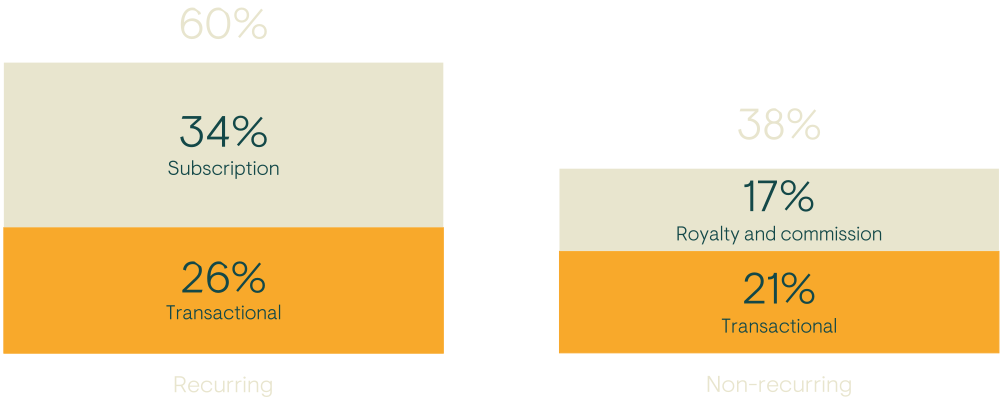
Source: Ninety One, FactSet, as at 31 December 2024. The portfolio may change significantly over a short period of time.
Robust balance sheets and the inherent resilience of earnings help to limit second-order effects from tariff-related economic weakness. This resilience is already evident in market performance. During tariff-induced sell-offs, the fund has experienced smaller drawdowns than the broader market, demonstrating its defensive strength.
Discipline amidst the noise
The current environment remains fluid and complex, marked by uncertain policy paths and macroeconomic shifts. Clarity and discipline outweigh speed.
We don’t know when this latest bout of volatility will subside. No one does. But we do know that markets will likely remain unsettled as trade rules are rewritten, inflation proves sticky and policies grow more unpredictable.
Now is not the time for overconfidence – it’s the time to hold portfolios that can absorb shocks, remain agile and stay anchored in fundamentals. Resilience isn’t optional – it’s essential. That said, we remain highly attuned to identifying opportunities and ready to lean into more dynamic exposures, particularly after our defensive holdings have provided effective downside protection.
