Key takeaways
- Fiscal discipline is paying off, with debt-to-GDP stabilising; National Treasury’s issuance cuts and buyback programme should also support the bond market.
- We expect inflation to rise above 5% early next year, with at least one more domestic rate hike likely.
- Growth remains weak, and Gauteng, which accounts for around a third of GDP, is key to a recovery.
- Despite the uncertainty, we believe South African bonds offer good value, supported by a credible South African Reserve Bank and improving public finances.
In early 2026, it seemed like the purple patch for the South African bond market would continue. South Africa had growth of close to 2% in its sights; the oil price was around US$65 a barrel; and our inflation had fallen to 3%.1 The global picture was also rosy: inflation was coming down; economic growth was robust; and most central banks were expected to cut rates in 2026. But that all changed when the US and Israel launched airstrikes on Iran on 28 February this year.
Since then, oil prices have spiked, and inflation concerns have triggered a rate-hiking cycle across the globe. Global bond yields have climbed to multi-year highs, with US ten-year Treasuries hitting more than 5% – their highest level since 2007.2 Consumers are under pressure, and countries are counting the cost as the supply crunch for refined oil products strangles growth and fans inflation. But amid all the difficulties, South African fixed income investors have room for optimism.
Facing the crisis with resilience
South Africa entered the shock from a position of relative strength. The South African Reserve Bank (SARB) was slower to cut interest rates than many of its emerging market (EM) peers, as well as developed market (DM) counterparts. This meant we had high real rates going into the crisis. Our lower 3% inflation target and fiscal improvements helped anchor expectations, providing a valuable buffer. We also maintained a healthy current account surplus over the first half of the year, thanks largely to the precious metals bull run. Together, these factors have supported the rand. Despite a deterioration in the terms of trade, our currency has remained relatively stable, as can be seen in Figure 1.
Figure 1: The rand is well-supported by our terms of trade
Your chart will be shown here
Source: Bloomberg, October 2026.
EM currencies benefited from a weaker dollar in the first half of the year. Now that the Federal Reserve has started hiking rates, it has supported the dollar, which could weigh on EM currencies, including the rand. However, we believe the credibility of the SARB and prudent fiscal policy should mitigate rand volatility. The currency is expected to hold up well, despite the challenges.
Higher revenue brings more spending in areas we welcome
The Medium-Term Budget Policy Statement (MTBPS), delivered in October, surprised financial markets on revenue and spending. Main budget revenue was R54 billion higher than February’s budget estimate, bolstered by company income tax, especially from mining companies, VAT collections and non-tax revenue – mainly mineral royalties. The revenue windfall helped offset the weaker fuel levy collections because of the oil shock. Government has provided further fuel price relief by reducing the fuel levy in two phases, ending in early January. More money is also being directed towards areas such as infrastructure and municipalities, and the contingency reserve has been increased to help respond to El Niño and other risks.
Issuance cuts and buybacks should support our bond market
In 2020, the bond market started suffering from ‘indigestion’ as National Treasury increased its bond issuance at its weekly auctions to unsustainable levels. Treasury has decreased its bond issuance materially since then. The most recent cut in issuance, announced in the MTBPS, came as a welcome surprise to the market. Another significant policy move is Treasury’s bond buyback programme, which will be implemented this fiscal year. We see this as a prudent way to manage the large repayments falling due over the next year. By using surplus cash to retire some of that debt early, Treasury eases the pressure on its repayment schedule.
Rating agencies are taking note of South Africa’s fiscal progress
For the first time in nearly two decades, South Africa’s debt-to-GDP ratio has stabilised, something the country has been working towards for a long time. The primary surplus, where government revenue exceeds non-interest spending, continues to grow. The budget deficit is slightly better than February’s estimates, with Treasury expecting it to keep narrowing over the medium term. This stands out at a time when many countries are moving in the opposite direction.
We believe South Africa is on the right trajectory for debt sustainability and fiscal consolidation. Government has also released draft fiscal anchor legislation for public comment, which, if passed, would help safeguard these gains and guide how future administrations manage public finances.
Both S&P Global Ratings and Fitch have upgraded South Africa's sovereign credit ratings. Moody’s has moved its outlook to positive, and agencies will keep a close watch on the fiscal numbers. Continued policy reform and political stability will also be key. A Moody’s upgrade is possible in the coming months.
Growth and inflation remain pressure points
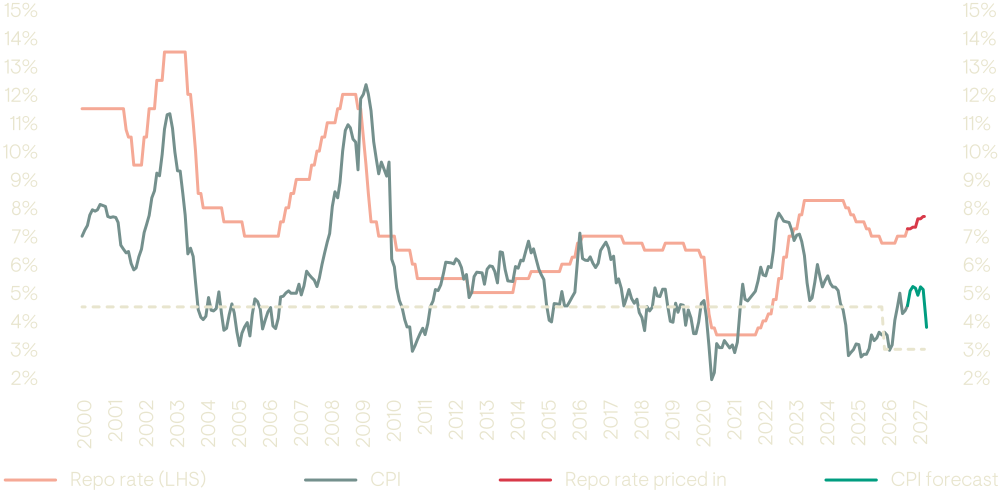
September’s inflation print, at 4.5%,3 was better than expected, but it is still well above the central bank’s 3% target, and we expect it to climb above 5% early next year before it eases. The SARB has already hiked twice, and we anticipate at least one, and possibly two, more hikes in this cycle.
Figure 2: Inflation is forecast to stay well above target, with further rate hikes expected
Source: Ninety One, October 2026.
The oil shock has also taken its toll on growth, and Treasury has cut its forecast for this year to 1.2%, from 1.6% in February.4 Extra spending on infrastructure should help support growth. Eskom and Transnet continue to improve, though there is still much to do. Growth, however, has been constrained in Gauteng, which accounts for around a third of South Africa’s GDP.5 Weak service delivery in parts of the province has dented confidence and investment.
We believe the private sector is willing to invest in Gauteng if there is confidence in how the major metros are run. Reliable services, political stability and effective cooperation between parties will be essential, and getting Gauteng onto a better trajectory would go a long way towards kick-starting growth.
Attractive bond yields offer a cushion
Despite the uncertainty, we believe South African bonds offer good value, with yields still comfortably above cash and inflation. If price pressures start to ease later next year, as we expect, there is scope for bond investors to earn capital returns. With a credible SARB and improving public finances, South Africa is well placed to weather the challenges ahead.
1 Source: Stats SA, Consumer Price Index for February 2026.
2 Source: Bloomberg, September 2026.
3 Source: Stats SA, Consumer Price Index for September 2026.
4 Source: 2026 MTBPS, October 2026.
5 Source: Stats SA, Provincial Gross Domestic Product 2025.