The fast view
- Money market funds represent an important cog in the global financial system, providing short-term financing and liquidity management.
- The asset class is a vital building block for portfolios and recent market events underscore its superior risk profile relative to perceived ‘safe havens’.
- However, the asset class is not without its risks; key among these are managing liquidity mismatches in times of heightened market stress.
- South Africa’s Financial Sector Conduct Authority (FSCA) is the latest regulator to take steps to create a more resilient regulatory framework for money market funds. This is good news for investors.
- Understanding and aligning investment choices with liquidity needs, risk tolerance, and regulatory trends remains crucial for corporate investors.
Understanding the global regulatory landscape
An asset class in focus
Globally, Money Market Funds (MMFs) are essential providers of short-term financing for financial institutions, corporations, and governments. Retail and institutional investors also use MMFs to invest excess cash and manage their liquidity.
For central banks across the globe, financial stability is a key goal, and to this end, many of them, including our own South African Reserve Bank, are members of the Financial Stability Board (FSB). Member jurisdictions have committed, under the FSB Charter and in the FSB Framework for Strengthening Adherence to International Standards, to undergo periodic peer reviews.
Addressing any potential vulnerabilities in MMFs is a key element of the FSB’s work programme as it looks to enhance the resilience of the non-bank financial intermediation (NBFI) sector. In 2021, it set out policy proposals to this end.
Regional differences
MMFs differ across FSB jurisdictions in terms of definition, structure, eligible assets, investors, currency denomination (local or foreign), liquidity and maturity limitations. MMFs with a ‘stable’ net asset value (NAV) account for 82% of global MMF assets, but are currently offered in less than half of FSB member jurisdictions. In some jurisdictions, the types of assets MMFs may invest in depend on the structure and type of NAV. MMFs are often denominated only in local currency, with important exceptions in the EU, Hong Kong, Mexico and Switzerland.
Authorities from China, the EU, France, India, Indonesia, Japan, Korea, Mexico, Saudi Arabia, South Africa, the UK and the US have all identified some vulnerabilities associated with MMFs under stress in their jurisdictions. The main identified vulnerability is the mismatch between the liquidity of MMF asset holdings and the redemption terms offered to investors, which makes MMFs susceptible to runs from sudden and disruptive redemptions. This vulnerability can be amplified by a high share of institutional investors, a stable or low-volatility NAV, and other rules that potentially incentivise investors to pre-emptively redeem their MMF holdings in times of stress.
Progress in implementing the 2021 FSB policy proposals to reduce vulnerabilities has been uneven. Authorities in all jurisdictions report that they had implemented policies to address MMF vulnerabilities before the 2021 FSB Report. Since then, some jurisdictions have introduced new policy tools or recalibrated existing ones (China, India, Indonesia, Japan, Korea, Switzerland, US), while others are still in the process of developing or finalising their reforms (EU, South Africa, UK).
South Africa’s regulatory framework
Existing rules around money market funds
South Africa’s regulators have already implemented clear rules to govern money market unit trusts (collective investment schemes) and limit risk. MMFs must adhere to strict maturity and diversification limits under the Collective Investment Schemes Control Act (CISCA) directives - enhanced in recent years to align with global standards.
Table 1: CISCA limits
| Regulatory category | Key limits and requirements |
|---|---|
| Maturity limits |
|
| Diversification and concentration |
|
| Liquidity management tools |
|
| Stable NAV practices |
|
Source: Board Notice 90 of 2014, published by the FSCA.
Evolving to make the asset class even safer
While South Africa’s environment remains well-regulated, we believe there is still room for improvement. As noted earlier, South Africa is among countries still working on the implementation of the 2021 FSB policy proposals.
Why global regulation is changing
Events that have flagged vulnerabilities
Community Bankers Money Fund
1994
Losses due to investments in risky derivative securities
NAV dropped from USD 1.00 to USD 0.96, leading to tightening of maturity and risk management regulations.
Notable stress (no official break)
2007-2008
Funds faced severe liquidity stress during the Global Financial Crisis due to exposure to structured credit products
Although no major EU MMF officially broke the buck, severe stress led to investor runs and ultimately prompted the EU Money Market Fund Regulation (MMFR) to enforce stricter maturity and liquidity rules, more explicit NAV definitions, and improved transparency
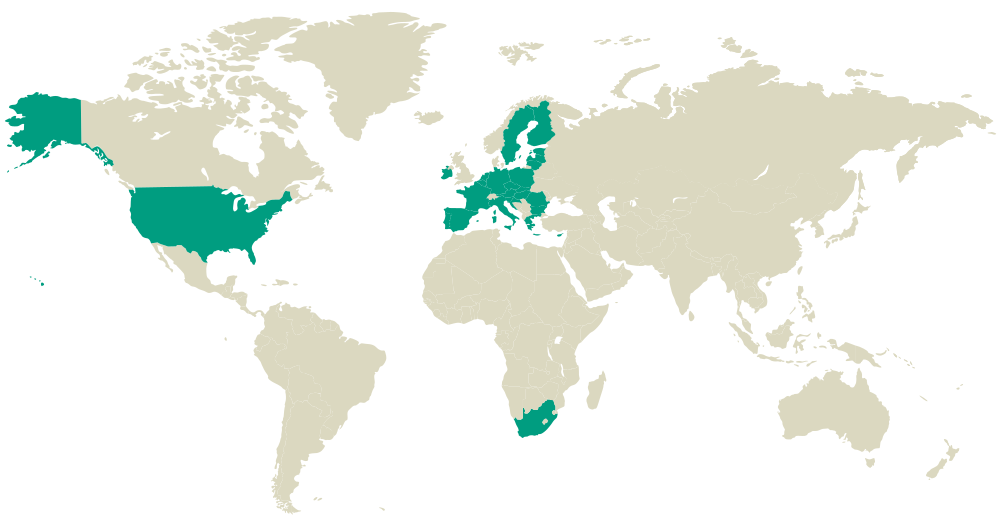
Reserve Primary Fund
2008
The collapse of Lehman Brothers caused asset losses
NAV fell from USD 1.00 to USD 0.97; triggered mass withdrawals and major regulatory reforms, including stricter liquidity rules and floating NAV for institutional prime funds.
Multiple MMFs (African Bank exposure)
2014
African Bank’s debt write-down due to insolvency
Approximately 10 MMFs’ NAV fell below stable R1.00, prompting managers to use liquidity management tools such as redemption gates and side-pockets. This triggered closer FSCA oversight and reinforced liquidity management regulations.
Ensuring an even playing field
Despite purportedly robust regulatory frameworks, from time to time, discrepancies have arisen in practices across funds, and instances of regulatory arbitrage have surfaced. Challenges with MMF yield comparisons and duration loopholes are issues regulators globally have grappled with.
Regulatory arbitrage refers to the practice of exploiting loopholes or differences in regulations to circumvent restrictions. A portfolio manager may structure a portfolio in such a way that it technically complies with the rules on liquidity and maturity limits, but still gains extra yield by subtly increasing risk. For example, longer-term debt instruments can be packaged or structured with frequent interest resets or embedded options, therefore allowing them to appear as short-term investments. The result is that the portfolio manager can then advertise this higher yield as a result of superior management, when in reality, there is more interest rate or liquidity risk than typically acceptable for a constant NAV MMF. Such practices tend to distort fund comparisons, making an apples-to-apples evaluation difficult for investors.
Implications for South Africa
Just as international regulators have amended regulations to limit these practices and reduce money market vulnerabilities, South Africa is expected to follow suit. Additional reforms being mooted include clearly defined maturity classifications, more explicit liquidity requirements, and potential adoption of liquidity fees or anti-dilution mechanisms. These changes aim to close existing loopholes and ensure that yield differences among MMFs accurately reflect genuine investment skill and strategy rather than hidden risks, providing more precise, more reliable comparisons for their investors.
Learning from global peers and aligning with best practice
The Financial Sector Conduct Authority (FSCA) is conducting a comprehensive review of BN 90, the regulation outlining MMF investment rules. This update aims to modernise existing rules, align them with new legislation – particularly the upcoming Conduct of Financial Institutions (COFI) Act – and reflect global regulatory standards. One of these learnings has led to the introduction of a new reference rate (see box below), drawing from lessons abroad such as the 2012 LIBOR rigging scandal in the UK.
Looking ahead, the goal is to create a more resilient MMF regulatory framework, safeguarding investor confidence and financial stability, while preserving MMFs’ essential role as secure, liquid investment options. To this end, we see three key areas of potential change on the horizon:
- Liquidity management enhancements
Regulators are exploring measures to improve liquidity buffers and require larger holdings of cash or government securities. - Anti-dilution mechanisms
Introducing liquidity fees or swing pricing (a mechanism used to protect existing investors from the costs associated with large inflows or outflows of cash) to ensure investors redeeming during market stress bear associated liquidity costs, reducing incentives for sudden withdrawals. - Stable versus floating NAV
South Africa is evaluating whether institutional MMFs should maintain a stable NAV as in the US, or move to floating, mirroring debates in the EU and UK.
Transition from JIBAR to ZARONIA
The FSCA has made interim adjustments to support the transition from JIBAR to the new reference rate, ZARONIA (South African Rand Overnight Index). Temporary exemptions to certain BN 90 rules now allow instruments linked to variable overnight rates, demonstrating flexibility during the regulatory transition. For nearly 25 years, JIBAR (Johannesburg Interbank Average Rate) has been South Africa’s preferred benchmark rate for overnight and term lending. However, JIBAR has inherent limitations, making it subject to inaccuracies and manipulation.
Globally, the LIBOR rigging scandal in the UK in 2012 resulted in fines totalling billions of dollars for global banks (e.g., Barclays, UBS, RBS, Deutsche Bank). It triggered global regulatory reforms and eventual phase-out of LIBOR in favour of more transparent, transaction-based benchmarks such as SOFR (US), SONIA (UK), and €STR (EU). You can listen to a more detailed discussion on the Cash Talk episode on the Ninety One podcast channel here, where we unpack these changes and the likely impact on cash investments.
Ninety One's low-risk investment options for cash management
Ninety One offers a variety of principal low-risk fixed-income funds tailored for corporate investors’ cash management needs. These are across the spectrum of pure money market to slightly longer-duration income funds.
Table 2: Ninety One low-risk fund options for cash management
Capital preservation
(strict money market)
Very low risk, extremely low volatility
Stable NAV (R1.00/unit)
Enhanced cash/ultra-short duration
Slightly higher risk than pure money market funds
Capital preservation prioritised but not guaranteed
Short-term income fund
(yield-oriented)
Moderate risk with slightly higher volatility
Higher yield compensating for modest NAV fluctuations
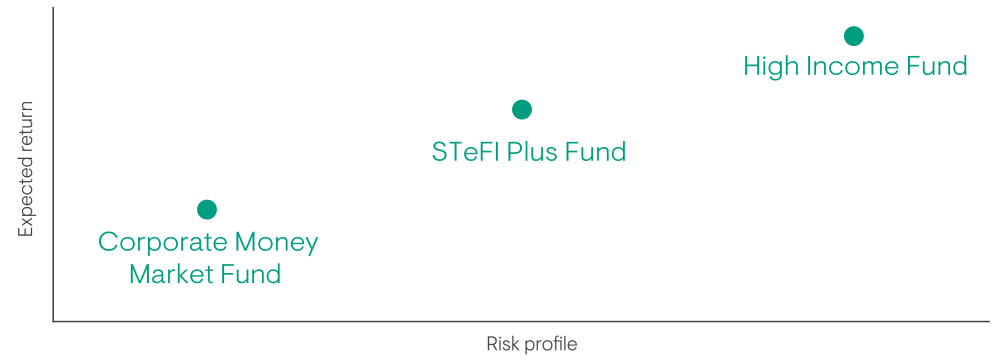
The objective is to outperform the STeFI overnight call rate
- Daily liquidity
- Minimal volatility
Instruments
- High-quality short-term instruments
- Primarily bank deposits
- NCDs, and commercial paper
- Maturity <13 months
- Average duration ≤90 days
- SA banks, government, SOE paper
The objective is to beat typical money market yields
- Slightly higher returns with limited increased risk
Instruments
- Primarily short-term instruments (bank NCDs, floating-rate notes)
- Flexibility to buy some longer dated securities if attractive
- Investment-grade securities with high liquidity
The objective is to provide high income yield
- Maximise total return (income + capital growth)
Instruments
- Predominantly high-yield bonds and short-dated fixed income securities
- Includes government bonds, corporate, and inflation-linked bonds
- Duration and credit exposure beyond typical MMF levels
Choosing the right fund for you
While changes can enhance financial stability and ensure that South Africa’s MMF vulnerabilities are reduced, investors can still ensure they are as informed as possible about the funds they are investing in and their inherent risks. Funds with low volatility but that do not have a constant R1.00 price, although modestly more risky than very conservative MMFs, generally more than compensate for this in the extra returns they offer slightly longer-term investors.
Selecting the most suitable fund essentially comes down to investment horizon, liquidity needs, and tolerance for any capital fluctuation. From Ninety One’s perspective, corporate investors must align their choice with their cash management objectives rather than simply chasing the highest yield.
| Corporate Money Market Fund | STeFI Plus Fund | High Income Fund |
|---|---|---|
| Who is it for? | ||
| Large corporates (min. R500 million) | Corporate treasuries with 6–12-month investment horizons | Corporate investors with a 12+ months horizon |
| Ideal for very short-term surplus cash with a capital preservation focus | Investors comfortable with minor NAV fluctuations for enhanced yields | Ideal for strategic cash allocations or known future liabilities |
| Suitable for investors willing to accept short-term volatility for higher overall returns | ||
Positioned for stability, prepared for change
As the regulatory landscape evolves, prudent corporate cash management demands staying abreast of changes in the money market space. Anticipated reforms promise greater resilience, transparency, and clarity, which are crucial in a world where trust is the cornerstone of financial stability. Drawing lessons from international experiences, including the US and the UK, and even here on our own shores in South Africa – regulators are proactively looking to address vulnerabilities - like transitioning from JIBAR to the more reliable ZARONIA. For corporate investors, this evolution presents both opportunities and the imperative to stay informed.
Carefully aligning your investment choices with your liquidity needs, risk tolerance, and return objectives will ensure sustainable financial outcomes rather than chasing yield alone. At Ninety One, we are committed to navigating these complexities alongside you. In the end, well-informed decisions not only protect your capital but strengthen the resilience of South Africa’s broader financial system, preparing us all for the future.
