With the first quarter of 2026 behind us and geopolitics dominating markets, we examine the key themes shaping retirement income advice in South Africa during turbulent times.
But before we introduce these themes, let's look at some historical context first.
Between 2000 and 2015, South African bonds, property and equities delivered strong real returns, and the living annuity became the dominant retirement income product. By 2015, many retirement fund administrators estimated that over 90% of retiring pension fund assets were flowing into living annuities at retirement.
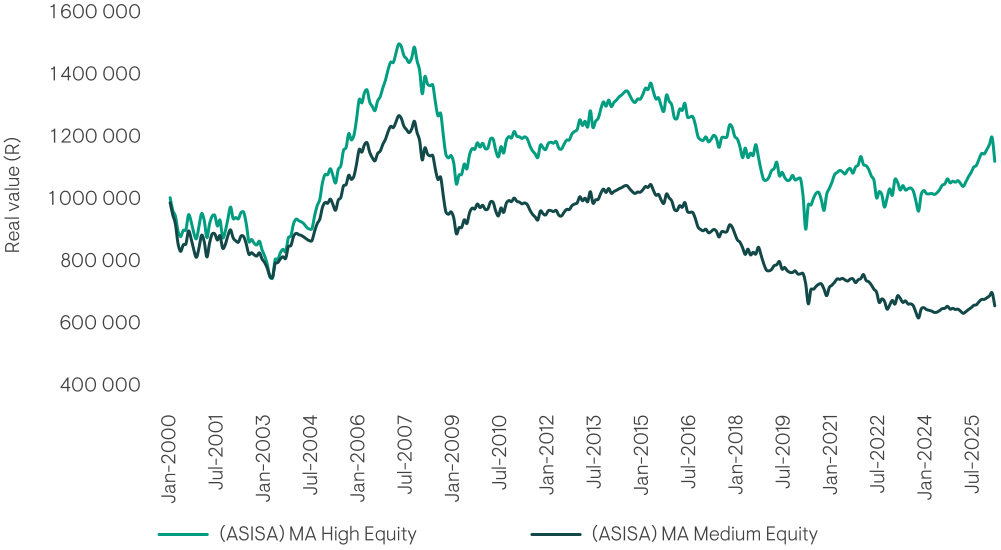
Few anticipated how quickly this would change. Figure 1 traces two living annuities from January 2000 to March 2026:
- Both started with a notional R1 million of capital and a 5% initial income draw.
- Both received identical CPI-linked annual income increases.
- Both annuities were invested in ASISA multi-asset sector averages.
Figure 1: Real assets under management (AUM) in 5% p.a. income living annuities
Source: Ninety One and Morningstar, dates to 31 March 2026. Performance figures are calculated NAV-NAV, net of fees, in ZAR. For illustrative purposes only. An individual investor's performance may vary depending on actual investment dates.
An annuity remains viable when its real AUM holds around or above the inflation-adjusted starting capital (R1 million in this illustration). If the real market value falls materially and persistently below that level, the annuity is at significant risk of failure.
The key takeaway from Figure 1: after 15 years of solid returns, real fund values began deteriorating from around 2015, as South Africa entered a prolonged economic slump. Load-shedding, Covid-19 and widespread municipal infrastructure collapse all contributed to the downturn.
The rethink
These conditions prompted a full reassessment across the industry – CIS managers, linked platforms and financial advisors all began reevaluating how they approached retirement income structuring. The core questions driving that debate were:
|
What constitutes safe versus marginal living annuities? |
How should advisors manage clients in marginal annuities? |
Is there a role for a guaranteed life annuity? |
At Ninety One, we have published widely on all three of these questions since 2017. Our research draws on stochastic modelling that simulates thousands of market scenarios and combines them with South African pensioner mortality to assess annuity success probabilities across different portfolio structures and income levels.1
In summary, our research sets out the following conditions for a successful living annuity:
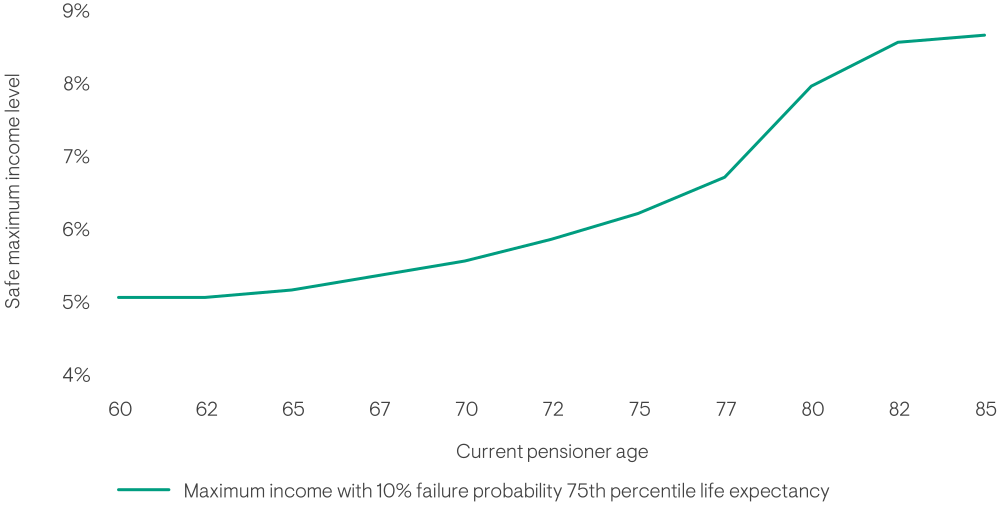
- It draws an income below the critical threshold level – given the age of the pensioner (see Figure 2).
- It has at least 60% exposure to growth assets (equities).
- It has between 25% and 55% of the portfolio invested offshore.
- It has a portfolio structured to minimise volatility, given the level of real return targeted.
Figure 2 maps these income thresholds against pensioner mortality. The graph combines investment modelling with actuarial survival probabilities to define, at each age, the income level at which success probability falls below 75% (condition 1). An income draw above that threshold at any age materially raises the risk of the annuity failing during the pensioner's lifetime.
Figure 2: Why income levels matter
Source: Ninety One.
More detail is available on the Ninety One retirement income hub on our website.
The key themes shaping retirement income advice
1. Living annuities and offshore investments
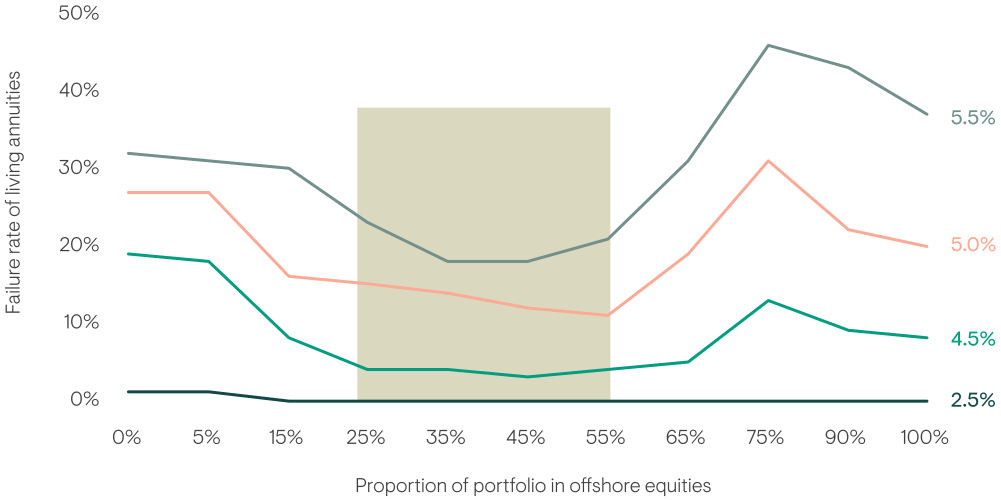
This brings us to our first topical debate – one that keeps rearing its head: offshore exposure in living annuities. Our initial research from 2017 identified offshore equity exposure as one of the key pillars to a successful living annuity, with at least 25% offshore exposure needed to maximise success rates. Post-Covid, we returned to the modelling with a new question: could too much offshore exposure damage outcomes? Figure 3 shows failure rates across four living annuities at different starting income draw levels.
Figure 3: Impact of offshore exposure on different income-drawing living annuities
Source: Ninety One.
The shaded region – where failure rates are at their lowest – sits between 25% and 55% offshore equity exposure, regardless of income draw level. This confirms the lower bound from our initial research while adding an important upper bound.
Above 60% offshore, failure rates rise sharply across nearly all income levels. The exception is very low income draws (2.5%), which are robust to higher offshore allocations because the income pressure on the portfolio is minimal.
This highlights an important risk for advisors who have been positioning living annuity clients predominantly offshore over recent years. That strategy is only appropriate where the client genuinely intends emigrating and will therefore have future living expenses denominated in hard currency. For clients retiring and spending their income in South Africa, very high offshore exposure is likely inappropriate and our modelling shows it materially increases the risk of annuity failure.
2. Guaranteed annuities and the inflation/interest rate cycle
Our second debate has been ongoing: it gained prominence as bond yields peaked between 2022 and 2024, lifting guaranteed life annuity rates to their most attractive levels in many years. At the same time, several large local life companies extended their product ranges and marketing efforts in the guaranteed space, increasing advisor and client awareness of this option.
With equity markets delivering pedestrian real returns concurrently, advisors faced a meaningful choice: persist with an underperforming living annuity or move clients into a guaranteed annuity at attractive rates. Industry statistics showed that, at one point during 2023 and 2024, as high as fifty percent of retirements used a guaranteed life annuity.
Make no mistake – guaranteed and hybrid annuities have a clear role for the right client. But they are not silver-bullet solutions: they introduce unique risks advisors must quantify. Liquidity constraints and life company balance sheet exposure are some of the obvious and well-understood risks. The critical underestimated risk, however, is inflation.
Inflation – the number one risk to pensioners
Inflation is familiar enough that clients often dismiss it as a known and manageable risk. Yet in practice, its long-term structural impact on retirement income is routinely underestimated. The problem is compounding: small errors in inflation assumptions, sustained over decades, translate into buying power erosion that is very difficult to recover from once it takes hold.
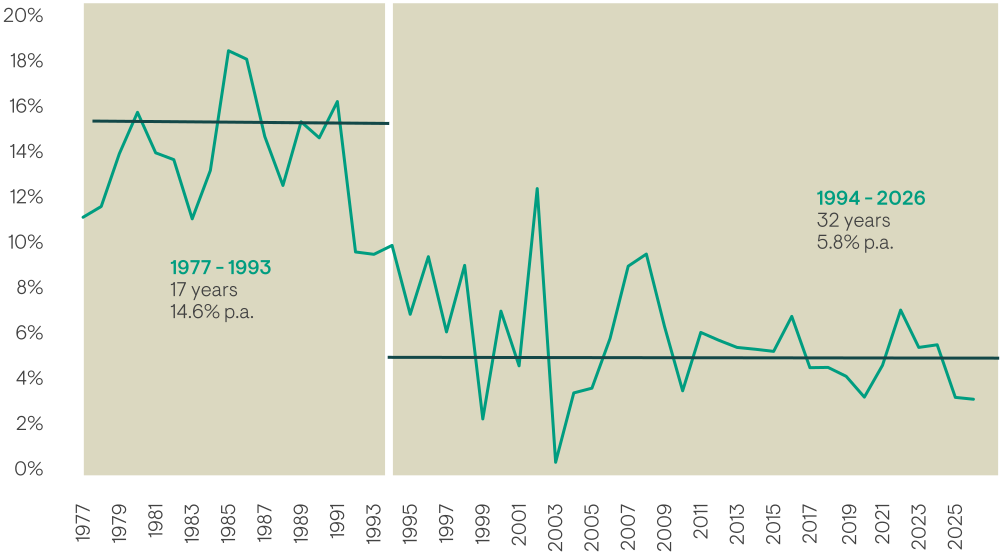
Figure 4 charts South Africa's consumer price index (CPI) since 1977 and illustrates an important principle: inflation does not oscillate randomly around a long-run average. It moves in extended structural cycles – decade-long periods of elevated inflation, followed by decade-long periods of subdued inflation. Over the course of a typical 30-year retirement income plan, the probability of encountering at least one of these sharply higher inflation decades is meaningful.
Figure 4: Historical South African consumer price index
Source: Morningstar, dates to 31 March 2026.
This is especially relevant now, as structural inflation concerns resurface following geopolitical turmoil and the impact on oil prices. After 30 years of low global inflation, it is easy to forget what the 1970s looked like – particularly for guaranteed annuities with fixed annual income increases.
Even a modest inflation estimate error compounds into serious buying power erosion over time. Figure 5 quantifies this.
Figure 5: Cumulative deterioration in the buying power of income from underestimating inflation over extended periods
| Inflation error | |||
| 1% | 2% | 3% | |
| Loss of buying power over 10-year term | 10% | 22% | 34% |
| Loss of buying power over 15-year term | 16% | 35% | 56% |
Source: Ninety One.
A 2% p.a. inflation error erodes buying power by 22% over 10 years and 35% over 15 years. A pensioner on a 5% fixed annual increase facing 8% inflation loses more than 35% of real buying power within a decade.
A CPI-linked life annuity would transfer this risk to the life company, but the local bond market offers limited inflation-linked instruments for life companies to hedge themselves. Therefore, very few local life companies offer CPI-linked increases. Those that do, price the option at around 4-5% initial income on a dual-life annuity – comparable to what a well-structured living annuity delivers sustainably.
3. The value of optionality in retirement planning
Our third topical debate deals with the value of flexibility for a pensioner, given how unpredictable retirement cash flows have become.
Unlike 30 years ago, when a 15-year retirement was typical, modern South African mortality tables point to planning horizons of around 30 years.
Advisors have noticed this shift. When we discuss retirement strategies with financial advisors, a consistent theme emerges: retirement is no longer a single event in someone's 60s, requiring substantial upfront advice followed by a retirement phase with limited advisor input. The complexity of managing income over a 30-year horizon – with changing health, family dynamics and market conditions – means that advisors who remain actively engaged post-retirement deliver meaningfully better client outcomes.
Many pensioners live longer, enter second careers, or face unexpected events, such as health setbacks and family changes, that require meaningful income adjustments. A couple's cash-flow requirements 10 years into retirement are difficult to predict. Ongoing advice has become as important as upfront advice.
In this extended uncertain retirement phase, there is now a growing reluctance to commit to a guaranteed life annuity, even where clients would benefit from purchasing one at retirement. Pensioners and advisors are increasingly adopting a wait-and-see approach – deferring the decision even when the actuarial case for locking in guaranteed income is compelling. This is not irrational: a living annuity provides the option to convert to a guaranteed annuity later, but not the reverse. That asymmetry gives optionality genuine economic value, even if it is difficult to quantify precisely.
We encourage advisors to split retirement assets across two or more living annuities at retirement rather than consolidating into a single policy. This structure preserves the ability to convert portions of the portfolio to guaranteed income at different points in the retirement journey, allowing advisors to make partial, staged annuity purchases as the pensioner's health, income needs and market conditions evolve.
4. Manager alpha and its outsized impact on living annuities
A frequently underestimated driver of living annuity outcomes is the investment manager. In retirement income advice, the emphasis is typically placed on income draw levels, asset allocation and annuity structure – all of which are important. But the compounding effect of a quality active manager over a 25- to 30-year living annuity horizon is at least as significant as any of these, and often more so.
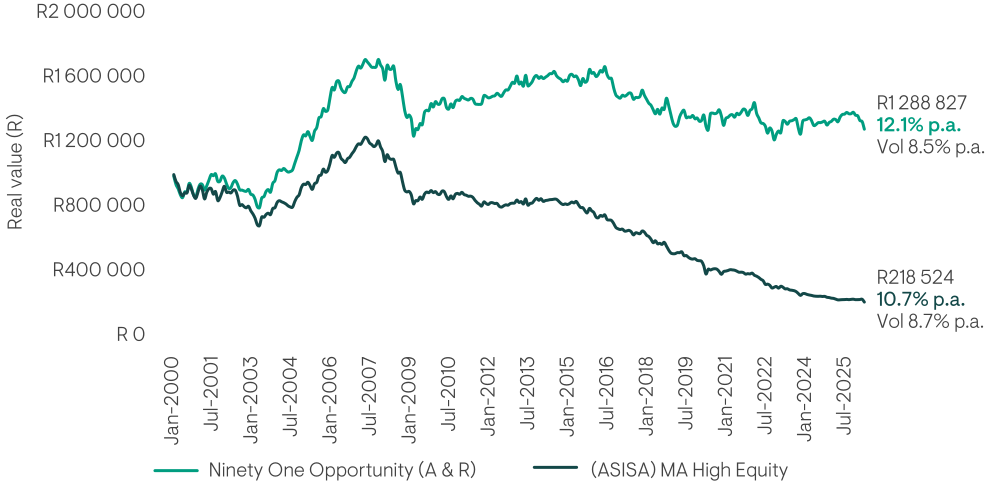
Figure 6, like Figure 1, charts the inflation-adjusted assets of two living annuities from January 2000 to March 2026 – both starting with R1 million and a 7% income draw (above our 5% rule of thumb), with annual CPI increases. One tracks the ASISA Multi-Asset: High Equity sector; the other the Ninety One Opportunity Fund.
Figure 6: Importance of manager alpha – performance of two 7% income annuities
Source: Ninety One and Morningstar, dates to 31 March 2026. Performance figures are calculated NAV to NAV, with income reinvested, net of fees in ZAR. The performance of Ninety One Opportunity is based on the A class for periods that fall within the A Inc ZAR class unit inception date (2 April 2000). An individual investor's performance may vary depending on actual investment dates. Highest and lowest annualised returns for Ninety One Opportunity (rolling 12-month figures): Jul-05: 43.8% and Feb-09: -15.7%. Please also refer to the Ninety One Opportunity Fund page on our website.
The performance numbers quoted in the chart for each investment option represent the cumulative lump sum performance over the full investment term from 1 January 2026 to 31 March 2026.2
After 26 years, the Ninety One Opportunity Fund's inflation-adjusted value is more than four times that of the sector average. The margin of outperformance was modest in absolute terms: compounding made the difference.
Notably, the Opportunity Fund sustained a 7% income draw throughout – a level that would have depleted the sector average portfolio. The implication extends beyond any single fund: a small but consistent margin of outperformance, delivered with comparable or lower volatility, can mean the difference between a sustainable annuity and a failing one. Manager selection and portfolio construction are not secondary considerations in living annuity advice – they are central to whether the annuity succeeds or fails over a 25- to 30-year horizon.
Conclusion
The living annuity versus guaranteed annuity debate has matured significantly over the past decade. What was once framed as a binary choice shaped by prevailing market conditions has evolved into a more nuanced conversation.
The focus has shifted toward optimising outcomes from living annuities and identifying when and how to blend different annuity types over the course of a retirement.
A well-constructed living annuity – invested within the parameters identified by our research and managed by experienced managers – remains the primary tool for solving the long-term retirement income puzzle. The challenge lies in the construction: income levels, growth asset exposure, offshore allocation, manager quality and maintaining flexibility all determine whether a retirement strategy succeeds or fails.
1 Managing retirement income
2 Source: Morningstar.
