The fast view
- A compelling and growing corner of the private market landscape, private credit is gaining attention.
- Investor benefits – specifically relating to emerging markets – include exposure to major structural growth drivers such as urbanisation, diversification, and compelling risk-adjusted return profiles.
Moving into focus
In recent months, private credit has emerged as a central theme in our conversations with investors.
This growing interest in a key — yet historically underrepresented — segment of the alternative investment landscape is both timely and warranted.
While private credit has seen substantial growth in developed markets, it remains relatively untapped across Africa and other emerging economies. Growing awareness of the risks – often overestimated, but manageable with the right expertise – is helping bring the asset class into sharper focus for investors.
This shift coincides with rising capital needs among businesses and corporates, creating compelling long-term investment opportunities. Demand for private credit is being fuelled by major structural trends such as infrastructure development in high-growth regions in emerging markets, urbanisation, and the financing of the energy transition.
A compelling opportunity set in a fast-growing market
The private credit market has emerged as a distinct and rapidly expanding asset class. Its growth — accompanied by increasing depth and diversification — has brought it into sharper focus for sophisticated asset allocators globally. Historically, alternative investments have been dominated by private equity, which focuses on acquiring stakes in unlisted companies. However, according to Preqin, a leading provider of financial data and information for the alternative assets industry, private credit now represents approximately 10% of the alternative investment market, making it the second-largest segment after private equity. Looking ahead, Preqin forecasts that assets under management (AUM) in private credit will grow at a compound annual rate of nearly 10% from the end of 2023 through 2029, with the asset class expected to surpass US$2.6 trillion — up from the current US$1.7 trillion.
Covering a broad spectrum
Private credit spans a broad spectrum of sub-asset classes, including direct lending (primarily senior secured), mezzanine debt, special situations and opportunistic credit, distressed debt, as well as infrastructure and real estate debt.
In our experience, the consistency and defensiveness of direct lending, combined with the dynamic, high-yielding nature of special situations and credit opportunities – which often capitalise on market mispricing, and require skilled, flexible lenders – can generate strong risk-adjusted returns. Similarly, emerging market infrastructure debt offers compelling opportunities, particularly where long-term capital needs align with sustainable development and economic growth potential. We define each of these below.
Direct lending
Direct lending – defined as loans made directly to a counterparty – spans senior (first claim on security) and subordinated (lower in the capital stack, thus riskier) parts of the capital structure. Success in this sub-asset class hinges on building a strong origination network across countries, sectors, and companies to ensure a high-quality, diversified deal pipeline and a focus on the most creditworthy borrowers. Careful deal structuring is also essential to embed the right protections.
Opportunistic credit
Ninety One’s credit opportunities platform invests across senior-secured and subordinated private credit, with a focus on market-leading blue-chip companies that operate in underpenetrated African and other emerging private credit markets and maintain low financial leverage. The imbalance between strong demand for flexible credit solutions and the limited number of providers creates compelling investment opportunities. We target companies with robust credit fundamentals – such as lower leverage, substantial asset bases, leading market positions, and strong management teams – that can command premium pricing in their respective markets. These opportunities are often event-driven (e.g., linked to M&A activity) and enable experienced investors like Ninety One to capitalise on market inefficiencies, making them a valuable complement to a diversified and resilient portfolio.
Infrastructure debt
There is a significant unmet need for long-term capital to finance infrastructure development across emerging markets. Beyond traditional projects — such as roads, bridges, and energy transmission lines — opportunities are expanding into sectors like healthcare, water and sanitation, housing, education, and digital infrastructure. This segment benefits from strong structural tailwinds, including rising funding needs driven by economic and population growth, urbanisation, and the global energy transition. As seen in South Africa, public finance remains essential but is increasingly constrained by budget limitations, heightening the need for private-sector participation. More broadly, as bank lending continues to be restricted by tighter regulations such as Basel III, a growing financing gap is emerging — one that specialised investors are well-positioned to fill.
Private debt strategies and economic cycles
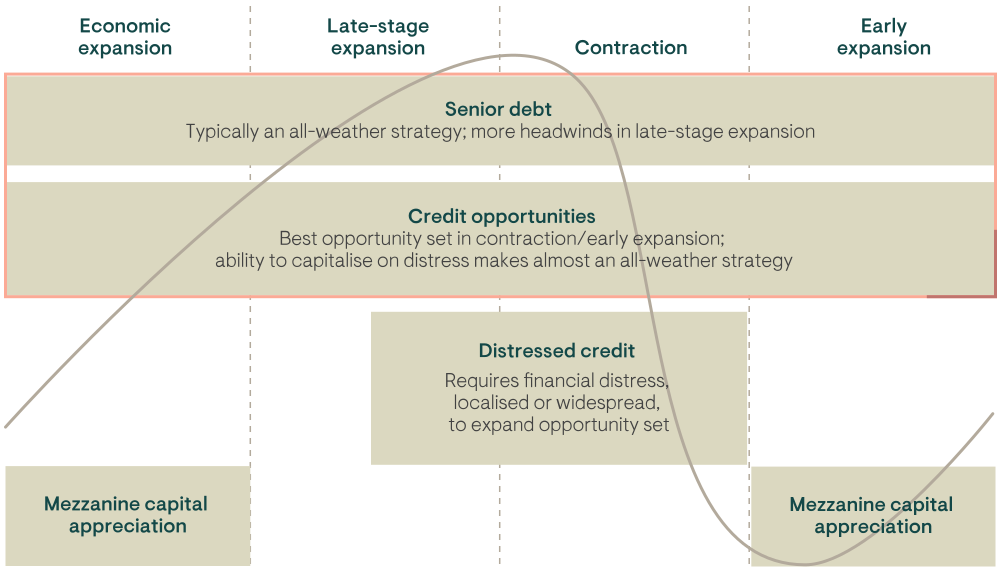
Economic cycles can be swift in emerging markets; the ability to time the market is more challenging. While private equity and more niche segments of private debt may offer higher return potential, realising and monetising those returns – and meeting investment targets – can be difficult. In our experience, within the direct-lending space, the consistency and defensiveness of senior debt, combined with the dynamism of credit opportunities, can deliver strong risk-adjusted outcomes. The same is true for emerging market infrastructure debt, which also offers attractive characteristics in the context of broader economic cycles, i.e., non-cyclical in nature.
Figure 1: Private market strategies in the context of economic cycles
Source: Cambridge Associates, September 2017. Please note that this chart has been redrawn by Ninety One.
A useful portfolio building block
Given the limited channels for accessing alternative investments, private credit is increasingly recognised by our clients as a strategic complement to private equity, offering distinct advantages in terms of its liquidity, risk profile, and return dynamics. While private equity involves higher-risk equity stakes, private credit – particularly in senior-secured formats – offers more predictable cash flows, relatively low volatility, and shorter investment tenors. These features help offset the illiquidity and delayed exits typical of private equity, especially as companies remain private for longer – a trend that’s gaining momentum. Together, the two asset classes can provide a balanced blend of growth and income – enhancing diversification and improving overall risk-adjusted returns.
Differentiated risk-return dynamics
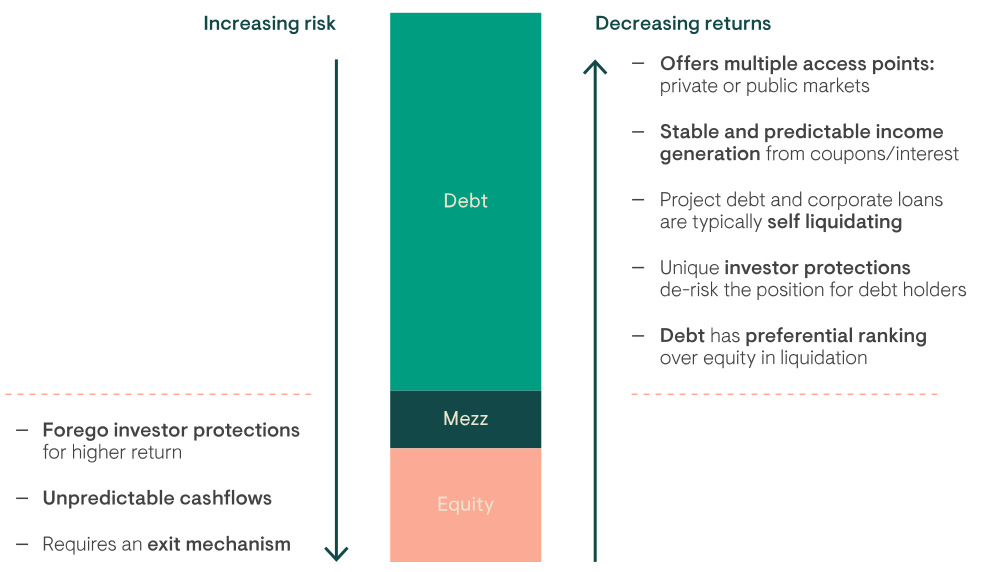
Private credit returns typically consist of regular interest payments, scheduled principal repayments, and occasionally, warrants or options for equity participation. In contrast, private equity returns are more variable, relying heavily on the business’s performance, and are usually realised only after debt obligations have been met. From a business perspective, debt is generally considered more cost-effective than equity. As a result, companies often aim to raise capital through private or public debt markets up to a sustainable level before turning to the more expensive equity financing. Private equity investors may also choose to complement their equity investments with private credit to enhance overall returns. Figure 2 below illustrates the risk-return dynamics across the capital structure.
Figure 2: Private debt vs. private equity comparison
Source: Ninety One, January 2025.
Emerging market risk: real vs. perceived
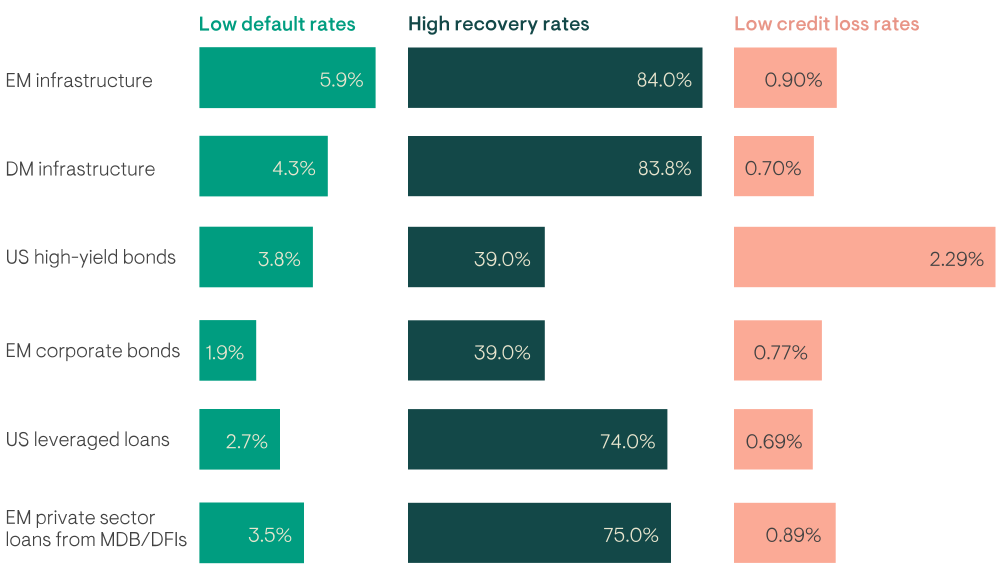
Perceptions of excessive risk in emerging markets have kept some investors on the sidelines. However, the reality is often more nuanced. A key metric in assessing credit risk is the default rate – and, where defaults occur, the loss given default is equally important. While default rates in emerging markets are slightly higher, recovery rates are broadly comparable to those in developed markets. In fact, annual credit loss rates in emerging markets have been found to be only around 20 basis points higher than in developed markets, despite emerging market assets offering significantly higher yields. These low actual loss rates are comparable to the expected losses of a portfolio of investment-grade-rated assets.
Figure 3: Comparison of default, recovery and credit loss rates
Past performance does not predict future returns; losses may be made.
Source: Ninety One, Moody’s based on long term averages over the period 1998 to 2022.
To understand this favourable risk/return trade-off, it’s important to recognise that the best private market opportunities often reside in inefficient markets where risk is mispriced. Attractive, risk-adjusted returns with a focus on capital preservation are achievable when supported by experienced, on-the-ground teams who understand local borrowers and market dynamics. Conservative investors can still earn superior yields compared to developed markets simply by allocating to managers with local presence and expertise.
For context, Ninety One’s Credit Opportunities strategy – part of the Emerging Markets Alternative Credit Platform, which has delivered stable risk-adjusted returns – typically invests in companies with borrower leverage below 3.5x, using senior loans secured by quality collateral. In contrast, developed markets often exhibit leverage levels between 5x and 7x, particularly when mezzanine and subordinated debt are included. Additionally, the oversupply of capital in developed market private debt has led to looser lending standards – such as covenant-light structures – unlike the stronger protections typically found in emerging markets.
From returns to real impact
In addition to offering compelling risk-adjusted returns and portfolio diversification benefits, private credit enables investors to provide essential financing to borrowers and projects and make a positive difference with their capital. In emerging markets, these investments can drive broader impact on economies – enhancing market efficiency, resilience, and integration by mobilising private capital, developing capital markets, and supporting infrastructure. This, in turn, helps unlock opportunities for underserved communities while contributing to economic growth and development.
In Africa and broader emerging markets, we see strong investment potential across three key sectors: Infrastructure and Telecoms, where capital improves access to essential services and supports a fair energy transition; Financial institutions, which advance financial inclusion and deepen capital markets; and Consumer, Industrial, and Services, which drive job creation and sustainable business development. Leveraging its global origination platform, Ninety One applies sector expertise to support these critical themes across its global opportunity set.
To illustrate this strategic focus, we highlight recent transactions in the digital infrastructure space executed by Ninety One’s Private Credit Investment platform across emerging markets:
-
Through the South Africa Infrastructure Credit Strategy, Ninety One provided a loan to Droogfontein Solar Two, a 75MW solar photovoltaic facility located 15km north of Kimberley, South Africa. Developed under Round 4 of South Africa’s Renewable Energy Independent Power Producer Procurement Programme (REIPPPP), the project uses single-axis tracking technology across a 180-hectare site and is connected to the national grid via the Kimberley–Macfarlane 132kV line. The project contributes 193.7GWh of clean electricity annually, supporting South Africa’s shift away from coal dependency. It helps meet national targets under the Integrated Resource Plan and supports the United Nations Sustainable Development Goal 7 (SDG 7) by providing affordable, reliable and sustainable energy.
-
Through its Emerging Markets Alternative Credit Platform, Ninety One provided a senior secured loan to Paratus Group Holdings to finance strategic corporate initiatives. Paratus is a pan-African telecommunications provider offering internet connectivity, data centres, cloud services, and satellite communications across seven countries in Southern, Central, and East Africa. The company’s mission is to extend modern connectivity to businesses and households in developing regions. The funded initiatives include enhancing last-mile connectivity and delivering more reliable internet services across Namibia, South Africa, Angola, Mozambique, DRC, Botswana, and Zambia.
-
Ninety One also extended a senior loan to a data centre operator active in Mexico, Brazil, Colombia, and Chile. The company is committed to 100% renewable energy usage and targets zero-carbon operations by 2040. With Latin America’s data centre market projected to double by 2030, this investment supports the region’s digital infrastructure while embedding climate-aligned design principles from inception.
Alternative Credit at Ninety One
Established platform with scale
Since 2008, we have launched 20 vintages and deployed over US$15 billion across corporate and infrastructure debt strategies. To date, more than 1 200 investments have been made, with capital returned on 11 fully realised vintages.
Unique and proprietary origination channels
The team’s deep-rooted presence across EMs has yielded a powerful sourcing network that is difficult to replicate. Historically, the firm has originated EM transactions through 500 sourcing partners.
Compelling track record
The platform has delivered average credit losses of just 0.2-0.4% pa across USD funds since 2014, reflecting investment-grade quality risk. Returns are priced in line with sub-investment grade credit, highlighting the ability to negotiate compelling risk-adjusted returns and benefit from persistent risk mispricing in EM private credit markets.
Deep expertise and active due diligence
The platform’s performance is rooted in active sourcing and structuring, which enables tight control over underwriting, ensures strong alignment on terms, and supports a selective, quality-focused approach. The platform comprises over 26 investment specialists across Cape Town, London, New York, and Singapore, supported by a dedicated team of legal and ESG and impact professionals.

