Q Why is infrastructure credit important for South Africa?
Infrastructure refers to the physical and digital structures and systems that enable the delivery of essential raw materials, products and services to the economy and society. These systems underpin economic growth, job creation, and service delivery by providing access to essential services – such as water and sanitation, energy, transportation, housing, education, and health care.
South Africa faces significant infrastructure funding needs, but public-sector funding is constrained, and traditional bank funding is insufficient to meet the scale of investment required.
The private sector plays an important role in financing essential infrastructure, helping to close the funding gap. The Ninety One SA Infrastructure Credit Fund, therefore, helps channel private capital into assets that support economic activity and service delivery, fundamental to South Africa’s economic resilience.
Q How does the Fund work?
The Fund is an open-ended credit strategy, focused on financing essential infrastructure primarily in South Africa. It aims to deliver strong, stable, risk-adjusted returns while supplying disciplined, long-term credit capital to support South Africa’s infrastructure ecosystem.
Rather than taking ownership of the infrastructure assets, the Fund provides debt instruments (including loans and bonds) to infrastructure projects, operators, and companies investing in either infrastructure development or the expansion of assets across key sectors, such as energy, water, transport, and digital networks.
Investors, therefore, participate as lenders, and returns are primarily earned through interest payments made by borrowers over time under agreed contractual terms.
Q How is this different from investing in infrastructure equity?
Infrastructure equity involves owning assets and generating returns through operational performance, asset value appreciation and exit outcomes. Returns are therefore influenced by growth expectations, valuation changes, and market conditions.
In contrast, the Fund provides debt capital. Returns are anchored in contractual repayment obligations agreed upon upfront, with income primarily derived from interest payments over the life of the investment. Performance is driven by the borrower’s ability to service debt from cash flow, rather than by asset valuations or exit timing.
Q How is investor capital deployed?
Investor capital is pooled within the Fund and deployed into privately negotiated infrastructure credit opportunities.
Our investment team originates, structures, and executes loan agreements tailored to the needs of borrowers, including project companies, utilities, infrastructure operators, and companies building or expanding infrastructure assets.
Funding may be used to build new infrastructure, expand or maintain existing assets, or refinance long-term projects.
Investments take the form of senior or subordinated debt instruments and may include privately negotiated and publicly issued credit instruments, depending on market conditions.
In essence, investor capital is deployed into carefully structured infrastructure debt investments designed to generate contractual income while supporting the development and operation of essential infrastructure in South Africa.
Q Why focus on lending?
The focus on lending is both strategic and grounded in how infrastructure is typically financed.
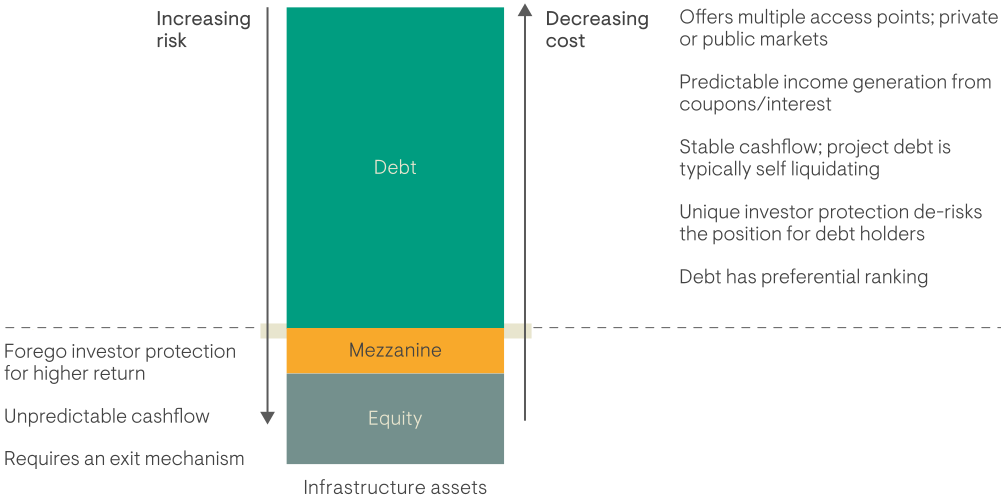
Infrastructure assets are generally financed using a combination of debt and equity instruments. Because debt is generally a more cost-effective source of capital, infrastructure providers tend to raise funding in the form of debt to a sustainable level before turning to equity capital.
In a South African context, where there is a substantial infrastructure funding gap and constrained public balance sheets, private debt capital is particularly important. It enables projects, operators, and companies building infrastructure assets to mobilise long-term funding while maintaining sustainable capital structures.
By providing well-structured, long-term debt capital, the Fund plays a critical role in supporting infrastructure developments and operations in South Africa without assuming the ownership risk inherent in equity investing.
For investors, this means that the focus is on cash flow coverage, contractual repayment obligations, and downside protection rather than asset valuations or exit timing.
Infrastructure debt vs equity
Debt funding provides protection and an ability to deploy at scale
Q How do infrastructure borrowers generate the cash to repay loans?
Infrastructure assets typically generate revenue through long-term contracts, regulated tariffs, or agreed service payments. In many cases, these revenue frameworks are established upfront and are governed by regulation.
Because the services provided are essential, revenue streams tend to be more predictable than in sectors exposed to discretionary spending. This predictability is central to assessing a borrower’s ability to meet interest and principal payments over time.
Q How do investors earn returns?
Investors earn returns primarily through contractual interest payments on the debt investments made by the Fund. Borrowers pay interest according to predefined terms and schedules. This income, after fees and expenses, contributes to the Fund’s returns.
Returns are not dependent on selling assets or rising market valuations. Instead, they accrue through agreed contractual interest payments over the life of the investment.
Q What role can the Fund play within a broader investment portfolio?
Infrastructure credit is typically income-focused rather than growth-driven, with returns anchored in contractual interest payments rather than asset valuation appreciation.
Investments are structured as loans with defined maturities, seniority in the capital stack, and contractual protections such as covenants and security packages.
While capital is not devoid of risk, the emphasis on contractual income and repayment discipline makes infrastructure credit less sensitive to short-term market volatility than equity investments.
Within a diversified portfolio, the Fund can serve as an income-oriented allocation, providing investors with exposure to essential real-economy assets through a structured credit approach.
Q How does inflation affect infrastructure credit in South Africa?
Inflation is an important consideration for South African investors. Many borrowers operate within revenue frameworks that include inflation-linked features, such as tariff indexation, regulated price adjustments or contractual escalations.
Where such mechanisms are in place, they can support revenue sustainability and help maintain debt service capacity. However, they do not guarantee inflation-beating returns. Outcomes depend on the loan structure, interest rate profile, and effectiveness of the cost pass-through mechanisms.
Q What are the key risks?
All credit investments carry risk. In infrastructure credit, risks may include borrower default, construction or operational delays, regulatory or policy changes, or broader macroeconomic pressures.
Outcomes depend on loan structure, asset quality, borrower creditworthiness and ongoing oversight.
Capital is not guaranteed, and losses are possible. The Fund seeks to manage risk through detailed credit analysis, careful structuring, diversification across sectors and counterparties, and active monitoring throughout the life of each investment.
Q How liquid is the Fund?
The Fund is structured to offer periodic liquidity of 5% of the portfolio’s net asset value on a quarterly basis. This balance reflects a deliberate trade-off – providing investor access while supporting assets whose economic lives extend over decades. The Fund is therefore best suited to investors with a medium- to long-term investment horizon.
Q What is the Fund’s target assets under management (AUM)?
Although the Fund has a 3-year track record, it was only officially launched to the market in April 2025. Its target AUM is R5 billion in the short term, R10 billion by 2029, and R15 billion over the long term.
Q Who is the Fund suited for?
The Fund is ideally suited to investors seeking income-focused returns, diversification beyond traditional asset classes, exposure to the real economy, and an understanding of the risks and liquidity characteristics of infrastructure credit.
Importantly, it is not intended as a short-term investment or a substitute for cash, nor is it designed to deliver equity-style growth.