Key takeaways
- Markets are being held aloft by a handful of mega-cap tech stocks, creating rising risk and a setup that rewards resilience and discipline over speculation.
- AI isn’t a simple yes or no; it’s reshaping how value is created and where it’s at risk. Our focus is on separating genuine opportunity from hype.
- Valuation, concentration and circular funding risks are well known, but the real question for investors is where the next decade’s wealth creation will come from.
- Owning durable, cash-generative businesses keeps portfolios anchored when markets lose their footing.
A market balancing act
The market’s advance looks more like a climber edging along a ridge – the view is spectacular, but the footing precarious. A small group of US tech giants has powered most of global equity returns, leaving markets dangerously top-heavy. The top ten US stocks now account for approximately 40% of the S&P 500. Over the past three years, more than half of the S&P 500’s gains have come from just ten names. That is not diversification – it’s imbalance dressed as strength.
When so much rests on so few shoulders, valuations become the market’s weak point. Earnings growth among leaders is slowing, competition is rising, yet multiples continue to stretch higher. At the height of the dot-com boom, companies like Cisco and Intel appeared untouchable but ultimately lost most of their market value for more than a decade. Even great businesses can be poor investments when valuations detach from fundamentals.
The signs of excess are also visible in ‘circular’ AI deals – start-ups buying from one another to inflate revenues, often with shared investors. It creates the illusion of momentum but generates little real cash, echoing the late 1990s when enthusiasm ran far ahead of substance.
Capital intensity – the paradox
Since the launch of ChatGPT in late 2022, AI-linked stocks have delivered not only the majority of market returns but also 90% of incremental capital expenditure growth. That level of dependence on a single theme is extraordinary. Progress looks smooth until a gust of wind hits, but when the foundation of growth is this concentrated, the gust doesn’t need to be strong.
For much of the last two decades, big tech has benefited from a capital-light model, characterised by fat margins, high scalability, and minimal incremental investment required for each new dollar of growth. AI is changing that. The sector is now ploughing tens of billions into data centres, chips, and infrastructure. Capital expenditure as a percentage of earnings appears more similar to telecom or energy than to software.
That matters for investors because high capital intensity has historically resulted in lower returns on capital over the long term. The shift may be necessary to compete in the AI arms race, but it calls into question whether tech’s high-return era is structurally behind it.
For the hyperscalers themselves, the paradox is striking. Their AI spend is discretionary, funded by massive existing cash flows, and not balance-sheet threatening. Some of that capacity will be utilised immediately, while some will be used eventually. That makes overbuilding harder to spot in real-time, but it doesn’t change the fact that returns on capital are drifting lower. Heads they win, tails they don’t really lose – but for investors, the path to compounding gets murkier.
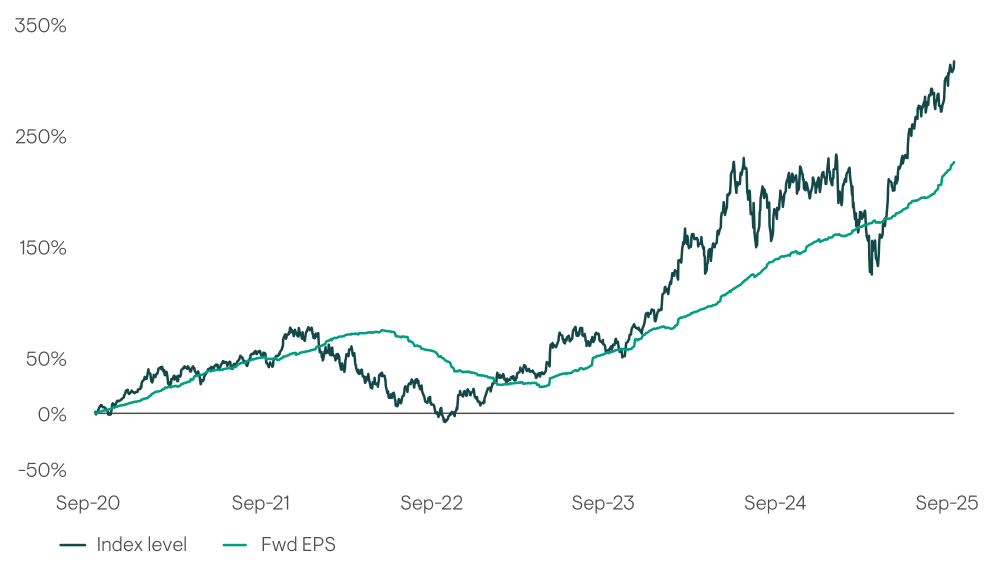
MSCI ACWI Semiconductor and Semi Equipment Index (last 5 years)
Hyperscaler CapEx (US$bn)
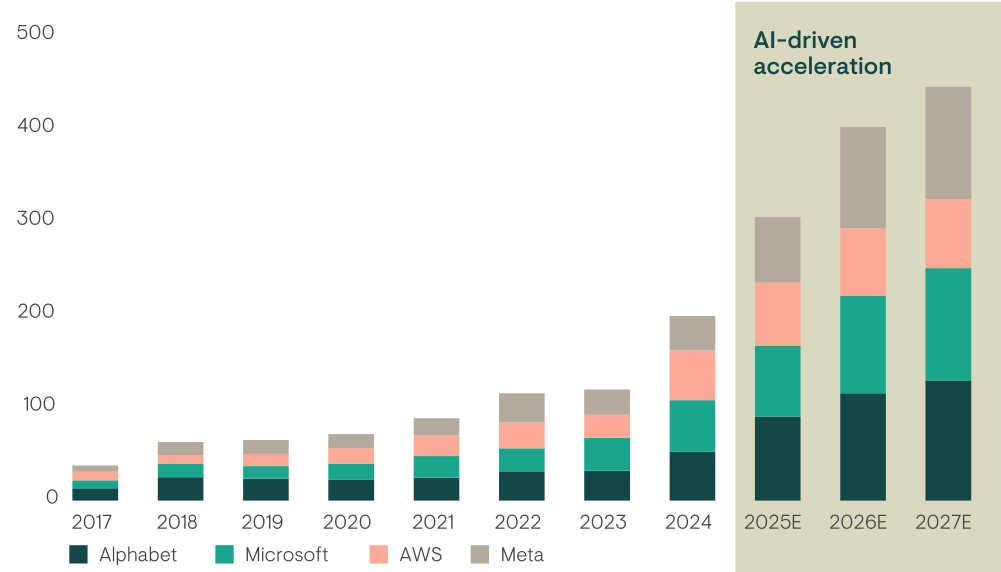
Source: Ninety One, Bloomberg, as at 15 August 2025.
The bigger question is what compounding will look like in the next decade. For 20 years, investors assumed technology meant high margins, asset-light scalability, and accelerating returns on capital. But if AI turns tech into an infrastructure-heavy business – closer to energy or telecom than software – then the entire playbook for quality growth changes. For investors, this isn’t just about avoiding bubbles; it’s about rethinking where true economic resilience lives.
Repricing the other side of AI
While money and attention have poured into the hardware behind AI–chips, data centres, and cloud infrastructure, the opposite has happened in software and information services. Many strong, profitable businesses in this space have been overlooked in comparison. Companies like LSEG, FactSet and Intuit – all central to how their clients run day-to-day – have lagged as investors focus on the obvious ‘AI winners’.
The market has a list of concerns: fewer people using paid seats, increased competition from smaller start-ups, new technology that may bypass existing software, or changes to how these firms charge customers. But these concerns miss the bigger picture. Scale, trusted brands, unique data and long-term customer relationships make these companies much harder to disrupt than the market assumes.
These aren’t generic tech firms. They’re essential service providers with deep roots in finance and business. In most cases, AI is more likely to strengthen their position than weaken it – helping them work faster, improve their products, and deepen client loyalty.
Recent share price weakness says more about mood than reality. These are cash-rich companies with strong balance sheets and pricing power. Their valuations have fallen to levels that don’t reflect their quality or staying power. For long-term investors, this creates an opportunity to own enduring businesses that have been temporarily pushed aside by a one-sided AI narrative.
Cycles and timing
There’s no shortage of calls for an imminent end to this cycle or a dramatic rotation in leadership. We see it differently. Markets can rise for longer than logic suggests, and when they do, we participate – but with discipline. The goal isn’t to time peaks, it’s to ensure that the gains we capture are backed by real earnings power, not sentiment.
Even if the AI cycle runs for years, balance matters: our preference is to own businesses compounding now, not just those promising a distant payoff. History shows that disciplined investors often look out of step near the top of a cycle – until they aren’t.
Cycles rarely end neatly; they tend to snap at the edges. Today’s weak points are visible – cloud margins are under strain, advertising budgets are reaching their limits, and start-up funding is tightening. Momentum can sustain belief for a while, but confidence can shift quickly when expectations outpace reality. Discipline isn’t about avoiding themes; it’s about avoiding regret.
Rotation dynamics – where next?
It’s worth remembering that major platform shifts tend to deliver broad societal benefits that extend well beyond the companies leading the charge. The railroads of the late 19th century transformed the US economy by unlocking trade and mobility, while the telecom infrastructure boom around 2000 laid the groundwork for internet adoption and a new wave of digital productivity. It seems reasonable to expect today’s technological shift to do the same – creating winners far beyond the current market leaders.
Market leadership changes rarely unfold as expected. In 2000, few predicted that the following decade would belong not to the ‘new economy’, but to energy, materials, and emerging markets.
The better question is not when this tips, but where capital flows next. Could the equivalent surprise today be consumer staples, healthcare, or utilities – sectors dismissed as boring but quietly resilient with pricing power and steady cash flows? In a world of inflated expectations, it is often the unfashionable that deliver the best forward returns. They may not trend on social media, but they compound steadily and help to protect capital when narratives fade.
Strategy and positioning
This is precisely why our strategy is built around fundamentals. The Ninety One Global Franchise Fund’s approach doesn’t depend on hype or multiple expansion. It depends on businesses with durable moats, strong free cash flow, and capital discipline. These are the qualities that deliver when the ridge narrows, and that protect when winds rise. The portfolio continues to prioritise free cash flow generation, strong profitability, and balance sheet strength – as consistently as it has since the Fund’s inception.
The businesses we own generate an average return on invested capital (ROIC) of 31%, versus 26% for the broader global market1. Despite that higher quality, the portfolio trades at an 8% discount to the market on a price-to-free cash flow multiple – the most attractive relative valuation in years.
Earnings strength remains a differentiator. Our holdings are expected to deliver free cash flow growth of around 12% per year over the next five years, well ahead of the market. Based on current stock prices and forecasts, that translates into an expected return of roughly 9.5% per annum – an appealing outcome in a world where many parts of the market are priced for perfection2.
When examining recent numbers, the story remains consistent. Our portfolio’s returns have been driven overwhelmingly by earnings growth, whereas the broader market has relied more heavily on multiple expansion. Since its inception, the Fund has outperformed3 because the companies we own deliver real earnings power. And even in the most recent period, when valuation has swung heavily in the market’s favour, our holdings have continued to compound earnings at a far stronger rate than the index.
Figure 2: Total return decomposition - earnings growth the primary driver of long-term returns
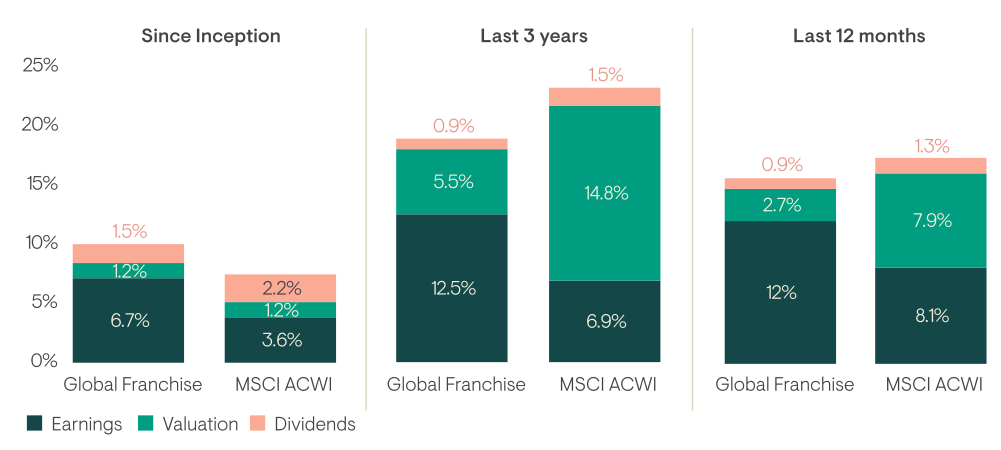
Source: Ninety One, FactSet, Bloomberg, 31 August 2025, inception based to April 2007. Based on a related portfolio with substantially similar objectives as those of the services being offered. Weighting based on GSF vehicle. Earnings based on Blended 12-month forward EPS. TSR is derived from portfolio constituents through time and is based on the weighted average aggregation of EPS growth and dividend yield. Headline Gross composite performance is then used to derive the residual rating change. Earnings, valuations and dividend yields may change and are not guarantees of future performance.
When markets have been at their toughest, we’ve shown our strength. During the Global Financial Crisis, we outperformed the market by almost 14%. Across the eight worst drawdowns since our inception, we’ve managed to come through ahead every time4.
After years of being crowded, quality now trades at a discount to the market. Our portfolio is at its most attractive relative valuation in years, accompanied by stronger earnings growth. That’s an inversion worth noting: the very discipline that looked unfashionable is now priced to deliver better forward returns
Staying on your feet
Markets are currently walking a narrow ridge: spectacular but fragile, exhilarating but risky. This is one of the least forgiving environments for complacency.
We cannot know the exact moment the ridge breaks. What we can do is ensure investors are tied to the rope – portfolios anchored to durable businesses that compound through cycles and protect capital when the winds inevitably pick up.
The real opportunity lies in seeing past the ridge – positioning capital not where the crowd is dancing, but where enduring compounding can still be found. That is the essence of resilience, and the foundation for the next decade of wealth creation.
This isn’t about predicting the gust. It’s about preparing for it. In investing, as on a ridge, you don’t need to sprint for the summit. You need to stay on your feet.
1. Source: Ninety One and FactSet, 30 September 2025.
2. Forecasts and opinions are not guaranteed to occur.
3. Gross of fees. Since inception: 01 May 2007 to 30 September 2025. Benchmark: MSCI AC World NDR (pre Oct-11, MSCI World NDR).
4. Past performance is not a reliable indicator of future results; losses may be made.
