In this, the first of a two-part series, we examine why consumer momentum is beginning to slow and what that means for the economic outlook. In our second instalment, we explore the evolution of South Africa’s infrastructure landscape and, with it, the new investment opportunities that are beginning to emerge.
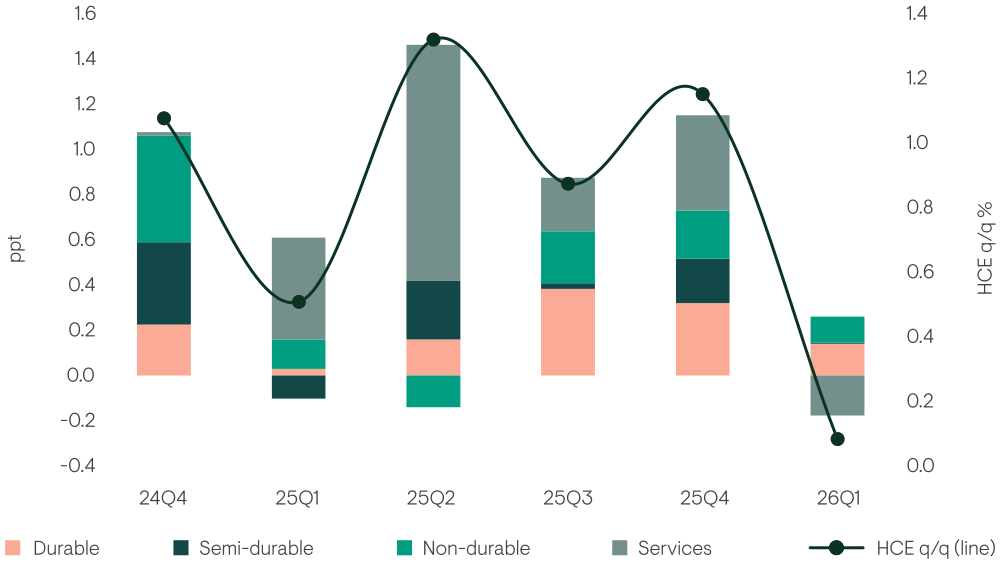
South African households entered 2026 with real momentum. The introduction of the two-pot retirement system gave consumers early access to retirement savings, inflation was on a downward trajectory, and interest rates were beginning to fall. Together, these factors supported consumption through much of 2025, with household spending contributing significantly more to economic growth than in the past.
However, by the end of the first quarter of 2026, many of these tailwinds were beginning to fade. The boost from retirement withdrawals had worked its way through the system, interest rates had stabilised, and the factors that underpinned consumer growth in 2025 were becoming less supportive.
Figure 1: Contribution to household consumption expenditure growth
Source: StatsSA, 2026
And then there was the external shock. Renewed conflict in the Middle East pushed oil prices higher, placing fresh upward pressure on inflation just as price pressures had begun to moderate. The slowdown in household spending was already underway, but higher fuel prices added another headwind at a time when consumers were becoming increasingly stretched.
The shift also altered monetary policy expectations. At the start of the year, markets had anticipated further interest rate cuts as inflation eased. Instead, higher energy prices and renewed inflationary pressure prompted the South African Reserve Bank (SARB) to raise rates, reinforcing the prospect that interest rates may remain higher for longer. After acting early and increasing rates in May, the SARB surprised markets at its July MPC meeting by holding rates steady despite upside risks to the inflation outlook. The central bank is carefully gauging the potential for further hikes as it responds to upside inflation risks, with consumers already facing significant headwinds. For households, this means that debt-servicing costs remain elevated at a time when disposable income is yet to meaningfully recover.
Consumers are adapting
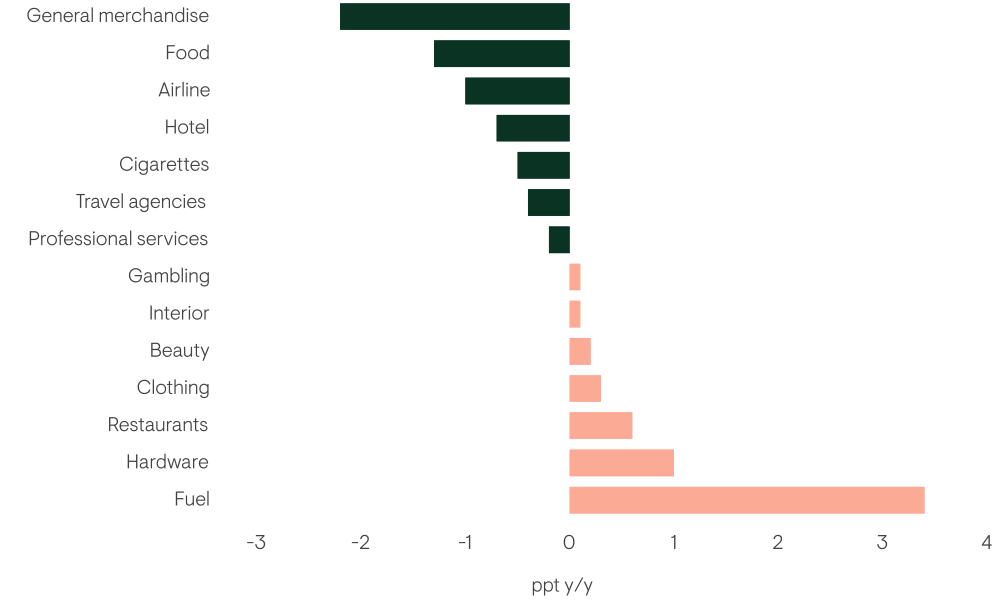
The good news is that consumers haven’t stopped spending; they’ve become more selective. Retail sales have moderated, consumer confidence remains subdued, and card-spending data suggests households are increasingly prioritising essentials such as fuel and groceries over discretionary purchases. Recent spending patterns reinforce the point. While essential categories have remained relatively resilient, discretionary spending has softened as households become more deliberate about where they spend.
Figure 2: Standard Bank: Spending Data
Source: Standard Bank, 2026
This means larger purchases are being delayed, shoppers are paying closer attention to price, and value has become an increasingly important consideration. Retailers are seeing the same trend. Demand remains, but consumers are approaching spending decisions more cautiously than they were a year ago. Vehicle sales have been more resilient than expected, supported by competitive pricing and a broader range of imported vehicles. Even here, however, resilience reflects changing purchasing behaviour rather than a broad-based improvement in consumer finances.
What this tells us about the economy
Household consumption accounts for around 60% of South Africa’s GDP. While consumer spending has helped support growth, it also highlights how dependent the economy has become on households at a time when investment has remained subdued.
External accounts point to a similar picture. Although the current account has improved, much of that reflects weaker imports rather than stronger export performance. In other words, the improvement says more about softer domestic demand than it does about a stronger, more competitive economy.
Taken together, these trends reinforce an important point. Household consumption has carried a significant share of South Africa’s growth over the past few years, but it cannot continue to do so on its own. A more durable recovery will require investment to play a much larger role.
Looking ahead
Current forecasts suggest the economy will grow by around 1.3% in 2026. But that modest improvement rests almost entirely on fixed investment being the swing factor.
With the consumer now decelerating, what separates this year’s slightly better outlook from a repeat of last year comes down to whether fixed investment can turn from contraction into even modest growth. Investment is not the engine of this forecast; it is the hinge on which the improvement turns. Should it remain flat, or contract as it did last year, that improvement fades and growth settles back towards last year’s pace.
That shift is not guaranteed. Business confidence remains constrained by energy and logistics bottlenecks, policy uncertainty and weak capital spending. But the conditions are gradually improving. Continued progress on electricity and logistics reform should support investment over time and broaden the economy’s sources of growth.
That also points to where the more interesting opportunities may now lie. An economy still reliant on the consumer offers little room for a meaningful change in direction. One where investment begins to recover offers considerably more, particularly in the sectors most closely tied to South Africa’s reform agenda: energy, logistics, and the businesses that finance and build both. The gap between reform progress and market pricing is precisely where the opportunity lies.
In our next instalment, we take a closer look at how our Alternative Credit team is helping unlock investment opportunities across South Africa’s infrastructure landscape.
