Growth assets have had a strong run so far in 2026, which naturally raises the question: “Has the good news already been priced in?”
Our answer is no. Working through our asset allocation process, which weighs opportunities through three lenses – fundamentals, valuations and market price behaviour – we still see sufficient support to remain constructive on growth assets, even after the rally. But it’s not just equities. Bonds are also looking more attractive on a valuation basis, although the picture here is more nuanced.
To better understand how we arrived at these outcomes, the following looks more closely at how we apply our ‘Compelling Forces’ framework.
Our ‘Compelling Forces’ framework
Rather than anchoring on a single macro call, we assess every asset allocation decision against three questions:
- What do the fundamentals (growth, inflation, and policy) tell us?
- Is that already priced in?
- What is investor behaviour (sentiment, positioning, and momentum) adding or subtracting from the picture?
An opportunity is most compelling when two or three of these line up. Right now, they largely do.
1Fundamentals
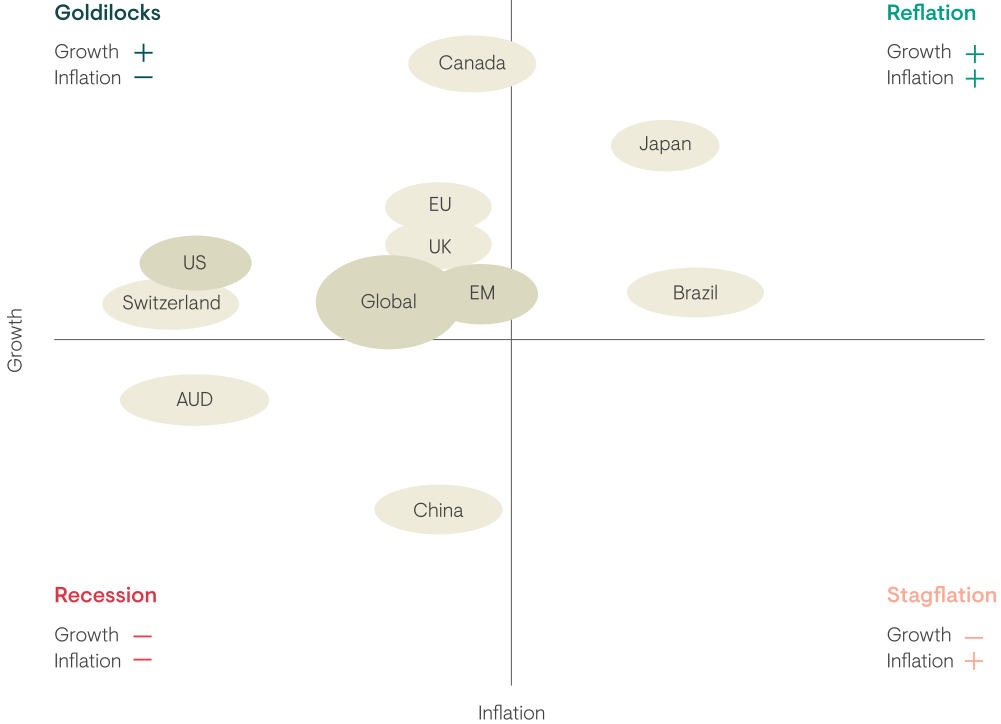
Despite media headlines of geopolitical risk, the world has quietly turned more supportive. The global economy has been moving through a reflationary phase with both growth and inflation firming for much of the year.
The more interesting development is what’s happened more recently: several major economies, the US chief among them, have rotated into what we call a ‘Goldilocks’ regime – solid growth momentum alongside more muted inflation. US core inflation measures have continued to come in softer than initial estimates, even as growth indicators, from manufacturing new orders to consumer activity, have held up. That combination has historically been one of the more favourable backdrops for equities and other growth-sensitive assets.
Europe, after a period of economic headwinds from the energy crisis in the Middle East, has similarly seen growth momentum improve, although it is still working through a firmer inflation pulse.
China remains the outlier, still contending with a softer growth and pricing environment from its property bubble deflation. That dispersion across regions is useful: different parts of the world, at different stages of the cycle, create diversification opportunities that a purely domestic or US-centric view would miss.
Figure 1: Current regime indicators for key global regions
Source: Ninety One, 5 September 2026.
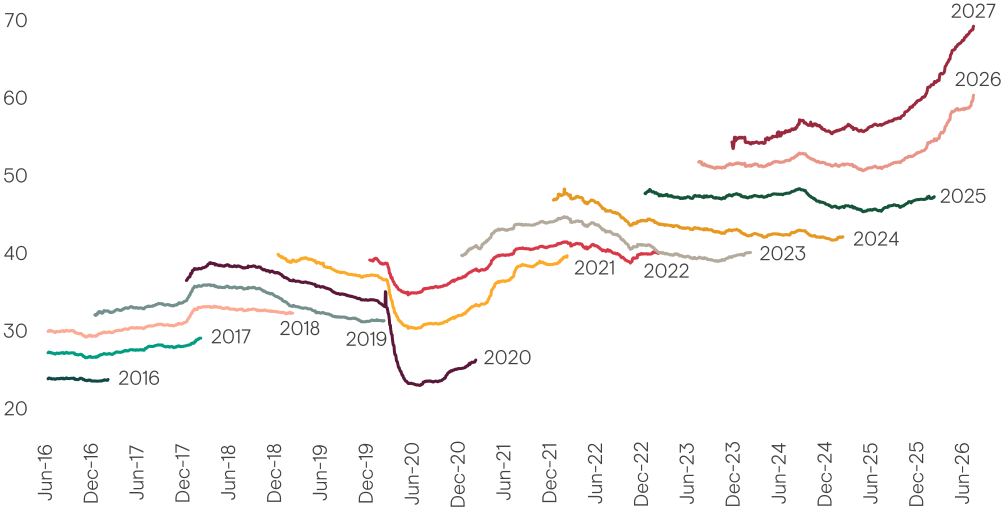
The other fundamental pillar is corporate earnings, and here the story has genuinely broadened. Earnings estimates have been revised up through the year, and, importantly, that strength is no longer confined to the small group of companies that were the earliest, most obvious beneficiaries of AI-related capital spending.
Earnings breadth has improved, with upgrades increasingly visible in cyclical and value-oriented parts of the market too. We see this as a healthier foundation for the rally than one resting on a handful of megacap names, and one that supports a broader participation across sectors and regions.
Figure 2: MSCI AC World EPS consensus estimates (USD)
Source: Ninety One, Bloomberg; August 2026.
2Valuations
Valuations are where the question of whether the rally has gone too far gets tested most directly. After several years of double-digit returns, global equities are no longer offering the same value as they once did. That said, we believe there is still room to run.
Global equity markets are, on a forward price-to-earnings basis, cheaper today than they were some months ago, despite the rally. Share prices have risen, but consensus earnings estimates have risen by more, producing an unusual de-rating alongside a rising market.
In other words, the lion’s share of this year’s returns has been earned through better fundamentals rather than investors simply paying more for the same profits. That’s a healthier dynamic, and one that leaves more room to run before valuations become a genuine constraint. Though inevitably it varies by region and sector, and pockets of the market, particularly among the highest-profile AI infrastructure names, do look more richly priced than the average.
On the fixed income side, valuations look attractive on several measures. Yields remain elevated relative to history across a number of major government bond markets, in some cases at their highest levels in 20 years or more. But this is a case where valuation and fundamentals are pulling in different directions: persistent fiscal deficits, heavy government bond issuance, and robust economic backdrops in several developed markets are genuine headwinds, and we’re not yet ready to call this an unambiguous opportunity. It’s one we’re watching closely rather than acting on aggressively. We find better opportunities in idiosyncratic local-currency emerging market debt. Countries such as Brazil, Colombia, and South Africa offer diversifying macroeconomic narratives alongside high real yields.
3Market price behaviour
The third lens is about what other market participants are doing. Put plainly, people trade markets, and sentiment can drive prices as much as fundamentals do in the short run.
Broad measures of market sentiment and volatility have been well-behaved for most of the year. The VIX, Wall Street’s most widely watched volatility gauge, has spent much of August trading in the mid-teens, near its lowest levels of 2026, and well below the low-30s levels it touched briefly in March during a bout of geopolitical stress. That’s generally consistent with a market that isn’t pricing in imminent trouble, and calm markets, all else equal, tend to be a friendlier backdrop for growth assets.
That said, ‘well-behaved’ is not the same as ‘no risk’, and we’re conscious that periods of unusually low volatility have, historically, been followed by higher volatility rather than more of the same. Geopolitical flashpoints throughout the year are a reminder that sentiment can shift quickly.
Piecing it all together
Fundamentals have turned more supportive as inflation cools, growth momentum improves, and earnings dynamics broaden. Valuations, despite the rally, are slightly more palatable in aggregate because earnings have grown faster than prices, though wide market dispersion means selectivity matters more than ever. And sentiment, while calm, isn’t complacent enough to worry us, though it is a reminder to stay diversified rather than fully leaning into the rally.
None of this is a call for indiscriminate risk-taking. Regional and sector dispersion is wide, government bond fundamentals in some markets remain a genuine concern despite attractive yields, and a single geopolitical or inflation surprise could shift the picture quickly. But taken together, our three lenses still point in the same direction: constructive on growth assets, with a firm eye on valuation discipline and diversification as the rally matures.
