At Ninety One’s recent Advisor Forum, we discussed a range of topics relevant to running a successful advisor practice in today’s challenging market and regulatory environment.
In a panel discussion with Kathryn van Dongen, Group COO of Carmel Wealth, and John Campbell, CEO of Chartered Wealth Solutions, we tackled a key challenge facing many fast-growing independent advice firms. How do you future-proof your practice? Do you maintain your position as an independently owned advice firm, taking active steps to manage the challenges of running your own firm, or do you embrace the benefits of scale available from joining some of the larger advisor networks?
Wealth advisory market remains a growth market
The session kicked off by framing the discussion with data we track at Ninety One on the health of the South African advisor market. Despite the constant media narrative of disruption, regulatory strain and rising cost pressures, the local investment advice market remains remarkably resilient.
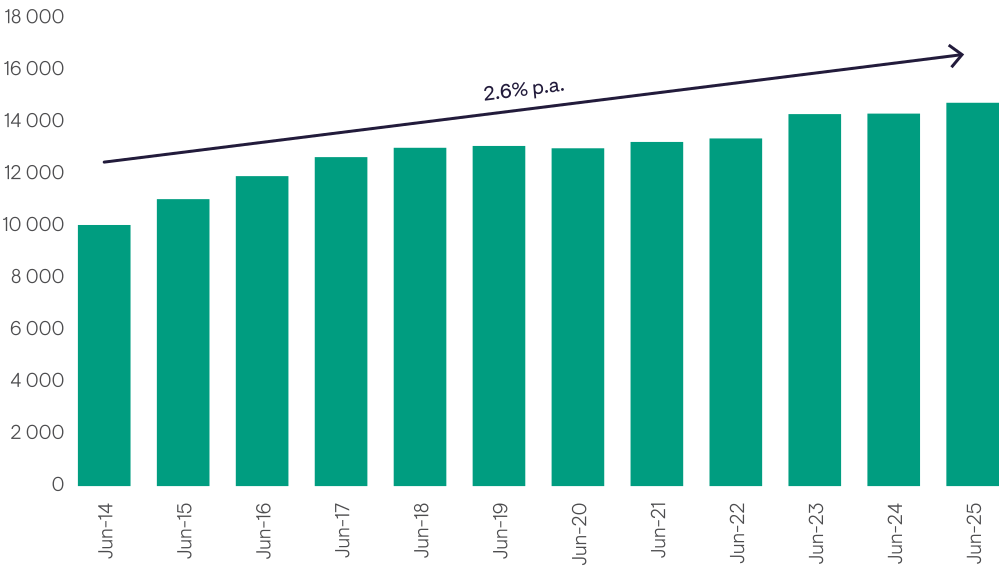
Looking at data from consulting firm Pi FSI covering independent advice firms holding all the key investment product licence categories with the FSCA, the number of active advisors has continued to grow slowly but steadily over the past decade – at around 2.6% per annum. The total of 14 750 registered independent investment advisors in June 2025 marks an all-time high.
Figure 1: Number of licensed independent advisors with FAIS investment authorisations
Source: Pi FSI report 2025 – RFA advisors with all FAIS investment authorisations.
Yet the market structure is shifting
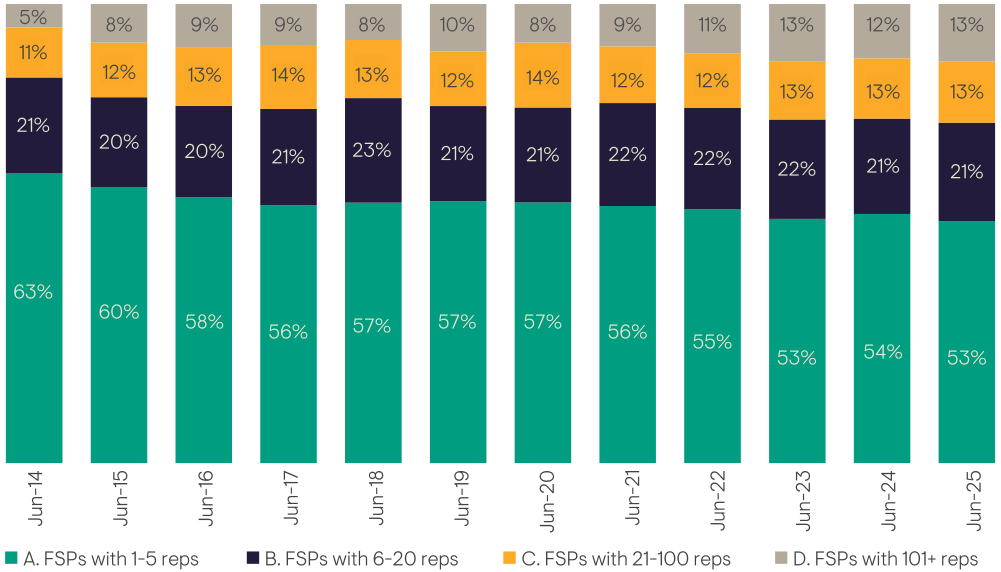
Beneath the stability of steady growth, however, lies a clear structural shift. Figure 2 shows the relative size of advice firms, as measured by advisor headcount. What stands out is that smaller firms – those with five or fewer registered advisors – made up 63% of the market a decade ago. Today, that proportion is down to 53%. At the same time, large corporate advisor networks employing more than 100 advisors are expanding – up from 5% of the market in 2014 to 13% in 2025.
Figure 2: Distribution of advisors by firm size (advisor headcount)
Source: Pi FSI report 2025 – RFA advisors with all FAIS investment authorisations.
Pressures driving the change to larger firms
Clearly, some smaller advice firms are finding it increasingly challenging to operate in the current climate. This observation served as the backdrop for our discussion on consolidation, scale and sustainability.
Kathryn opened by highlighting the pressures that small practices face. Technology, compliance, cyber security and professional support costs have all escalated, often beyond what a single-advisor firm can afford or manage effectively. “Operating alone,” she noted, “can be overwhelming in such a complex environment.”
Another aspect raised was the ageing wealth advisor population and the growing importance of structured succession planning. Many advisors are now seeking partners to share infrastructure or provide continuity for clients.
John echoed these points, adding that running a compliant, well-governed business has become far more demanding than it was even a decade ago. “It’s becoming more and more difficult to do so profitably,” he said. Small-firm owners often draw out most of their earnings and under-invest in their business – something that will have to change as compliance and operational expectations continue to rise.
That said, both Kathryn and John agreed that smaller firms can still succeed – but only with deliberate focus. Survival will require embracing specialisation in their value proposition (i.e. growing as a leading specialist for a specific type of client, rather than continuing to be a generalist). It will also require outsourcing non-core functions – establishing technology and compliance partnerships will be essential. As Kathryn put it, “It has to be done purposefully – it doesn’t happen by accident.”
Why does the discussion often get stuck on advisor practice valuations?
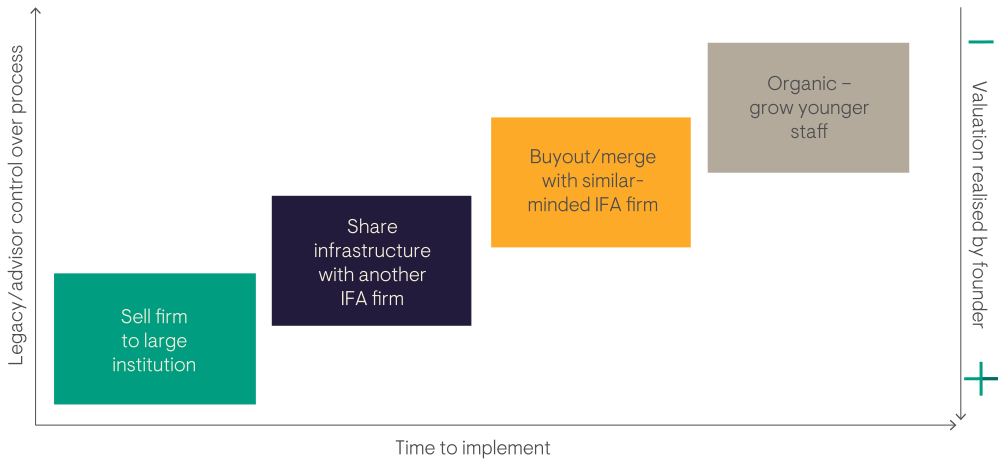
We explored why valuations are such an integral part of any succession or consolidation exercise. During the discussion we shared the framework we often use at Ninety One to consider the trade-offs inherent in different consolidation/succession options. The model (Figure 3) highlights how these options represent different trade-offs between price, time and advisor legacy.
Figure 3: Succession plans and their trade-offs
Source: Ninety One.
For example, at one end of the spectrum, a sale to a corporate consolidator (bottom left) can be executed quickly and deliver an attractive valuation – but at the cost of control and cultural independence. At the other end, organic succession (top right) preserves legacy and autonomy but can take more than ten years to complete and typically realises a lower monetary value for the seller.
We also discussed why valuation can sometimes be a particularly sensitive matter for some sellers, whereas other advisors would be more concerned about the legacy they leave behind.
Clearly, no advisor wants to sell their life’s work at a below-market-value price point. However, in our experience supporting advisors with succession planning, we have found that major valuation disagreements typically arise because the selling advisor’s own retirement provision is inadequate. The unfortunate reality is that selling a financial advisory practice for a capital lump sum struggles to replace even 50% of the income the advisor earned while working in the business. Inadequate retirement provision makes the sale price critical to the selling advisor’s financial independence in retirement – and often scuppers a succession deal.
The discussion highlights a broader point: advisors should ensure that their own personal financial planning aligns with their business exit strategy long before entering negotiations.
Understanding the large corporate consolidation landscape
The panel discussion then shifted focus to the developing landscape of options for advisors looking to join a large national consolidator network.
Kathryn drew clear distinctions between the main consolidation models in the South African market:
Product provider consolidation
This model is typically driven by large corporates seeking distribution for their in-house products and vertical integration (sharing in the fees for advice, product custody, discretionary fund management and investment management). A key indicator of this model, she noted, is evident when a buyer offers a high fixed revenue multiple price “without asking anything about your business”. That usually signals that the consolidator’s agenda lies in asset gathering rather than a commitment to preserving the advice ethos of the existing firm.
Private equity consolidation
This model is widespread in the UK but still limited in South Africa. UK transactions often involve short-term funds targeting a five-to seven-year exit, leading to high valuations for selling advisors but significant future risks (for example, to whom will the private equity buyer sell the network in seven years’ time?). Locally, most private capital is more patient and partnership-oriented. These buyers typically offer slightly lower valuations but seek to build long-term, efficient advice businesses.
Lessons from the independent-advisor-to-independent-advisor model
The discussion then pivoted to an independent-advisor-to-independent-advisor consolidation model – an increasingly interesting approach adopted by larger independent advice firms. These partnerships are typically driven more by culture and advice philosophy than by distribution or short-term financial engineering.
John shared their experience at Chartered Wealth Solutions, where, over twenty years, they acquired ten practices – all of which integrated successfully, largely because of one key factor: cultural fit.
He explained that many advisors who joined them rediscovered their passion for client work once freed from the burdens of business management and regulatory compliance oversight. Most of these advisors remained with the firm for years after the initial transaction, contributing to continuity and client retention.
According to John, the greatest challenges with this model arise when the seller’s business model and philosophy are not compatible with those of the acquiring firm – for example, a firm’s focus on stock picking or market timing rather than holistic financial planning. For a merger to succeed, there must be alignment in values, advice philosophy and client profile.
Guidance for advisors considering their options
Both Kathryn and John offered practical tips for those contemplating a sale, partnership, or growth transaction:
-
Know your buyer
Understand their capital source, time horizon and intentions. Are they long-term partners or short-term consolidators?
-
Clean up your business
Ensure data accuracy, client segmentation and compliance readiness before any discussions.
-
Explore multiple options
Don’t rush to the first suitor. As John put it, “Make sure it feels like the best fit.”
-
Put clients first
At the end of the process, you should be able to look a client in the eye and say, “I’ve found the best home for you” – and believe it.
My takeaway
Firstly, the discussion reinforced my conviction that independence and scale are not opposing concepts – they are complementary choices along a continuum that requires careful planning and preparation to capture the best of both worlds.
Secondly, our industry remains financially strong and professionally vibrant. Yet the demands on advice firms – technological, regulatory and operational – are only increasing. For some, joining forces will unlock the next phase of growth and sustainability. For others, focused independence, supported by smart partnerships, will remain the right path.
Whichever route you choose, the key is intentionality – to plan ahead and understand your options. And never forget: the acid test will be whether your decisions serve both your business and your clients’ long-term interests.
Finally, the discussion reinforced our conviction at Ninety One that despite market and regulatory pressures, independently owned financial advice firms will remain the backbone of the South African market. We remain committed to our partnerships with quality independent advice practices.
