Key takeaways
- Starting conditions matter – Global equity returns have been unusually strong and valuations elevated; long-term forward returns are likely to be more constrained1.
- Quality has diverged – Recent dispersion among Quality managers reflects fundamentally different definitions and implementations of “Quality.”
- Earnings durability is decisive – Long-term equity returns are driven by sustained earnings and free cash flow compounding, not multiple expansion.
- Valuation has reset – Companies within the Ninety One Global Franchise Fund continue to deliver strong earnings growth, while relative valuations have compressed meaningfully.
- Opportunity is emerging – Resilient compounding businesses trading at more reasonable prices offer an attractive forward-looking setup in a concentrated market.
Global equities have delivered exceptional performance over the past three years2, supported by resilient growth, moderating inflation and enthusiasm around AI.
Markets have rewarded momentum, cyclicality and perceived growth certainty, while more defensive Quality attributes – earnings stability, balance sheet strength and lower economic sensitivity – have lagged. Three-year returns for the MSCI ACWI now sit in the 97th percentile of outcomes since 1990, and valuations remain elevated relative to long-run averages.
While starting valuations say little about short-term market movements, their relationship with longer-term outcomes is far stronger. History suggests that from today’s starting point, global equities in aggregate are likely to deliver only low-single-digit nominal annualised returns over a ten-year horizon – a reminder that exceptional recent performance often makes the next decade more demanding for investors.
Not all Quality is the same
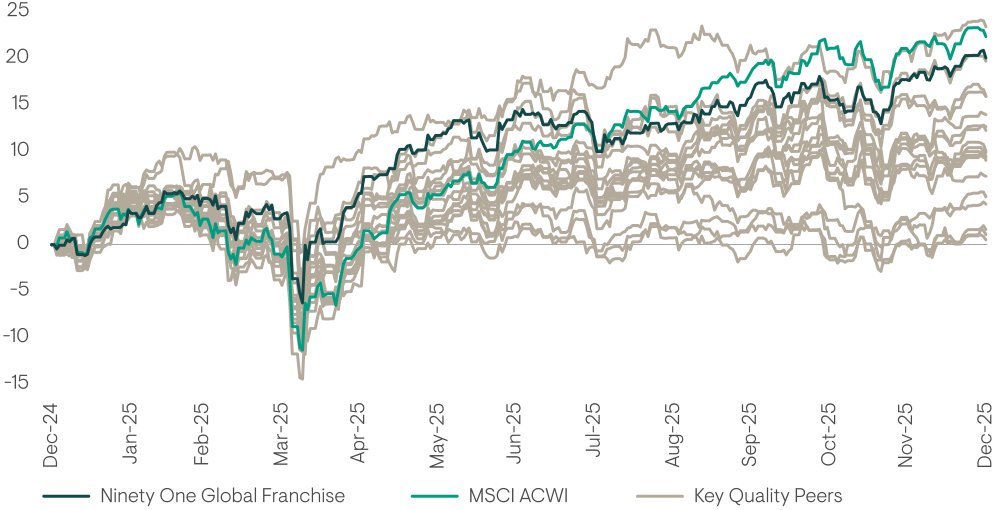
One of the defining features of 2025 was the extraordinary dispersion of returns among global Quality managers.
Figure 1: Wide dispersion of returns across Quality approaches in 2025
Source: Ninety One, Morningstar Direct, Gross Returns, USD, as at 31 December 2025.
This was not a simple test of the Quality factor. It was a test of how Quality was defined.
Some strategies emphasise static screens such as high historical profitability or low leverage, often leading to concentrated exposure in traditional defensive sectors. Others tilt Quality towards prospective growth, embedding material exposure to higher beta technology or momentum-driven stocks, sometimes with limited valuation discipline.
As shown in Figure 1, these approaches can produce markedly different outcomes as economic drivers evolve.
High historical profitability does not guarantee future earnings growth if opportunities diminish or competitive intensity increases. Equally, growth exposure unsupported by durable economics leaves returns dependent on multiple re-ratings.
Recent experience reinforces a simple point: Quality is not a binary factor but a spectrum. The decisive question is whether current business economics can translate into sustained earnings and free cash flow compounding over time.
Where that link weakens – through eroding competitive advantage or reliance on valuation expansion – Quality can become fragile.
The Ninety One Global Franchise Fund has exhibited a comparatively strong and durable earnings growth profile, which has been a key driver of long-term returns.
Our definition of Quality
Our approach to Quality is more of a philosophy than a factor label.
Quality cannot be reduced to a formula. It is an integrated assessment of competitive advantage, reinvestment runway, capital allocation discipline and balance sheet resilience. Capturing it requires forward-looking analysis and a willingness to adapt as business economics change.
At its core is a simple belief: long-term equity returns are driven primarily by the compounding of earnings and free cash flow. Durable compounding requires businesses that can reinvest incremental capital at attractive rates, supported by pricing power and strong balance sheets.
This framework allows evolution without abandoning core principles.
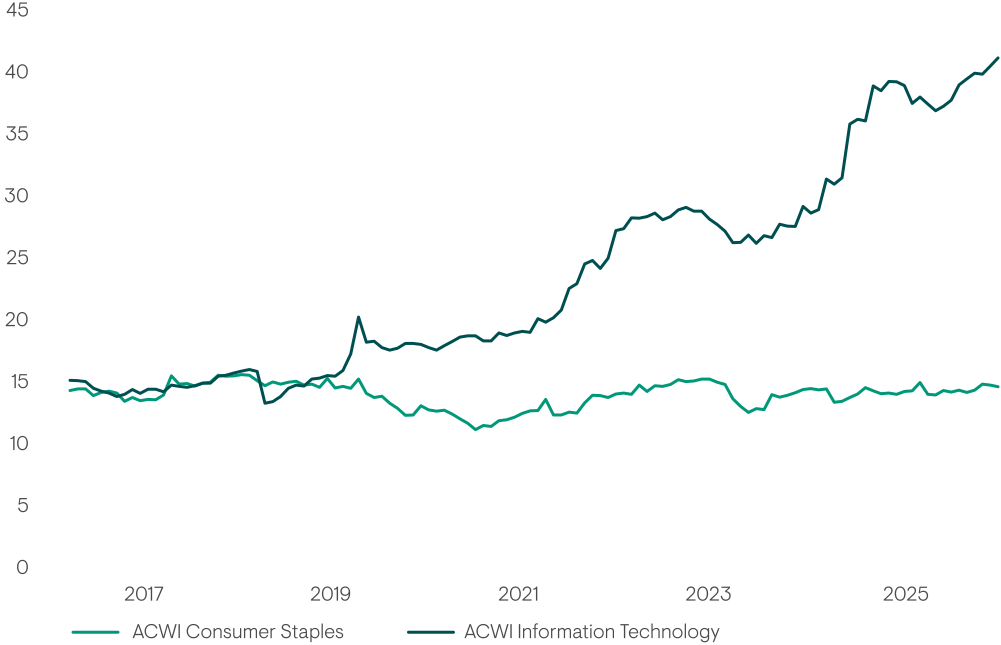
Over the past decade, exposure was reduced to segments where returns on capital deteriorated, while increased in selected technology and financial services businesses exhibiting recurring revenues and capital-light economics. These shifts were driven by bottom-up assessments of earnings durability rather than sector rotation.
Evolution of the Ninety One Global Franchise Fund’s sector breakdown and MSCI ACWI sector ROIC
Figure 2: Sector breakdown since inception
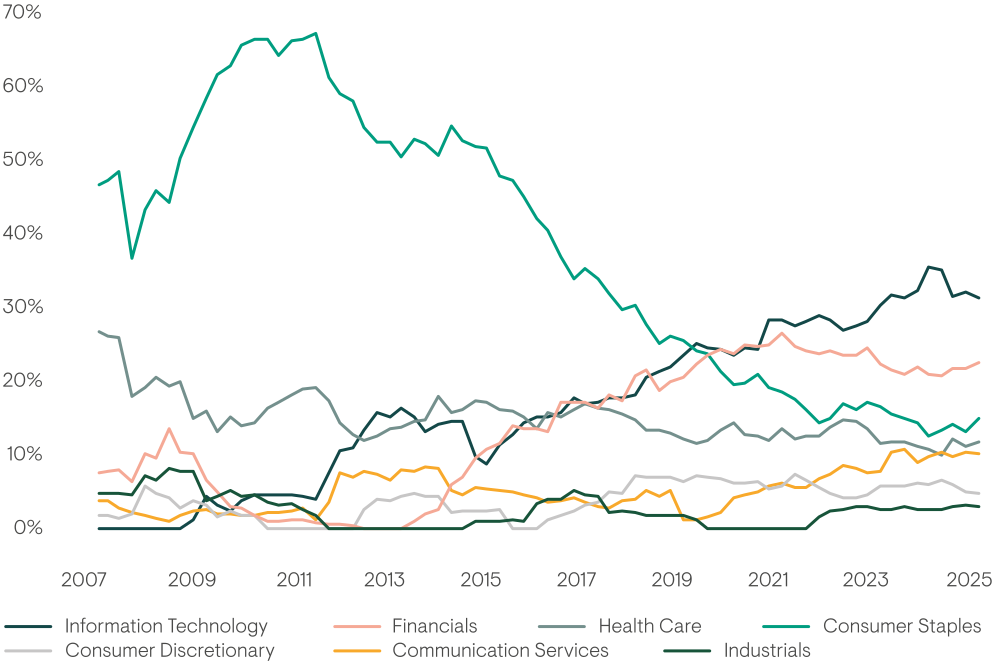
Figure 3: MSCI ACWI sector indices, ROIC %
The portfolio may change significantly over a short period of time. Source: Ninety One, FactSet, Morningstar, as at 31 December 2025.
The resulting portfolio maintains high exposure to Quality characteristics but low correlation to traditional growth, value or passive Quality styles. For allocators constructing blended portfolios, this differentiation is important. A fundamental Quality allocation should add a distinct return driver rather than replicate existing exposures.
The valuation reset creates opportunity
The most compelling aspect of the current environment is the disconnect between earnings performance and valuation.
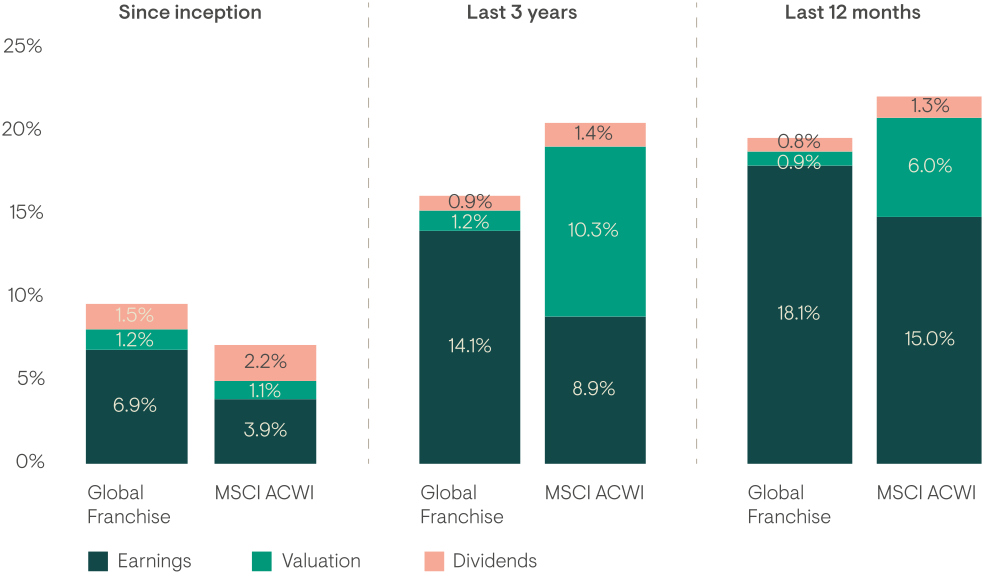
Aggregate earnings from Global Franchise companies grew 18% in 2025 – ahead of historical averages and ahead of the broader market. Yet the Strategy has experienced a significant market-relative de-rating. The forward price-to-earnings (P/E) premium to the MSCI ACWI has compressed materially from its 2022 peak to levels not seen in a decade.
The relative de-rating has been the primary contributor to recent underperformance, more than offsetting the stronger underlying earnings compounding delivered by the portfolio.
Figure 4: Decomposition of total shareholder returns (31 December 2025)
Past performance does not predict future returns; losses may be made.
Source: Ninety One, FactSet, Bloomberg, as at 31 December 2025, inception April 2007. TSR is derived from portfolio constituents through time and is based on the weighted average aggregation of EPS growth and dividend yield. Gross performance is used to derive the residual rating change.
This matters for forward returns. When resilient earnings growth persists, but valuations reset, the starting point for compounding improves. Returns become less dependent on multiple expansion and more driven by underlying business performance.
This dynamic is particularly relevant in a market characterised by elevated concentration and high expectations embedded in AI infrastructure and cyclical growth stocks. Capital expenditure cycles rarely move in a straight line, and market prices often peak ahead of earnings.
At the same time, many businesses with durable competitive advantages, recurring revenues, and strong free cash flow generation now trade at valuations that understate their long-term compounding potential. The broad de-rating across software, information services, and select consumer franchises has expanded the opportunity set for disciplined fundamental investors.
Looking ahead
The macro backdrop is becoming more complex. Geopolitical tensions have intensified, policy uncertainty is rising, and global supply chains remain in flux. At the same time, elevated valuations and growing index concentration leave little room for disappointment in parts of the market.
In this environment, predicting macro outcomes is difficult. What matters more – and where our focus lies – is the resilience and adaptability of the businesses we own.
The recent period has been described as a failure of Quality. We see it differently. It has been a failure of narrow, backward-looking definitions of Quality – often reliant on historical metrics or crowded exposures – rather than a failure of the underlying principle: that long-term returns are driven by businesses’ ability to generate returns above their cost of capital.
That distinction matters today. As the chart below shows, the Quality of the Ninety One Global Franchise Fund – measured by returns on invested capital – has continued to strengthen, even as relative valuations have reset to the most attractive levels in a decade. In simple terms, the fundamentals have improved while the price has come down.
Figure 5: Global Franchise ROIC vs relative valuation
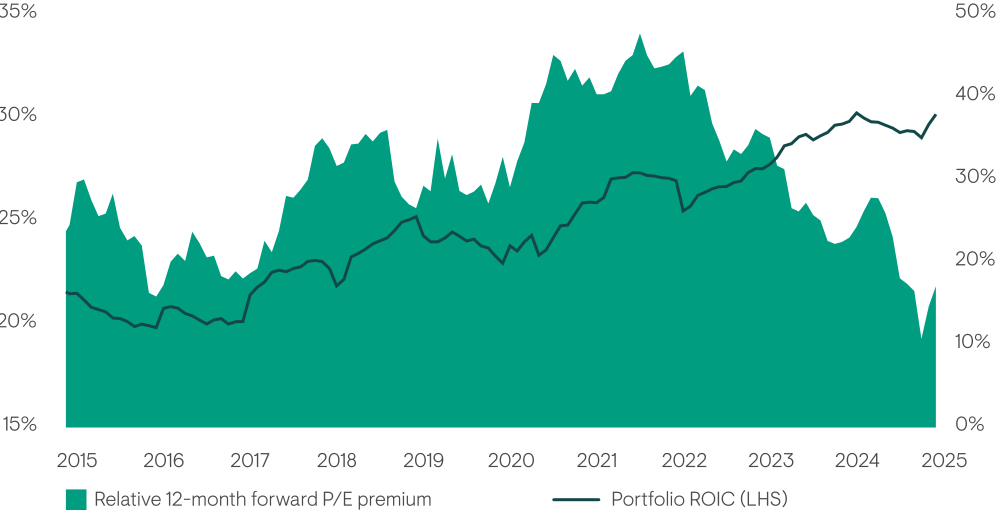
Sources: Ninety One and FactSet, as at 31 December 2025. Data is based on a substantially similar related account. The data does not represent the historical performance of the Fund and is not indicative of the potential future performance of the Fund.
That combination is rarely uninteresting.
In a market where passive exposure is increasingly concentrated and expected returns are more constrained, we believe owning businesses that can generate their own growth – rather than relying on index momentum – offers a more durable path to compounding capital.
Quality’s relevance has not disappeared. It has simply become more selective and, in our view, more attractive.
1 Forecasts are not guaranteed to occur.
2 Past performance does not predict future results.
