Find an advisor tool
The value of professional financial advice.
When we picture retirement, many of us imagine freedom: time to travel, to rest, to enjoy family and life on our terms. But the reality for most South Africans looks very different.
According to National Treasury, only 6% of South Africans retire with enough income to maintain their standard of living. That means most investors retire without the financial security they had hoped for, often needing to adjust their lifestyle, delay retirement, or rely on loved ones, and sometimes all three.
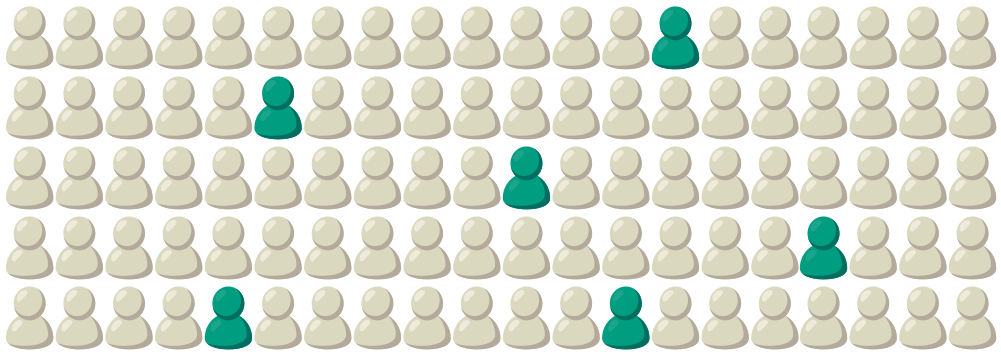
Source: National Treasury.
Whether you’ve already started saving for retirement – or are still planning to – the reality is the same:
For many South Africans, retirement saving either starts late, happens inconsistently, or falls short of what is ultimately needed.
Even if you are contributing to a retirement fund, saving alone does not automatically translate into a comfortable retirement.
The real question is whether what you’re putting away today will be enough to sustain your lifestyle tomorrow.
Many investors aim to replace around 75% of their pre-retirement income – but reaching this level typically requires consistent saving over time. Starting early and contributing consistently can significantly improve outcomes. Lower contribution rates or delays in starting can make it much harder to reach your retirement goals.
Many retirees will need their savings to last 30 years or more, which makes planning for sustainable income essential.
If saving enough is the challenge, the next question becomes:
A practical way to think about retirement planning is through two simple numbers: 5 and 20.
5%
A prudent starting annual income drawdown in retirement.
20x
The approximate multiple of your final salary* you may need saved to support that income - if you want to retire on 100% of your final salary.
*If you are comfortable with a replacement ratio of 75%, then 15 times should suffice
This simple framework helps translate a complex question into something more tangible.
In his article, Why 5 and 20 are the key numbers for retirement success, Paul Hutchinson explores this idea in more depth, suggesting that you can draw no more than 5% of your retirement capital each year, growing with inflation, in order for it to last for at least 30 years. On that basis, investors may need to accumulate savings of roughly 20 times their final annual salary to target a full income replacement. Reaching these goals depends not only on how much you save, but also on when you start.
Key takeaway
A clear retirement goal can turn an abstract idea into a practical, measurable objective.
Time is one of the most powerful drivers of retirement outcomes.
The earlier you start, the more time your savings have to compound and the less you may need to contribute each month. Starting later often means saving significantly more to reach the same goal.
To illustrate the impact of starting early, the table below shows the contribution rates required to reach a target of 20 times your final salary by age 60:
Retiring at age 60 with 20 times your final annual salary
| When you start | % of salary needed |
|---|---|
| Age 20 | ~15% |
| Age 30 | ~30% |
| Age 40 | ~60% |
Delaying your savings journey can make reaching your target more challenging – but it’s never too late to act.
Even small increases today can have a meaningful impact over time, particularly when combined with a well-structured long-term plan.
Once you understand your target and the role of time, the next step is to take action.
Key takeaway
Time is one of the most powerful contributors to retirement success. Starting earlier can reduce the savings burden later.
No matter where you are starting from, there are practical steps you can take to secure your financial future.
Key takeaway
A well-structured plan, supported by ongoing advice, can make a meaningful difference to long-term retirement outcomes.
Retirement planning is not about perfection. It is about progress.
Wherever you are starting from, taking the next step can help improve your long-term outcome. You may want to:
If you would like support in building or refining your plan, the Ninety One Find an Advisor tool can help you connect with a qualified professional.
