Investors, financial advisors and investment firms are facing a period of profound change as disruptive technology and the growth of alternative investments reshape the industry. At our recent IP Advisor Forum, Siobhan Simpson, Head of SA Unit Trusts, Khadeeja Bassier, Chief Operating Officer, and Deon Smith, Global Head of Product Development, discussed some of the key forces driving this change – from AI and tokenisation to the rise of private markets. Together, these trends are redefining asset management – expanding access, broadening opportunity and challenging traditional models of investing. Here are some of the highlights from the session.
Harnessing the power of AI
The true story of AI is about the pace of change. That pace is shaped by two forces: the speed at which the technology itself evolves – how capable and mature it becomes – and the rate at which humans can adapt. Despite the hype, technology doesn’t transform the world on its own; it needs people to understand it, explore it, and experiment with it. With this wave of AI, that human process of adaptation and learning is more important than ever.
Models capable of complex reasoning are advancing fast. The pace of improvement is exponential – tasks that once took hours now take seconds, and the length of tasks AI can perform is doubling every seven months.
Rapid acceleration in AI task performance
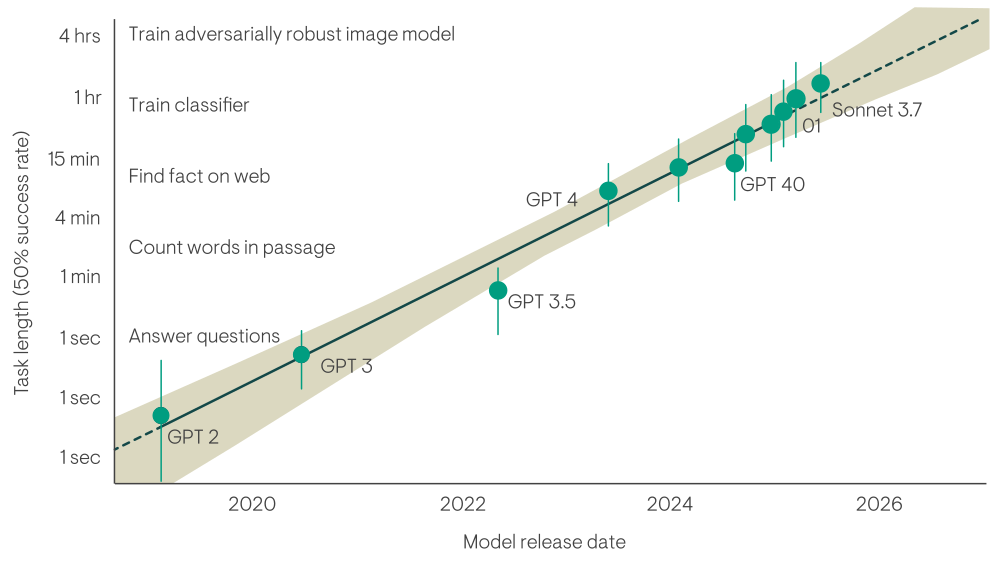
Source: METR, Measuring AI ability to Complete Long Tasks, March 2025.
Moving higher up the value chain
This acceleration is creating space in the workplace for people to do more of what matters. Reallocation is key. In financial services, this change is already under way, with AI enhancing research capabilities and reshaping how portfolios are managed.
Our industry is having its Kodak moment. When digital technology upended a familiar model, photography didn’t die; it multiplied. Similarly, investing will endure, but how we invest is changing fast. The ‘why’ remains constant: we still need to generate attractive investment returns and maintain strong relationships with our clients. What will change are the tools, the processes, and the very definition of what it means to create alpha.
At Ninety One, the focus is on understanding where these tools can genuinely add value. Across the investment teams, experimentation is under way to test where AI augments existing processes and decision-making, and where human expertise remains indispensable. The approach is measured and deliberate: to harness innovation without losing the distinctive human perspective and judgement that underpin sound investment decisions.
As more retail investors turn to AI for insight and ideas, the human advisor’s role becomes even more important – to cut through the noise, bring perspective and guide them through this new world.
While AI tools are beginning to influence investors’ behaviour, other technologies are transforming how they access investment opportunities.
Tokenisation and democratisation: widening access
Many of the most innovative companies, from SpaceX to OpenAI, raise capital privately, meaning they have largely been accessible only to those with the deepest pockets. But this is beginning to change.
Through tokenisation (using the blockchain), almost any real-world asset – a company, a fund, even a piece of art or property – can be represented digitally and traded securely and instantaneously. Tokenisation allows investors to own fractions of an asset, making it possible to participate with far smaller amounts – even a few rand – breaking down long-standing barriers to entry and promoting financial inclusion. The idea of ‘R1 to access any investment opportunity’ may still be emerging in South Africa, but globally it’s already reshaping how investors engage with markets.
For South Africa, this could be a leapfrog moment. Technology has the potential to open investment opportunities to a broader range of investors, offering immediacy, transparency and choice. But greater access also brings greater complexity. Advisors and platforms will play a critical role in helping investors navigate this new universe – distinguishing between legitimate innovation and speculation, and ensuring that accessibility is matched by understanding and trust.
Private markets: broadening the opportunity set
Alongside the technological shifts transforming investment access, the universe of investable assets is expanding rapidly. While global wealth remains concentrated in public markets,1 this is set to change. Private markets – including private equity, private credit and infrastructure – are growing faster than traditional public markets. For investors, this represents a broadening of the opportunity set.
Privately owned businesses are often capital-hungry, and the structure of their funding means that private debt and quasi-debt are becoming increasingly attractive ways for them to raise capital. Private credit offers companies flexibility: it’s typically cheaper than equity, allows them to retain control, and enables customised funding solutions. For investors, it provides a differentiated source of return and diversification.
Ninety One has been active in this space for more than two decades, with around R170 billion currently invested through its private debt capability, alongside growing allocations to other alternative strategies.
In South Africa, these opportunities have historically been limited to institutional investors. But as technology and product innovation evolve, new ways to access private markets are emerging. Extending these opportunities responsibly to a broader range of investors will require the same focus on transparency, liquidity and valuation discipline that underpin institutional portfolios. For advisors, understanding these dynamics and how they complement public market exposure is critical to building resilient portfolios.
Staying ahead of change
As Warren Buffett reminded investors earlier this year, “The world is not going to adapt to you – you’re going to have to adapt to the world.” It’s a timely message for our industry. Growth in asset management is encouraging, but it’s not enough on its own. We need to stay agile – ready to respond to changing markets, evolving client needs and shifts in product trends.
At Ninety One, that mindset is already at work. We’re challenging norms, refining how we invest and what we offer, and staying one step ahead so that our clients can stay confident in a world that’s constantly moving.
1. Approximately 91% of US wealth portfolios are invested in listed assets (US$220 trillion).
