South Africa
Select your role
Ninety One Actively Managed Exchange-Traded Funds (AMETFs)
We are bringing our 30+ years of active investment expertise and the insights of 240+ global professionals into a vehicle that’s easily accessible on an exchange. Our Actively Managed ETFs (AMETFs) are designed to deliver reliable income with a capital preservation bias, providing investors with new tools to diversify portfolios and generate yield.
With our JSE-listed Actively Managed ETFs, we’re meeting the evolving needs of investors and advisors, particularly those who prefer listed instruments and require intraday liquidity.
Our ETFs offer flexible, low-minimum access to the same underlying portfolios managed by Ninety One’s experienced investment teams, helping to bridge the gap between traditional unit trust structures and stockbroker-aligned client portfolios.
Actively Managed ETFs Explained
What is an ETF?
An exchange-traded fund (ETF) is a listed investment fund that holds assets like shares, bonds or commodities—traded on the stock exchange just like a normal share. Investors can trade throughout the day while the stock exchange is open.
Features & benefits
ETFs may be actively managed or index-tracking, allowing exposure to preferred investment styles and asset classes.
ETFs offer an easy route to diversification. By investing in an ETF, you gain exposure to a portfolio of assets with just one transaction.
Unlike unit trusts, which are priced at the end of the trading day, ETFs can be bought and sold throughout the day at market prices, offering flexibility and liquidity.
Regulated as CIS like any unit trust, requiring safeguarding of assets and independent Trustee oversight.
What is an ETF?
What is an ETF?
An exchange-traded fund (ETF) is a listed investment fund that holds assets like shares, bonds or commodities—traded on the stock exchange just like a normal share. Investors can trade throughout the day while the stock exchange is open.
Features & benefits
ETFs may be actively managed or index-tracking, allowing exposure to preferred investment styles and asset classes.
ETFs offer an easy route to diversification. By investing in an ETF, you gain exposure to a portfolio of assets with just one transaction.
Unlike unit trusts, which are priced at the end of the trading day, ETFs can be bought and sold throughout the day at market prices, offering flexibility and liquidity.
Regulated as CIS like any unit trust, requiring safeguarding of assets and independent Trustee oversight.
How does an actively managed ETF differ from a passive ETF?
How does an actively managed ETF differ from a passive ETF?
Passive ETFs track a market index and aim to mirror the index return. Actively managed ETFs rely on the expertise of portfolio managers to find opportunities and aim to outperform the market or meet specific return goals. Actively managed ETFs combine the benefits of active management with the efficiency of an ETF.
Benefits of active management
outperformance
decision-making
construction
management
managed
ETFs
liquidity
efficiency
Benefits of an ETF
Why Ninety One for AMETFs?
Why Ninety One for AMETFs?
Our soon-to-be-launched actively managed ETFs go beyond simple index tracking. We are bringing our 30+ years of active investment expertise and the insights of 240+ global professionals into a vehicle will soon be easily accessible on an exchange. Our insights and experience help you adapt to market shifts, offer exposure to a mix of asset classes, helping investors diversify in ways traditional ETFs can’t.
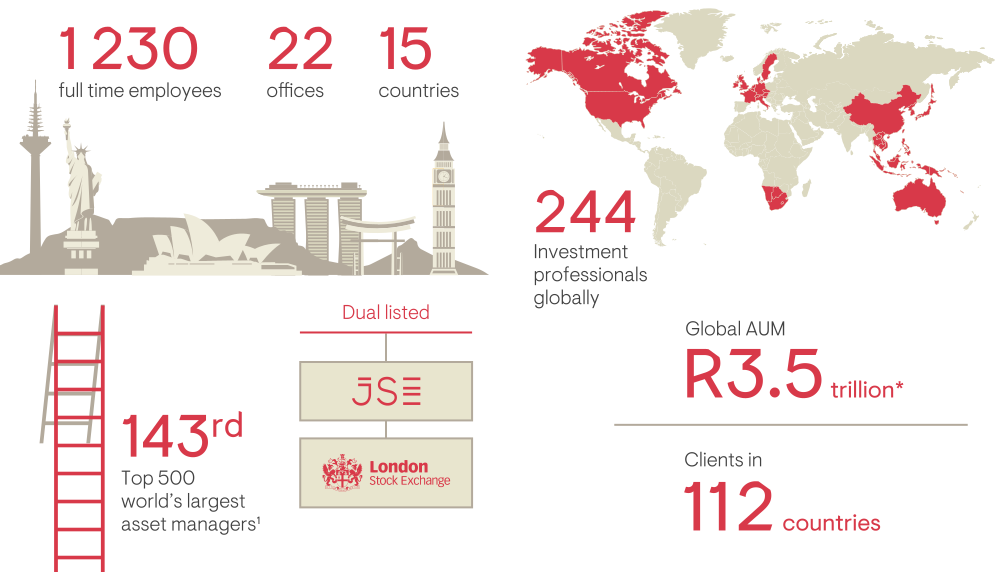
Source: All figures shown are as at 31 March 2025 unless otherwise stated.
1 Willis Towers Watson Largest Asset Management report, October 2024.
* Source: Firm level AUM as at 30 September 2025.
Where to invest in an AMETF?
Where to invest in an AMETF?
Investing in an ETF is simple and flexible enough to suit how you like to invest. Here are the most common ways:
1. Through an ETF platform or investment app
You can access Ninety One’s actively managed ETFs directly through several user-friendly platforms, including:


-
These platforms allow you to:
- Search for ETFs by name or code (e.g. 91DINC, 91GINC)
- Invest with no or low minimums (some even allow fractional share purchases)
- Trade during JSE market hours
- Monitor your portfolio from your phone or desktop
2. Via a stockbroker (BDA account)
If you already work with a stockbroker or use an online brokerage account linked to the JSE’s BDA (Broker-Dealer Accounting) system, you can buy or sell ETFs just like you would a share.
-
Here’s how:
- Search for the ETF by its JSE code
- Place a trade during market hours (you can use a market or limit order)
- Your ETF units will be held in your BDA account alongside other listed securities
This method is commonly used by discretionary wealth clients, brokers, or investors who manage multiple listed instruments in one place.
3. Through a Linked Investment Platform (LISP)
Ninety One’s ETFs are also available via select LISP platforms, such as the Ninety One Investment Platform. This route is suitable for investors who prefer to consolidate their listed and unlisted investments in one environment, or who work through a financial advisor.
How do the AMETFs differ from Ninety One’s unit trusts?
How do the AMETFs differ from Ninety One’s unit trusts?
- There is no difference in the investment strategy underlying the AMETF or the unit trust
- The differences relate to trading frequency and how the investments are accessed –
- AMETFs are bought on exchange directly from a stockbroker or via an ETF platform whereas the unit trusts are bought from traditional investment platforms.
- AMETFs trade intra-day (during stock exchange opening hours) whilst unit trusts trade at the end of day.
- AMETFs have lower minimum investment amounts (you can invest as little as the price of a single share and some ETF platforms allow fractional shares i.e. even lower minimums).
Our available AMETFs
Our available AMETFs
|
91DINC Ninety One Diversified Income Prescient Feeder Actively Managed Exchange Traded Fund |
|
|---|---|
|
91DINC gives investors access to Ninety One’s well-established multi-asset income strategy in a listed format, targeting stable, above-inflation returns with downside risk management. The portfolio is Regulation 28 compliant and diversified across local bonds, credit, cash, property, equities, and offshore assets, with a strong focus on income generation and capital preservation. |
|
| Instrument Name: | Ninety One Diversified Income Prescient Feeder Actively Managed Exchange Traded Fund |
| JSE Code: | 91DINC |
| Benchmark: | STeFI Composite |
| Performance Target: | The portfolio aims to maximise yields, delivering above-cash and above-inflation returns over time (gross of fees). |
| ISIN: | ZAE000347043 |
| Launch Date: | 12 November 2025 |
| Distribution Frequency: | Quarterly (March, June, September, December) |
| Liquidity Provider: | Prescient Securities (Pty) Ltd |
| Settlement Cycle: | T+3 |
| Disclosure: | Semi-transparent, Quarterly disclosure |
|
91GINC Ninety One Global Diversified Income Prescient Feeder Actively Managed Exchange-Traded Fund |
|
|---|---|
|
91GINC offers offshore diversification through a global, low-duration, multi-asset income strategy aiming to deliver US dollar cash +1.5 over rolling 12 months with no negative returns. With a focus on high-quality fixed income assets and built-in currency diversification, the fund seeks to deliver consistent yield while limiting drawdowns. |
|
| Instrument Name: | Ninety One Global Diversified Income Prescient Feeder Actively Managed Exchange-Traded Fund |
| JSE Code: | 91GINC |
| Benchmark: | Overnight SOFR (ZAR) |
| Performance Target: | Overnight ZAR SOFR + 1.5% (gross of fees) over rolling 12 months with no negative returns |
| ISIN: | ZAE000346813 |
| Launch Date: | 12 November 2025 |
| Distribution Frequency: | Semi-annual (March and September) but invests in accumulation structure |
| Liquidity Provider: | Prescient Securities (Pty) Ltd |
| Settlement Cycle: | T+3 |
| Disclosure: | Semi-transparent, Quarterly disclosure |
AMETF Downloads
Ninety One at a glance
ZAR
GBP
USD
EUR
Assets under management
ZAR
GBP
USD
EUR
Assets under management
Data as at 31.12.25 unless otherwise indicated.
Join our mailing list
Important information
Collective Investment Schemes in Securities (CIS) should be considered as medium to long-term investments. The value may go up as well as down and past performance is not necessarily a guide to future performance. CISs are traded at the ruling price and can engage in scrip lending and borrowing. The collective investment scheme may borrow up to 10% of the market value of the portfolio to bridge insufficient liquidity. A schedule of fees, charges and maximum commissions is available on request from the Management Company. There is no guarantee in respect of capital or returns in a portfolio. A CIS may be closed to new investors in order for it to be managed more efficiently in accordance with its mandate. CIS prices are calculated on a net asset basis, which is the total value of all the assets in the portfolio including any income accruals and less any permissible deductions (brokerage, STT, VAT, auditor’s fees, bank charges, trustee and custodian fees and the annual management fee) from the portfolio divided by the number of participatory interests (units) in issue. Forward pricing is used. The Fund's Total Expense Ratio (TER) reflects the percentage of the average Net Asset Value (NAV) of the portfolio that was incurred as charges, levies and fees related to the management of the portfolio. A higher TER does not necessarily imply a poor return, nor does a low TER imply a good return. The current TER cannot be regarded as an indication of future TER's. During the phase in period TER’s do not include information gathered over a full year. Transaction Costs (TC) is the percentage of the value of the Fund incurred as costs relating to the buying and selling of the Fund's underlying assets. Transaction costs are a necessary cost in administering the Fund and impacts Fund returns. It should not be considered in isolation as returns may be impacted by many other factors over time including market returns, the type of Fund, investment decisions of the investment manager and the TER.
Exchange traded funds are listed on an exchange and may incur additional costs.
Though the Management Company has appointed Ninety One SA (Pty) Ltd, FSP 587, an authorised financial services provider, under the Financial Advisory and Intermediary Services Act, 2002 as its investment manager, the Management Company retains full legal responsibility for any third party-named portfolio. Where foreign securities are included in a portfolio there may be potential constraints on liquidity and the repatriation of funds, macroeconomic risks, political risks, foreign exchange risks, tax risks, settlement risks, and potential limitations on the availability of market information. The investor acknowledges the inherent risk associated with the selected investments and that there are no guarantees.
Performance has been calculated using net NAV to NAV numbers with income reinvested.
Exchange Traded Funds vs Unit Trusts: Whilst both unit trusts and ETFs are regulated and registered under the Collective Investment Schemes Control Act, ETFs trade on stock exchanges just like any other listed, tradable security. Actively managed ETFs (AMETF) offer exposure to CIS and differ from other ETFs which track indices because the fund manager actively selects and adjusts the fund’s holdings and asset allocation to try to outperform a benchmark. Unlike a unit trust, which can be bought or sold only at the end of the trading day, an ETF can be traded intraday, during exchange trading hours.
For any additional information such as fund prices, brochures and application forms please go to www.prescient.co.za.
This portfolio operates as a white label fund under the Prescient ETF Scheme, which is governed by the Collective Investment Schemes Control Act.
The Management Company (Prescient) and Trustee are registered and approved under the Collective Investment Schemes Control Act (No.45 of 2002). Prescient and Ninety One are members of the Association for Savings and Investments South Africa.
This document is for information purposes only and does not constitute or form part of any offer to issue or sell or any solicitation of any offer to subscribe for or purchase any particular investments. This document must be read in conjunction with placing document or pricing supplement, which contains detailed information on the AMETF. Opinions expressed in this document may be changed without notice at any time after publication. We therefore disclaim any liability for any loss, liability, damage (whether direct or consequential) or expense of any nature whatsoever which may be suffered as a result of, or which may be attributable directly or indirectly to the use of or reliance upon the information.