Public dissatisfaction is the third force reshaping politics, policy and markets in the 2020s.
Across the US, the UK, Europe and even China, many people feel that the political and economic system is delivering less and becoming harder to trust. Stagnant living standards, wider inequality, rapid demographic change and an online environment saturated with negativity are feeding anti-system sentiment and more volatile politics. We don’t see this as cyclical; we see it as structural.
One reason is that governments are being asked to do more yet seem less able to act. Decisions are slower, delivery is weaker and the gap between what voters expect and what the state can achieve has widened. Expertise often sits too far from power, incentives are poorly aligned and layers of regulation can slow action to a crawl. Our research treats this as a problem of state capacity as much as politics.
The economic bargain has weakened too. In many advanced economies, real wage growth has been weak for years and younger generations are less confident that they will do better than their parents. That frustration is sharpened by a longer-running shift in income from labour to capital. As a smaller share of growth has gone to workers, the gains have felt less widely shared.
While inequality may not be new, its visibility is. Social media and digital news place displays of wealth, privilege and elite behaviour in front of people constantly, often against a backdrop of their own financial strain. That makes inequality feel more immediate and more personal. It is one reason why hostility towards elites has proven so politically powerful.
Demographics add another layer. Ageing populations and falling fertility make it harder to sustain headline growth and contain fiscal pressure. Japan is a useful example: since the early 1990s, its GDP growth has trailed the US yet output per working-age adult has held up much better. Living standards depend on per-capita output, but governments fund pensions, healthcare and debt from total output. While immigration is one way to ease these labour shortages, it can also intensify political strain.
Figure 6: Share of firms citing skilled labour shortages as a concern
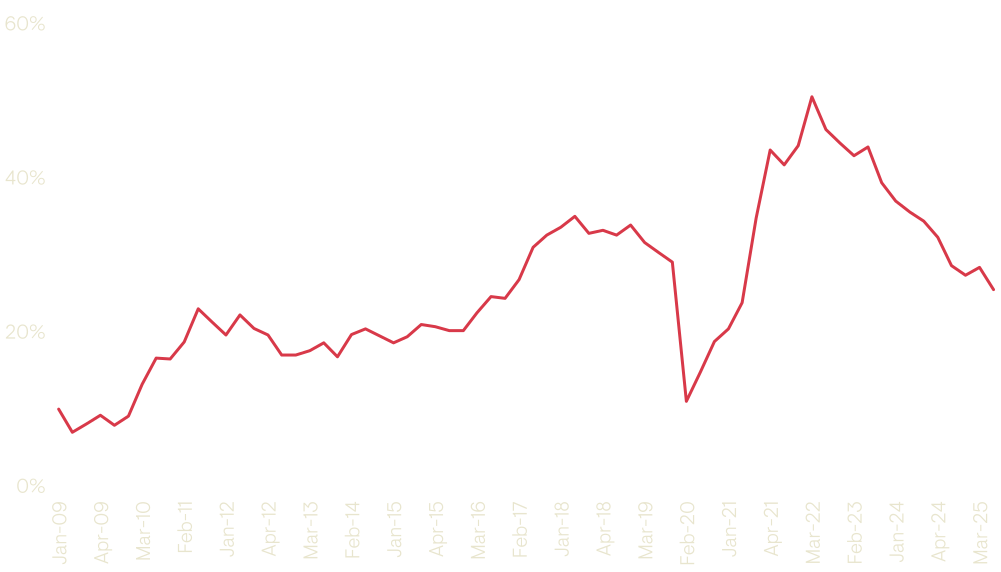
Source: ifo Institute, Business Survey (Germany). 2009–2025.
The online environment sharpens all of this. Digital platforms allow neglected issues to surface, but they also reward outrage, fear and conflict. In this way, grievance is not only expressed more loudly but is sustained and amplified and fed back into politics every day.
For investors, this matters because grievance changes policy choices. It makes tariffs, industrial subsidies, tighter immigration rules and fiscal promises more likely, while weakening support for multilateral institutions and making policy less predictable. That shows up in inflation, supply chains, fiscal paths and country risk.
New reality:
The fourth systemic crisis: a crisis of global integration
The forces shaping the 2020s, multipolarity, material bottlenecks and public dissatisfaction, are converging into a broader crisis of global integration.