Emerging Market Debt Indicator – August 2026
Our EM Debt team shares its latest outlook and positioning across the investment universe.

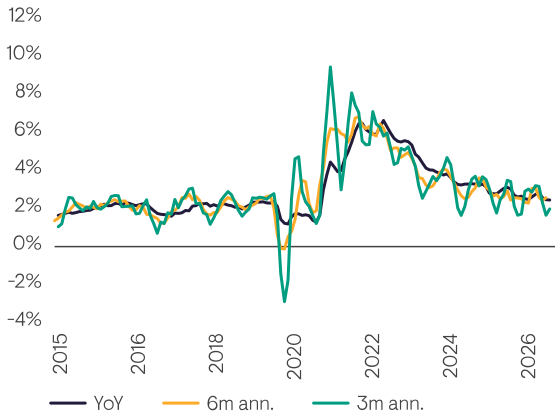
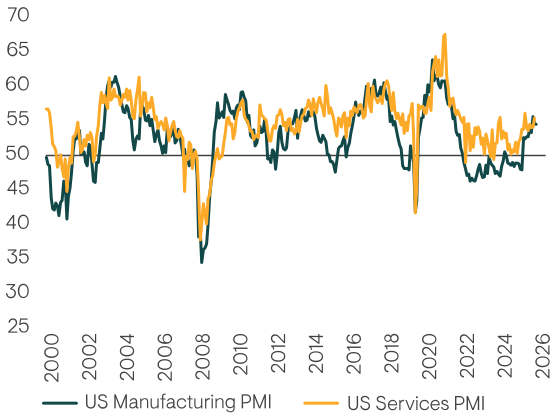
The US economy continues to demonstrate resilience, with economic data remaining buoyant, despite energy market headwinds and rising interest rates. The credit cycle continues to accelerate, with momentum broadening beyond private credit. In the near term, fiscal spending has supported consumers while artificial intelligence (AI) capex is supporting a broad investment cycle. Inflation momentum has turned negative; however, near-term volatility in energy prices poses renewed headwinds to disinflation. While growth headwinds have risen with higher interest rates and the Fed’s return to tightening, the strength of the underlying growth impulse is expected to continue supporting US risk assets in the near term. However, downside risks are rising, with valuations increasingly elevated across all areas of the equity market and the AI capex cycle potentially approaching its peak, with limited policy support expected. The lagged impact of tighter financial conditions over recent months presents additional headwinds as we move into 2027.
Figure 1: US core CPI
Source: Ninety One, September 2026.
Figure 2: US PMI
Source: Ninety One, September 2026.
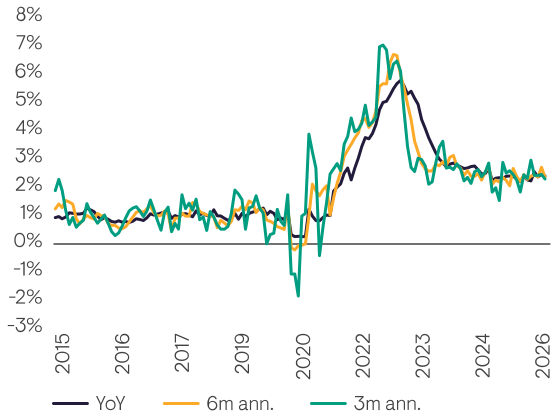
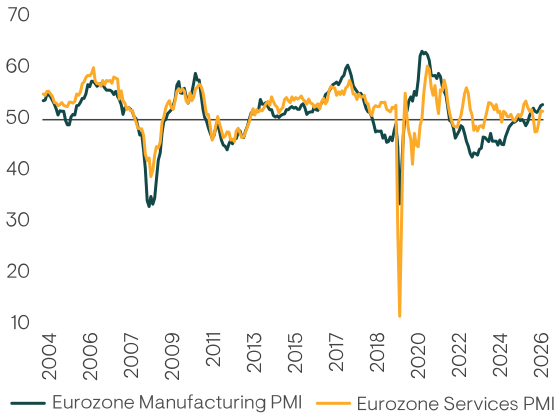
In Europe, economic momentum has rebounded strongly. The sustainability of this recovery will depend on the degree to which tighter policy and financial conditions and further energy price volatility weigh on consumers and businesses. While an improving credit cycle and expanding fiscal budgets in Germany and across Europe continue to pose upside risks, headwinds from higher interest rates, rising energy prices and uncertainty over the timing of fiscal support appear to be offsetting these in the near term. The European Central Bank has hiked rates to offset rising inflationary pressures and is likely to remain proactive, with a high sensitivity to inflation surprises. This increases the probability of further hikes, and, in turn, of a policy mistake. Political uncertainty in France has risen, adding further headwinds to growth and increasing stability concerns over European markets.
Figure 3: Euro core CPI
Source: Ninety One, September 2026.
Figure 4: Euro PMI
Source: Ninety One, September 2026.
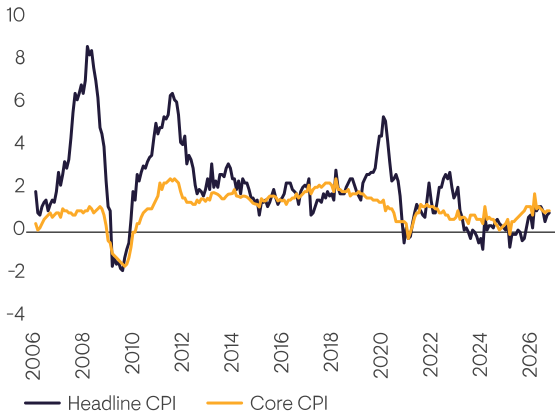
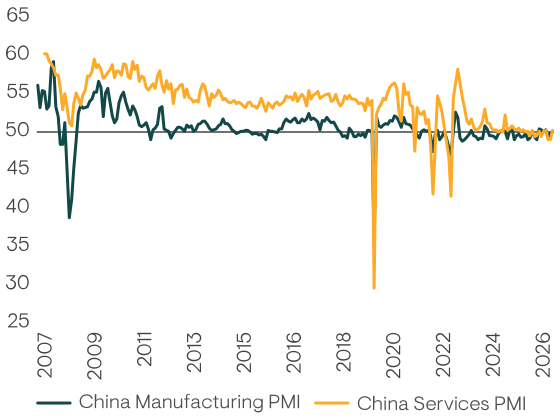
In China, weak domestic activity over the summer has driven authorities to renew easing efforts and support economic stabilisation to ensure they meet their growth target. Overall, Chinese authorities continue to prioritise domestic consumption as a driver of growth. The “special action plan” outlines a broad set of measures to shift the economy away from its recent growth drivers, high value-add industry and exports, towards domestic consumption. Constraints remain on how far they can ease and support growth. Recent data shows some signs of a recovery from a weak base, with consumer confidence improving and a potential near-term bottoming in the property market. However, the overall credit impulse suggests households are deleveraging, an ongoing headwind to any growth recovery.
Figure 5: China inflation
Source: Ninety One, September 2026.
Figure 6: China PMI
Source: Ninety One, September 2026.
Given our central investment roadmap, as discussed above, we continue to believe that risk assets will remain supported by a broad and robust growth backdrop in the near term. However, we acknowledge that downside risks are rising as central banks tighten policy and demand headwinds persist. Given elevated risks and stretched investor positioning across key areas of the equity market, we have been moderating our risk asset exposure at the margin and diversifying towards more defensive areas such as healthcare, and towards areas with broader performance drivers that have lagged more recently, such as the S&P 500 Equal Weight Index. In fixed income, valuations in defensive government bonds have reset notably, reflecting a reassessment of long-term real growth expectations. As a result, the longer end of yield curves and inflation-linked bonds are at levels that offer attractive diversifying qualities, in our view.
General risks. The value of investments, and any income generated from them, can fall as well as rise. Where charges are taken from capital, this may constrain future growth. Past performance is not a reliable indicator of future results. If any currency differs from the investor’s home currency, returns may increase or decrease as a result of currency fluctuations. Investment objectives and performance targets are subject to change and may not necessarily be achieved, losses may be made. Environmental, social or governance related risk events or factors, if they occur, could cause a negative impact on the value of investments.
Specific risks. Currency exchange: Changes in the relative values of different currencies may adversely affect the value of investments and any related income. Emerging market (inc. China): These markets carry a higher risk of financial loss than more developed markets as they may have less developed legal, political, economic or other systems. Commodity related investment: Commodity prices can be extremely volatile and significant losses may be made. Default: There is a risk that the issuers of fixed income investments (e.g. bonds) may not be able to meet interest payments nor repay the money they have borrowed. The worse the credit quality of the issuer, the greater the risk of default and therefore investment loss. Equity investment: The value of equities (e.g. shares) and equity-related investments may vary according to company profits and future prospects as well as more general market factors. In the event of a company default (e.g. insolvency), the owners of their equity rank last in terms of any financial payment from that company.
