Deutschland
Select your role
Kapitalmarktausblicke – März 2022
Das Capital Market Assumptions Modell von Ninety One legt den Fokus auf die wichtigsten Treiber der langfristigen Performance. Durch unsere Kapitalmarktausblicke können wir das Renditepotenzial verschiedener Anlageklassen besser einschätzen und erhalten eine bessere Informationsgrundlage für Kundengespräche. (Podcast in englischer Sprache)
26. Mai 2022
Multi-Asset team
Capital market assumptions - March 2022
Overview

Our framework emphasises income payments across asset classes, as they are both readily measured and pivotal in determining returns. In addition, long-term history is available, and income is less subject to manipulation than accounting metrics.
We divide returns into three components. The first – income – is a tangible, known entity, but the others are subject to material misestimation:
- Income: yield is historically the single most important explanatory factor for income-generating assets
- Growth: the extent to which income is expected to change over time
- Revaluation: the price per unit of income likely to apply at the end of the period (typically, 10 years)
This section is a summary of our approach; more detail may be found in the Methodology section.
Capital market assumptions - March 2022
Overview
This section is a summary of our approach; more detail may be found in the Methodology section.
Our framework emphasises income payments across asset classes, as they are both readily measured and pivotal in determining returns. In addition, long-term history is available, and income is less subject to manipulation than accounting metrics.
We divide returns into three components. The first – income – is a tangible, known entity, but the others are subject to material misestimation:
- Income: yield is historically the single most important explanatory factor for income-generating assets
- Growth: the extent to which income is expected to change over time
- Revaluation: the price per unit of income likely to apply at the end of the period (typically, 10 years)
This section is a summary of our approach; more detail may be found in the Methodology section.
Key takeaways
Asset owners face a real challenge over the next decade. The traditional approach to asset allocation is set to deliver very modest returns.
Our current capital market assumptions (31 March 2022) highlight a real challenge for asset owners: we anticipate a traditional 60% global equity, 40% global government bond portfolio will deliver a muted 2.8% annualised return for the next decade in nominal terms, when hedged into US dollars. This is only marginally lower than our expectations from 12-months ago but close to 3% down from our forecasts in March 2020 in the immediate aftermath of the COVID sell-off. The uplift available from higher risk fixed income assets only modestly increases a balanced portfolio return expectations and brings higher correlations to equities. In such a low-return environment, we believe there is a need for considerable value-add from asset allocation and security selection decisions as well as from identifying investments that will benefit from structural growth tailwinds to achieve investment objectives.
Historical effectiveness
We tend to evaluate effectiveness in terms of getting the direction of travel correct.
Long-term predictions are fraught with uncertainty and open to error. We can, however, retrospectively apply our framework to assess its historical effectiveness. Because we focus on contextual information, we tend to evaluate effectiveness in terms of the reliability of the direction of the signal at market peaks or troughs; getting the broad direction of travel correct over a decade is a critical factor in an overall investment outcome.
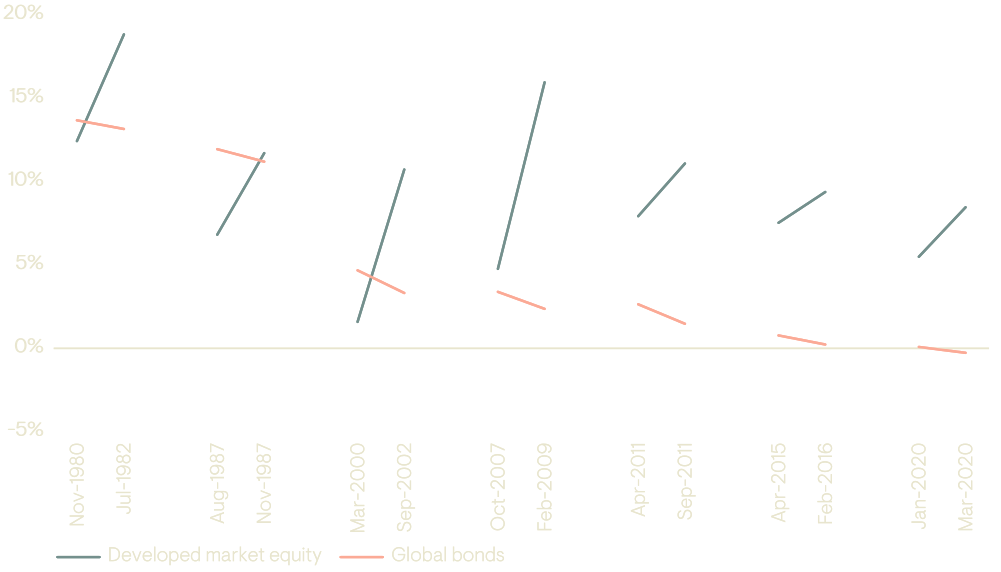
The following chart identifies a variety of market peaks and subsequent troughs, stretching back to 1980, for each of developed market equity and global bonds. We then show the subsequent 10-year predicted returns at those points.
Expected returns can vary significantly depending on the point of the cycle
Source: Ninety One. Data is global since 2000; prior dates based on US outcomes. Bonds based on 10-year tenor
For example, the first point on the chart corresponds to November 1980 (roughly a market peak) followed by a trough in July of 1982. The relevant 10-year forecasts in each instance were:
| Peak | Subsequent Trough | |
|---|---|---|
| Developed Market Equity | 12.4% | 18.8% |
| Global Bonds | 13.7% | 13.2% |
Indeed, global equities tripled in the decade from November 1980, and rose fourfold from July 1982. The chart illustrates the desired pattern – riskier assets tend to have lower anticipated 10-year returns at peak than they do at the subsequent trough; conversely, the more defensive bond asset tends to do better at the peak than the trough. Interestingly, although this pattern is repeated over time, it does appear to be getting more compressed – perhaps due to the expansive liquidity provision over this period.
Fixed income
Returns in fixed income edge up compared to last year’s assumptions across government bond and credit markets.
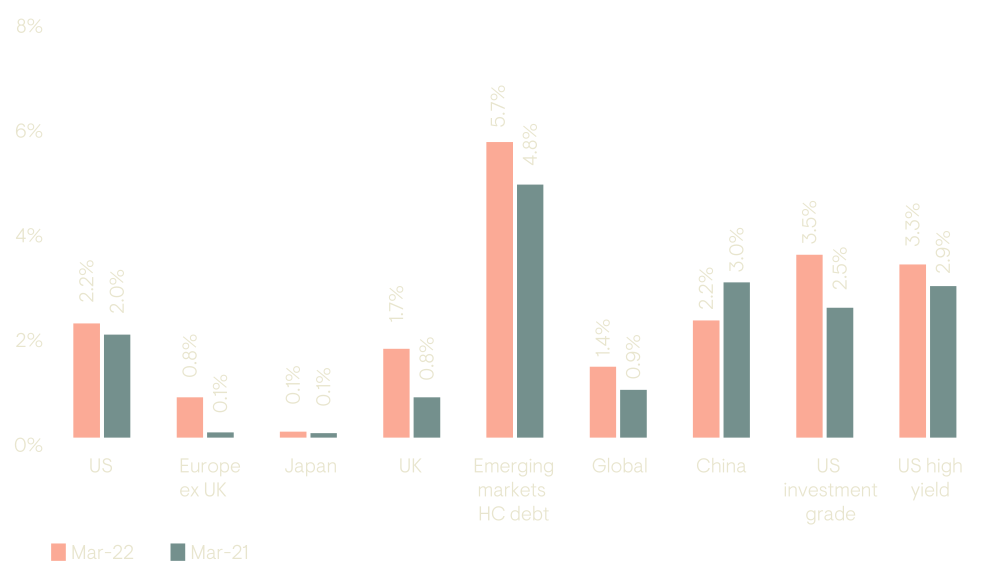
The following chart examines fixed income assets in nominal, local currency terms, for March 2022 versus a year prior:
Sovereign bond yields and credit spreads have both increased, leading to somewhat higher return expectations
Source: Ninety One
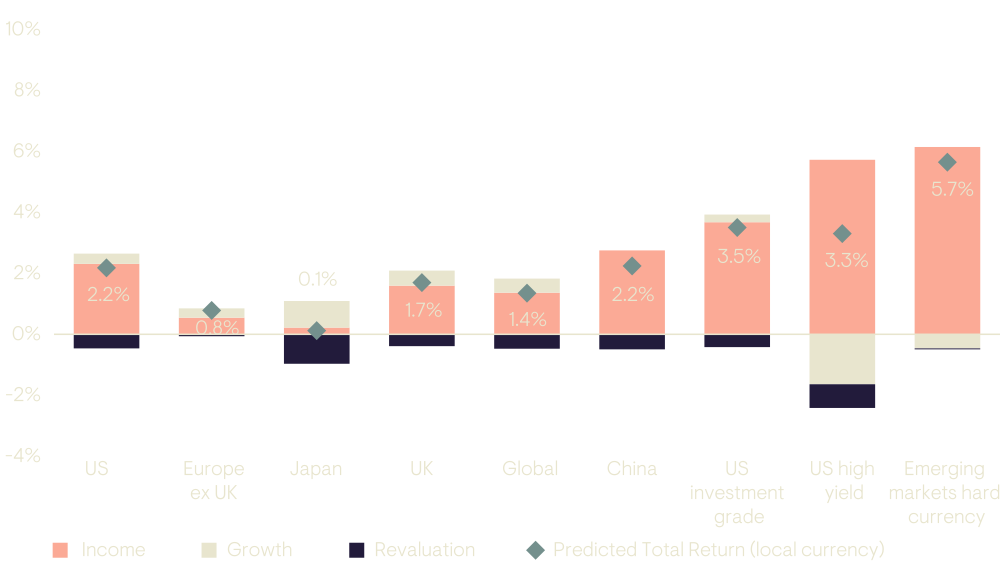
Actual and expected increases in policy rates from central banks have pushed global government bond yields up, which results in higher return expectations from both income and valuation with a smaller negative impact forecast from mean reversion. Yield curves have flattened which reduces the expected uplift from roll returns and means that at the global level the increase in expected returns over the past 12 months of 0.4% (in local currency terms) is slightly less than the increase in yields of 0.6% over the same period. In contrast with other economies, Chinese monetary policy has moved into an easing cycle helping yields on government bonds to decline over the last year and bringing down return expectations.
Credit spreads have also increased which has provided an additional source of higher return expectations across US Investment Grade and High Yield corporate credit and Emerging Market sovereign credit markets. The changes in spreads and in overall return expectations was smallest in the US High Yield market, with the result that lower returns are now expected from US High Yield credit than from US Investment Grade credit, which is discussed in more detail below. US High Yield credit spreads are still some way below their long term average levels, leading us to continue to forecast a negative return impact from mean reversion in credit spreads over the next ten years. By contrast, Investment Grade spreads are now in line with their average level and EM Sovereign spreads have risen to above average levels, creating an expectation of a modest uplift from mean reversion.
The following chart sets out our return forecasts in more detail, dissecting fixed income regions in the context of our Capital Market Assumptions framework pillars: income, growth and revaluation.
Income and Growth account for the bulk of return potential across fixed income
Source: Ninety One
Case study
01 Investment Grade vs High Yield returns – duration risk vs credit risk
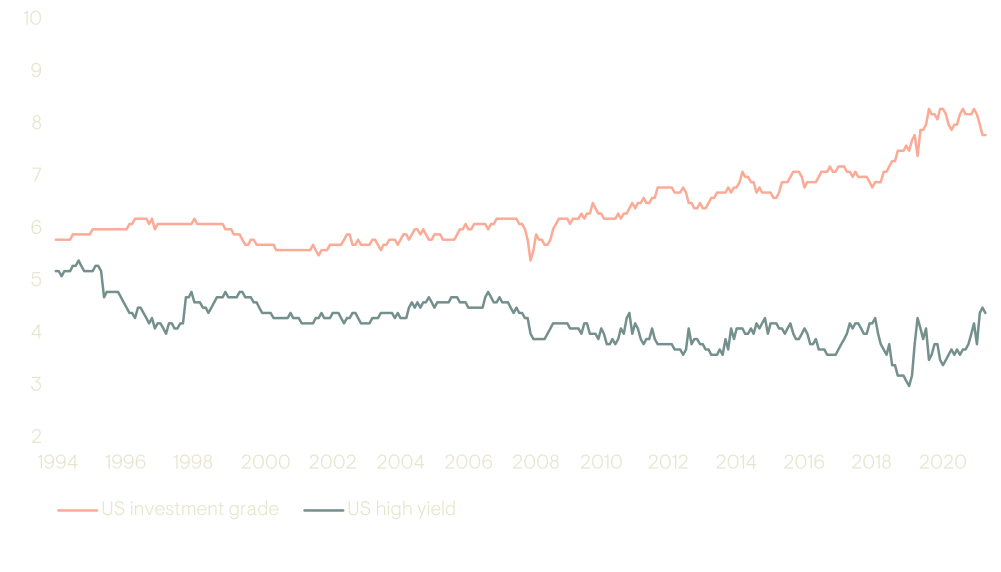
The duration of the US Investment Grade credit market has steadily increased as higher quality businesses have taken advantage of low interest rates to extend the maturity profile of their debt. By contrast, the duration of the US High Yield market has stayed relatively constant over time as lenders are less prepared to underwrite long maturity debt for companies with lower credit ratings and many high yield bonds are issued with call features.
Higher quality corporates have always been able to issue somewhat longer maturity debt than lower rated companies but, prior to the GFC, the difference in duration risk was small enough that investors could focus on credit risk as the predominant driver of relative returns. As maturity and duration profiles have diverged, it has become increasingly important to understand the different combinations of risk and return drivers across corporate credit markets.
Modified duration (to worst)
Source: ICE BofA Bond Indices
To account for this difference, we model US Investment Grade as a constant maturity 10 year bond and US High Yield as a 5 year bond which closely resembles the value-weighted average of the overall markets.
Our total return forecasts for credit markets combine returns from the underlying government bond market with the credit specific returns. The table below splits out these different drivers of returns to give a clearer understanding of why High Yield returns appear likely to disappoint relative to Investment Grade returns.
| US Investment Grade | US High Yield | |||||
|---|---|---|---|---|---|---|
| Government | Credit | Total | Government | Credit | Total | |
| Income | 2.3% | 1.4% | 3.7% | 2.4% | 3.3% | 5.7% |
| Growth | 0.3% | -0.1% | 0.3% | -0.2% | -1.5% | -1.6% |
| Revaluation | -0.5% | 0.0% | -0.4% | 0.1% | -0.9% | -0.8% |
| Total Return | 2.2% | 1.3% | 3.5% | 2.4% | 0.9% | 3.3% |
Source: Ninety One
Counterintuitively, this suggests that the greater duration risk in Investment Grade is not associated with higher expected returns and the greater credit risk in High Yield appears set to deliver lower returns than the credit component of Investment Grade. The similar expected returns from 5 and 10 year US Government bonds are a straightforward reflection of the slightly inverted yield curve observed at this point in time. High Yield credit spreads are significantly higher than Investment Grade credit spreads but expected credit losses are far higher. High Yield credit spreads are well below their historic average levels and are expected to revert towards average over the forecast horizon whereas Investment Grade credit spreads are currently in line with their historic average. There is an underlying logic here in that market pricing could be said to embed an expectation that future credit losses from high yield will be lower than in the past and therefore the fair value of credit spreads is lower than our model suggests.
Looking at the history of our modelled expected returns from the credit component of High Yield credit, we see that it is unusual but not unprecedented for this forecast return to be as low as it is today and to be below the forecast for the credit component of Investment Grade returns.
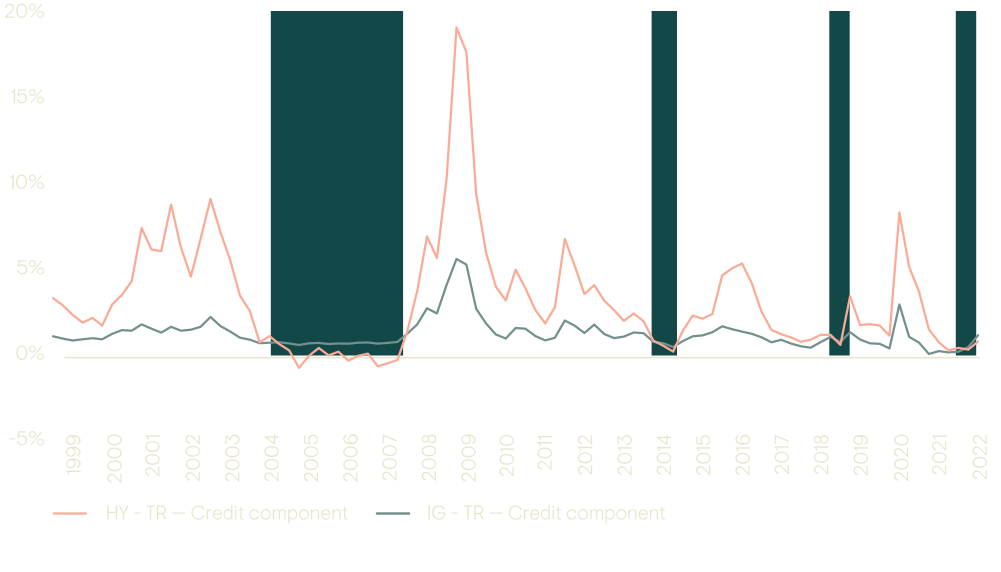
This has happened historically at the peaks of previous credit cycles, when defaults were running at very low rates and market pricing embedded an expectation that these low realised losses from High Yield credit could persist for a meaningful period. The shaded areas in the chart highlight the periods where the credit component of High Yield was forecast to deliver a lower return than the credit component of Investment Grade. The two most recent episodes in 2014 and 2018 proved relatively short lived and a downturn in the credit cycle followed shortly thereafter. This environment did persist for several years after the initial point where High Yield returns fell below Investment Grade in 2004. In retrospect however, this period is now viewed as a bubble in US credit which set the scene for the crisis in 2008 – 2009.
Equities
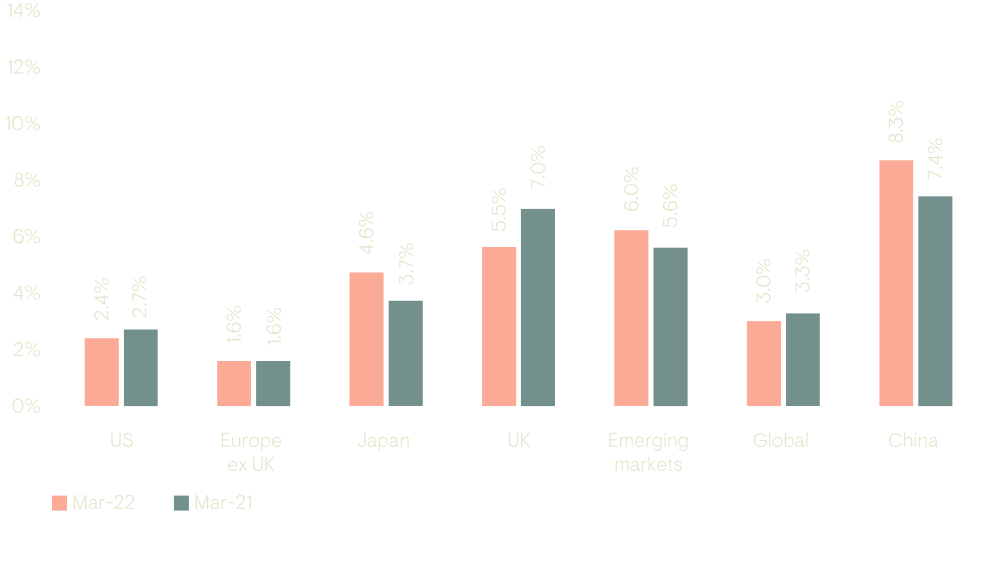
A year of divergent regional performance means that whilst return expectations have fallen further at the global level, the range of expected outcomes in different markets has widened.
The best performing equity markets over the last twelve months were the UK and US, both delivering double digit total returns. With the US market now making up over 60% of global market capitalisation, Global equity returns were similarly positive. Income and growth forecasts for Global equities were little changed over the last 12 months but total return forecasts have fallen as a result of expectations of a more negative impact from valuation reversion.
Europe ex UK and Japan both delivered more modest positive returns over the last year but the real underperformers were in Emerging Asian equity, most notably China which declined more than 30% over the 12 months. This decline has seen return expectations for income and revaluation increase materially for both China and Global Emerging Markets. This is slightly offset by a downward revision to the structural growth forecast for the Chinese market which is explained in box 2 below.
Global equity return forecast has fallen further but regional divergence has widened with expected returns rising across Asian and Emerging Markets
Source: Ninety One
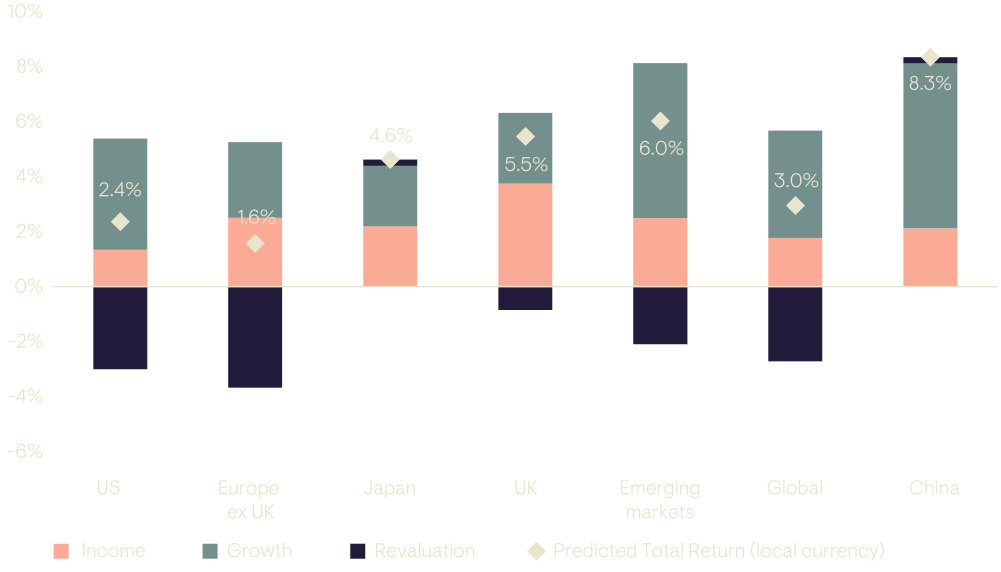
When we look at the components of our forecasts for equities, we see that the entire anticipated return (bar the UK and Japan) is driven by the growth assumptions over the next decade as the current level of income is low by historical standards and more than offset by the drag expected from mean reversion in valuations. At the same time, our growth forecasts imply a meaningful deceleration in dividend growth from the rates achieved over the last 20 years. In box 1, we study the drivers of dividend growth, showing how the robust growth of the last two decades has been achieved and why it is unlikely to be repeated in the coming decade.
China and Emerging markets offer returns which are particularly attractive when compared to the lower expected returns in the US and Europe ex UK
Source: Ninety One
Case study
01 Why is the outlook for growth from equity markets relatively subdued?
Over the last two decades, global corporate earnings and cashflows have grown at historically rapid rates even as trend GDP growth has slowed and we have experienced both a once in a century global financial crisis and a pandemic. Analysing the drivers of this exceptional period of corporate performance and examining the long run historic data, we conclude that a similar outcome over the next ten years should be seen as a low probability scenario.
The forecasts used in our Capital Market Assumptions for equities focus on dividends per share (DPS) as the income stream which drives returns for shareholders. We can also decompose growth in dividends per share into 4 components and consider the outlook for each independently:
| Revenue growth |
| + Change in net margin |
| + Change in dividend payout ratio |
| - Net equity issuance |
| = Dividend per share growth |
To look ahead to the next decade, it is instructive to start by looking back at the experience of history to illustrate how large the influence of each of these 4 drivers has tended to be and how they have varied.
The longest and richest data sets by far cover the US equity market so we will focus there. Whilst this inevitably misses interesting details in other regions, it will capture the most important factors for the market which currently makes up over 60% of global equity market capitalisation. Robert Shiller’s publicly available S&P500 index data provides earnings per share (EPS) and DPS going back over a century but the published data for S&P500 margins and net issuance only provide around 40 years of history. To extend this, we use the National Income and Product Accounts data tables from the US Bureau of Economic Analysis to estimate S&P500 margins prior to 1990, augmented by net issuance data from Kuvshinov & Zimmerman’s “The Big Bang: Stock Market Capitalization in the Long Run”. This results in a consistent data set for the period December 1935 to December 2021.
When we compare the period since the cyclical peak in 2000 to the long run data, we see that DPS has grown faster in the recent period despite revenue growth having been less than half the long run average. This has been made possible firstly by exceptional margin expansion, which has accounted for over 1/3 of DPS growth since 2000. Secondly, payout ratios have also increased over the period, whereas, in the long run, we expect no significant overall contribution from changes in margins and payout ratios. Finally, the US market has experienced a structural shift from a historical position where net issuance of equity modestly diluted existing equity owners year after year, to an era of net equity retirement which has been accretive to growth for ongoing shareholders.
Contribution to annual dividend per share growth
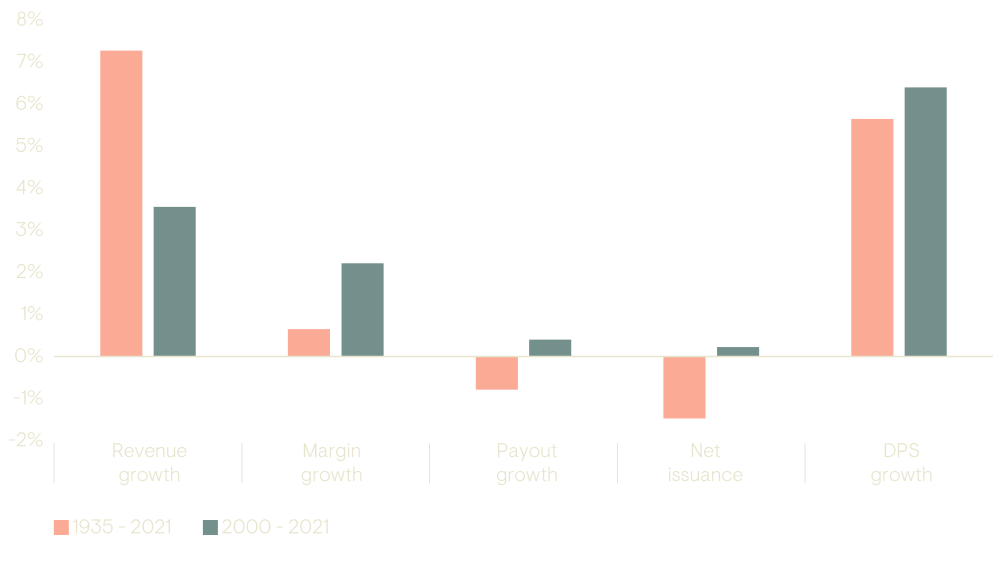
This same decomposition of DPS is shown in the chart below on a rolling 10 year basis
Contribution to annual dividend per share growth (rolling ten years)
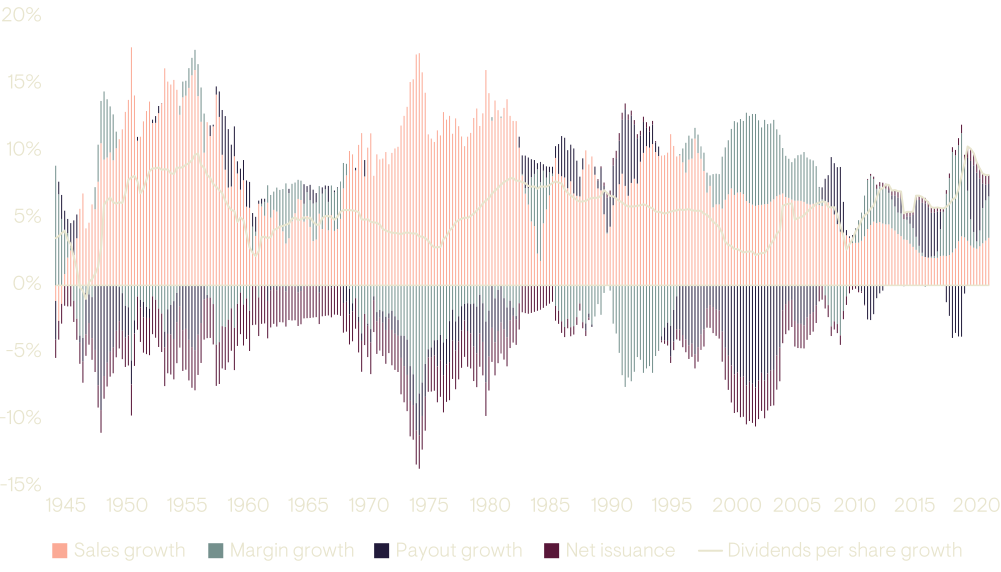
Based on the historic outcomes we observe:
- 10 year DPS growth has been relatively stable in the mid to high single digits with one brief exception following the end of the second world war
- Revenue growth has been the only component which has been positive throughout but has been more variable than dividend growth, ranging from low single digit to mid teen annual growth rates
- Changes in margins and payout ratios have had close to zero impact on growth on average, with periods of positive contributions similar in frequency and scale to periods of negative contributions
- Net issuance has diluted returns for most of history. Use of share repurchases expanded following legislative change in 1982 and this saw repurchases slightly exceed issuance of new equity in the 1980s and again in recent years. The positive impact on growth from these periods of negative net issuance was insignificant in absolute terms but marked a change from historic rates of dilution which had averaged 2-3% per annum
Focusing on the last 20 years, we see a highly unusual confluence of positive drivers –
- DPS growth trended higher, peaking at the highest rate over the entire period and remaining at a very elevated level in the latest reading. Growth was last at similar levels in the roaring 50s, with quite different inflation and growth outlooks
- This happened at the same time as revenue growth rates slumped to close to the lowest levels seen historically, in line with the slowdown in the trend rate of GDP growth
- All 4 drivers have been firmly positive on average over this period, something not seen in any prior 10 year period
The positive contribution from higher profit margins is a particularly notable factor in recent corporate performance. If we look at our long term margin series we can see that dramatic margin expansion has taken place over the last 30 years, taking net profit margins up to the highest levels achieved historically.
S&P500 net profit margin
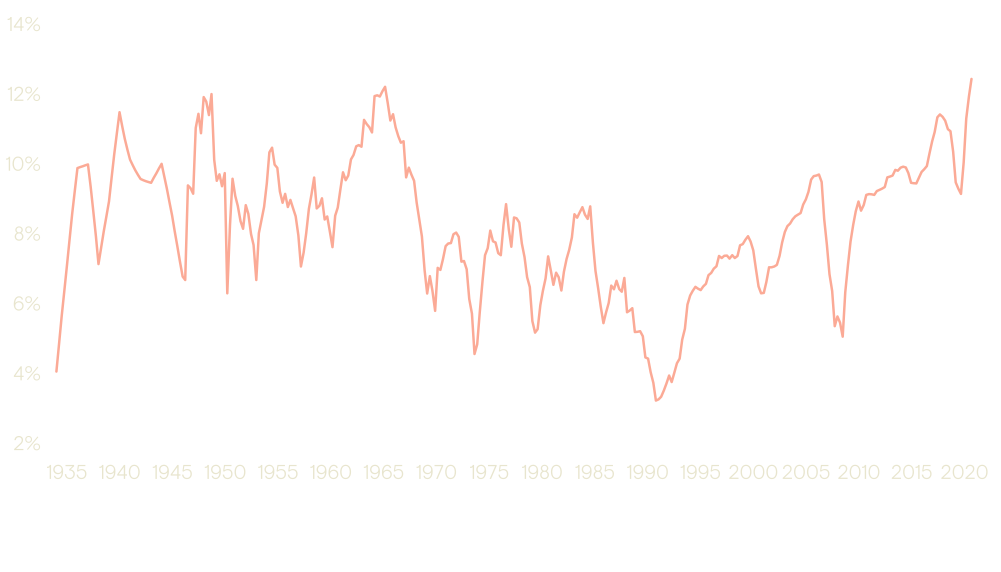
Margins have not however been reliably mean reverting on a ten-year basis with notable structural breaks or trending periods alongside more stable range bound eras,
- from the 1940s to 1960s net margins broadly held in a range of 8 – 12% with short, regular cycles
- in the 1970s and 1980s the average level shifted down and the range tightened somewhat to 6-8% typically, whilst the short cycles remained
- after a dip to a depressed level at the start of the 1990s, margins trended significantly higher over the next 30 years, the cycles remained but became more elongated, going on to make new highs after every downturn
This makes a simple assumption of mean reversion in margins problematic. Instead we take a more modest approach, assuming that in the absence of compelling fundamental arguments, the current level of margins is the best available forecast for future margins. Therefore we do not incorporate any impact from changes in margins into our current dividend growth forecasts.
There have been multiple underlying drivers of the trend to higher margins and some of these may well be structural in nature and will support sustained high margins for a significant time yet. In particular, the compositional shift away from asset intensive industry towards asset light, intangible based business models appears durable. Low growth in real wages and regulatory acceptance of increasing concentration and market power have become politically sensitive topics and whilst major regulatory overhaul is not yet on the horizon, these are unlikely to be substantial sources of further margin expansion in the foreseeable future. By contrast, the long-term declines in corporate tax rates and interest costs may already have passed inflection points, potentially switching from modest tailwinds for margins to headwinds from here. New constraints on margins may also emerge over time: in manufacturing industries, any move away from just-in-time inventory management or to build other redundancies into supply chains would be expected to be negative for margins whilst an environment of higher and more volatile inflation and commodity prices would be most challenging in industries where purchases of raw materials make up a large portion of the cost base.
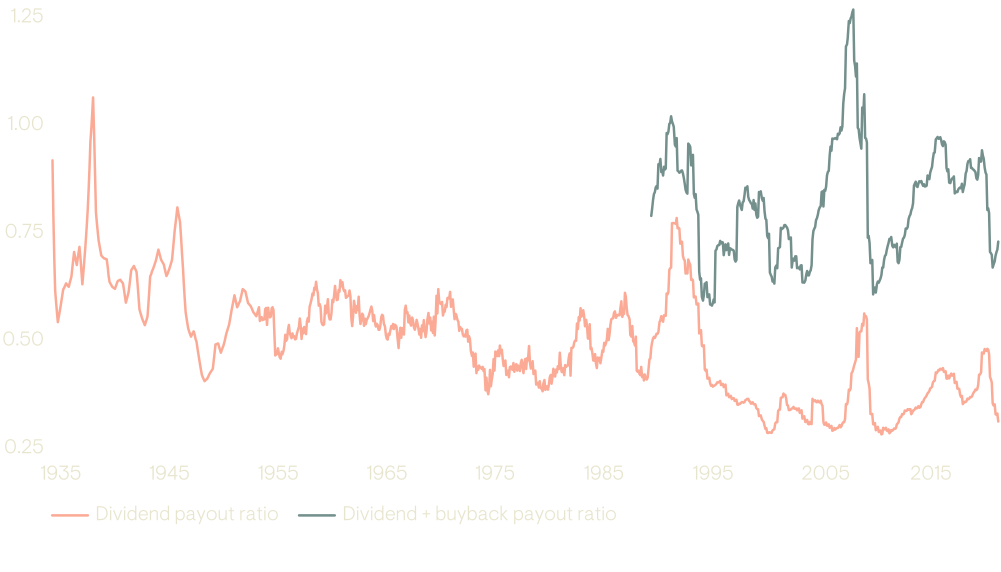
Dividend payout ratios also appear to have been through different regimes over the long term and show limited predictability on a ten-year basis. Whilst current payout ratios appear low relative to long run average levels, this neglects the return of capital through share repurchases. To enable a like-for-like comparison, we add the cashflows used to buy back shares (adjusted for stock-based compensation) to those paid as dividends. (Data in this form only starts in 1990 so we cannot show the first buyback boom in the 1980s).
Whilst share buybacks reduce the stock of equity capital outstanding and are hence accretive for ongoing shareholders, other corporate transactions dilute ongoing shareholders through the issue of new equity capital. Throughout the majority of the 20th century, the net impact of all these corporate actions resulted in 1-4% of net issuance per annum as a percentage of market capitalisation of the US equity market. This represented a relatively steady dilution of the growth experienced by existing investors. The step change in the use of share repurchases in the 1980s drove net issuance negative for the first time later in that decade. The TMT boom of the late 90s then saw a dramatic increase in primary issuance, with net issuance making a new high in 2000 of over 6% of market cap. In this century, primary issuance has been more subdued and, in most years, large ongoing buyback policies have led to negative net issuance overall. Emergency secondary issuance in the wake of the GFC briefly took net issuance back into positive territory and booming market conditions in 2021 brought a relatively short-lived resurgence in primary issuance. Our forecasts assume that recent trends in net issuance persist and so reflect the recent experience, with modest negative net issuance in the US and modest positive net issuance in most other markets where regulatory factors typically make repurchases somewhat less prevalent.
Net issuance (rolling 12 months)
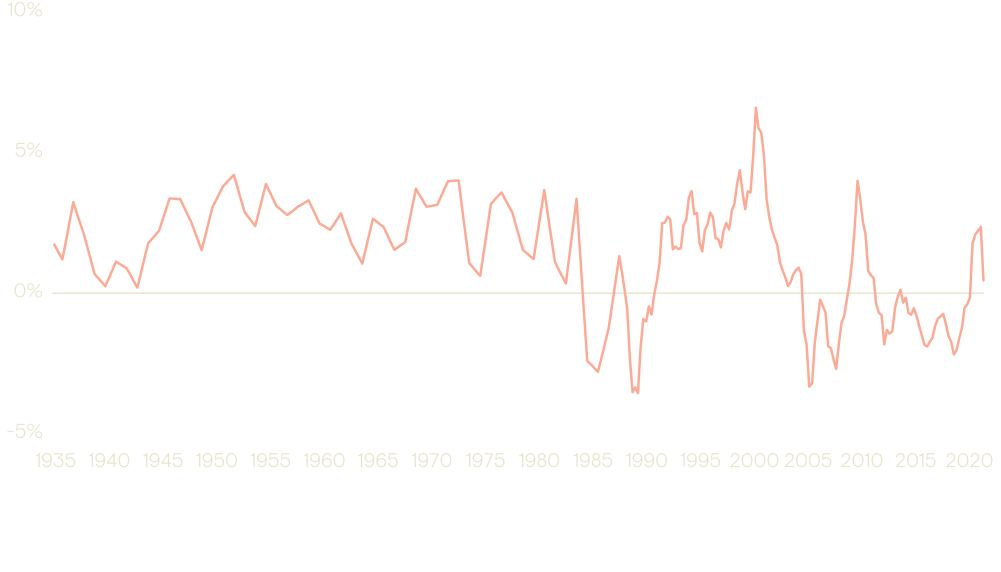
The above shows that, in aggregate, US corporates have been paying out a larger proportion of net income to shareholders in the last 20 years than for most of the prior century. Even in a low growth environment where attractive reinvestment opportunities are more limited, there appears to be relatively little scope for a further increase in the average payout ratio to provide a sustainable source of additional dividend growth.
02 A slower growth outlook in China
China’s ascent over recent decades has been labelled an economic miracle. The International Monetary Fund (IMF) estimates that over the 30 years to the end of 2021, Chinese real GDP per capita increased more than tenfold, from $1,500 to $17,500 (in constant international US dollars) and China’s share of global GDP increased from 4% to 19% (at purchasing power parity), making it the second largest economy in the world today. The fundamental planks of this exceptional period of economic growth are usually taken to be the economic reforms initiated by Deng Xiaoping in the 1970s, urbanisation and China’s emergence as a trading powerhouse since becoming a member of the World Trade Organisation (WTO) in 2001.
Growth on this scale cannot continue indefinitely and indeed, in recent years, the power of these growth engines has started to wane. In the period since the GFC, economic growth has gradually slowed and has become increasingly dependent on ever greater leverage in the economy. The real GDP growth target set for 2022 of “around 5.5%” is the lowest target in over 30 years, with many economists doubting that even this level of growth can be achieved.
Our dividend growth estimates start from the trend rate of growth in nominal GDP per capita over the last 15 years. Where we have a strong reason to believe that a structural shift in the underlying rate of growth is likely to occur within our ten year forecast horizon we can adjust the trend growth rate higher or lower to take account of the changing outlook. Evolution of the economic data over a number of years and the outlook provided by Chinese policy makers suggest that China is undergoing just such a structural change and we have therefore attempted to quantify the adjustment which is required to trend growth to account for this.
Whilst the modern Chinese economy is unique in many ways, the path that it is has taken shares similarities with other countries which have enjoyed periods of rapid economic development in the past. We believe that looking at some of the closest historical analogues can provide a guide to the most likely outcomes for an economy in a similar place to where China is today.
The key characteristics which we are looking for to identify historically analogous are:
- A sustained period of very strong growth
- GDP per capita and living standards converged towards those of high income countries
- Growth rates peak and decline gradually
There are three examples in recent history which fit this pattern most closely
- German Wirtschaftswunder / post WWII reconstruction
- Japanese industrialisation
- Asian tiger economies (Hong Kong, Taiwan, Singapore, South Korea)
The Maddison Project database provides long histories for GDP per capita data at the country level in constant international USD. Whilst this not directly comparable to the nominal LC figures used in our return forecasts it has the advantage that it allows to focus on real productivity and capital growth rates which we expect to slow as an economy matures.
The chart below shows trend growth in GDP per capita in China as well as the three historic ‘economic miracles’, with a clear acceleration and subsequent decline in growth rates in each case.
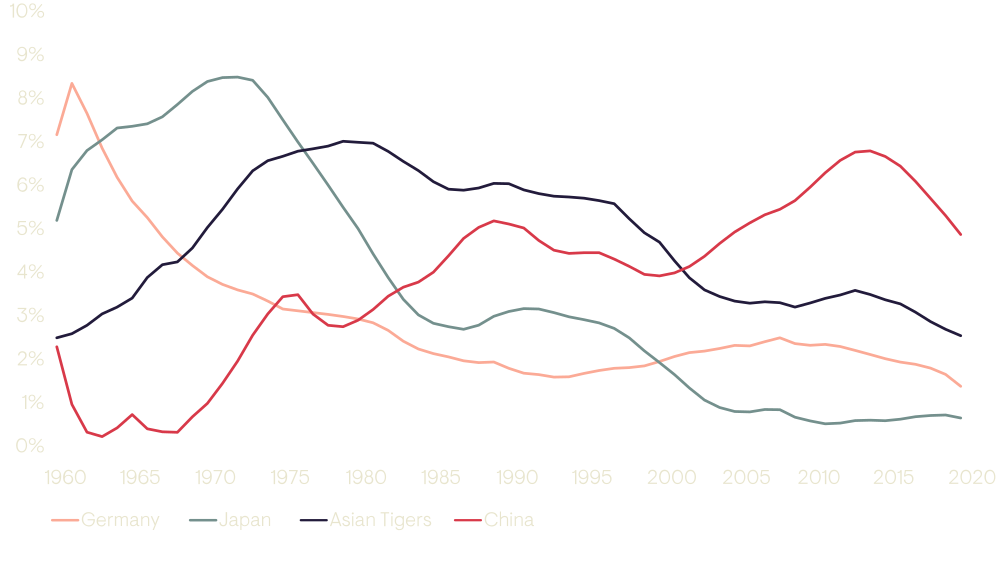
To further quantify the scale of these historic growth slowdowns, we identify the decade of peak growth in each case and examine how growth rates changed over the subsequent 2 decades. To capture broad changes in medium term growth trends, we take the trend growth rates at the end of each calendar decade rather than the precise peak in growth. Using decades is no less arbitrary than cherry picking the peaks and troughs and provides a smoother basis for identifying structural changes.
Chinese Growth peaked in the late 2000s – early 2010s so we have already been through the first decade of this slowdown and our forecasts are looking ahead to the second decade of slowing growth.
| Country | Peak growth decade |
Trend GDP per capita growth (constant international USD) | |||
|---|---|---|---|---|---|
| Peak decade | decade 2 | decade 3 | Change vs peak decade | ||
| Germany | 1950s | 7.2% | 4.0% | 3.0% | -4.2% |
| Japan | 1960s | 8.4% | 5.1% | 3.2% | -5.3% |
| Asian Tigers | 1970s | 7.0% | 6.1% | 4.8% | -2.3% |
| China | 2000s | 6.0% | 4.9% | ||
| Average | 7.6% | 5.0% | 3.6% | -3.9% | |
| Median | 7.2% | 5.1% | 3.2% | -4.2% | |
The historical analogies suggest that Chinese GDP per capita growth over the next ten years is likely to fall to somewhere around 2 – 3% per annum, on the basis that –
- Chinese growth peaked at 6% and the average decline from the peak decade is 4%
- Declines were larger in the 2 early examples but the rate of decline in China to date more closely resembles the Asian tiger economies than the steeper initial falls in Germany and Japan
- The average and median growth rates in decade 3 are a little over 3%
- In the historic analogues, the growth slowdown took hold as the level of GDP per capita approached that of the richest 10% of countries at that point in time. China’s GDP today is only at the level of the median country, albeit with wide divergence within China between the richest cities and provinces and the remaining large rural population. This suggests that China could have more catch-up potential left than our earlier examples and growth may continue to decline at a gentler pace.
- On the other hand, relative to earlier periods, the external environment may be less helpful from here and past tailwinds from technological advance and globalisation have faded
GDP per capita (2011 international USD)
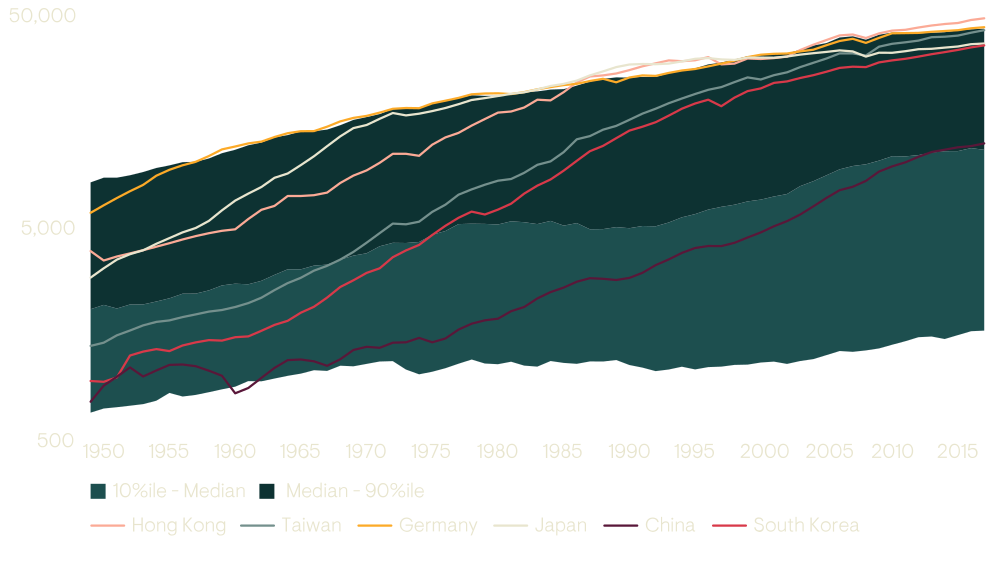
Source: Maddison Project database, 2020
Overall, it seems reasonable to expect trend GDP per capita growth to fall to around 2.5% in ten years’ time. This also represents a slowdown of 2.5% from the current level and we apply this as an adjustment to our dividend growth estimate for Chinese equities. This is reflected in the forecasts published as at 31 March 2022.
Currency
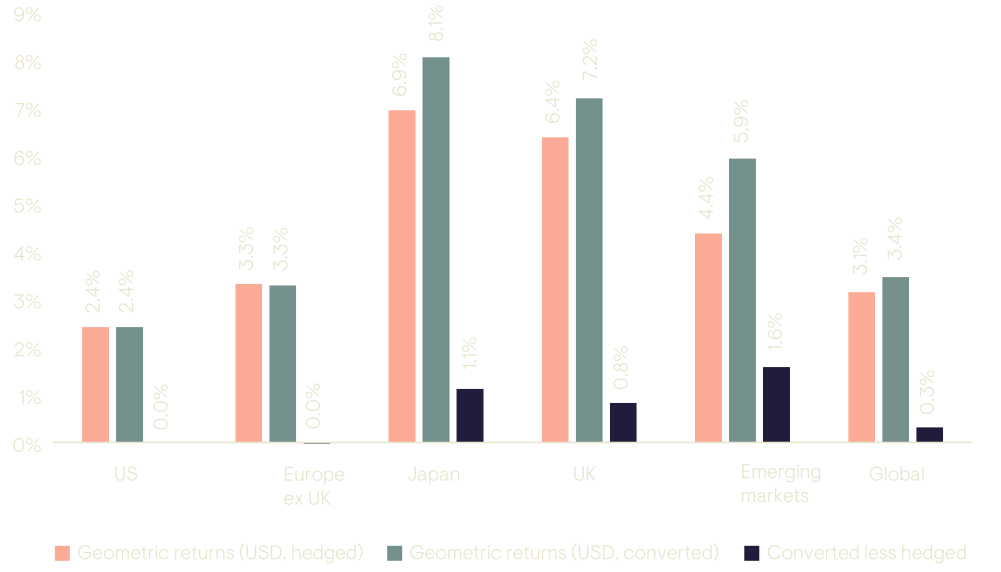
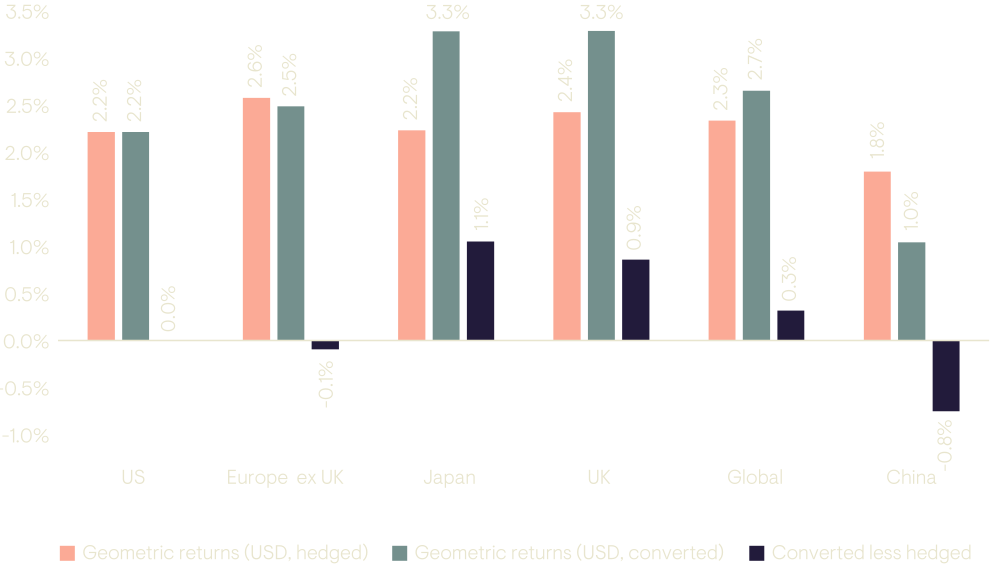
The currency decision – particularly whether to use ‘hedging’ or ‘conversion’ – can have a material impact on the outcome.
While we calculate our expected returns on a “local currency” basis, we appreciate that clients need to take a currency decision – whether to hedge or not. We therefore show each of our equity and fixed income assumption on these two bases – hedged (using interest rate parity) and unhedged / converted (based on real exchange rate reversion):
Equity expectations
Fixed Income expectations
Source: Ninety One
Methodology
We focus on fundamentals. We divide returns into three components. The first is known and widely available, but the other two are subject to material misestimation.
Predicting long-term returns is fraught with difficulty; market values are not only determined by fundamentals, but also sentiment and exogenous events. We aim to keep things as straightforward as possible, and therefore focus on fundamentals. We:
- Favour simplicity to capture the key drivers and accept wide uncertainty bands
- Strive for consistency with the investment process, focussing on cashflows
- Aim to be comprehensive across asset classes, with the ability to extend within
We divide returns into three components. The first is known, more readily measured and widely available in the public domain, but the other two are subject to material misestimation:
- Income – yield is the single most important explanatory factor for income-generating assets
- Growth – the extent to which income will likely change over time
- Revaluation – the price per unit of income likely to apply at the end of the period
By default, we assume a 10-year investment horizon, to reflect the fact that we are long-term stewards of client capital. We do not consider tax, given different requirements pertaining to different mandates. The approach we outline is our baseline estimate; we may make judgemental adjustments to the underlying drivers if warranted.
Here we set out our methodology for equities, fixed income and currencies:
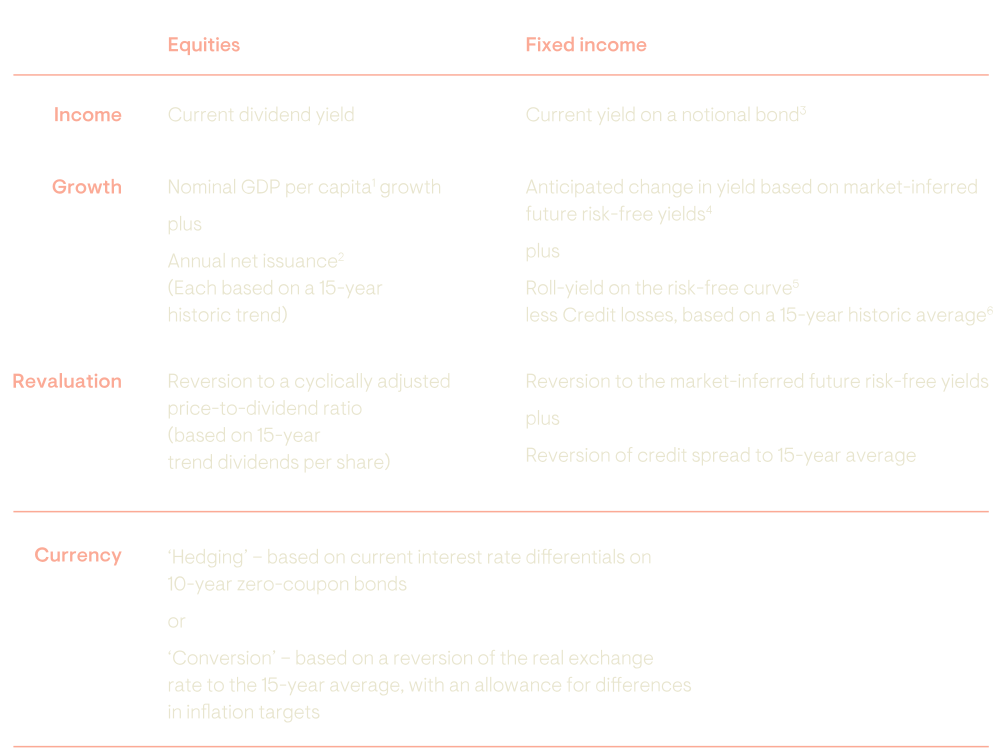
1 Where a market has a high proportion of overseas sales, we use the average of the local and global nominal GDP per capita trend growth rates.
2 Uses the average of local and global issuance trends given lower predictability for more specific universes and a belief in global convergence. Overrides may also be applied where local figures are volatile.
3 Yield to Maturity based on notional 10-year bonds (except in the case of High Yield, where 5-year bonds are used)
4 Credit spread curve data tends to be unreliable; we presume because the notion of quality changes with tenor. We therefore assume a constant spread
5 This is an implicit allowance for rebalancing of the constant maturity bond
6 Based on Moody’s default data
Equities
Equities are assumed to be purchased on a buy-and-hold basis. We use relevant MSCI indices to reflect the regions.
We proxy income with dividends. While many equity investors prefer to focus on earnings, we regard dividends as being less subject to manipulation – these distributions are a tangible payment that is publicly available information – and therefore more reflective of the long-term fundamental cash-generating properties of the broad market. While other metrics (e.g. free cash flow) have evolved, they do not yet have similarly long history.
The history of US dividends stretches back over a century
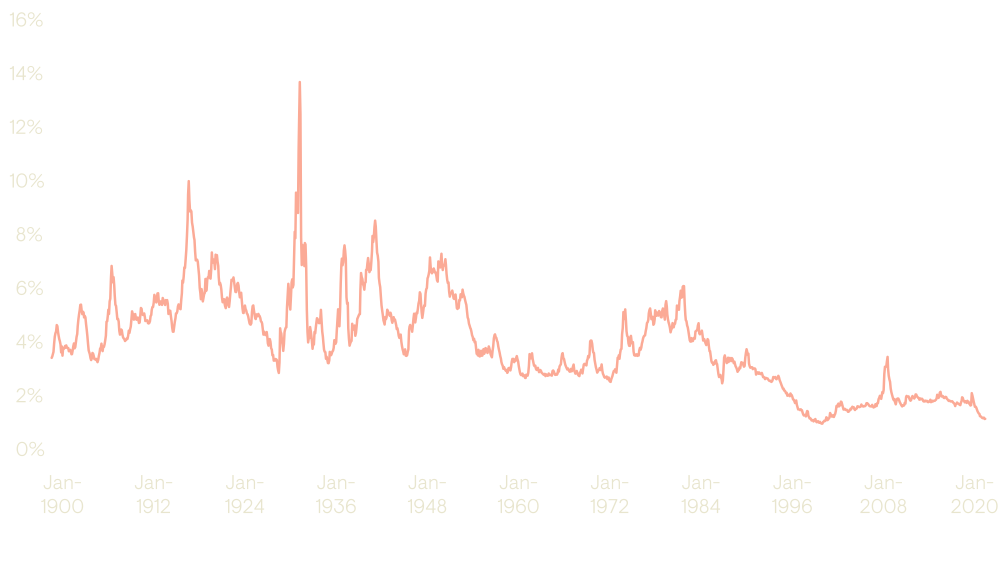
Source: Shiller, U.S. Stock Markets 1871-Present and CAPE Ratio
In this context, growth primarily relates to an equity market’s ability to increase dividends over time. GDP per capita has historically proven to be a reasonable proxy for dividend growth – and a closer match than GDP itself, as illustrated below. We simply allow for the global effects of growth based on the extent of non-domestic revenue exposure, assuming developed market growth is an average of local and global growth, while emerging market growth is wholly determined locally7. Growth is proxied based on trailing 15-year trend growth, a period that captures the secular effects of a couple of cycles.
Nominal GDP per capita has proved a useful proxy for dividend growth
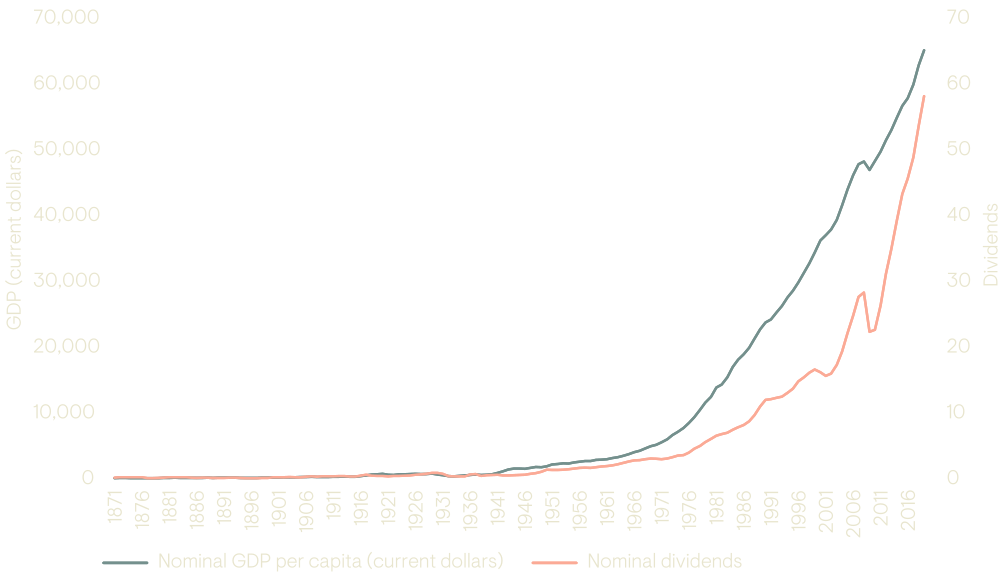
Source: Shiller, U.S. Stock Markets 1871-Present and CAPE Ratio; Williamson, “What was the US GDP Then?”, MeasuringWorth
Lastly, we factor in an adjustment for revaluation. We believe that valuation acts as a gravitational pull over long periods; however, changes in market composition and dynamic means that this is not a static metric. We use the price-dividend ratio and trend dividend yield as our valuation metric, assuming this reverts to a long-term (15-year) average. This allows us to both maintain consistency with our income-focused framework, and smooth out the cyclical nature of dividends. While we acknowledge full reversion is unlikely – prices tend to overshoot both on the upside and the downside – this simplification remains conceptually sound on average, as can be seen in the graphic below.
The actual price-dividend reverts reasonably neatly to the trend average over time
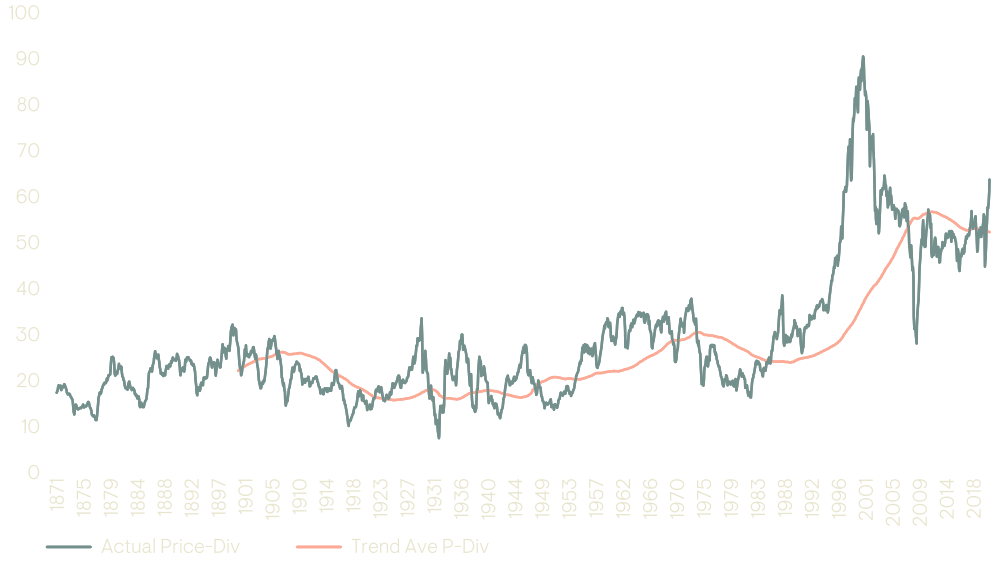
Source: Shiller, U.S. Stock Markets 1871-Present and CAPE Ratio, internal calculations
Fixed Income
Our portfolios target specific duration contributions when allocating to bonds; therefore, we feel it appropriate to use constant maturity bonds as the basic building block. We further deconstruct bonds into risk-free and spread components, enabling us to cover both sovereign and corporate debt.
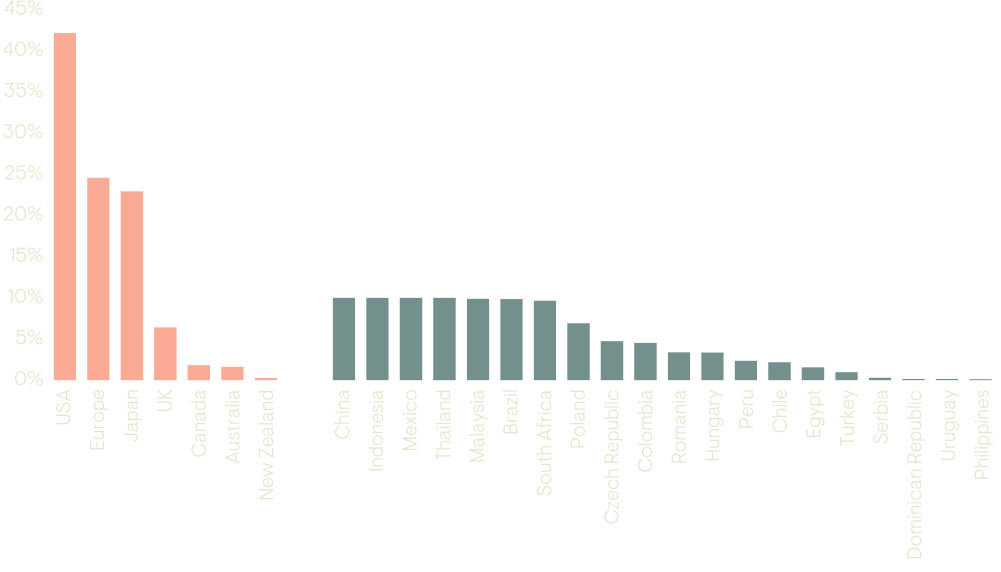
Income assumes the par yield of the bonds, typically for a notional 10-year bond. Regional indices are then generated by using the weighted average of the relevant country inclusions, as illustrated below.
Regional indices are generated using a weighted average of the relevant countries
Source: Ninety One calculations based on BAML indices
We define growth as being the roll yield obtained from consistently rebalancing the portfolio to maintain a constant maturity. So, for example, with a typical contango yield curve where the longer-term price is higher than the short-term, after one year the bond holder would sell the lower yielding, higher priced nine-year bond to buy a higher yielding, lower priced 10-year bond. Implicit in this view is a belief that the shape of the yield curve remains relatively consistent (including a constant spread component for credits).
Growth is the roll yield from consistently rebalancing the portfolio to maintain a constant maturity

Source: Ninety One. This graphic is for illustrative purposes only.
Revaluation is easier for government bonds than corporates; the former typically have liquid, traded markets enabling us to infer the forward market expectation of pricing. The implicit belief that markets converge to these expectations seems reasonable as a baseline for active management decisions. Credit spreads are, however, less broadly available; we therefore assume that the excess spread reverts to its 15-year average.
Currency
We calculate currency returns in local currency. As explained in the currency section, we then adjust on two bases:
- Hedging – Since it is common practice to hedge currency risk, and these costs are largely known at the date of investment, we use this as our base case. We assume that the position is hedged at inception for the 10-year horizon (essentially ignoring the small cash-flow differences that might occur), using covered interest rate parity. We derive the relative hedging cost from the zero-coupon bond yields corresponding to the investment horizon.
- Conversion – Many investors are willing to bear the currency risks, and therefore hold their assets unhedged. To proxy this, we use real effective exchange rates – i.e. adjusting the currency cross rates for relative inflation movements. We assume these exchange rates revert to their 15-year averages with an allowance for the difference in inflation targets, thereby allowing some currency mean reversion.
7 Based on the Morgan Stanley Global Exposure Guide 2019, Developed Markets tend to average c. 40% foreign exposure, while Emerging Markets are sub 20%.
Frequently asked questions
To foster a sense of dialogue, we include a curated list of questions we have received from various stakeholders and our responses. We will continue adding to this section over time.
Q In equities, why have you used GDP per capita and not GDP itself?
GDP per capita has historically proven to be a reasonable proxy for dividend growth.
This is in spite of the fact that the relationship between fundamental company growth, in aggregate, and country-level economic growth is weaker than might otherwise be expected due to compositional mismatches. For example, GDP includes both private and public sector outputs; however, only the former are captured in aggregate via listed equities. Similarly, economic growth tends to be locally focussed, whereas listed companies often have substantial global operations.
Q Have you considered the impact of issuance or other corporate activity on the growth of income within equities?
The impact of net issuance is important, as it reduces the participation in economic growth by owners of equities. Items such as buybacks tend to be stable – their attractiveness is based on the regulatory and taxation basis applicable at a point in time, which tend to change infrequently. Other sources may be more volatile – for example, market changes due to M&A activity, views on the appropriateness of stock-based compensation, or even secondary issuance due to market stress. We infer the net issuance impact from the change in MSCI Index Divisor over time.
Q What assumptions do you make for credit defaults?
We make allowances for credit defaults with the bond growth rate, using Moody’s long-term default histories. We use the Moody’s country rating for specific country sovereign debt, and the ratings banding for credit indices. By assuming that a “AAA” rating has similar meaning in both sovereign and corporate contexts, we can reasonably proxy a wide array of indices.
Q Given that Capital Markets Assumptions have so much associated uncertainty, what is the benefit of even attempting?
We see two key benefits:
- A clear understanding of return drivers enables sharper thinking about potential asset class outcomes, including under various scenarios.
- Insight into the likely direction and possible magnitude of returns helps our clients understand what outcomes may be reasonable
Q How effective have your Capital Market Assumptions been?
As can be seen here, the Capital Market Assumptions have shown clear differences between market troughs and market peaks.
Q Why use dividends / price-dividend rather than earnings and the more conventional price/earnings?
Dividends, being physical payments to share-holders, are less subject to manipulation that earnings (which are only book profits). We believe that results in stronger conclusions.
In addition, data sets tend to have a longer history of dividend payments, enabling us to consider the approach in a broader variety of historic contexts.
Q What key factors items are not considered in your approach?
Our Capital Market Assumptions assume that the fundamental market drivers remain unchanged. They therefore ignore exogenous shocks – e.g. climate risks and geopolitical events (although we may update our assumptions in the event of a material shock).
We currently focus on single-asset return outcomes; therefore, we make no comment about potential changes in cross-asset correlations or asset-specific volatilities.
We do not adjust for individual client circumstances either: client tax status may impact the relative attractiveness of asset classes.
Q Why do your growth assumptions look so much more pessimistic than the last twenty years of equity and / or dividend growth?
For corporate cashflows to continue growing at a significantly faster rate than the broad economy, one of three things needs to occur:
- Revenue grows faster than the broad economy – e.g. via the launch of new products which are far superior to competitors, or through the capture of new market segments (including internationalisation). The former should not make a difference at the aggregate market level (one competitors revenue growth comes at the expense of another) but the latter may occur through, for example, internationalisation. That is why we link growth to a mixture of local + global GDP
- Costs fall (or, equivalently, margins increase) – e.g. via lower tax rates, more efficient use of resources, economies of scale, or regulatory capture. We think further margin expansion is challenging as tax decreases have likely reached their nadir, while regulatory capture cannot happen indefinitely. Since we have not yet found a reasonable long-term (10-year) predictive proxy, we prefer not to forecast this element, i.e. assuming that margins remain roughly constant.
- Business reinvestment increases (when returns are higher than the cost of capital) – If businesses are prioritising their investment, marginal investments will offer a decreasing rate of return, such that ultimately returns converge to cost of capital. If not, we’d expect competitors to enter. Again, a natural limit exists. Again, in the absence of a reliable predictive proxy, we essentially assume that pay-out ratios remain constant.
In short – because we focus on variables that have both been historically predictive and have a sensible fundamental interpretation, we continue to favour GDP as a predictor (implicitly, of revenue). We continue to actively research appropriate variables for margins and pay-out ratios; however, in an environment where we think each faces headwinds, we are comfortable to continue with our simplifying assumption.
Q Why a 10-year horizon?
As long-term custodians of our client’s capital, our focus is on helping our clients achieve suitable outcomes.
In addition, we require a timeframe long enough for fundamental drivers to be expressed, in-spite of cyclical noise.
Q How often are your assumptions updated?
We intend to update the Capital Market Assumptions twice each year – after the March- and September quarter-ends.
We may also provide intra-period updates if we believe a market event is significant enough to materially change the 10-year outlook. For example, we released an internal update in late March 2020 to highlight the potential upside from equities and credit after the initial corona-induced market collapse.
Q Why nominal (and not real) returns?
Inflation is notoriously difficult to predict; so much so, that our work suggested that nominal forecasts were often more reliable than real forecasts.
Q Why two currency bases – hedged and converted?
Both are common approaches to international exposure – some prefer hedging, whereas others are prepared to bear the resultant currency risk. We therefore thought it appropriate to include both so, irrespective of preference, the assumptions would be useful.
Q How are CMAs used within the Multi-Asset process?
Capital Market Assumptions are a framework for thinking about reasonable client outcomes and providing broad market context. These figures do not directly result in individual investment decisions.
Importantly, the Capital Market Assumptions represent the view of the Multi-Asset Capability within Ninety One; other investment teams are free to disagree.
Q Are the assumptions purely systematic?
We wish the framework to be consistent over time to help sharpen thinking on asset-level drivers; therefore, where possible, we prefer to use set assumptions.
We do, however, reserve the right to override specific assumptions where there is a strong market-specific reason to do so.
Q Why do you not predict macro-economic variables within the Capital Market Assumptions?
We wish to understanding potential client outcomes over the long-term; therefore, our focus is on identifying those drivers which best explain and predict such outcomes. As can be seen in our framework, that can be done without specific macro-economic views.
Ask a question
If you have any questions about our framework that you'd like to discuss further, please complete this form and we will respond to you directly
General risks. Forecasts are inherently limited and modelling involves risks, assumptions and uncertainties, they are forward looking and are not guarantees nor a reliable indicator of future results. Actual returns could be materially higher or lower than projected. This information is not intended as a recommendation to invest in any particular asset class or strategy or as a promise of future performance. The value of investments, and any income generated from them, can fall as well as rise. Costs and charges will reduce the current and future value of investments. Where charges are taken from capital, this may constrain future growth. Past performance is not a reliable indicator of future results. If any currency differs from the investor's home currency, returns may increase or decrease as a result of currency fluctuations. Investment objectives and performance targets are subject to change and may not necessarily be achieved, losses may be made. Environmental, social or governance related risk events or factors, if they occur, could cause a negative impact on the value of investments.
Important information
Source: Ninety One proprietary capital market assumptions as at 31 March 2022.
These estimates are gross of fees (returns can be reduced by management fees and other expenses incurred) and reflect the view of Ninety One’s multi-asset team, whilst the views of other teams across Ninety One may differ. Details on our Capital Market Assumptions methodology available upon request.
Our expected returns estimates are for illustrative purposes only, are not a guarantee of performance and are subject to change. They are provided merely as a framework to assist in the implementation of an investor’s own analysis and an investor’s own view on the topic discussed herein. They should not be relied upon as recommendations to buy or sell securities. Forecasts of financial market trends that are based on current market conditions constitute our judgment and are subject to change without notice. We believe the information provided here is reliable, but do not warrant its accuracy or completeness. The outputs of the assumptions are provided for illustration/discussion purposes only and are subject to significant limitations. Expected return estimates are subject to uncertainty and error. Expected returns for each asset class are conditional on an economic scenario; actual returns in the event the scenario comes to pass could be higher or lower, as they have been in the past, so an investor should not expect to achieve returns similar to the outputs shown herein. Because of the inherent limitations of all models, potential investors should not rely exclusively on the model when making a decision. Unlike actual portfolio outcomes, the model outcomes do not reflect actual trading, liquidity constraints, fees, expenses, taxes and other factors that could impact the future returns. Note that these asset class assumptions are passive, and do not consider the impact of active management. All estimates in this document are in US dollar terms unless noted otherwise. The final total returns are converted from logarithmic to geometric estimates. This means that the components of the return breakdown may not sum to the total return. While useful for modelling and calculation purposes, the logarithmic return is theoretical (assumes continuously compounding returns) whereas the geometric estimate reflects practical experience (reflects discrete periods of compounded returns).